AI-powered dexterous robots are getting practical: better touch sensing, multimodal policies, and rigorous warehouse testing. Use this guide to evaluate what’s deployable in 2026.
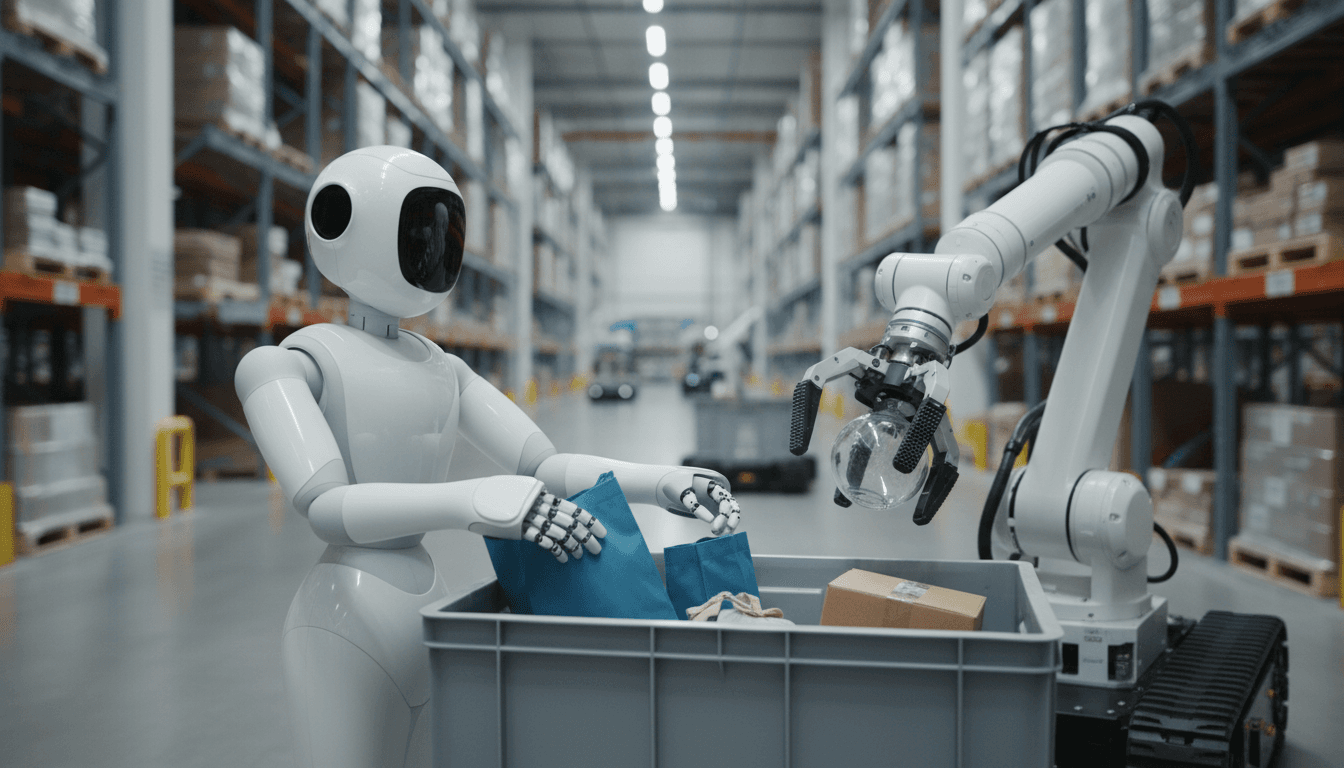
AI Dexterous Robots Are Finally Ready for Real Work
Robotics has a perception problem: a lot of people still think “real” robots are either industrial arms doing the same motion forever, or humanoids doing slow-motion demos. Meanwhile, the most commercially relevant frontier is less flashy and far more practical—AI-powered manipulation: robots that can reliably pick, place, re-grasp, and handle messy, variable objects without constant engineering babysitting.
That’s why a “Video Friday” roundup with Halloween costumes is more than a seasonal gag. Under the playful clips sits a serious theme that’s central to this AI in Robotics & Automation series: dexterous manipulation is moving from research videos to scalable automation, especially in logistics, light manufacturing, healthcare support tasks, and service environments.
If you’re evaluating robotics for operations in 2026 budgets (and you probably are), the most useful question isn’t “Can the robot do the task once?” It’s: Can the robot do it 10,000 times with real-world variability—and can we measure, improve, and maintain that performance? The developments below point to a clearer “yes” than we’ve had in years.
Dexterous manipulation is an AI problem and a hardware problem
Answer first: Robots get stuck on manipulation because intelligence without touch and compliant mechanics is brittle, and great hardware without robust policies is underused. The winners will pair both.
A lot of teams over-index on model architecture and ignore the physical side. I don’t think that’s a viable strategy anymore. If your gripper can’t sense the onset of contact, micro-slip, or object deformation, your AI policy is forced to “guess” from vision—usually too late.
Two threads from the roundup highlight why this is changing.
Tactile sensing is getting specific (and that specificity matters)
The tactile finger concept (a multimodal tactile design combining dynamic and static sensing) is a big deal for one reason: it’s built around what manipulation actually needs.
In contact-rich tasks—bag handling, blister packs, soft produce, medical supply sorting—the crucial signals show up at contact onset and during micro-slips. That’s where fast dynamic-response materials shine. Pair that with a complementary static sensing method and you get something closer to a human finger:
- Dynamic touch for fast detection (contact/breaking contact, vibrations)
- Static touch for steady-state pressure and shape cues
Here’s the practical takeaway: tactile isn’t a nice-to-have for “fancy hands.” It’s the difference between a robot that can handle fragile, deformable inventory and one that crushes, drops, or hesitates.
Open-source hands signal a coming cost reset
The open-source anthropomorphic hand featured in the roundup lands on a number that matters: sub–$2,500 materials cost and a build measured in hours, not weeks. That’s not “cheap” in consumer terms, but it’s an inflection point for R&D and pilots.
It means more teams can:
- test dexterous policies on humanlike form factors
- reproduce experiments without vendor lock-in
- iterate hardware with realistic budgets
If you’re in manufacturing or healthcare automation, this trend has a downstream benefit: more competition and more standardization. Better components and reference designs tend to reduce integration risk over time.
Touch + vision + action: why multimodal AI is the real story
Answer first: The next step isn’t “add more sensors.” It’s making AI combine sensors intelligently, so a missing or noisy modality doesn’t tank performance.
Most companies still build multimodal policies the lazy way: concatenate features from cameras, force/torque, and touch into one model and hope the network figures it out. In the lab, that can work. In a warehouse, it’s fragile.
A smarter approach highlighted in the roundup is factorizing policies by modality—for example, a vision-specialized model and a touch-specialized model—then using a learned router to blend their contributions.
Why I like this direction:
- Dominant modalities stop drowning out useful ones. Vision tends to overpower touch in training unless you’re careful, but touch often carries the decisive signal at the moment of grasp.
- You can add sensors incrementally. Start with vision. Add fingertip tactiles later without retraining everything from scratch.
- You can degrade gracefully. If a camera is occluded or a tactile taxel fails, you don’t want a full system retrain; you want the policy to adapt.
This is exactly the kind of design pattern that makes AI robotics more deployable. The goal isn’t a perfect demo—it’s a system that keeps working when conditions change.
People also ask: “Do we really need tactile for warehouse automation?”
For simple carton moves with uniform SKUs, maybe not. But once you hit:
- polybags
- mixed-SKU totes
- soft goods
- fragile items
- irregular packaging
…tactile becomes a reliability multiplier. If your ROI depends on handling variance (and it usually does), tactile is often cheaper than endlessly tuning vision pipelines and exception handling.
Warehouse automation is being judged by test discipline, not hype
Answer first: The strongest warehouse robotics teams build credibility through repeatable testing environments that mimic customer sites—and that’s where AI policies either mature or fail.
The warehouse automation segment described in the roundup emphasizes something I wish more buyers asked about: validation methodology.
If you’re bringing robots into logistics operations, the integration risks aren’t abstract. They’re painfully specific:
- conveyor speeds vary
- lighting changes across shifts
- labels are scuffed
- pallets arrive damaged
- operators intervene in unpredictable ways
A robust vendor will show you how they test:
- dock layouts and inbound flow replicas
- edge-case inventory types
- stress tests over long duty cycles
- failure recovery behaviors (not just success rates)
Here’s a stance I’ll stand by: a vendor’s test facility and test data are part of the product. If they can’t talk clearly about failure modes, mean time between intervention, and what they do when a grasp fails, you’re not buying automation—you’re buying a science project.
Practical checklist: what to ask before you pilot
Use these questions to separate “cool videos” from deployable robotics:
- What’s the intervention rate at steady-state? (Not during early tuning.)
- How does the system detect and recover from failure? Re-grasp, re-plan, ask for help?
- What sensors are required for your SKUs? Vision-only vs vision+touch changes both cost and performance.
- How do you update policies? Over-the-air updates, site-by-site tuning, or global improvements?
- What’s the data strategy? Do you log grasps, slips, near misses, and outcomes for continuous improvement?
If the answers are vague, expect your operations team to pay the price later.
Home data collection signals a new (messy) training economy
Answer first: Paying for in-home data collection hints at where general-purpose robotics is headed—more diverse training data, but also thornier privacy, QA, and deployment questions.
One item in the roundup mentions a program where users can pay to collect robot data in their homes. It’s a reminder that the industry is trying to solve a hard constraint: robots learn faster when they see more real environments.
Warehouses are diverse, but homes are chaos. If models can generalize across home clutter, they tend to generalize better across long-tail industrial variability too.
But this also introduces a reality check for business buyers:
- Data needs labeling, filtering, and governance.
- Domain shift is real: home objects don’t map cleanly to industrial SKUs.
- Safety and privacy constraints increase the cost of usable datasets.
The upside is still meaningful: more large-scale behavior data is a prerequisite for more capable general-purpose manipulation. Just don’t confuse “we collected a lot of video” with “we can pick your products reliably.”
Human-robot collaboration is becoming a product feature
Answer first: Empathy and social cues aren’t fluff; they reduce friction and improve throughput when robots share space with people.
A research highlight in the roundup focuses on robots using nonverbal cues—like nodding—and empathetic responses to build trust and rapport. That might sound like a soft science tangent, but it connects directly to deployment reality.
In hospitals, schools, and even warehouses, robots don’t work alone. They work around people who:
- need to understand what the robot is doing
- want predictable behavior
- will intervene when something looks wrong
I’ve seen human-robot collaboration fail for surprisingly basic reasons: operators don’t trust the robot’s movement, the robot doesn’t signal intent, or the UI feels like a PhD project. Social signaling helps because it makes the robot’s internal state legible.
If you’re deploying service robots or collaborative mobile manipulators, consider adding requirements that sound “non-technical” but pay off operationally:
- intent signaling (lights, motion cues, posture)
- turn-taking behaviors
- simple apology/acknowledgement patterns after failures
These aren’t gimmicks. They’re workflow glue.
What to watch as we head into ICRA 2026
Answer first: The next 12–18 months will reward teams that combine (1) multimodal policies, (2) dexterous hardware, and (3) measurable reliability.
The roundup nods to major conference content and upcoming events (including ICRA 2026 in Vienna). Conference keynotes and seminars often sound abstract, but the signal to look for is practical:
- Are results shown across many objects, not a curated few?
- Is performance reported over long horizons (hours/days), not just short clips?
- Do they quantify failure recovery, not only success?
- Do they demonstrate incremental integration of new modalities (add touch later, add wrist F/T later)?
If you’re buying robotics for logistics, manufacturing, or healthcare operations, those questions are the bridge between research progress and purchase confidence.
Snippet-worthy truth: A manipulation policy isn’t “smart” if it can’t explain its failures—and recover without a human rescuing it.
Where this leaves automation leaders in 2026 planning
AI robotics is entering a more accountable phase. Dexterous manipulation is no longer just “can we pick up a weird object?” It’s becoming: can we run a stable process around grasping variance? That shift favors organizations that treat robotics like a system—hardware, AI models, sensing, testing, and operations working together.
If you’re scoping pilots for warehouse automation or collaborative robots, start with tasks where touch and dexterity change the economics: mixed-item picking, bag handling, kitting with irregular components, or healthcare supply handling where damage and contamination matter.
If you want a practical next step, I’d do this: write down your top 20 “annoying” exceptions—the items and situations humans handle without thinking—and use that as your evaluation dataset. The vendors that can talk clearly about those edge cases (and show how they test them) are the ones worth your time.
What’s the next task in your operation that’s still “too variable to automate”? That’s usually the best place to start looking at AI-powered dexterous robots—because that’s where the technology is finally catching up.