Personalized corporate gifts scale only when CNC precision meets AI-driven intake, proofing, and QC. Learn the workflow that delivers premium results on time.
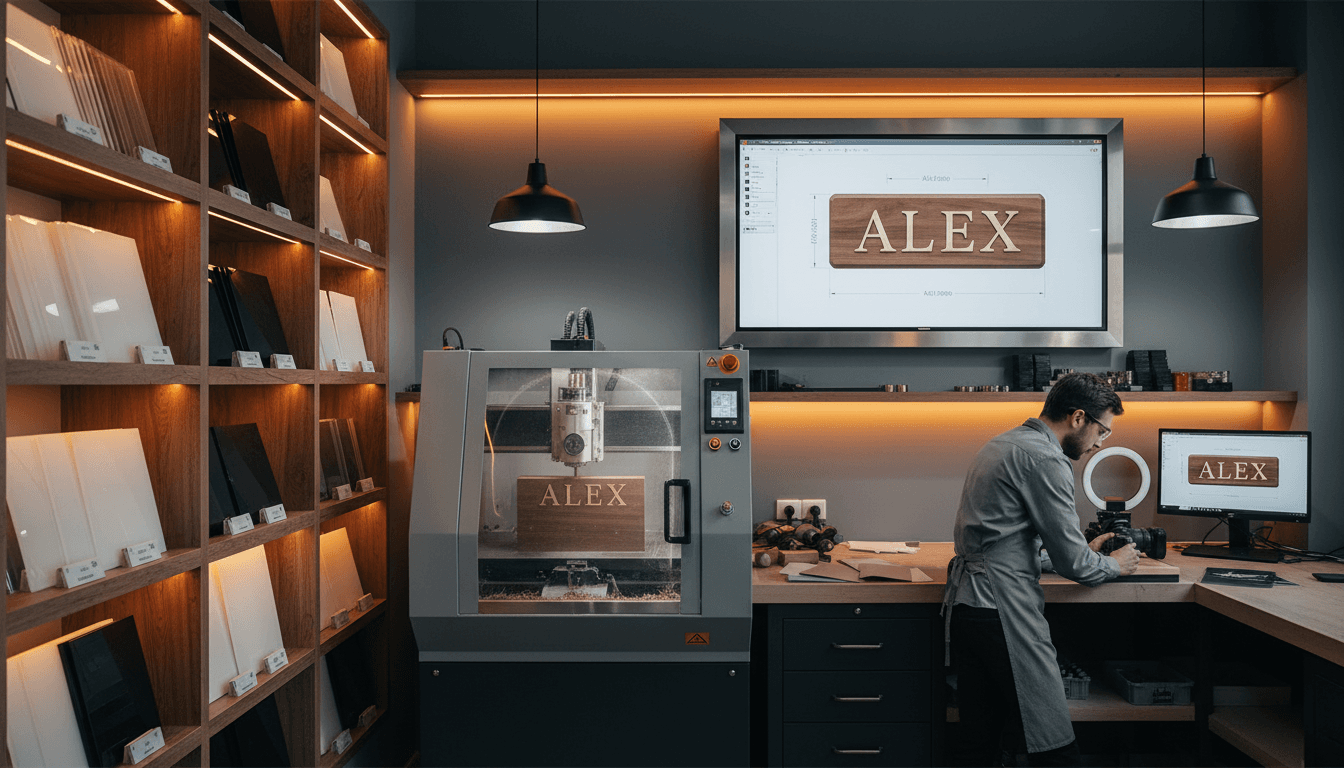
AI-Powered Personalized Gifting at Scale With CNC
A week before the holidays, corporate gifting teams all run into the same wall: everyone wants “personalized,” but nobody wants the chaos. Names need to be right. Logos need to be crisp. Deadlines don’t move. And the moment you go from 25 gifts to 2,500, the manual approach collapses.
That’s why I like using custom gifting brands such as Amphasis Design as a practical case study for our “AI in Robotics & Automation” series. Not because the products are flashy—but because the workflow is a real-world example of what modern automation is good at: high-mix, low-volume production with consistent quality. CNC engraving is the visible part. The real story is what happens upstream: design intake, proofing, file generation, scheduling, and quality control. That’s where AI starts paying for itself.
This post breaks down what “personalization at scale” actually requires, how CNC-based customization works in practice, and where AI-driven systems can remove friction—without turning gifts into soulless commodities.
Personalized gifting is a manufacturing problem (not a shopping problem)
Personalized corporate gifts fail for operational reasons, not creative ones. Teams usually have great ideas. What they don’t have is a production system that can handle variation.
The minute you add names, departments, award titles, or individual messages, you’ve introduced:
- More SKUs (sometimes effectively infinite)
- More approvals (proofs, brand checks, spelling)
- More opportunity for defects (misalignment, wrong material, wrong recipient)
- More schedule risk (rework, re-engraves, late shipping)
That’s why the “generic swag bag” still exists. It’s not beloved—it’s controllable.
Here’s the thing: CNC personalization changes the controllability equation. It turns customization into a repeatable process: consistent toolpaths, predictable material handling, and reliable output—especially when paired with good automation practices.
Why CNC works so well for premium personalization
CNC (computer numerical control) is basically a promise: if the input is right, the output will be consistent. For gift products—nameplates, engraved desk accessories, awards, acrylic plaques—that consistency is the difference between “premium” and “cheap.”
A CNC-based approach supports:
- Accuracy: tight positioning and clean edges
- Repeatability: the 400th piece looks like the 1st
- Material flexibility: wood, acrylic, metal, glass (depending on tooling)
- Detail: fine lines, intricate logos, crisp type when designed correctly
Amphasis Design’s positioning around craftsmanship plus CNC precision is smart because it matches what buyers want in December: meaningful gifts that still arrive on time.
Where AI fits: scaling customization without scaling headcount
AI’s biggest contribution to personalized gifting is reducing the “human glue work.” The engraving itself can already be automated. The bottleneck is everything around it: interpreting customer inputs, creating proofs, generating production-ready files, and catching mistakes early.
If you’re running (or buying from) a personalized gifting operation, AI can help in four specific parts of the pipeline.
1) AI-assisted personalization intake (stop retyping everything)
Most companies still collect personalization data through messy spreadsheets and email threads. That’s how you end up engraving “Jonh” instead of “John.”
A better approach is structured intake plus AI validation:
- Convert uploaded lists into clean, standardized fields (name casing, titles, departments)
- Flag likely issues (duplicate recipients, missing characters, suspicious abbreviations)
- Enforce brand rules (logo minimum size, allowed taglines, approved fonts)
This is unglamorous, but it’s where error rates drop fast.
2) Automated proof generation and approvals
Proofs are where time disappears. A human designer tweaks layouts, exports PDFs, waits for feedback, repeats.
AI doesn’t need to “design like an artist” to be useful here. It needs to:
- Auto-place names and logos into pre-approved templates
- Produce proof images with consistent margins and alignment
- Track approvals and version history
In practice, this turns personalization into a configure-to-order workflow. Customers still get choices. Production still gets standards.
3) CAM prep: from approved design to machine-ready output
The handoff from design to CNC is where many shops build tribal knowledge. The fastest operator becomes the bottleneck.
With the right system, you can standardize:
- Toolpath parameters by material (feed rate, depth per pass)
- Engraving strategies for small text vs. large fills
- Fixturing assumptions (where “zero” is, how parts are clamped)
AI can help by recommending settings based on prior successful jobs and by detecting risky geometry (e.g., thin strokes that won’t engrave cleanly at a given bit size).
Personalization at scale is less about “more machines” and more about “fewer exceptions.”
4) Quality control: catching problems before they ship
The most expensive gift is the one you have to redo the night before delivery.
Computer vision (often powered by machine learning) can perform basic but valuable checks:
- Is the engraving centered?
- Is the correct name engraved?
- Is the logo present and oriented properly?
- Are there visible surface defects (burn marks, scratches, incomplete passes)?
Even a simple camera station with good lighting can reduce rework. Add AI-based comparison to the approved proof, and QC becomes consistent—not dependent on who’s on shift.
A practical workflow for “personalization at scale” (corporate edition)
If you’re buying personalized corporate gifts, you don’t need to know G-code. You do need to know whether your vendor has a process that won’t break under volume.
Here’s a workflow I’d look for (or build) when ordering 100–10,000 custom items:
- Standard product selection (limit the number of base products)
- Template-based personalization options (message length limits, approved fonts)
- Data upload + validation (structured fields; automated checks)
- Auto-generated proofs (batch proofs, not one-off screenshots)
- Approval lock (no “quick tweaks” after production starts)
- Batch scheduling (group by material, tooling, and engraving type)
- In-process QC (spot checks + camera verification)
- Packaging logic (recipient matching, barcodes, packing slips)
When CNC is paired with clean intake and automated proofing, a vendor can deliver what corporate teams actually want: premium output with predictable lead times.
What to ask a vendor before you place a big order
These questions sound simple, but they reveal whether a shop is running a scalable system or improvising.
- How do you prevent name/list errors before engraving starts?
- Do you provide batch proofs and track approvals per line item?
- What’s your rework rate during peak season?
- Can you serialize items (unique IDs) to match gifts to recipients?
- How do you handle last-minute changes—without derailing the schedule?
If the answers are vague, you’re buying risk.
Where automation expands beyond engraving: the “full gift pipeline”
The next wave of automation in gifting is end-to-end, not tool-by-tool. Engraving is only one station in a bigger system.
Here are three areas where robotics and automation commonly show up as volume grows:
Packaging and kitting
Kitting (putting the right item in the right box with the right insert card) becomes brutal at scale. Automation options include:
- Barcode scanning to confirm recipient-item matching
- Pick-to-light systems for kit assembly
- Automated label printing triggered by job status
The value isn’t speed alone. It’s traceability—knowing exactly what shipped to whom.
Inventory and material handling
High-mix production creates material sprawl: different blanks, finishes, hardware, and packaging.
Even basic automation—like bin locations, reorder triggers, and job travelers—reduces downtime. With AI forecasting, you can anticipate:
- Which materials will spike (acrylic plaques vs. wood awards)
- Which tool bits wear fastest during peak runs
- Which SKUs are likely to cause bottlenecks
Customer service automation (the underrated win)
Personalization generates questions: “Can we add a second line?” “Will the logo engrave well?” “Can we split shipping?”
AI-assisted support can handle repetitive intake, extract requirements, and route edge cases to humans. The result: faster turnaround without hiring a seasonal army.
The creative industry lesson: automation doesn’t erase craftsmanship
A lot of people still treat automation as the opposite of creativity. I don’t buy that.
In personalized gifting, automation protects the creative work by removing the parts that don’t deserve human attention:
- Copy/paste personalization data
- Formatting the 300th proof
- Fixing avoidable typos
- Re-running jobs that failed due to preventable setup errors
That frees people to focus on what customers actually notice: material choice, proportions, finish quality, and tasteful personalization.
Amphasis Design’s emphasis on premium finishing and professional customization fits this model well. CNC provides the precision baseline. Process discipline provides the reliability. AI and automation make it scalable.
Next steps: how to apply this if you’re buying—or building—custom gifts
If you’re leading corporate gifting, procurement, or ops, start with a simple stance: personalized gifting is a production system, and systems can be improved.
- If you’re a buyer: choose fewer base products, enforce structured personalization inputs, and demand batch proofing.
- If you’re a vendor: invest in intake automation, template libraries, and basic vision-based QC before you buy another machine.
- If you’re exploring AI in robotics & automation: gifting is a surprisingly good sandbox—high variability, strict quality expectations, and real deadlines.
The next holiday season will be even more personalized than this one. The companies that win won’t be the ones with the loudest branding. They’ll be the ones that can produce meaningful one-to-one experiences with industrial reliability.
What part of your personalization workflow still depends on a hero staying late—and what would it take to turn that step into a repeatable system?