Disney’s robotic Olaf shows how AI animatronics teach reliability and interaction—lessons that transfer to service robots in logistics and healthcare.
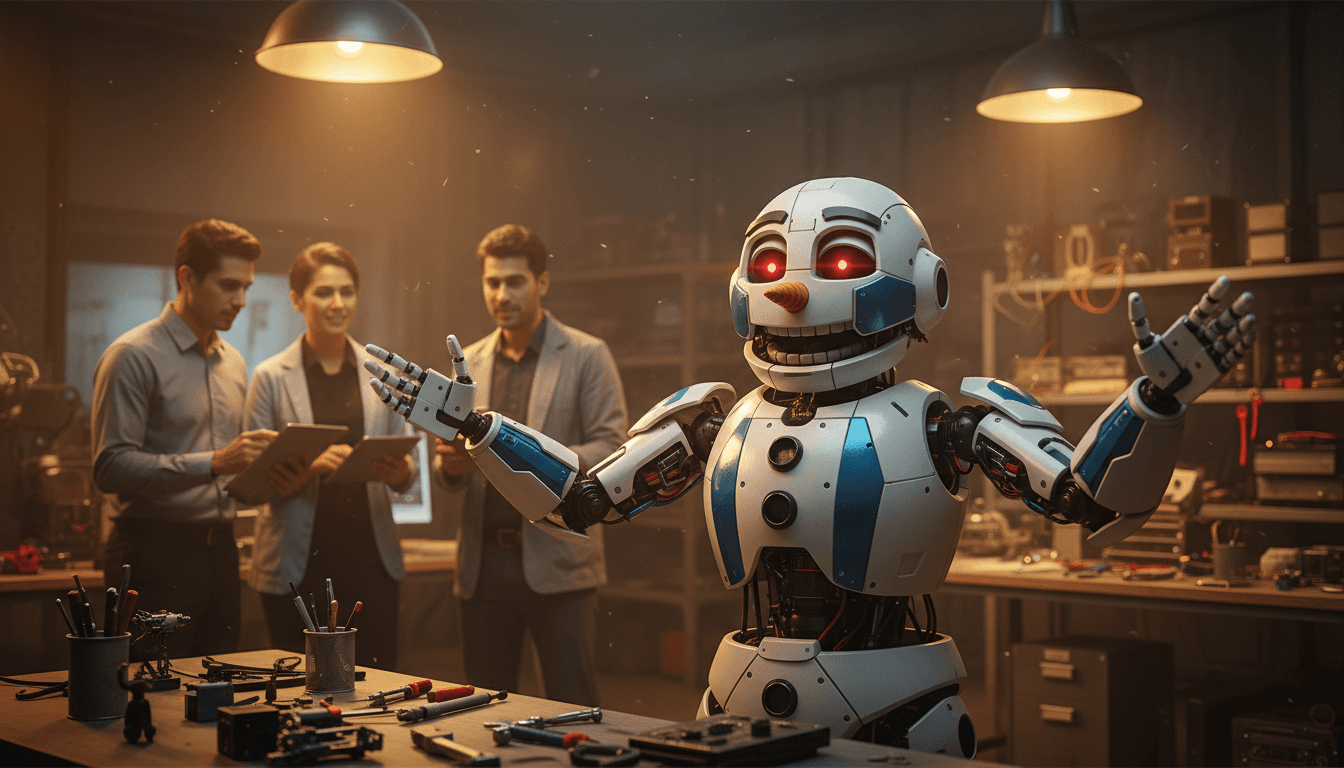
AI Animatronics: What Disney’s Robot Olaf Teaches
A self-walking Olaf isn’t “just” a theme-park novelty. It’s a public demo of a robotics stack that many companies still can’t ship: reliable bipedal motion, expressive character behavior, and repeatable performance day after day in a chaotic environment filled with people.
That’s why Disney’s robotic Olaf debut matters to anyone building robots for hospitals, hotels, warehouses, airports, or retail. Entertainment is a brutal proving ground. Guests don’t care about your robotics roadmap—they notice if a character stutters, freezes, or feels creepy. The same is true when a service robot hesitates in a hallway or a logistics robot drops a tote.
This post is part of our AI in Robotics & Automation series, and I want to make a clear claim: animatronics are one of the most practical windows into the next wave of service robots—because they force teams to solve interaction, safety, and reliability at once.
Disney’s robotic Olaf is an interaction-first robot
Key point: Olaf isn’t optimized for payload or speed; he’s optimized for trust—the human sense that the robot is present, safe, and “alive” enough to engage.
That focus is easy to dismiss until you look at where the market is heading in late 2025: companies want robots that can operate around non-experts (patients, shoppers, visitors, shift workers) without constant supervision. As soon as robots leave fenced areas, “interaction quality” becomes a top-tier requirement.
Disney Imagineering’s approach—combining robotics hardware, AI-driven behaviors, and immersive staging—shows what interaction-first design looks like:
- Motion that reads as intentional (not merely stable)
- Timing tuned to people (pauses, glances, micro-gestures)
- Consistency under repetition (the thousandth performance still feels smooth)
In warehouses you’d call this “operational reliability.” In parks it’s called “magic.” Same engineering constraint.
What makes a character robot feel lifelike (without being creepy)
Answer first: It’s not hyper-realistic faces. It’s coherent behavior—body language, gaze direction, and response timing that match the context.
A few practical design truths I’ve found hold across entertainment and service robotics:
- Predictability beats surprise. People forgive simple behavior if it’s consistent.
- Small motions carry most of the emotion. A subtle head tilt or shoulder drop does more than a complex hand routine.
- Latency is a deal-breaker. If a robot “reacts” too late, it reads as broken or fake.
For teams building customer-facing robots, Olaf is a reminder: you don’t start with “What’s the most advanced model we can run?” You start with “What behavior earns trust in 2 seconds?”
The hidden AI behind expressive robotics
Key point: Expressive robots need AI, but not always in the way people assume. The flashy part is generative AI; the workhorse is perception, control, and behavior orchestration.
The RSS roundup that featured Olaf also pointed to a broader reality in 2025 robotics: progress is coming from systems—integrated perception, manipulation, locomotion, and coordination—more than from any single neural network.
Here are the AI layers that typically matter most in expressive robots:
1) Behavior orchestration (the “director”)
Answer first: The robot needs a policy for what to do next that is robust to messy real-world timing.
In a park, behavior orchestration includes:
- Detecting guest proximity and attention
- Selecting a safe and story-consistent action
- Handling interruptions (strollers, sudden crowding)
- Failing gracefully (stop, reset, pose) when something drifts
In a hospital, it’s similar—just with different constraints:
- Detect staff vs. patient vs. visitor
- Yield in hallways and doorways
- Decide when to ask for help
- Pause safely when uncertainty spikes
2) Perception tuned for interaction, not benchmarks
Answer first: You don’t need perfect scene understanding; you need reliable signals that drive safe choices.
Many teams over-invest in perception complexity and under-invest in calibration to the environment. Parks have variable lighting, reflective surfaces, and constant occlusions. So do hospitals.
In practice, interaction perception often prioritizes:
- Person detection and distance
- Motion prediction (who’s walking into the robot’s path)
- Basic pose/gaze cues
- “Do we have enough confidence to proceed?” gating
3) Motion control that preserves character
Answer first: The control system must keep the robot stable and keep the motion style consistent.
This is where entertainment pushes robotics beyond “don’t fall.” A character robot can’t recover from a slip with a jarring, industrial-looking stance and still feel believable.
That requirement translates directly to service robots: a delivery robot that jerks aggressively near people will get complaints even if it’s technically safe.
From Olaf to warehouses: why logistics demos matter
Key point: If Olaf represents interaction-first robotics, logistics demos represent throughput-first robotics—and the future belongs to teams that can do both.
The same IEEE Spectrum video roundup that highlighted Olaf also included a telling logistics demonstration: multiple humanoid robots completing a real warehouse task over an uninterrupted run, moving dozens of boxes to racks of different heights. Whether you build humanoids or specialized automation, the message is consistent:
- Reliability over long runs is the KPI that separates demos from deployments.
- Coordination is becoming a product feature, not a research topic.
What “real-world autonomy” actually means in 2025
Answer first: It means the robot completes a task for long enough that humans stop babysitting.
In lead-gen conversations, I hear “We want autonomy” when the real need is:
- Fewer manual resets
- Fewer edge-case stalls
- Predictable recovery behavior
- A monitoring layer that tells operators what matters
If your robot can run for 18 minutes uninterrupted doing useful work, that’s not marketing fluff. It’s a signal that your sensing, control, and task planning are stabilizing.
Tactile sensing and contact intelligence: the next moat
Key point: Vision-only robotics is hitting a ceiling in the messy parts of the physical world. Tactile sensing is becoming a competitive advantage.
One of the most practical research highlights in the roundup was a tactile system enabling a quadruped robot to carry unsecured cylindrical objects on its back by sensing object shift and adjusting posture in real time.
That’s not a quirky trick. It’s a preview of where AI in robotics and automation is going next:
- Robots that use contact as data
- Control policies that treat touch as a first-class signal
- Better performance in cluttered, slippery, deformable environments
Why this matters outside research labs
Answer first: Contact intelligence reduces your dependency on perfect grasps, perfect fixtures, and perfect environments.
If you’re automating material handling, construction-site inspection, or hospital supply delivery, you’re constantly dealing with:
- Unknown object placement
- Deformable packaging
- Shifting loads
- Misaligned insertion tasks (connectors, ports, trays)
Touch feedback helps robots “feel their way through” uncertainty rather than stopping the line.
Human-robot teaming isn’t optional in healthcare and field work
Key point: The most deployable robots in the next 24 months will be the ones designed to work with humans, not replace them.
The roundup’s coverage of a triage-focused robotics challenge highlighted something that gets lost in humanoid hype: when stakes are high (medical care, emergency response, field operations), you want human-in-the-loop robotics.
That doesn’t mean remote teleoperation forever. It means designing a clean handoff between:
- Autonomy (robot handles routine navigation and manipulation)
- Supervision (human confirms uncertain steps)
- Intervention (human takes over briefly in edge cases)
In practice, the best systems treat humans as the exception handler—not the continuous controller.
A practical checklist for teams building interactive robots
If you’re building service robots, expressive robots, or field automation, I’d pressure-test your roadmap with these questions:
- What happens when confidence drops? (Stop? Ask? Back up? Retry?)
- Can the robot explain itself in one sentence? (On-screen, voice, or UI)
- Do you have a “safe idle” behavior that still looks intentional?
- What’s your recovery time after a minor slip or sensor glitch—5 seconds or 5 minutes?
- Can a non-expert operator resolve 80% of issues without engineering support?
The companies that answer these well are the ones that ship.
What to do next if you’re evaluating AI robots for your business
Key point: Buying or piloting robots in 2026 should be less about novelty and more about measurable operational stability.
Here’s a grounded way to evaluate vendors—whether they’re selling humanoid robots, inspection quadrupeds, or interactive service platforms:
- Ask for uninterrupted run footage (10–20 minutes minimum) of the task you care about.
- Demand a failure taxonomy: top 10 failure modes and how the system responds.
- Measure time-to-recovery in pilots, not just success rate.
- Evaluate interaction quality with real users early (frontline staff, not just managers).
- Check maintainability: battery workflow, part replacement, calibration routines.
If you’re serious about leads and deployments, this is where the real differentiation shows up.
Snippet-worthy stance: A robot that’s 10% less capable but 10x easier to recover and maintain will win most real deployments.
Where expressive AI robotics goes next
Disney’s robotic Olaf is a friendly face on a serious engineering trend: robots are moving from “doing tasks” to “operating with people.” That shift is happening across entertainment, logistics, construction, and healthcare at the same time.
The next wave of progress won’t come from chasing one perfect humanoid form factor. It will come from teams that combine:
- Interaction-grade perception
- Robust autonomy with graceful fallback
- Contact intelligence (tactile + force control)
- Operations tooling (monitoring, triage, updates)
If you’re planning your 2026 automation roadmap, decide where you sit on this spectrum: are you building robots that merely function, or robots that people trust? That answer will shape your adoption curve more than any spec sheet.