Adaptable home robots succeed or fail on real-world messiness. Here’s what AI-driven generalization means in 2025—and how to evaluate it.
Adaptable Home Robots: What Actually Works in 2025
Most home robots fail for a boring reason: your house isn’t a factory.
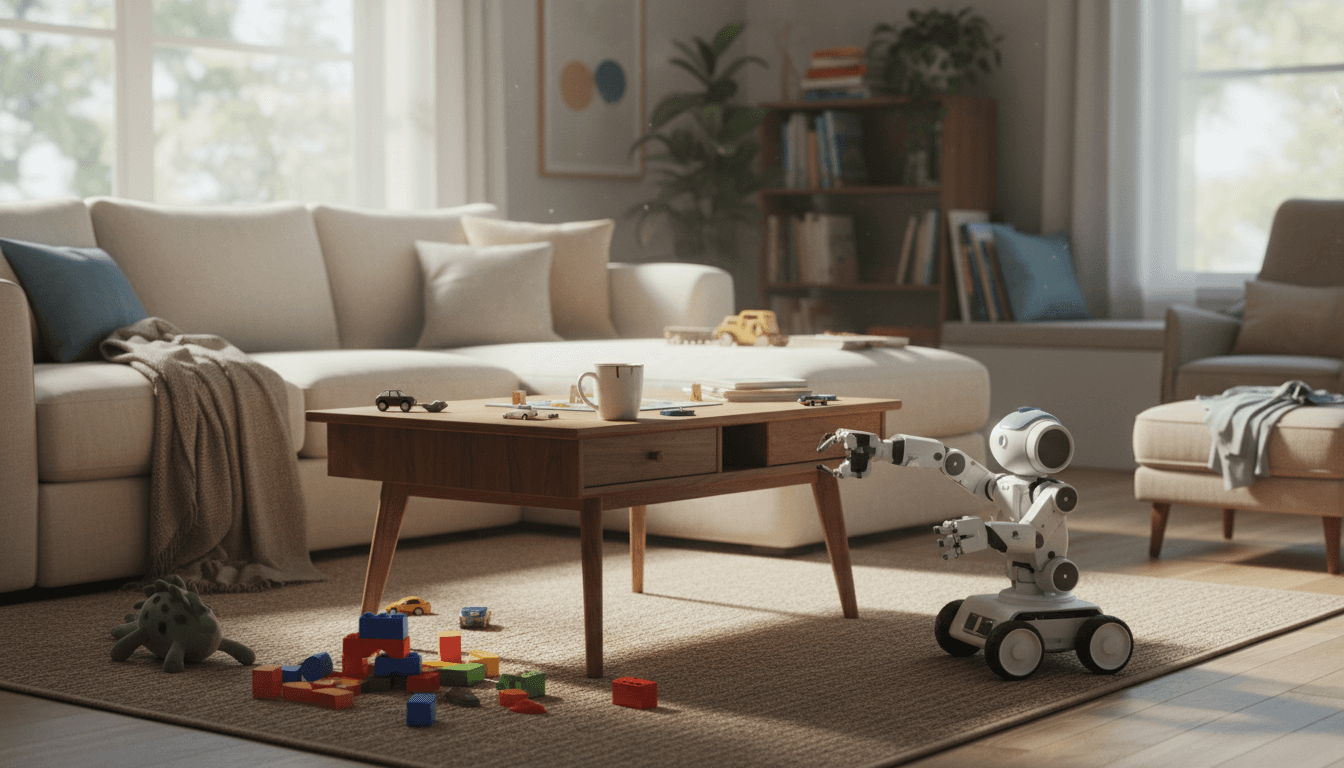
A kitchen counter gets rearranged mid-week. A chair is pulled out and left at an angle. Kids leave toys where a robot expected clear floor. Pets add a whole new set of moving hazards. The promise of domestic robotics has never been “a robot that can do one task in one lab setup.” It’s been a robot that can keep working when the world changes.
That’s why the conversation in Robot Talk Episode 121 with NYU professor Lerrel Pinto lands so well. Pinto’s research focus—robots that generalize and adapt in messy real-world settings—is basically the central technical hurdle for home robots, and it’s also the thread that connects domestic robotics to the bigger story in our AI in Robotics & Automation series: AI only matters in robotics when it survives reality.
Adaptability is the real product requirement for home robots
Adaptability isn’t a feature; it’s the minimum bar for usefulness at home. If a robot can’t handle novelty—different lighting, clutter, new objects, slightly shifted furniture—it becomes a demo, not a device.
In industrial automation, engineers win by reducing variability: identical parts, controlled lighting, fixed fixturing, repeatable cycles. Homes are the opposite: high variability, low tolerance for failures, and constant edge cases. A robot that “works 95% of the time” might still feel unusable if the missing 5% happens when there’s hot liquid, glass, or a frustrated caregiver.
Pinto’s work sits in that uncomfortable gap: how do we build robots that learn robust behaviors instead of memorizing setups? In practice, that means combining:
- Large-scale learning (more diverse data, larger models)
- Representation learning (better internal understanding of sensory input)
- Reinforcement learning (RL) and decision-making that can adjust when conditions change
- Affordable, open hardware so more researchers can iterate in the real world, not just simulations
If you’re building service automation—whether in homes, hospitals, or hospitality—this is the same underlying requirement: a robot must adapt without constant reprogramming.
Why “smart home” isn’t the same as “robot-ready home”
A lot of people assume a smart home (sensors, voice assistants, connected appliances) automatically makes robotics easier. Sometimes it helps, but it’s not a shortcut.
A mobile manipulator still has to:
- Localize itself reliably in changing spaces
- Recognize objects under variable lighting and occlusion
- Grasp items that weren’t placed in ideal orientations
- Recover gracefully when the plan fails
The difference between a scripted robot and an adaptable one shows up most clearly in recovery behavior: can it re-try with a new grasp? Can it walk around a new obstacle? Can it ask for help in a way that’s safe and specific?
What AI changes: from scripted behaviors to learned skills
AI-driven adaptability comes from learned skills that transfer across situations. That’s the headline. The details are where most teams get stuck.
Traditional robotics stacks often rely on carefully tuned perception + planning + control pipelines. They can work well, but they’re brittle when the world changes. Modern robot learning aims to build policies that handle variation because they’ve seen variation—either in data, simulation, or both.
Pinto’s lab emphasis on large-scale learning and models is aligned with what we’re seeing across embodied AI: bigger, more general models can reduce the amount of per-home customization needed.
The three layers of adaptability (and where teams should invest)
If you’re evaluating AI for home robots, I’ve found it helps to separate adaptability into three layers:
-
Perception robustness
- Can the robot identify objects across lighting, clutter, and partial views?
- Does it remain stable when the camera lens gets smudged or the sun hits the sensor?
-
Action generalization
- Can it grasp “a mug,” or does it only grasp that mug in that pose?
- Can it open different drawers, not just the one from training?
-
Online adaptation
- When it fails, does it learn from the attempt (even slightly)?
- Can it adjust force, angle, speed, or strategy without a human re-tuning the parameters?
Home robotics needs all three. Most products today only truly nail the first layer (and even that’s hard). The next wave will be decided by how well teams solve action generalization and safe online adaptation.
The messy-world problem: data, cost, and safety
The biggest constraint in domestic robotics isn’t model architecture; it’s getting the right experience into the system safely.
In homes, you can’t collect failures at scale the way you can with web apps. A “small” mistake can mean broken glass, damaged property, or someone getting hurt. That’s why Pinto’s interest in representation learning, behavior modeling, and reinforcement learning for adapting to new scenarios matters: the goal is to reduce how many real-world trials you need to get robust behavior.
Data scaling: why “more” only helps if it’s more diverse
Robots don’t benefit from data volume the same way language models do unless the dataset is diverse in the right dimensions:
- Object shapes, weights, and materials (plastic vs. ceramic vs. cloth)
- Lighting conditions (daylight glare, warm indoor lights, shadows)
- Background clutter and occlusions
- Human interference (someone grabs the object mid-action)
- Novelty (objects never seen before)
Teams building AI-powered home automation often underestimate this. You can collect 10,000 grasps and still learn a fragile policy if they’re all on the same tabletop with the same camera angle.
Safety: the non-negotiable bottleneck
Adaptable robots in the home must be safe by design, not by warnings in the manual.
Practical safety measures that actually reduce risk:
- Force/torque limits and compliant control for close human interaction
- Conservative action filtering (don’t execute high-risk motions when uncertain)
- Anomaly detection (recognize when the world doesn’t match expectations)
- Clear escalation paths (pause and request help instead of “pushing through”)
This is where service robotics overlaps directly with healthcare robotics and assistive robotics—and why the domestic setting is a proving ground for service automation more broadly.
What “affordable, open-source robots” changes in 2026 planning
Open and affordable platforms are how robot learning stops being a lab luxury.
Pinto’s mention of building open-source, affordable robots may sound like a side note, but it’s a strategic lever: cheaper platforms allow more iterative testing, more diverse contributors, and faster debugging. In the long run, that accelerates the entire ecosystem—including commercial vendors—because tools, datasets, and benchmarks improve.
For leaders planning 2026 roadmaps (and budgets), this has a practical implication:
- If your organization wants to prototype adaptable behaviors quickly, you’ll get farther by standardizing on a platform your team can replicate than by buying one expensive “hero robot” that nobody wants to experiment on.
A smaller fleet of consistent robots also makes it easier to build:
- Comparable metrics across trials
- Reproducible training data
- Reliable regression tests (“did last week’s model break drawer opening?”)
How home-robot adaptability maps to service automation (logistics + healthcare)
Domestic robotics is a stress test for service automation because the environment is unstructured and unpredictable. The same AI capabilities that make a home robot more useful translate cleanly to logistics and healthcare.
Logistics: handling variance without reprogramming
In warehouses and micro-fulfillment, the big operational cost is exception handling—items in weird poses, packaging differences, mixed SKUs, damaged labels.
Adaptable robot learning can reduce:
- Manual re-teaching when inventory changes
- Downtime when layouts shift
- The need for precise fixturing for every task
Healthcare and eldercare: safe interaction and graceful failure
Hospitals and care facilities look “structured” until you watch a real shift: rooms change, equipment moves, people improvise. For assistive tasks—fetching items, helping with routine setup—adaptability matters, but safe behavior matters more.
A useful stance here: don’t aim first for fully autonomous care. Aim for robot assistance that reliably reduces workload:
- Fetch and carry tasks
- Restocking common supplies
- Simple, supervised manipulations
Success is measured in minutes saved per shift and reduced cognitive load, not flashy autonomy.
Practical checklist: what to ask before investing in adaptable home robots
If you’re evaluating vendors or planning an internal prototype, ask questions that reveal whether adaptability is real or staged. Here’s a field-tested checklist.
1) Generalization proof
- “Show the robot doing the same task in three different homes or rooms.”
- “Show it with 10 different object instances (not just one prop).”
2) Failure behavior
- “When it fails to grasp, what does it do next—retry, replan, or freeze?”
- “How does it detect it’s stuck or uncertain?”
3) Data and updates
- “What data does the robot learn from, and how is it governed?”
- “Can we deploy model updates safely with rollback?”
4) Safety and compliance posture
- “What physical limits are enforced in software and hardware?”
- “How is human proximity handled (speed limits, stop zones, contact detection)?”
5) Total cost of ownership
- “How many hours per week of human babysitting should we expect?”
- “What’s the on-site maintenance model?”
If a vendor can’t answer these cleanly, you’re not looking at adaptability—you’re looking at a polished demo.
Where adaptable home robots are headed next
The near-term future is “helpful autonomy,” not humanoids doing everything. The robots that win in homes will likely specialize in a narrow set of high-frequency chores, but they’ll perform them across diverse conditions with minimal setup.
Expect progress to come from a few converging trends:
- Better sensorimotor foundation models that learn reusable skills
- More realistic training via simulation + targeted real-world data
- Stronger recovery policies (the unglamorous secret to reliability)
- Ecosystems built around affordable platforms that many teams can improve
And because it’s December 2025, there’s a timely pressure point: post-holiday chaos. Homes are at peak variability—new devices, boxes, rearranged rooms, visiting relatives. It’s the perfect reminder that the “real world” is not a corner case. It’s the default.
Adaptable robots for the home aren’t just a consumer product milestone. They’re a benchmark for the entire AI in Robotics & Automation stack—perception, learning, safety, and operations—working together under constant change.
If you’re exploring AI-powered robots for domestic settings, logistics, or healthcare, the most useful next step is simple: pick one messy, high-variance task and measure how quickly the system can recover when the world doesn’t cooperate. What task would you choose first—laundry handling, kitchen pickup, or supply restocking?