AI contract review speeds legal workflows, improves consistency, and reduces escalations. Here’s how U.S. teams deploy it with strong compliance guardrails.
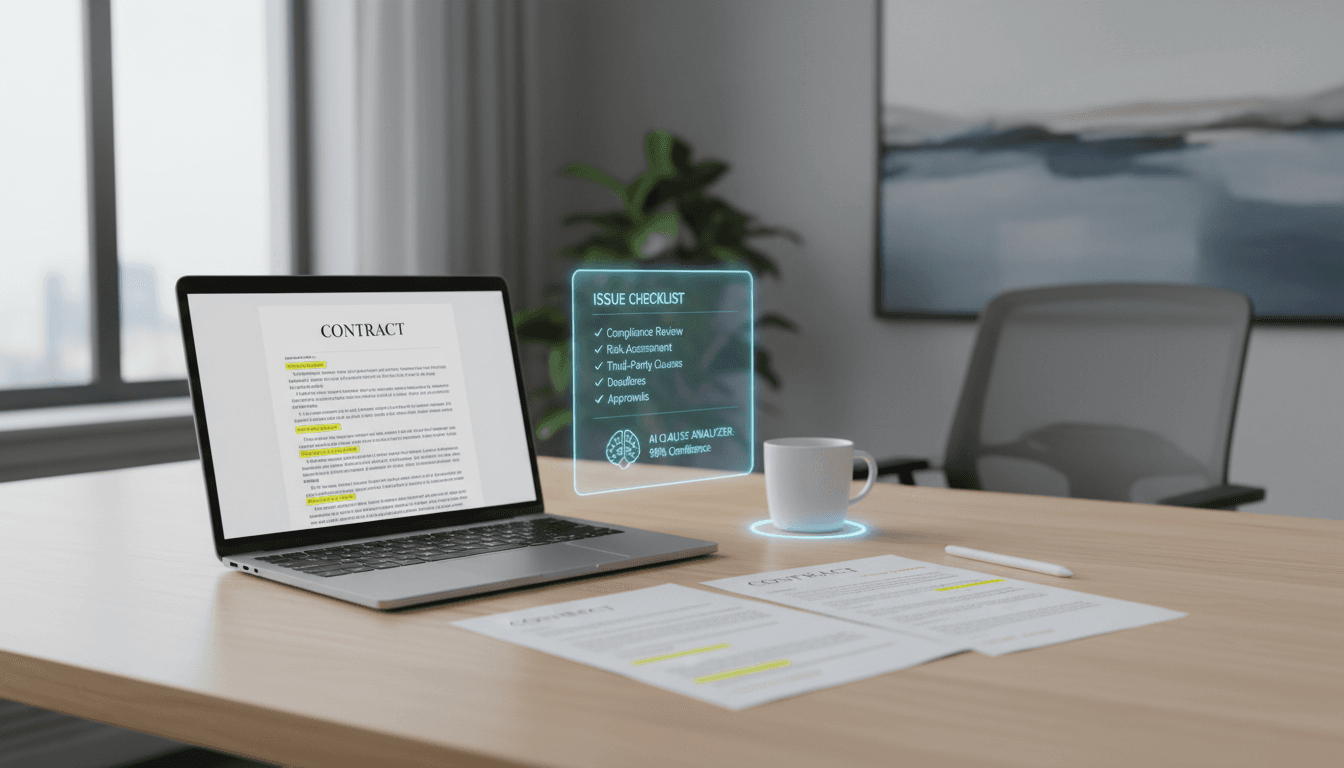
AI Contract Review: Faster, Safer Legal Workflows
Most contract “review” time isn’t legal reasoning—it’s triage.
Someone has to find the change from last version, spot the non-standard indemnity clause, confirm whether the limitation of liability is missing a cap, and check if a vendor slipped in auto-renew terms that procurement never agreed to. That work is repetitive, high-stakes, and—during year-end and quarter-end crunch—often done under time pressure.
AI-powered contract review is finally making that grind optional. In the AI in Legal & Compliance series, this post focuses on how AI is simplifying contract reviews inside U.S. legal teams and SaaS-driven businesses—and what it takes to deploy it responsibly so you get speed and control.
Why AI contract review is taking off in the U.S.
AI contract review is growing because it targets the biggest bottleneck in commercial legal work: throughput. U.S. companies aren’t struggling to generate more contracts—they’re struggling to process them without adding headcount.
Three forces are driving adoption:
- Volume keeps rising. More vendors, more SaaS tools, more data-sharing addendums, more privacy language, more security schedules.
- Risk tolerance is shrinking. Regulators, customers, and boards expect tighter governance around data use, security, and third-party risk.
- Legal teams are expected to act like product teams. Faster cycle times, measurable SLAs, clean handoffs, and repeatable workflows.
The result is a clear mandate: reduce review time while improving consistency. AI is well suited for that because contract work has patterns—clause structures, fallback positions, and policy-backed requirements—that can be detected and compared quickly.
Snippet-worthy truth: Most legal teams don’t need “smarter contracts.” They need more consistent reviews and fewer preventable escalations.
What “AI contract review” actually does (and what it shouldn’t)
Good AI contract review tools don’t replace judgment; they compress the time it takes to get to judgment. In practice, they’re doing four jobs.
1) Clause identification and normalization
AI can recognize clause types even when they’re written differently (for example, confidentiality obligations written as “non-disclosure,” “proprietary information,” or “restricted information”). That enables consistent tagging and faster navigation.
Practical impact:
- Reviewers spend less time hunting.
- Teams can build repeatable playbooks by clause type.
2) Deviation detection (what changed, what’s missing)
Comparing versions and spotting “silent” changes is where humans lose time. AI can flag:
- Redlined changes that materially shift risk
- Missing clauses (like data processing terms)
- Non-standard language that should trigger an approval path
This is especially valuable for vendor paper where the risky parts are often buried in schedules.
3) Policy mapping (playbooks, fallback language, approvals)
The best implementations pair AI detection with legal playbooks:
- “If the liability cap is uncapped, require VP approval.”
- “If governing law isn’t a U.S. state we accept, propose fallback.”
- “If a subcontractor clause lacks notice requirements, insert standard.”
AI helps route issues to the right person and suggests standard alternatives. The legal team stays the decision-maker.
4) Structured outputs for reporting and operations
Contracts aren’t just documents—they’re operational assets. AI can extract structured fields such as:
- Renewal date, notice period
- Payment terms
- Insurance limits
- Data residency language
Once data becomes structured, you can measure cycle time, see where negotiations stall, and identify which vendors repeatedly push unacceptable positions.
What AI shouldn’t do:
- Finalize contracts without human sign-off
- Invent clause interpretations (“hallucinations”) as if they’re authoritative
- Override playbook rules because it “sounds reasonable”
If your tool can’t show why it flagged a clause and where it found it, it’s not ready for real legal workflows.
A practical workflow: from intake to signature in less chaos
The most effective AI contract review setups treat review like an assembly line with checkpoints. Here’s a workflow I’ve found works well in SaaS and enterprise environments.
Intake: categorize and pre-screen
When a request comes in, AI can classify:
- Contract type (MSA, SOW, DPA, NDA, partner agreement)
- Jurisdiction/venue
- Presence of security/privacy schedules
Then it runs a pre-screen against your playbook and assigns a “review complexity” score (simple, standard, high-risk). Even a basic routing step cuts the back-and-forth that slows teams down.
First-pass review: issues list, not a blank page
Instead of starting from page 1, reviewers start from an issue list:
- Clauses that deviate from standards
- Missing required terms
- Items requiring approvals
This changes the cadence of review. You’re no longer “reading a contract.” You’re resolving known issues.
Negotiation: suggested fallback language with guardrails
This is where AI can save time if you keep guardrails:
- Suggestions should be limited to approved fallback positions
- Edits should be tracked and attributable
- High-impact areas (IP ownership, indemnity, liability, data use) should require explicit confirmation
A practical rule: AI can draft, but your playbook decides.
Post-signature: extract obligations and renewals
Most teams stop optimizing after signature. That’s a mistake.
AI-driven extraction can send key fields to:
- Contract lifecycle management (CLM)
- Ticketing systems
- Vendor risk tools
- Finance/procurement systems
That’s where digital services benefit: the contract becomes structured data that other systems can use, not a PDF sitting in a folder.
Where the biggest efficiency gains actually come from
Speed gains come less from “reading faster” and more from standardizing decisions. AI is a force multiplier when it reduces variance.
Here are the highest-impact areas for U.S. legal teams:
Standard playbooks that people actually follow
AI makes playbooks usable in real time. Instead of a static document no one opens, reviewers get contextual prompts:
- “This is vendor-friendly indemnity; propose Company Standard v2.”
- “This limitation of liability excludes data breach—requires security review.”
The win is consistency. Consistency reduces escalations. Escalations are what kill cycle time.
Fewer preventable escalations
Most escalations happen because:
- A reviewer isn’t sure whether a deviation is acceptable
- An approver doesn’t have time to re-read the whole contract
AI helps by producing a clean, structured summary of issues, with citations to exact sections. Approvers get what they need quickly, and legal retains control.
Better queue management during seasonal peaks
It’s December 25, and while many teams are offline, contract queues aren’t. Year-end pushes (renewals, budgets, vendor onboarding) create predictable surges.
AI review helps you:
- Batch low-risk agreements for fast turnaround
- Reserve senior lawyer time for true edge cases
- Maintain service levels without burning out the team
One-liner: AI doesn’t remove legal work—it removes the waiting.
Risk, compliance, and trust: how to deploy AI without regretting it
The compliance question isn’t whether AI is “allowed.” It’s whether your implementation is auditable. Legal teams need to defend decisions later.
Make outputs explainable and traceable
Your AI system should:
- Quote the clause text it’s referencing
- Point to section numbers/pages
- Keep a review log (who accepted, edited, or rejected suggestions)
If you can’t reconstruct how a risky clause got approved, you’re building future headaches.
Protect confidentiality and client data
For many organizations, contracts contain:
- Pricing
- Security posture
- Personal data references
- Negotiation history
Minimum safeguards include:
- Clear data handling policies
- Role-based access control
- Contract-specific permissioning
- Retention rules aligned to legal hold practices
Don’t skip human-in-the-loop
Human review isn’t a checkbox. It’s the mechanism that keeps AI useful.
A strong model is:
- AI does first pass and highlights issues
- Humans make decisions and approve language
- AI learns patterns (within policy boundaries) through feedback
Align with the “AI in Legal & Compliance” operating model
Across this topic series, one theme keeps repeating: automation works when it’s paired with governance. Contract review is no different.
The teams getting the best results treat AI as part of their legal ops stack:
- Defined playbooks
- Clear approval matrices
- Measured cycle time and defect rates
- Periodic audits of flagged/missed issues
“People also ask” about AI-powered contract reviews
Will AI replace contract lawyers?
No. AI replaces the repetitive parts of contract review, not the responsibility. Legal teams still set policy, negotiate exceptions, and own risk decisions.
What contracts benefit most from AI review?
High-volume, repeatable paper benefits first:
- NDAs
- Vendor MSAs
- DPAs
- Standard SOWs
Then teams expand to more complex agreements once playbooks and approvals are mature.
How do you measure success?
Measure operational outcomes, not vibes:
- Median cycle time (intake to signature)
- Escalation rate (and reasons)
- Rework rate (how often edits are undone)
- Compliance adherence (required clauses present)
If your metrics aren’t improving, the issue is usually playbooks or workflow design—not the model.
What to do next if you want AI to simplify contract reviews
Start with one workflow, one playbook, and one measurable goal. Trying to automate “all contracts” on day one creates chaos.
A practical starting plan:
- Pick a high-volume contract type (often NDAs or vendor MSAs).
- Define standards for 10–15 clauses that drive most escalations.
- Implement AI clause detection + deviation flagging.
- Require structured issue summaries for approvals.
- Track cycle time for 30–60 days and iterate.
AI-powered contract review is one of the clearest examples of how AI is powering technology and digital services in the United States: it turns a slow, document-heavy process into a managed workflow that scales.
If your contract queue is growing faster than your legal team, the real question isn’t whether you should use AI—it’s whether you can afford to keep reviewing contracts the same way next quarter.