AI compliance tools help fleets and brokers detect CDL fraud, verify drivers, and reduce unfair underbidding. Strengthen trust without slowing freight.
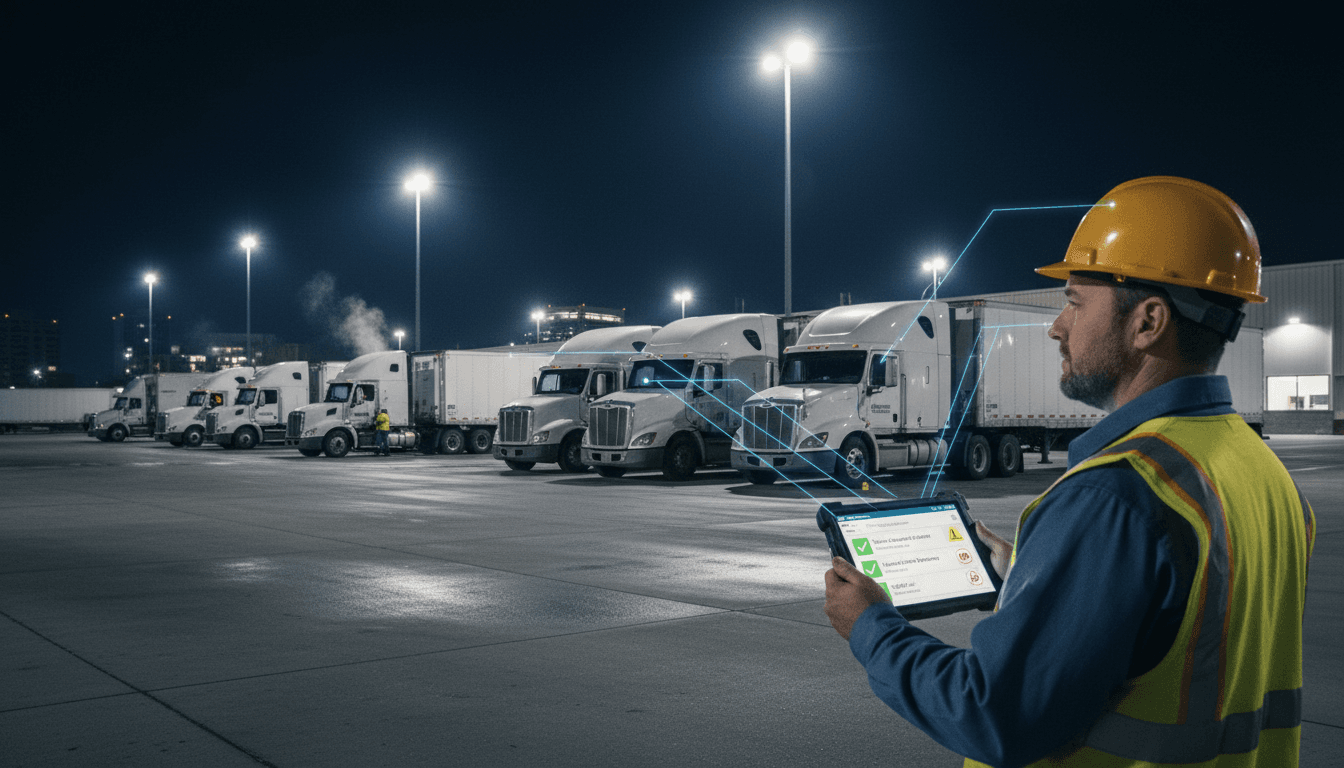
AI Compliance Tools to Fight CDL Fraud in Trucking
Freight can’t move for three and a half years below operating cost and still be dismissed as “just a cycle.” When a small fleet owner says brokered loads over 500 miles are paying $0.25–$0.75 per mile under his cost—month after month—he’s not describing a market dip. He’s describing a system where noncompliance can be profitable.
That’s the core tension raised by a recent FreightWaves report: compliant carriers are struggling to compete against operations allegedly enabled by labor arbitrage, non-domiciled CDLs, and CDL fraud, all amplified by uneven enforcement. Whether you run a fleet, broker freight, manage shipper compliance, or insure trucking risk, the takeaway is the same: when identity and eligibility checks are weak, pricing integrity collapses.
This post sits inside our “AI in Trucking & Freight: Fleet Intelligence” series for a reason. If enforcement can’t scale with the complexity of modern freight networks, then AI-driven compliance monitoring has to do what humans and legacy workflows can’t: verify faster, flag earlier, and make fraud and exploitation harder to monetize.
Why “cheap labor + weak verification” breaks freight pricing
Answer first: Freight prices get distorted when a subset of carriers can cut costs through illegitimate labor and licensing practices while still accessing the same loads as compliant fleets.
The FreightWaves piece highlights a blunt economic reality from Steve Troyer (California Midwest Xpress): fuel, tires, maintenance, insurance—those don’t magically get cheaper for rule-followers. If one carrier can underbid another by $0.25–$0.50 per mile, the advantage usually comes from one of two places:
- Labor cost arbitrage (lower wages, questionable employment setups, or rotating drivers)
- Compliance avoidance (hours-of-service manipulation, licensing irregularities, or incomplete documentation)
That creates a market where the “efficient” operator isn’t the one with better dispatch, better maintenance, or smarter routing. It’s the one most willing to treat compliance as optional.
The problem isn’t competition. It’s asymmetric enforcement.
Healthy competition is when everyone plays by the same rules and wins on execution. This situation is different: the rules exist, but enforcement is inconsistent, and that inconsistency becomes a pricing weapon.
The result looks like this:
- Noncompliant capacity underbids lanes.
- Brokers and shippers (often unintentionally) reward the lower bid.
- Compliant fleets bleed cash, take on debt, defer maintenance, or exit.
- Safety risk rises because the market is selecting for corner-cutting.
If you’re a shipper, this isn’t “someone else’s carrier problem.” It’s a supply chain integrity problem. A cheap load that later becomes an accident, cargo claim, or enforcement shutdown can cost far more than you saved.
CDL fraud and non-domiciled drivers: what’s actually at stake
Answer first: The biggest risk isn’t political—it’s operational. When the industry can’t reliably verify who is driving and whether they’re legally qualified, every downstream control becomes weaker.
The FreightWaves report points to concerns raised across the industry: fraudulent or improperly issued CDLs, transient/non-domiciled licensing patterns, and weak oversight that allegedly enables exploitative arrangements.
Here’s the practical impact on day-to-day freight operations:
- Carrier qualification becomes noisy. “Active authority” doesn’t tell you much if identity and licensing validation are shallow.
- Safety programs get undermined. A fleet can have a clean-looking front door while rotating people through the cab.
- Liability becomes murky fast. After an incident, the questions come hard: Who employed the driver? Who trained them? Who verified credentials? Who dispatched the load?
- Rate signals become unreliable. If underpricing is subsidized by rule-breaking, it’s not a true market price.
One quote from the source captures the human and economic reality: compliant operators feel punished for doing it right. And from a system design standpoint, that’s exactly what’s happening.
The seasonal layer (December matters)
Mid-December is when many fleets are juggling:
- Holiday volume surges in some lanes
- Tight delivery windows
- Weather risk
- Year-end compliance reviews and insurance renewals
When demand spikes and teams are stretched, fraud thrives in the gaps—especially if onboarding, credential checks, and dispatch controls still depend on manual reviews and static PDFs.
Where AI fits: compliance monitoring that scales past spreadsheets
Answer first: AI helps by turning compliance from an occasional audit into a continuous, automated risk-control system—without adding headcount.
Most fleets and brokers aren’t failing because they don’t care. They’re failing because verification is fragmented:
- A CDL image sits in one system
- Driver onboarding notes live in email
- Background checks are outsourced
- Dispatch uses a TMS that doesn’t talk to compliance
- Safety reviews happen quarterly (if you’re lucky)
AI doesn’t “replace compliance.” It connects the dots—and flags patterns humans won’t catch until it’s too late.
1) AI-driven driver identity and credential verification
AI can automate checks that are tedious, inconsistent, or easy to spoof:
- Document authenticity screening (detecting edited images, mismatched fonts, suspicious metadata)
- Cross-field validation (name/address/date mismatches across onboarding forms)
- Expiration monitoring for CDLs, medical cards, endorsements
- Anomaly detection (one phone number used by many drivers; repeated addresses; rapid driver turnover)
This matters because fraud rarely shows up as a single obvious lie. It shows up as small inconsistencies across multiple records.
2) Labor and dispatch pattern monitoring (the “rolling sweatshop” signal)
The article describes allegations of trucks rotating multiple drivers or operating in exploitative conditions. You can’t fix labor abuse with routing software alone—but you can detect operational signals.
Examples AI models can flag:
- Improbable utilization patterns (assets moving nearly 24/7 for weeks)
- HOS-telemetry mismatches (movement patterns inconsistent with reported duty status)
- Repeated driver swaps on the same unit with minimal downtime
- Geofence inconsistencies (equipment appears at location A while paperwork claims B)
Even if you don’t have perfect data, these flags help compliance teams prioritize where to look first.
3) Carrier risk scoring for brokers and shippers
Brokerages and shipper compliance teams need an answer to a hard question: Which carriers deserve extra scrutiny before tendering high-value freight?
AI risk scoring works when it’s transparent and action-oriented. The best systems don’t just assign a number; they explain the drivers:
- Unusual authority changes
- Address/ownership inconsistencies
- Rapid growth with thin safety staffing
- Claims anomalies
- Abnormal driver churn
The point isn’t to blacklist. It’s to route trust intentionally, and stop rewarding the cheapest bid when the risk profile doesn’t match.
A useful rule: if a carrier’s rate is consistently “too good,” your compliance process should treat it like a data problem, not a bargaining win.
A practical playbook: how to deploy AI compliance without slowing freight
Answer first: Start with the highest-leverage moments—onboarding, dispatch, and tendering—then automate alerts so humans only review exceptions.
Here’s a field-tested approach I’ve found works for teams that don’t want a year-long tech project.
Step 1: Map your verification bottlenecks
List where fraud can enter your operation:
- Driver onboarding
- Owner-operator onboarding
- Carrier packet setup (for brokers)
- Load tender and pickup confirmation
- Claims handling
Pick one to tighten first. Onboarding usually gives the fastest ROI.
Step 2: Standardize the minimum dataset
AI can’t help if every record is different. Define required fields:
- Legal name (as on CDL)
- License number and state
- Medical card expiry
- Phone/email
- Home address
- Employment relationship (W2/1099/lease-on)
- Tractor/VIN association (when applicable)
Then enforce it in your forms and TMS workflow.
Step 3: Automate “red flag” alerts, not full decisions
Good compliance AI is a triage engine. Use it to trigger human review when:
- A document fails authenticity checks
- A driver’s identity data conflicts across sources
- Operational utilization looks improbable
- A carrier’s profile shifts suddenly
This keeps freight moving while still raising the cost of deception.
Step 4: Close the loop with outcomes
Every time your team confirms a problem (or clears a false alarm), feed that result back into:
- Your rules n- Your model training set (if applicable)
- Your SOPs n- Your carrier/driver coaching
That’s how you get better month after month instead of repeating the same audits.
People also ask: “Isn’t enforcement the government’s job?”
Answer first: Yes—and waiting for perfect enforcement is a losing strategy. Private compliance is now part of operational excellence.
The fleet owner in the story isn’t asking for more rules; he’s asking for consistent enforcement of existing ones. I agree. But even in a world where enforcement improves, the industry still needs scalable verification because freight networks are too fast, too distributed, and too document-heavy.
Shippers, brokers, fleets, and insurers are already acting like enforcement is partly their responsibility—because financially, it is. AI compliance tools make that reality manageable.
What a “level playing field” looks like in 2026
A level playing field isn’t a slogan. It’s a measurable operational state:
- Credential checks happen in minutes, not days
- Document fraud gets flagged before the first dispatch
- Abnormal utilization triggers investigation quickly
- Carrier risk is evaluated continuously, not annually
- Compliant fleets stop getting priced out by rule-breakers
That’s the promise of fleet intelligence applied to compliance: fewer blind spots, fewer bad actors rewarded, and fewer legitimate operators forced into gut-wrenching decisions just to keep trucks rolling.
If you’re reviewing your 2026 plans right now—budgets, renewal negotiations, shipper scorecards—add one line item: AI-driven compliance monitoring for CDL verification and labor risk. The cost of doing nothing is showing up in rates, exits, claims, and safety outcomes.
Where do you see the biggest verification gap in your operation: driver onboarding, carrier onboarding, or day-to-day dispatch monitoring?