Amazon’s asset-light trucking model shows why AI-driven coordination matters more than ownership. Learn how fleet intelligence improves service, cost, and reliability.
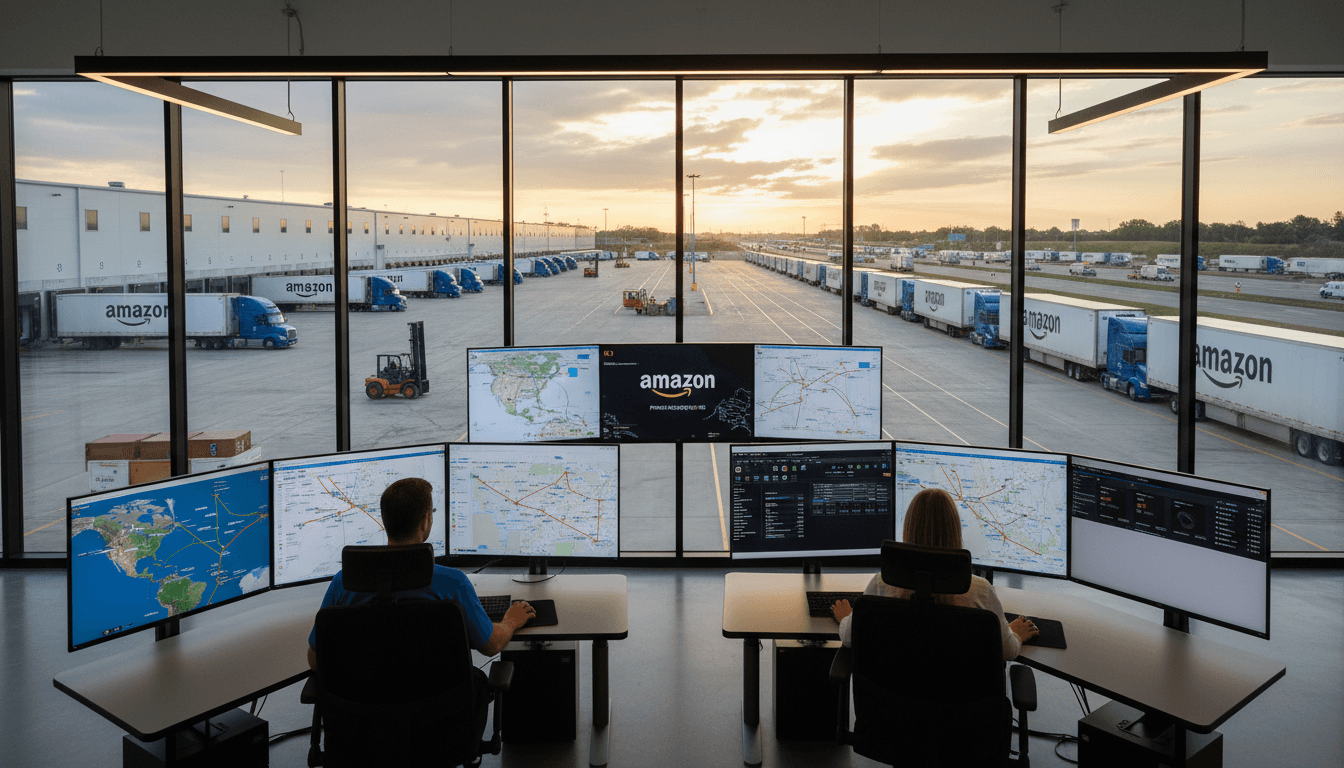
AI-Powered Asset-Light Trucking: Lessons from Amazon
Freight markets punish fixed costs. When spot rates soften and volumes wobble, the carriers with the most metal on the balance sheet feel it first—payments don’t care that demand dipped.
Amazon’s Freight Partner model flips that script: entrepreneurs can run trucking companies hauling Amazon freight without buying tractors upfront and without absorbing fuel and toll volatility. That’s a business model story… but it’s also an AI coordination story. Because an asset-light network only works when someone can predict demand, allocate capacity, and keep service tight across hundreds (or thousands) of moving parts.
This post is part of our “AI in Trucking & Freight: Fleet Intelligence” series, where we focus on practical AI in trucking—route optimization, safety, fuel efficiency, load matching, and maintenance. Amazon Freight Partners is a clean case study in how network intelligence can matter more than fleet ownership.
Amazon Freight Partner is a playbook for network intelligence
Amazon Freight Partner (AFP) succeeds because it reduces barriers to entry and wraps those small fleets inside a highly managed operating system.
From the reported program structure: partners access Amazon-branded trucks with no upfront down payment, receive consistent weekly work and fixed weekly rates, and Amazon covers fuel and tolls. That combination does two things:
- It removes the biggest early-stage killer for small carriers: cash-flow whiplash.
- It shifts the competitive battleground from “who owns equipment?” to “who can run a reliable operation?”
Here’s the stance I’ll take: asset-light models don’t win because they’re cheaper; they win because they’re easier to standardize and optimize. Standardization is what makes fleet intelligence (including AI in logistics) actually stick.
Why this matters in late 2025
Heading into peak season wrap-up and Q1 planning, most shippers and 3PLs are doing the same two things:
- Tightening service-level expectations (on-time, on-compliance, fewer exceptions)
- Scrutinizing transportation spend with more rigor than “last year plus 3%”
Networks like AFP are attractive because they promise predictable execution. But predictability doesn’t come from vibes—it comes from measurement, feedback loops, and fast decision cycles. That’s the natural habitat for AI-driven logistics.
The real innovation: de-risking trucking ownership without de-skilling it
The obvious headline is “start a trucking company without buying a tractor.” The more interesting point is who can now enter the market.
AFP reportedly doesn’t require prior trucking experience and includes a 12-week training program, plus ongoing business coaching focused on safety, compliance, recruiting, on-time performance, and metrics.
That’s a big deal because the trucking industry has historically “priced out” capable operators who weren’t already insiders. When you strip away capex and fuel uncertainty, you attract operators who can run people, process, and performance.
Asset-light trucking works when leadership quality is the scarce resource—not equipment.
A highlighted example from the program: a former nurse manager with no transportation background reportedly scaled to 19 trucks out of Atlanta. That’s not a one-off miracle; it’s what happens when the operating environment is structured and the work is consistent.
Where AI fits: operational consistency at scale
If you’re building a partner-based network (or managing one), AI isn’t a “nice-to-have.” It’s the difference between:
- A portfolio of small fleets you constantly chase
- A coordinated system where exceptions are managed before they explode
In practice, fleet intelligence for asset-light networks focuses on:
- Demand forecasting (lane/day/hour volume expectations)
- Capacity planning (right number of drivers and tractors staged in the right places)
- Dynamic route optimization (weather, congestion, facility dwell)
- Exception prediction (late pickup risk, late arrival risk, HOS risk)
- Performance coaching loops (micro-trends by driver, lane, facility)
The AFP model bakes in the cultural expectation that performance is measured. That’s exactly what makes AI adoption easier.
Asset-light networks create a new “control tower” problem
When you don’t own the fleet, you can’t rely on ownership to enforce behavior. You rely on standards, incentives, and visibility.
So the core question becomes: How do you coordinate service across many independent operators as if you were one fleet?
The answer is a control tower with strong data plumbing and clear operational rules. AI in transportation and logistics is what turns that control tower from a dashboard into a decision engine.
The four AI capabilities that matter most
If you’re building an AFP-like network (or even a regional partner program), these are the AI capabilities I’d prioritize.
-
Predictive ETAs and risk scoring
- Not just “ETA is 4:20 PM,” but “ETA confidence is 62% and late risk is rising because dwell exceeded baseline by 38 minutes.”
-
Route and schedule optimization under constraints
- Real operations include HOS, appointment windows, driver preferences, trailer availability, and facility congestion. AI-assisted optimization finds workable plans faster than humans can.
-
Automated exception management
- The goal isn’t fewer alerts. It’s fewer surprises. Good systems escalate only when intervention can change the outcome.
-
Continuous coaching and quality management
- AI can surface patterns: which lanes cause chronic late arrivals, which facilities create detention spikes, which driver cohorts need extra training on specific behaviors.
In a partner network, service quality is a math problem dressed up as a relationship problem.
What this model changes for carriers, shippers, and drivers
AFP is positioned as an entrepreneurship path, but it also changes expectations across the freight ecosystem.
For small carriers: cash flow becomes a design choice
Consistent weekly work and fixed weekly rates (as described) mean partners can plan hiring, maintenance cycles, and growth.
From a fleet intelligence standpoint, predictable demand unlocks:
- Better predictive maintenance planning (service trucks when demand is lower)
- Smarter driver scheduling (less last-minute scrambling)
- More stable safety performance (less pressure to “make up time”)
If you run a small fleet outside of AFP, you can still copy the principle: stability is operational leverage. Use AI for load matching and lane selection to reduce volatility rather than chasing every hot load.
For shippers and 3PLs: partner networks can outperform owned fleets
A lot of shippers assume an owned fleet is “more reliable.” Sometimes it is. Often it’s not—especially when equipment utilization targets force bad decisions.
Partner networks can be more reliable when:
- The shipper enforces uniform SOPs
- Performance metrics are transparent
- AI-driven routing and forecasting reduce variability
In other words, reliability comes from system design, not titles on vehicle registrations.
For drivers: W-2 stability becomes a competitive advantage
Reportedly, drivers working for AFPs are W-2 employees of the small business, with benefits such as healthcare and paid time off that are less common in the broader industry. Some partners reportedly offer additional benefits like childcare, 401(k), and mental health support.
That matters because driver retention is still one of the most expensive “silent costs” in trucking. From an AI in trucking lens, retention correlates with:
- Better safety outcomes
- Lower recruitment and onboarding spend
- More consistent on-time performance
AI can support this too, but not with surveillance theater. The practical applications are:
- Fair, explainable performance metrics
- Reduced forced dispatch changes
- Proactive fatigue and schedule risk signals
How to apply the AFP lessons in your own fleet intelligence roadmap
You don’t need Amazon’s scale to borrow the logic. You need a structured operating model and the data discipline to improve it.
Step 1: Standardize the “inputs” before you optimize
AI can’t fix chaos. Start with consistent definitions:
- What counts as on-time? (arrival vs. check-in vs. unload)
- What is dwell time measured against?
- How are HOS violations categorized?
- What are the top 10 exception codes, and are they used consistently?
If your network has 20 different versions of “late,” you’ll get 20 different versions of bad decisions.
Step 2: Build an exception-first operating rhythm
Most operations teams spend their day reacting. Flip it.
A good rhythm looks like:
- Morning: top lanes/facilities by late-risk score
- Midday: dwell-time outliers and trailer availability risks
- Afternoon: next-day staging based on forecasted volume
This is where AI-driven forecasting and route optimization show immediate value—because you’re tying insights directly to actions.
Step 3: Use AI to shrink variability, not just cost per mile
The KPI obsession is usually cost per mile. That’s necessary, but it’s not sufficient.
For partner networks, the high-value KPI is variability:
- Variability in pickup arrival
- Variability in transit time
- Variability in dwell
Lower variability improves service and reduces “buffer costs” like extra tractors, extra drivers, and extra slack time. In my experience, reducing variability is how you improve both cost and service without turning every week into a fire drill.
Step 4: Coach the system, not just the driver
AFP’s coaching emphasis (as described) is the right instinct. The mistake many fleets make is coaching only drivers.
AI can highlight when the real problem is systemic:
- A facility’s appointment scheduling creates chronic bottlenecks
- A lane’s expected transit time is unrealistic in winter conditions
- A shipper’s loading pattern causes trailer shortages
Fixing those issues is how partner networks scale without burning people out.
People also ask: common questions about asset-light trucking and AI
Is asset-light trucking always cheaper?
No. It can be more expensive per mile on paper. It’s often cheaper in risk-adjusted terms because you avoid idle assets and can flex capacity faster.
Does AI matter if you already have steady freight?
Yes—steady freight makes AI more valuable, not less. Predictable demand creates cleaner training data and clearer cause-and-effect relationships.
What’s the biggest failure mode in partner-based networks?
Inconsistent standards. If each partner runs different processes, you end up managing personalities instead of performance.
The bigger trend: trucking is becoming “software-defined”
Amazon Freight Partners isn’t just an entrepreneurship program. It’s a signal that trucking is shifting toward software-defined operations, where coordination, forecasting, and compliance systems can be more decisive than asset ownership.
For leaders working on fleet intelligence—whether you’re a shipper, a 3PL, or a carrier—the opportunity is clear: build a network that can sense, decide, and act faster than the market moves.
If you’re exploring AI in trucking (route optimization, predictive ETAs, safety analytics, maintenance forecasting), start with one question: Where does variability enter your operation, and what data would let you predict it 24 hours earlier?