Neutral host small cells are becoming the fastest path to AI-ready 5G densification. Here’s what the VMO2–Freshwave rollout teaches operators and councils.
Neutral Host Small Cells: The AI-Ready 5G Playbook
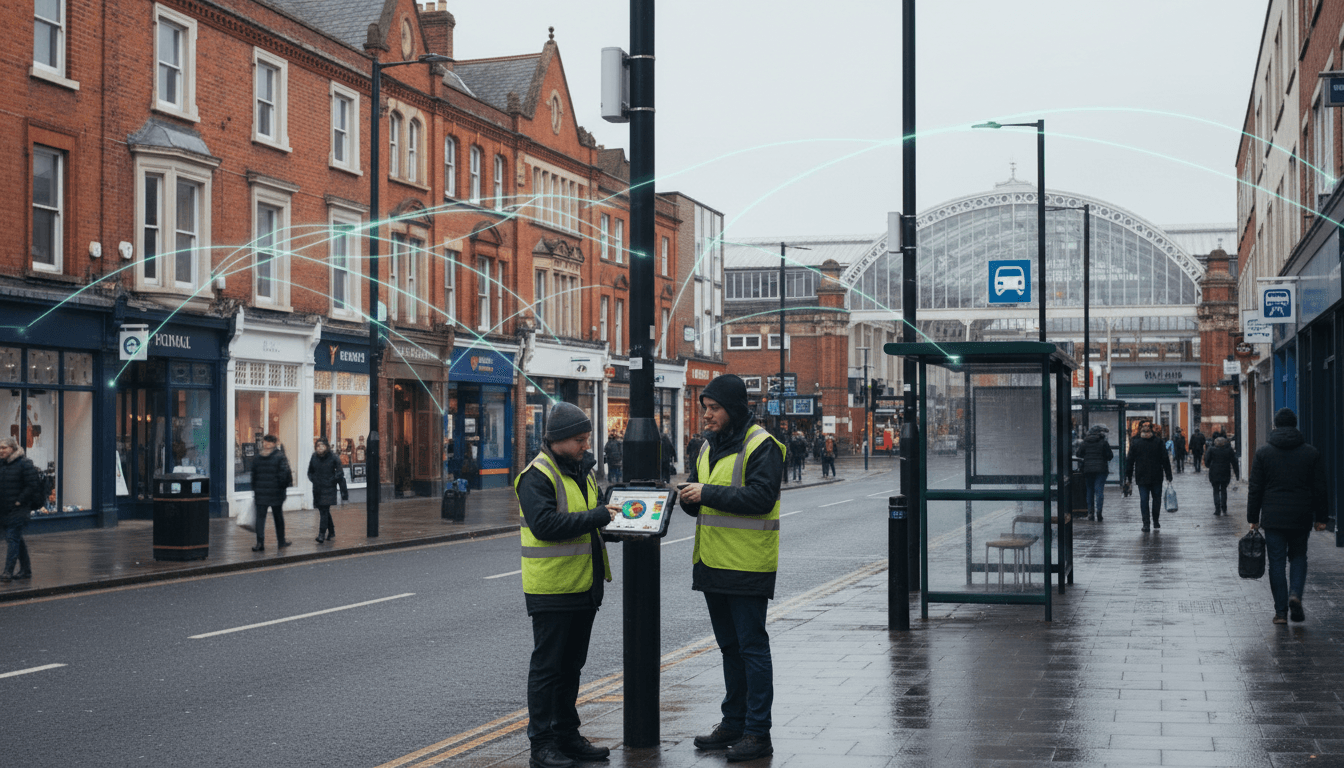
Thirteen small cells don’t sound like much—until nine of them are already live, placed exactly where network demand spikes: a high street, a rail station, and a tourist landmark. That’s what’s happening in Guildford, where Virgin Media O2 (VMO2), Surrey County Council, and Freshwave are rolling out 4G/5G small cells using a neutral host model.
Most operators already know the pain: macro sites can’t fix every coverage hole, indoor signal struggles, and “busy places” keep getting busier. The part that’s easy to miss is what this kind of partnership really signals for 2026 planning: small-cell densification is becoming an operations problem, not only a radio problem. And that’s where AI in telecommunications starts paying for itself.
This post is part of our AI in Telecommunications: Network Intelligence series. The Guildford deployment is a tidy example of a bigger trend: AI-driven network optimization needs dense, well-instrumented infrastructure, and neutral host small cells are one of the fastest ways to get there without duplicating street-level hardware.
Neutral host small cells fix the “last 200 meters” problem
Neutral host small cells are shared radio infrastructure deployed by a third party, designed to support one or more mobile network operators. The key is the operating model: a specialist builds and runs the street-level kit (and often the backhaul and power arrangements), while operators integrate service on top.
That’s not just a commercial footnote. It addresses the real deployment bottlenecks:
- Permitting and local coordination: councils care about disruption, safety, and aesthetics.
- Street clutter: nobody wants three separate cabinets and poles from three operators.
- Time-to-air: demand is rising faster than traditional site acquisition cycles.
Freshwave’s Guildford build highlights an underappreciated constraint: size and appearance. When small cells can mount on existing street furniture and blend into the environment, the whole project shifts from “urban redevelopment drama” to “infrastructure maintenance.” That’s how you get nine out of thirteen sites active quickly.
From an AI angle, the “last 200 meters” is also where model accuracy lives or dies. If your customer experience drops in specific micro-locations—platform 2 at the station, the busy corner by the shops—AI can predict and detect it, but you still need a practical way to add capacity right there. Small cells are that mechanism.
Why this matters in December 2025
Heading into 2026 budgets, operators are balancing three pressures at once: rising traffic, public expectations of reliable 5G, and tighter scrutiny of capex. Neutral host is attractive because it can convert some expansion into a service-style cost model while improving outcomes in high-impact areas.
And seasonality matters. Q4 and Q1 repeatedly create “stress tests” for networks—holiday travel, retail peaks, and weather-driven indoor usage. Small cell projects that land before peak periods often reveal their ROI quickly through fewer complaints and fewer emergency optimizations.
The real story isn’t the radios—it’s the operating model
The Guildford project is described as open access infrastructure with benefits like “faster rollout” and “less street clutter.” I agree with that framing, but I’d go further: neutral host changes who owns complexity.
In a classic operator-built model, the MNO owns:
- detailed RF design
- street works scheduling
- hardware lifecycle and spares
- field dispatch
- fault triage across power/backhaul/RAN
In a neutral host model, a large slice of that shifts to the provider. That’s good—if you measure the right things.
Here’s what I’ve found works: treat neutral host as an SLA and observability problem first, and a coverage project second. If you can’t see performance per node, per band, per hour, you can’t manage customer experience and you can’t feed AI models with reliable ground truth.
The KPIs that actually predict success
If you’re evaluating neutral host small cells (as an operator, council, or venue owner), push for these metrics from day one:
- Time-to-on-air (TTOA) per site, from permit request to live traffic
- Busy-hour user throughput and cell edge throughput (not just averages)
- Handover success rate between small cell and macro layer
- Backhaul utilization and latency (a common hidden constraint)
- Mean time to detect (MTTD) and mean time to repair (MTTR) per node
Those KPIs also map cleanly to AI-driven network optimization and AIOps workflows.
How AI makes small cell deployment smarter (and cheaper)
AI doesn’t replace RF engineering; it prioritizes it. For street-level densification, the value is in deciding where to build, what to build, and how to tune it—before you waste civil work money.
In practical terms, AI helps in four places.
1) Predictive coverage analysis: stop guessing where demand will land
Small cells should go where demand concentrates, not where it’s easiest to mount a box.
AI models that combine:
- historical cell performance counters
- mobility patterns (commuter flows, event patterns)
- device capability mixes
- local topology (street canyons, building density)
…can produce candidate site lists ranked by expected impact. That’s far more defensible than arguing over heatmaps in a meeting.
In a town-center scenario like Guildford—high street + station + tourist landmarks—predictive models often find two “gotchas”:
- micro-congestion at intersections where people pause (queues, crossings, entrances)
- uplink constraints from user-generated video and messaging bursts
2) Capacity planning: right-size the node for today and next year
Overbuilding small cells is an expensive hobby. Underbuilding creates repeat work.
AI-assisted planning can recommend:
- spectrum configuration and carrier activation schedules
- expected PRB utilization at busy hour
- whether the bottleneck will be RAN, backhaul, or core path
This is where neutral host becomes especially interesting: shared infrastructure can be scaled once for multiple tenants, but only if forecasting is credible.
3) Self-optimizing networks (SON) that don’t behave like whack-a-mole
When you add small cells, you change the interference environment and the mobility layer. The risks are predictable:
- sticky users that don’t hand back to macro
- ping-pong handovers at borders
- coverage “islands” that look good in tests but fail at peak time
AI-based optimization can continuously tune parameters like:
- handover thresholds
- neighbor relations
- power and tilt strategies (where supported)
The goal isn’t perfect automation. It’s fewer late-night incidents and fewer “we’ll fix it in the next parameter sweep” cycles.
4) Predictive maintenance: treat small cells like a fleet
Thirteen nodes in one town is manageable. Hundreds across a region becomes fleet management.
AIOps models can spot patterns that precede outages:
- rising packet loss on a backhaul segment
- temperature or power irregularities (where telemetry exists)
- recurring minor alarms that correlate with user complaints
Neutral host providers are often better positioned to run this at scale because they see many deployments and failure modes. Operators should insist on access to the telemetry that matters, not just monthly summaries.
What the Guildford rollout signals for UK 5G densification
The UK’s densification story is shifting from “more towers” to “more places.” Freshwave notes it has deployed 800 outdoor small cells for various operators. That’s a meaningful indicator: the market is normalizing around repeatable deployment patterns.
VMO2 also links this work to a £700 million transformation project, and that’s a clue to how operators are thinking: modernization isn’t only new radios; it’s new operating rhythms. Neutral host small cells fit that narrative because they can be rolled out in targeted pockets while broader network programs continue.
From a local authority perspective, Surrey County Council frames the project as part of a digital strategy aimed at stronger local economies and more resilient communities. I like that phrasing because it’s measurable if you choose to measure it:
- fewer connectivity “dead zones” for local businesses
- more reliable mobile coverage for transport hubs
- better support for public services that increasingly assume broadband-grade mobile data
The uncomfortable truth: if councils and operators don’t coordinate, towns end up with duplicated hardware and slower upgrades. Neutral host is one of the few models that aligns incentives well enough to avoid that.
A practical checklist for operators and councils
If you’re planning a neutral host small cell program in 2026, start with governance and data—not hardware catalogs. Here’s a checklist that prevents the most common pain later.
Governance and commercial structure
- Define tenant onboarding steps and timelines (how a second operator joins later)
- Agree the SLA boundaries: what counts as a neutral host issue vs operator issue
- Set change management rules (firmware updates, parameter changes, maintenance windows)
Data and AI readiness
- Require near-real-time access to:
- performance counters (RRC, throughput, BLER where relevant)
- availability/alarms
- backhaul latency and loss
- Standardize naming/location metadata (if sites aren’t cleanly labeled, AI models suffer)
- Decide where analytics runs: operator NOC, neutral host NOC, or shared portal
Deployment practicality (the stuff that delays projects)
- Pre-approve street furniture types and mounting standards
- Map power availability and plan for resiliency at critical sites (station areas matter)
- Validate backhaul paths early; backhaul surprises are a top-three schedule killer
Customer experience validation
- Do walk/drive testing at:
- busy hour
- weekend peak
- event-like conditions (even simulated)
- Track complaint volumes and correlate with cell KPIs (this is where AI helps)
Snippet-worthy truth: If you can’t connect small-cell telemetry to customer experience, you’re not doing network intelligence—you’re collecting trivia.
Where this is heading: small cells as the physical layer of network intelligence
Neutral host small cells won’t solve every coverage issue, and they won’t remove the need for strong macro layers. But they’re becoming the most pragmatic answer to a hard reality: 5G performance is increasingly decided in specific micro-locations—stations, shopping streets, campuses, and venues.
For AI in telecommunications, this matters because network intelligence thrives on dense instrumentation and controllable infrastructure. The combination of neutral host + AI-driven network optimization is a sensible direction: faster rollout, shared physical assets, and better decision-making about where investment actually improves experience.
If you’re responsible for network performance, digital infrastructure, or smart-city connectivity, the question to ask next isn’t “Should we deploy small cells?” It’s this: Do we have the data, operating model, and AI workflows to keep a growing small-cell layer healthy at scale?