Vision AI failures in utilities usually come from data gaps, label noise, and drift. Learn how to harden inspection AI for grid and renewables.
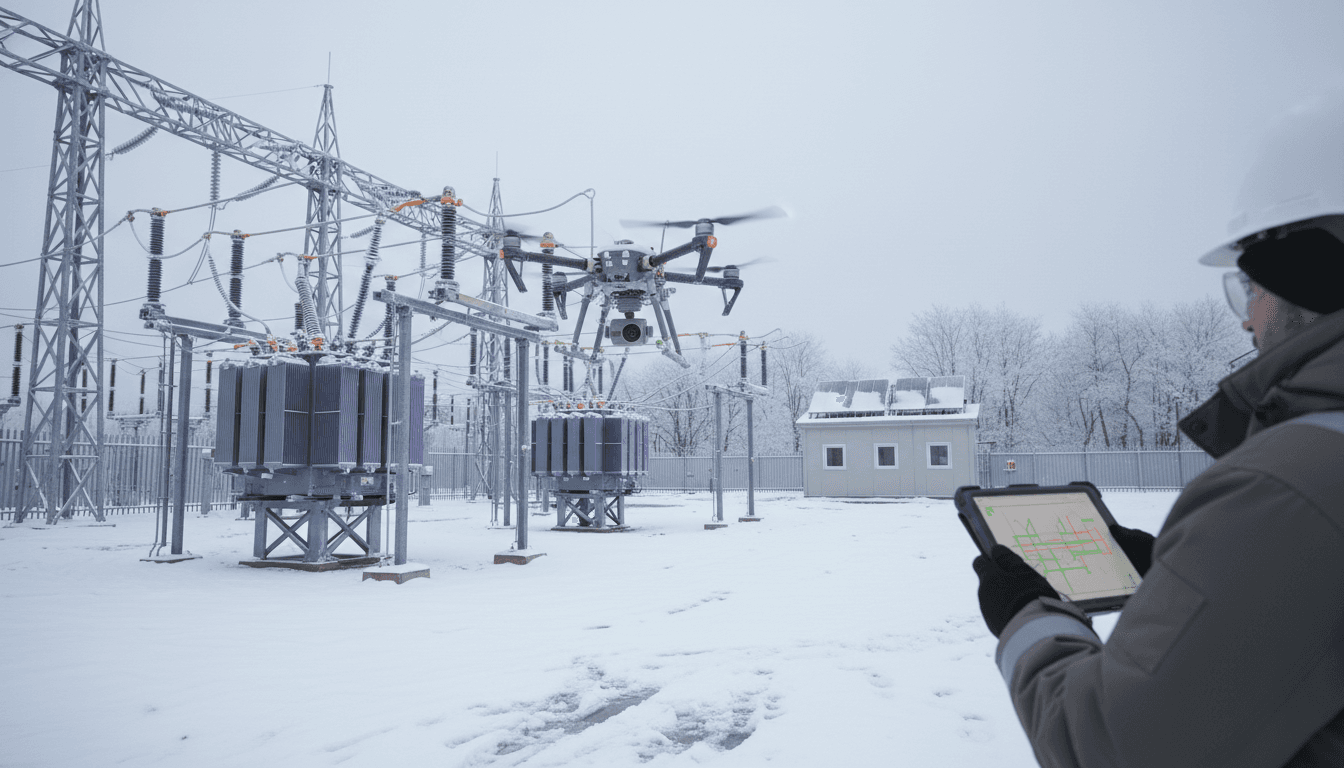
Vision AI Failures in Utilities: Fix the Data, Not Just AI
Production vision AI doesn’t usually fail because the model “isn’t smart enough.” It fails because the real world is messy—and your data, labels, and evaluation plan didn’t fully account for that mess.
In energy and utilities, that gap gets expensive fast. A missed hotspot on a substation connector can become an outage. A false corrosion alert can trigger an unnecessary truck roll. And if you’re using computer vision for safety, the stakes get even higher.
This post takes the most common failure modes highlighted in the Why Vision AI Models Fail whitepaper (Voxel51 / IEEE Spectrum) and translates them into practical guidance for grid monitoring, equipment inspection, and renewables operations—while staying grounded in what this series is about: AI in supply chain & procurement. Because when vision AI breaks, it doesn’t just break in the field; it breaks your planning, spares strategy, vendor performance metrics, and maintenance procurement cycles.
Why utilities’ vision AI fails more often than teams expect
Vision AI fails in utilities because operational variance is wider than most training sets. Different crews, cameras, seasons, lighting, asset vintages, and vendor parts all create “new worlds” the model must handle.
A few utility-specific realities make this worse:
- Seasonality is extreme (December glare off snow, fog, storms, early darkness). These aren’t edge cases; they’re guaranteed.
- Assets change over decades, not months. A “standard” insulator can have five generations in one territory.
- Data collection isn’t centralized. Drone vendors, helicopter patrols, substation CCTV, mobile phones, and thermal cameras all create domain mismatch.
- Maintenance and procurement decisions feed back into data. Changing a preferred supplier changes the visual appearance of components—quietly introducing drift.
If you treat computer vision as a one-time model build, you’ll ship something that looks great in a demo and disappoints in production.
Failure mode 1: Not enough data (or the wrong data)
The most common vision AI failure is simple: your dataset doesn’t represent the operating reality you’re deploying into.
The utility version of “insufficient data”
Teams often have “a lot of images,” but not the right coverage:
- Plenty of normal conditions, too few failure conditions (overheating lugs, cracked polymer sheds, missing cotter keys).
- Many assets from one region, few from others (coastal corrosion vs. inland dust).
- Great daylight imagery, weak nighttime/thermal coverage.
- Clean drone captures, limited handheld images taken during storm response.
Here’s the uncomfortable truth: a million images of healthy poles won’t teach your model to detect the one configuration that fails every winter.
What works: build a coverage plan, not a dataset
A strong approach is to create a data coverage matrix and treat it like a procurement spec:
- Asset types: poles, crossarms, insulators, breakers, transformers, PV inverters, wind nacelles
- Sensor types: RGB, thermal, multispectral, fixed CCTV
- Conditions: rain, fog, snow, low sun angle, night, dirty lens
- Failure modes: corrosion, overheating, arcing marks, oil leaks, vegetation encroachment
- Vendors/part families: insulator models, connector types, bushing variants
Then set explicit targets. For example:
- “For each critical defect type, minimum 300 confirmed positives across at least 3 regions and 2 sensor types.”
- “For thermal hotspot detection, include both high-load and low-load periods.”
That’s also where this intersects with AI in supply chain & procurement: if you can’t get defect positives internally, you may need to contract targeted data capture (or structure vendor agreements to include labeled defect imagery as part of inspection services).
Failure mode 2: Class imbalance and the tyranny of “rare events”
Utilities live in the world of rare events. That’s the point of reliability engineering. But it’s a problem for computer vision: most high-risk defects are rare.
Why class imbalance shows up as “false confidence”
A model can get very high accuracy by mostly predicting “no defect.” In production, that translates to:
- Missed detections (worst-case)
- Or over-triggering (constant false alarms)
Neither is acceptable when dispatching crews is expensive and safety-critical.
What works: change what you measure (and what you reward)
Most companies get this wrong by obsessing over a single aggregate score.
For imbalanced defect detection, prioritize:
- Recall for critical defects (catch the dangerous stuff)
- Precision at an operational threshold (how many alerts become real work orders)
- Cost-weighted metrics (false negative cost is not equal to false positive cost)
A practical tactic is to define an “inspection-to-truck-roll ratio” target. Example:
- “No more than 5 visual alerts to generate 1 confirmed field action for defect class A.”
That turns model tuning into an operations conversation, not a Kaggle contest.
Failure mode 3: Labeling errors and inconsistent ground truth
Label noise is a quiet killer in vision AI. In utilities, labels can be inconsistent for reasons that are totally understandable:
- Inspectors disagree on severity (surface rust vs. actionable corrosion)
- Thermal anomalies depend on load and ambient conditions
- A “defect” might be present but not visible at that viewing angle
- Different contractors follow different labeling guidelines
What works: treat labeling like a controlled process
If you want production reliability, you need label governance:
- Write a label taxonomy that matches operational decisions (e.g., “monitor,” “repair planned,” “immediate action”).
- Run inter-rater agreement checks (you’re looking for where humans disagree, because models will too).
- Use “golden sets”: a small set of high-confidence labeled examples used to continuously audit labeling quality.
- Store label provenance: who labeled it, when, with what guidance version.
This is also a procurement win. When you outsource inspections, you can contract for:
- labeling guidelines adherence
- re-label SLAs
- audit sampling rules
If you don’t specify it, you’ll pay for it later in the form of model chaos.
Failure mode 4: Bias, blind spots, and “unknown unknowns”
Bias in utilities’ vision AI isn’t only about demographics (though fairness matters in many domains). In infrastructure monitoring, bias often means systematic blind spots:
- The model works great on newer assets, fails on older equipment.
- It’s trained on one manufacturer’s components and underperforms on another.
- It flags defects more often in one region because of background differences (snow, desert, vegetation).
What works: evaluate by slice, not by average
Your model isn’t “good” or “bad.” It’s good on some slices and dangerous on others.
Build an evaluation report that breaks results down by:
- region/operating district
- asset vintage or part family
- sensor type and camera model
- season and time-of-day
- contractor/vendor that captured the images
Then take a stance: don’t deploy globally if you’ve only validated locally. A phased rollout by district, with explicit performance gates, beats a big-bang rollout that nobody trusts.
Future-proofing: evaluation and monitoring that match the grid
The whitepaper emphasizes evaluation frameworks and production monitoring. In utilities, that translates to a simple rule:
If you’re not monitoring data drift, you’re not running vision AI—you’re running a pilot.
Avoid data leakage (the silent “too-good-to-be-true” metric)
Data leakage happens when training and test sets aren’t truly independent. Utilities are especially vulnerable because:
- The same asset appears in many images over time.
- Nearby poles share similar backgrounds.
- Inspection flights capture sequential frames that are near-duplicates.
If you split randomly by image, your test set will look amazing.
What works is splitting by asset ID, inspection route, or time window. If the goal is next-quarter performance, test on later time periods.
Monitor the things operations actually care about
Production monitoring shouldn’t just track model accuracy (you often won’t know ground truth immediately). Track leading indicators:
- Input drift: camera type changes, resolution changes, seasonal lighting shifts
- Confidence drift: average prediction confidence dropping for certain districts
- Alert yield: percent of alerts confirmed by human review
- Workflow lag: time from alert → review → field verification
Tie those signals back to maintenance supply chain reality:
- If alert volume spikes, do you have the spares inventory and crew capacity?
- If alert yield drops, do you pause automation and route alerts for review?
This is where AI in supply chain & procurement becomes more than forecasting. The vision system becomes a demand signal generator for parts, labor, and contractor services.
A practical playbook: making vision AI reliable for energy operations
Reliable vision AI is built with a data-first mindset and an ops-first rollout plan. Here’s a field-tested sequence that tends to work.
Step 1: Start with one decision, not ten
Pick a single, high-value decision such as:
- “Dispatch a thermal follow-up inspection”
- “Create a work order for vegetation management”
- “Escalate a substation safety alert to an operator”
Then define what “correct” means operationally.
Step 2: Build your dataset around failure economics
Rank defect classes by risk × cost × frequency, then allocate labeling and data capture accordingly.
- High-risk, low-frequency defects need targeted collection and strict evaluation.
- Lower-risk, high-frequency findings can be handled with human-in-the-loop review.
Step 3: Put procurement in the loop early
Most utilities treat vision AI as an engineering project. It’s also a vendor management project.
Procurement can help by:
- standardizing capture requirements across drone/inspection vendors
- negotiating rights to reuse imagery for model training
- defining label quality acceptance criteria
- ensuring part/vendor metadata is captured so you can evaluate model performance by supplier
That last point matters: if a model starts missing defects on a new connector supplier’s hardware, you want to know fast.
Step 4: Roll out with guardrails
Use guardrails that match risk:
- Low-risk tasks: allow auto-triage (e.g., “no vegetation risk detected”)
- Medium-risk tasks: require human review before work order
- High-risk tasks: require confirmation with a second modality (thermal + visual) or a second reviewer
Automation should earn trust. Trust doesn’t come from promises; it comes from consistent outcomes.
Where to go next
Vision AI model failure isn’t a mystery. In utilities, it’s usually a predictable result of insufficient coverage, imbalanced defect data, noisy labels, and evaluation that doesn’t match real deployment conditions.
If you’re responsible for reliability, inspections, or asset management, the fastest improvement often comes from treating data like infrastructure: specified, governed, monitored, and funded. And if you’re in supply chain & procurement, you’re not on the sidelines—vision AI will change your demand signals, vendor scorecards, and contracting requirements.
If your grid’s vision AI system is producing more arguments than actionable work orders, what would happen if you stopped tuning the model for two weeks—and focused entirely on data coverage, labeling governance, and drift monitoring instead?