Union Pacific’s Casa Grande yard expansion doubles capacity—and creates better data for AI-driven routing, forecasting, and supply chain optimization.
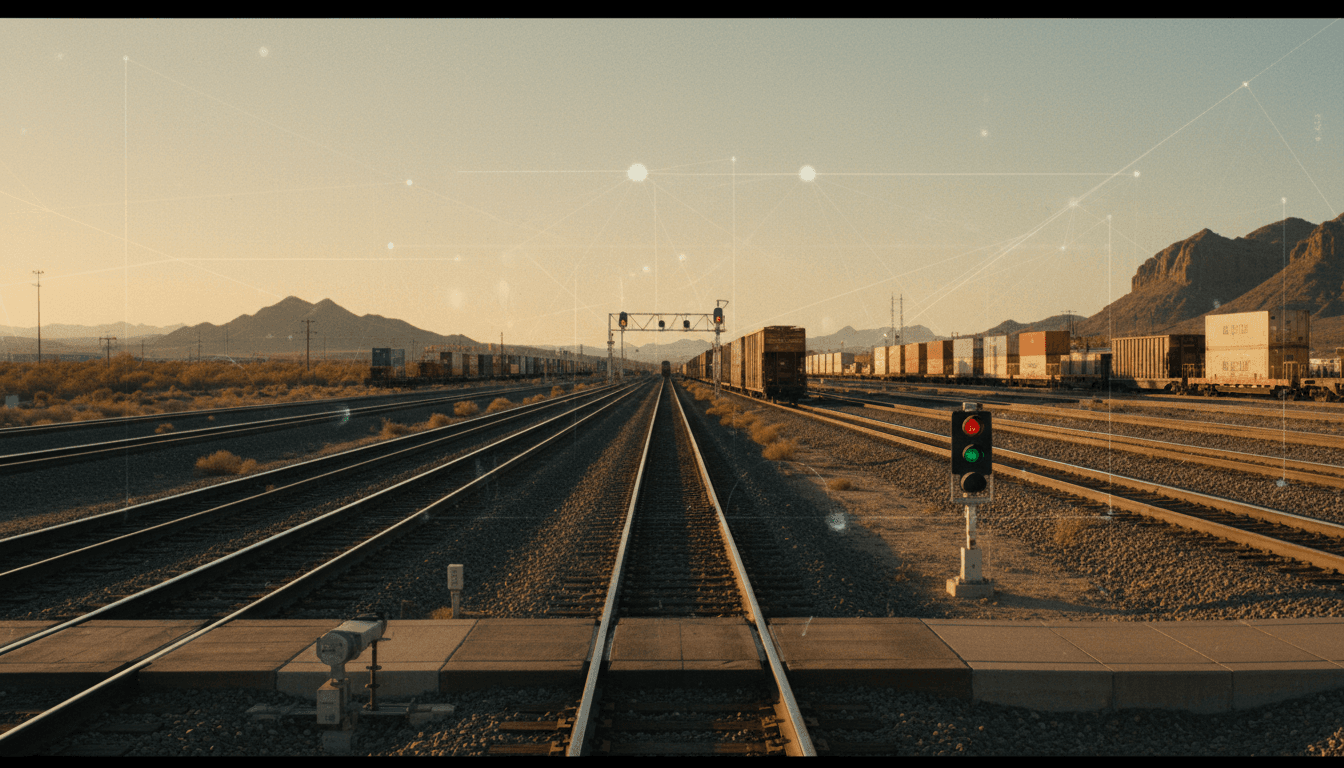
Rail Yard Expansion: The Data Engine AI Needs
Union Pacific just doubled the capacity of its Casa Grande Yard in Arizona by adding four new tracks, a new industrial lead, a powered switch, a new yard control point, and upgraded mainline signals. That sounds like “railroad news.” If you’re responsible for supply chain performance, it’s something more specific: a capacity increase that creates cleaner, richer operational data—and better odds that AI forecasting and routing models will actually work in the real world.
Most companies treat AI in transportation and logistics like a software purchase. The reality is less glamorous and more practical: AI performs best when the physical network is stable enough to produce consistent, comparable data. Yard expansions and signal upgrades are the kind of unsexy infrastructure moves that reduce variability, improve cycle-time reliability, and make predictions less brittle.
This post is part of our “AI in Supply Chain & Procurement” series, where the consistent theme is simple: demand planning, sourcing decisions, and inventory strategy only get smarter when the underlying logistics network gets more predictable. Casa Grande is a great example of that relationship.
Why a rail yard expansion matters to AI-driven supply chains
A yard expansion matters because yards are where network flow becomes measurable. Trains arrive, dwell, get reclassified, depart, and create time-stamped events. When capacity is constrained, those events get noisy: long dwell times, irregular departures, and cascading congestion that makes it hard to separate “true demand” from “network delay.”
Doubling yard capacity tends to improve three things AI cares about:
- Signal-to-noise ratio in historical data: Fewer extreme outliers from gridlock.
- Operational repeatability: More consistent handoffs and switching windows.
- Decision latitude: Dispatchers and planners have more feasible options, which enables optimization rather than constant firefighting.
If you’re building or buying AI supply chain optimization tools, this is the part people skip. Models don’t just need data—they need usable data. A constrained yard produces “data,” but it often describes congestion rather than demand.
Capacity isn’t just throughput—it’s optionality
When a yard runs hot, you get one strategy: move what you can, when you can. When capacity expands, you get choices: which blocks to build, when to release trains, whether to prioritize local industry spots versus manifest connections, and how to stage power and crews.
From an AI perspective, expanded optionality is gold. It allows tools like:
- Predictive ETAs to stabilize because departures aren’t constantly slipping.
- Network optimization to recommend different routings without “breaking” feasibility.
- Inventory positioning models to trust that replenishment lead times won’t swing wildly.
What Union Pacific changed at Casa Grande—and why it’s more than construction
Union Pacific’s Casa Grande Yard upgrade included:
- Four new tracks (core capacity increase)
- A new industrial lead (better access for local industry switching)
- A powered switch (replacing manual throwing)
- A new yard control point (more structured control of movements)
- Upgraded mainline signals (better integration with the Sunset Route flow)
Each element hits a different part of the reliability equation.
Powered switches: a safety move that also improves data quality
Union Pacific noted that the powered switch helps crews avoid slips, trips, and strain by eliminating the need to hand-throw the switch. Safety improvements are the headline—and they should be.
But there’s a planning upside too: manual steps introduce timing variance. The more steps depend on walking, weather, fatigue, and local constraints, the harder it is to model task duration. Powered switches reduce that variability, which typically tightens the distribution of switching times.
Tighter distributions are exactly what AI models need. If you’ve ever tried to forecast dwell time and found your error bars comically wide, it’s often because the process itself is inconsistent.
Control points and signal upgrades: fewer surprises, better predictions
A new yard control point and upgraded signals can reduce “mystery minutes”—those unclassified delays that show up as slack, padding, or unexplained dwell. When movements are governed more explicitly:
- Event logs become clearer (arrival, permission, movement, departure)
- Conflicts are resolved with fewer ad-hoc decisions
- Dispatching becomes more consistent across shifts
If you’re a shipper, that translates to more trustworthy rail service windows, which is the foundation for better procurement planning (more on that below).
The real connection: physical capacity enables digital optimization
AI in transportation and logistics tends to fail for one of two reasons:
- The model is fine, but the network is too constrained to follow recommendations.
- The network is capable, but the data is too messy to learn reliable patterns.
Yard expansions help both.
AI routing and scheduling need feasible “degrees of freedom”
Optimization isn’t magic. If your network has no slack, the “optimal plan” is often just “survive.” By expanding Casa Grande, UP increases the likelihood that:
- Trains can be held and released more strategically
- Blocks can be staged to reduce rework
- Local industry service can happen without derailing mainline priorities
Those are prerequisites for AI-driven scheduling. The best algorithm can’t route freight through a bottleneck that physically cannot process it.
Better capacity can reduce bullwhip effects upstream
Here’s where the AI in Supply Chain & Procurement angle gets real. Procurement teams often respond to unreliable transit times with:
- larger safety stocks
- earlier ordering (pulling demand forward)
- expediting (and paying for it)
Those behaviors create distorted demand signals, which then hurt forecasting accuracy. When rail network reliability improves—even modestly—companies can tighten replenishment policies and reduce artificial demand spikes.
A yard expansion is not “just rail.” It’s a contributor to cleaner demand signals.
How shippers can use AI to benefit from expanded rail capacity
Expanded capacity doesn’t automatically become better service for every shipper. The winners are the ones who adjust their planning systems and operating rhythms to take advantage of improved flow.
1) Recalibrate lead-time assumptions (don’t keep last year’s buffers)
If your planning system still assumes chronic delay through a corridor, you’ll keep buying inventory and expediting as if nothing changed.
What I’ve found works is a structured reset:
- Update lane-level lead-time distributions (not just averages)
- Recompute safety stock using the new variability
- Validate with a 6–8 week “reality check” window before making aggressive reductions
AI demand planning tools can help here, but only if you feed them refreshed assumptions and stop treating lead times as static.
2) Add yard and corridor signals into your risk models
Most shipper risk models focus on weather, labor, and port congestion. Rail yard constraints rarely get explicit treatment—yet they’re often the reason your ETA confidence collapses.
Practical approach:
- Maintain a corridor-level “operability score” tied to dwell, departure adherence, and congestion indicators
- Use that score to trigger procurement actions (alternate sourcing, earlier buying, or modal shifts)
The point isn’t perfection. It’s making rail network state a first-class input to supply chain optimization.
3) Use AI to choose when rail is the right answer (not all freight should ride)
When rail service stabilizes, it becomes a stronger candidate for freight that’s currently moving by truck because planners don’t trust rail schedules.
AI in transportation procurement can help identify:
- shipments with enough time slack to benefit from rail economics
- lanes where reliability has improved enough to reduce penalty risk
- customers or DCs where appointment flexibility makes rail practical
The win isn’t theoretical. It’s measurable in landed cost, emissions, and capacity resilience.
“People also ask” questions your team should settle now
How does a rail yard expansion affect freight transit time?
A yard expansion typically improves consistency more than raw speed. You may not see a day shaved off every move, but you often see fewer extreme delays and tighter ETA ranges.
Does more yard capacity automatically reduce dwell?
Not automatically. It reduces the probability of congestion-driven dwell, but results depend on operating plans, crew availability, and how the railroad sequences work. Capacity creates the conditions; execution captures the benefit.
Where should AI be applied first after an infrastructure upgrade?
Start where reliability gains translate directly to business value:
- ETA prediction and appointment planning (customer experience and detention)
- Inventory policy recalibration (cash and service levels)
- Mode and lane optimization (transportation spend)
If you try to jump straight to full network optimization without stabilizing inputs, you’ll spend months arguing about why the model “doesn’t match reality.”
What this signals for 2026 planning: rail + AI is a paired investment
Casa Grande sits on Union Pacific’s Sunset Route and supports both local industries and manifest freight. That matters heading into 2026 because shippers are balancing three pressures at once:
- Peak-season fragility (holiday surges expose every bottleneck)
- Cost control (transportation budgets remain tight)
- Resilience (multi-modal options are now a board-level topic)
Infrastructure investment is the long game. AI is the fast loop. Together, they’re how networks get both stronger and smarter.
If you’re building your 2026 roadmap for AI supply chain optimization, don’t treat rail network changes as background noise. Treat them as model inputs and opportunity triggers.
Memorable rule: AI can’t optimize what your infrastructure can’t execute.
Next step: audit the corridors that feed your network, identify where capacity has improved, and update your forecasting and procurement rules accordingly. Then ask the question most teams avoid: If rail reliability improves, which “temporary” workarounds should we finally retire?