Rail mergers can break AI forecasts fast. Here’s how to protect routing, ETAs, and procurement decisions when rail networks and labor dynamics shift.
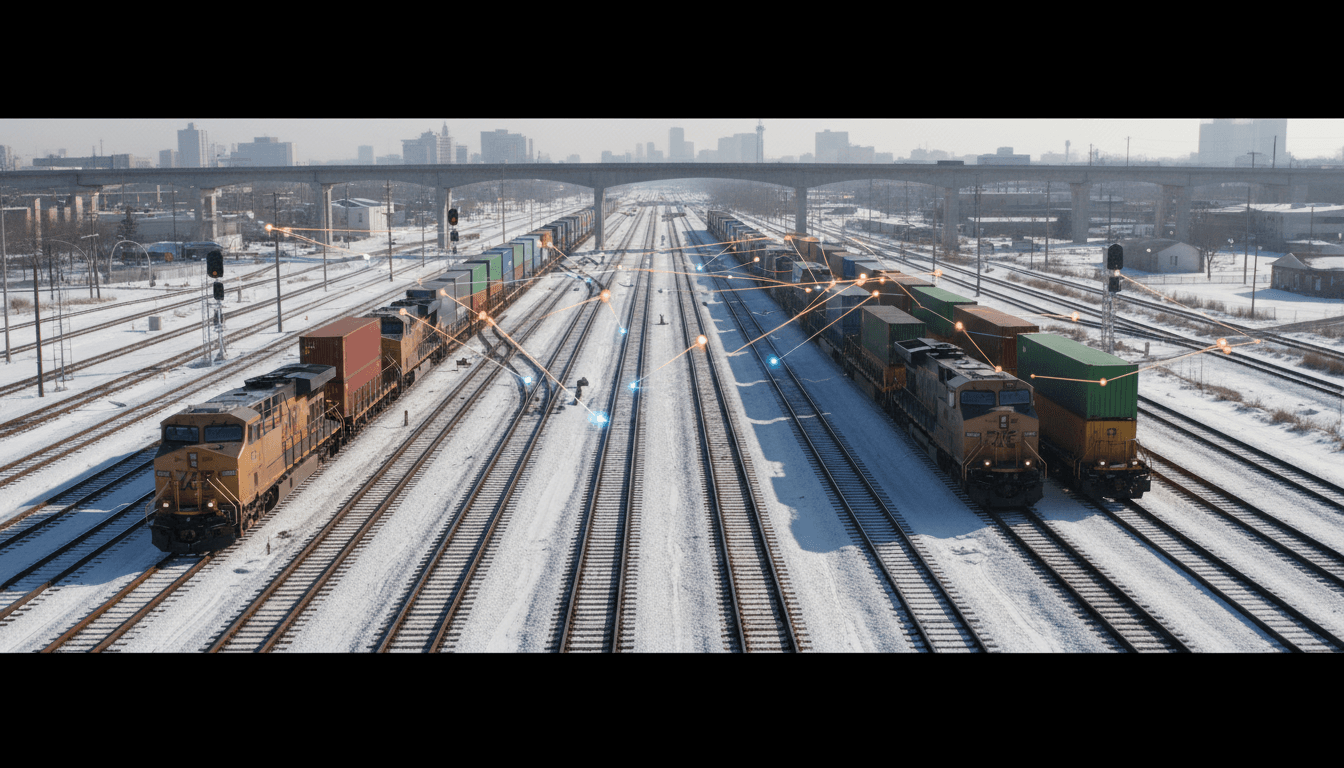
Rail Merger Risk: Keep AI Supply Chains Accurate
A single regulatory filing can scramble a year’s worth of supply chain assumptions.
That’s why the proposed Union Pacific–Norfolk Southern transcontinental rail merger—and the very public opposition from two of the biggest U.S. rail unions—deserves more attention from supply chain and procurement leaders than a typical “industry consolidation” headline. If you run AI-driven forecasting, transportation procurement, or network optimization, a major rail merger is not background noise. It’s a structural change to the map your models think they’re operating on.
The union message is clear: they expect higher safety risk, potential service disruption, and less attractive rail options for customers if the merger proceeds. The railroads argue the opposite: fewer interchanges, faster freight movement, and lower system friction. Both claims can be true in different corridors, for different commodities, and at different points in the integration timeline. The practical question for shippers is simpler: How do you keep planning accuracy when the underlying rail network and labor dynamics might shift fast?
What union opposition really signals to shippers
Union opposition is an early warning indicator that operational variability could rise during a merger—even before a single track, yard, or schedule is changed.
Two major unions, representing train crews and maintenance-of-way employees, have said they won’t back the proposed UP–NS deal, pointing to safety concerns, job protection gaps (seniority, relocation), and the likelihood that the merged carrier could divest “non-core” lines to short line railroads while running longer trains on mainlines.
For supply chain teams, the takeaway isn’t “the merger is good” or “the merger is bad.” The takeaway is:
- Labor friction becomes forecast risk. If unions expect job losses, forced relocations, or changed working rules, morale and staffing stability become operational variables.
- Safety debate often correlates with speed and dwell volatility. Even small changes in inspection regimes, track time windows, or crew availability show up as terminal dwell and missed connections.
- Service rationalization changes the network you buy. If lower-density lines move to short lines, you may see new interchange points, different cutoffs, and different performance profiles.
A merger is rarely “one change.” It’s hundreds of changes spread across 12–24 months. Your AI models will only be as good as the assumptions you update.
“Hell or the highway” is a pricing signal, too
When unions warn that customers could face fewer workable rail options, they’re also describing a classic procurement problem: reduced contestability.
Even if the merger is framed as “end-to-end,” many shippers experience rail competition at the lane level: one origin ramp, one destination ramp, one serving carrier, one feasible schedule. If consolidation tightens that further, pricing power can shift—especially in peak seasons.
For AI in transportation procurement, that means lane-level models should track:
- Effective number of viable carriers (not “carriers in the market,” but carriers you can actually use)
- Switching costs (equipment, transload, contracts, terminal access)
- Seasonal sensitivity (ag, retail surge, chemicals)
Rail mergers change the “data generating process” behind your AI
A rail merger doesn’t just change service. It changes how the data you rely on gets produced.
Most AI in supply chain & procurement—demand forecasting, ETAs, inventory optimization, sourcing decisions—implicitly assumes a relatively stable relationship between:
- Network structure (interchanges, corridors, terminals)
- Operating plan (schedules, dwell patterns, train length, crew availability)
- Pricing behavior (tariffs, accessorials, contract structures)
Mergers disrupt those relationships. In data science terms, you’re dealing with concept drift: historical patterns stop predicting the future because the system itself has changed.
Here’s how that shows up in the real world:
Interchange removal can improve averages while hurting edge cases
The merger partners claim eliminating interchanges (notably around major hubs) can speed freight movement. That’s plausible. But an “average improvement” can hide a nasty truth:
- Some lanes get faster and more reliable.
- Other lanes get re-routed, reclassified, or deprioritized.
If your model is trained on aggregate on-time performance, it may miss the customers who get pushed into the “long tail” of exceptions.
Short line transfers change exception patterns
If secondary lines are sold or leased to short lines, your network may gain an extra handoff. That introduces different failure modes:
- Increased coordination points
- More variability in local service windows
- Different maintenance standards and capital constraints
AI systems that treat “rail” as one homogeneous mode tend to underperform here. You want features that explicitly represent railroad type and interchange complexity.
Labor rules and staffing constraints become first-class variables
Rail is heavily union-regulated. During major organizational change, labor agreements and staffing availability can create real capacity ceilings.
For planning systems, that means adding (or strengthening) signals for:
- Terminal congestion proxies (dwell, queue time)
- Crew availability indicators
- Service embargo alerts
If you don’t track labor and service advisories as structured data, your “perfect” optimizer will keep producing plans your operations team can’t execute.
How to make AI planning resilient during major rail network shifts
Resilience is not a dashboard. It’s a set of design choices that keep decisions usable when assumptions break.
If your supply chain AI is expected to help during a rail merger (or any infrastructure shift), build around three principles: scenario planning, constraint realism, and rapid feedback loops.
1) Run merger scenarios like you run peak season scenarios
Treat the merger as a multi-quarter event with phases: pre-approval uncertainty, integration planning, network rationalization, operating plan consolidation.
Practical scenario set (simple, but effective):
- Base case: no major change, normal variability
- Optimistic case: interchange reductions improve transit time by 5–15% on targeted corridors
- Disruption case: temporary service instability (missed switches, added dwell) increases transit time variability by 20–40%
- Network change case: divestment/short line transfer adds one interchange and 1–3 days buffer on affected lanes
You don’t need perfect numbers. You need a consistent playbook that makes your team faster at reacting.
2) Upgrade from “route optimization” to “network-aware optimization”
Many transportation optimizers pick the cheapest or fastest path given static assumptions. A merger demands network-aware optimization: you model the network as a living system.
What I’ve found works is adding explicit penalties and constraints for:
- Interchange count (each interchange increases risk and variability)
- Terminal dwell risk scores
- Lane-level reliability (not mode-level)
- Contractual constraints (service commitments, accessorial exposure)
Then you can make procurement decisions that reflect operational reality, not just a rate sheet.
3) Use “early drift detectors” for service and cost
AI systems shouldn’t wait for quarterly reviews to discover that rail performance changed.
Set up drift monitors that trigger investigation when:
- On-time delivery drops by X points for a lane for 2–3 consecutive weeks
- Dwell time at a hub rises above a threshold
- Accessorial charges spike (storage, demurrage-like fees, reconsignment)
- Your planned vs. actual transit time error exceeds a defined band
When drift is detected, the system should do something useful:
- Re-rank modes (rail vs truck vs intermodal)
- Add safety stock recommendations
- Suggest alternative ramps or transload points
- Flag lanes for sourcing or supplier lead time adjustments
The procurement angle: contracts, risk sharing, and service definitions
If this merger proceeds, the winners won’t be the companies with the fanciest model. They’ll be the ones whose contracts and operating plans make uncertainty manageable.
During big rail shifts, procurement should renegotiate around measurable service definitions and shared risk, not vague commitments.
Contract clauses worth revisiting (now)
- Service-level language tied to lane-specific performance (not generic network averages)
- Accessorial clarity (what triggers charges, when they apply, how disputes work)
- Contingency routing approvals (pre-approved alternates reduce response time)
- Volume flexibility bands (avoid penalties when you must shift freight to truck)
And if you’re using AI for transportation procurement, train your recommendation logic to account for contract risk, not only price.
Don’t ignore the customer-facing impact
Unions argue the merger could push up consumer prices. Whether that happens broadly is hard to prove in advance, but at the shipper level the mechanism is straightforward:
- If reliability drops, you carry more inventory.
- If rail options shrink, you pay more for capacity.
- If you shift to truck, your cost per mile and emissions profile often rise.
AI in supply chain planning should translate rail uncertainty into customer metrics: fill rate, stockout probability, and promised delivery dates.
People also ask: what should supply chain leaders do first?
What should I do this quarter if my network relies on UP or NS? Start by mapping your top 20 rail-dependent lanes and identifying which ones have no easy alternative. Those lanes get scenario buffers, drift monitoring, and procurement attention first.
Can AI prevent disruption from a rail merger? AI can’t prevent a disruption, but it can reduce the business impact by detecting drift early, recommending alternate routings, and adjusting inventory and lead times before service failures hit customers.
How do unions affect AI logistics adoption? Union-regulated environments tend to have stricter operating rules and slower change management. That’s not bad—it just means your AI must model constraints honestly and your rollout plan must include frontline input.
What to do next (and why it fits this series)
This post sits squarely in our AI in Supply Chain & Procurement series because it’s a perfect example of a bigger truth: AI planning is only as reliable as the infrastructure and governance it depends on. Rail networks are critical infrastructure for North American supply chains, and changes in ownership and operating models ripple straight into forecasting, routing, and supplier lead times.
If you want your AI to stay useful through 2026 planning cycles, treat the potential transcontinental rail merger as a live stress test. Tighten your lane-level data, monitor drift weekly, and update procurement terms so you’re not trapped when assumptions break.
If you’re building or upgrading an AI-driven transportation and inventory planning stack, ask one hard question: If a core carrier’s network changes in 90 days, will our system adapt—or will it keep confidently recommending last year’s reality?