Predictive truck diagnostics cuts the real cost of breakdowns: uncertainty. Learn how tools and AI reduce downtime, speed repairs, and protect margins.
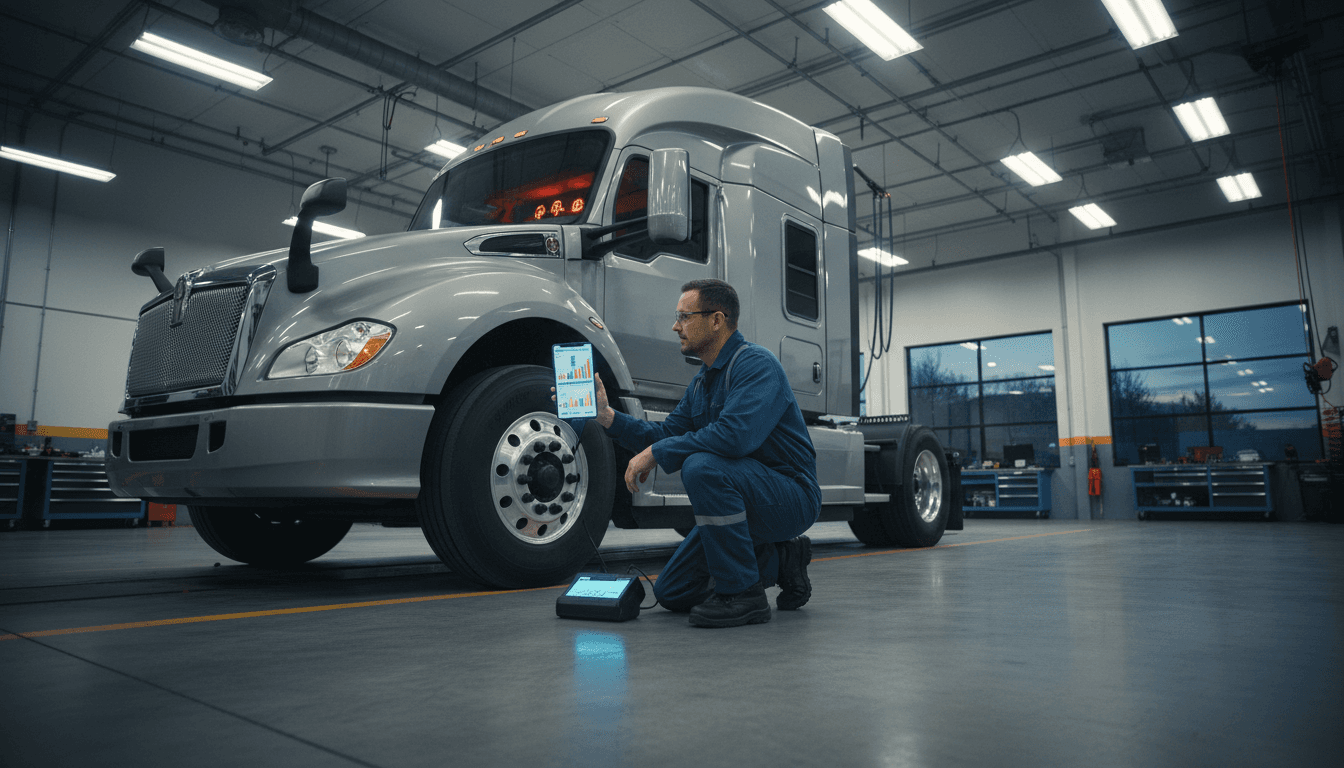
Predictive Truck Diagnostics: Cut Downtime, Boost Margins
A single check-engine light can trigger a chain reaction: missed appointments, service queues, rescheduled loads, and a dispatcher trying to re-plan a week in a day. The part that drains your bank account fastest usually isn’t the sensor or filter. It’s the hours (or days) spent not knowing what’s actually wrong.
That “uncertainty tax” is showing up everywhere right now—especially heading into 2026 planning. Freight demand is still uneven, insurance and labor remain expensive, and shippers have less patience for late deliveries. In that environment, maintenance isn’t just a shop problem. It’s a supply chain reliability problem.
This post is part of our AI in Supply Chain & Procurement series, and I’m going to take a clear stance: truck diagnostics is the most practical on-ramp to AI-driven logistics efficiency. If you can’t capture clean data about what’s failing and when, predictive maintenance is just a buzzword on a slide deck.
The most expensive part of a breakdown is uncertainty
Answer first: The biggest cost in many breakdowns is the time and operational chaos created by incomplete information.
When a truck derates or throws aftertreatment faults, you’re immediately making high-stakes decisions with partial visibility:
- Is this safe to run to the next stop?
- Do we need a tow, or can we limp to a shop?
- Is this a real failure or a false-positive event?
- Which shop can actually diagnose it quickly?
If you don’t have answers, you default to the most conservative (and costly) path: park it, tow it, wait your turn, and approve exploratory labor. That’s why a small issue turns into a multi-day disruption.
One shop owner called it “parts roulette.” Tyler Robertson of Diesel Laptops uses a better term: the “parts cannon”—firing expensive parts at a problem until something changes. It’s not malicious. It’s what happens when diagnostics are slow, OEM information is fragmented, and techs are under pressure.
Here’s the procurement tie-in most teams miss: uncertainty inflates spend. It increases labor hours, drives expedited shipping fees for parts, and forces higher-cost capacity decisions when loads have to be recovered.
Diagnostics isn’t a mechanic detail—it’s an operations system
Answer first: A diagnostic workflow is an operations capability, because it determines how fast you can return capacity to service.
Most fleets treat diagnostics as a shop task. In reality, diagnostics touches:
- Planning: what loads can be covered tomorrow
- Customer service: whether ETAs can be trusted
- Procurement: which parts to buy, when, and at what price
- Safety/compliance: whether the truck should move at all
- Finance: cash flow predictability (especially for small carriers)
Why “right-to-repair” matters for commercial vehicles
If you’ve worked in automotive, you’ve seen how standardized access to diagnostic info created a healthier ecosystem of tools, training, and independent repair options. Commercial trucks haven’t reached that level. Much of the best information remains gated behind OEM systems, subscriptions, and VIN-specific permissions.
The result: diagnostic delays become systemic. And systemic delays are exactly what AI efforts struggle with, because AI needs consistent data, consistent labeling, and consistent access to repair steps.
The practical shift: own enough diagnostics to manage the decision
Owner-operators and small fleets don’t need to rebuild engines on the shoulder. They need situational awareness. The goal is to make good decisions quickly:
- “This is a sensor issue; we can finish the day.”
- “This is an emissions fault; we need a safe regen plan.”
- “This is critical; park it now and avoid a bigger failure.”
That’s the operational win: turn unknowns into bounded choices.
What modern diagnostic tools change (and why AI depends on them)
Answer first: Modern tools reduce downtime by turning fault codes into actionable steps and by creating the data foundation for predictive maintenance.
Tools like Diesel Laptops’ Diesel Decoder (and comparable fleet-grade platforms) focus on a simple promise: plug in, read what the truck is saying, and translate it into actions a driver or manager can take.
In plain terms, practical diagnostics tools typically enable:
- Read and clear fault codes to understand severity and confirm if an issue returns.
- View live engine data to verify whether the system is operating inside normal ranges.
- Run safe procedures (like a regen when appropriate) with guidance.
- Get troubleshooting steps instead of starting with guesswork.
- Identify part numbers and alternatives so procurement isn’t waiting on a counterperson’s availability.
That last point is huge for supply chain and procurement: if you can identify a part precisely, you can reduce:
- wrong-part purchases
- returns and restocking fees
- premium freight for “we need it tomorrow” orders
- downtime waiting for “maybe it’s this” parts to arrive
The “one tow pays for it” math is real—but incomplete
Yes, avoiding a single tow bill often justifies the tool cost. But the bigger financial driver is cycle time:
- time from first fault to confirmed diagnosis
- time from diagnosis to parts ordered
- time from parts arrival to repair completion
AI-driven maintenance programs don’t magically remove these steps. They make them faster—if the data is available and trusted.
Aftertreatment and DPF issues: why misdiagnosis keeps bankrupting carriers
Answer first: Aftertreatment faults are costly because they’re often symptoms, not root causes—and guessing gets expensive quickly.
DPF lights and regen failures are where many operators bleed cash, especially when cold weather hits and trucks idle more. The common trap is treating aftertreatment as the “broken thing,” when it’s frequently the messenger.
A real-world example from the discussion with Tyler Robertson:
- A driver spent weeks and thousands chasing DPF problems.
- The root cause was an oil leak upstream.
- The aftertreatment system was where the error surfaced, not where the failure began.
This is exactly where better diagnostics changes outcomes. With live data and structured troubleshooting, you’re more likely to:
- detect upstream conditions (temps, pressures, sensors)
- avoid repeated DPF cleanings that don’t address the cause
- prevent cascading failures that trigger derates and roadside events
One point worth being blunt about: emissions deletes are illegal. The smart move is not “bypassing the system.” It’s understanding the system well enough to repair it correctly the first time.
The next step: AI-driven predictive maintenance in trucking
Answer first: Predictive maintenance works when AI can see consistent fault history, operating conditions, and repair outcomes—and then recommend actions before a roadside event.
AI in transportation often gets framed as autonomous vehicles or warehouse robots. For most fleets, the fastest ROI is simpler: predict failures, schedule repairs, and keep trucks rolling.
Here’s what’s already happening in the market:
- Real-time monitoring of transit and fleet assets
- AI models that flag early indicators (temperature drift, sensor patterns, regen frequency changes)
- Human technicians validating what the system sees (because false positives waste money)
Why predictive diagnostics still hits a wall
Tyler’s point is right: without accurate, VIN-specific data, AI guesses.
AI needs:
- correct fault code definitions by make/model/engine family
- service procedures that match that VIN’s configuration
- historical outcomes (what fixed it, how long it took, what it cost)
If that information is incomplete or locked away, predictive maintenance becomes “probable causes” instead of “do this next.” Probable causes can still help, but fleets shouldn’t confuse it with a ready-to-execute maintenance plan.
What “good” looks like in 2026 planning
If you’re setting priorities for the next budget cycle, aim for a closed loop:
- Capture codes + live data at the moment of failure (or early warning).
- Classify severity (stop now, limp, schedule, monitor).
- Prescribe next actions (tests, parts, service steps).
- Procure the right parts with minimal delay.
- Confirm the repair outcome and feed it back into the system.
That loop is where AI becomes more than a dashboard. It becomes operational memory.
A practical playbook: reducing downtime in 30 days
Answer first: You can cut downtime fast by standardizing triage, capturing consistent data, and tightening the parts-to-repair workflow.
Here’s a straightforward 30-day rollout plan I’ve seen work for small fleets and mid-sized carriers.
Week 1: Standardize roadside triage
Write a one-page triage SOP. Keep it simple.
- What codes/data must be captured before calling a shop?
- Who decides “park vs limp”? (Name the role.)
- Which info must be shared with the shop upfront?
Week 2: Fix the handoff between driver, dispatcher, and shop
Most delays come from “telephone diagnostics.” Require a structured message:
- truck/unit number
- fault codes captured
- last regen time (if relevant)
- symptoms observed (power loss, smoke, temps)
- a photo of dash warnings if possible
Week 3: Tighten your parts procurement flow
Procurement can reduce downtime without negotiating a single new contract.
- build a short list of high-failure parts by unit/engine family
- define approved alternates (aftermarket vs OEM) by criticality
- keep a micro-stock of cheap, high-impact items (sensors, clamps, common connectors)
Week 4: Start measuring the downtime you can control
Track three numbers per event:
- time to diagnosis
- time to parts in hand
- time to return to service
Even a basic spreadsheet works. The point is to find your real bottleneck.
Memorable rule: If you don’t measure “time to certainty,” you’ll keep paying for uncertainty.
What this means for AI in supply chain & procurement
Breakdowns aren’t only a maintenance issue—they’re a service level and cost-to-serve issue.
- If you’re forecasting demand but ignoring asset reliability, your forecast can be “right” and still fail operationally.
- If you’re optimizing routes but not reducing unplanned downtime, your plan is fragile.
- If you’re negotiating parts pricing without improving diagnostic accuracy, you’ll still waste money on wrong parts and repeat repairs.
Diagnostics is the bridge: it connects shop-floor reality to AI-driven planning.
The next time a truck throws a fault code, the goal isn’t heroics. It’s speed and clarity. Know what’s wrong faster, decide faster, and keep freight moving.
If you’re building your 2026 roadmap, here’s a useful question to end on: Do you have enough diagnostic data to let AI predict the next failure—or are you still waiting for a shop to tell you what happened after the fact?