Amazon’s money-back air cargo guarantee signals a new era of reliability. See how AI-driven ETA, routing, and exception management make SLA guarantees feasible.
Money-Back Air Cargo: How AI Makes It Possible
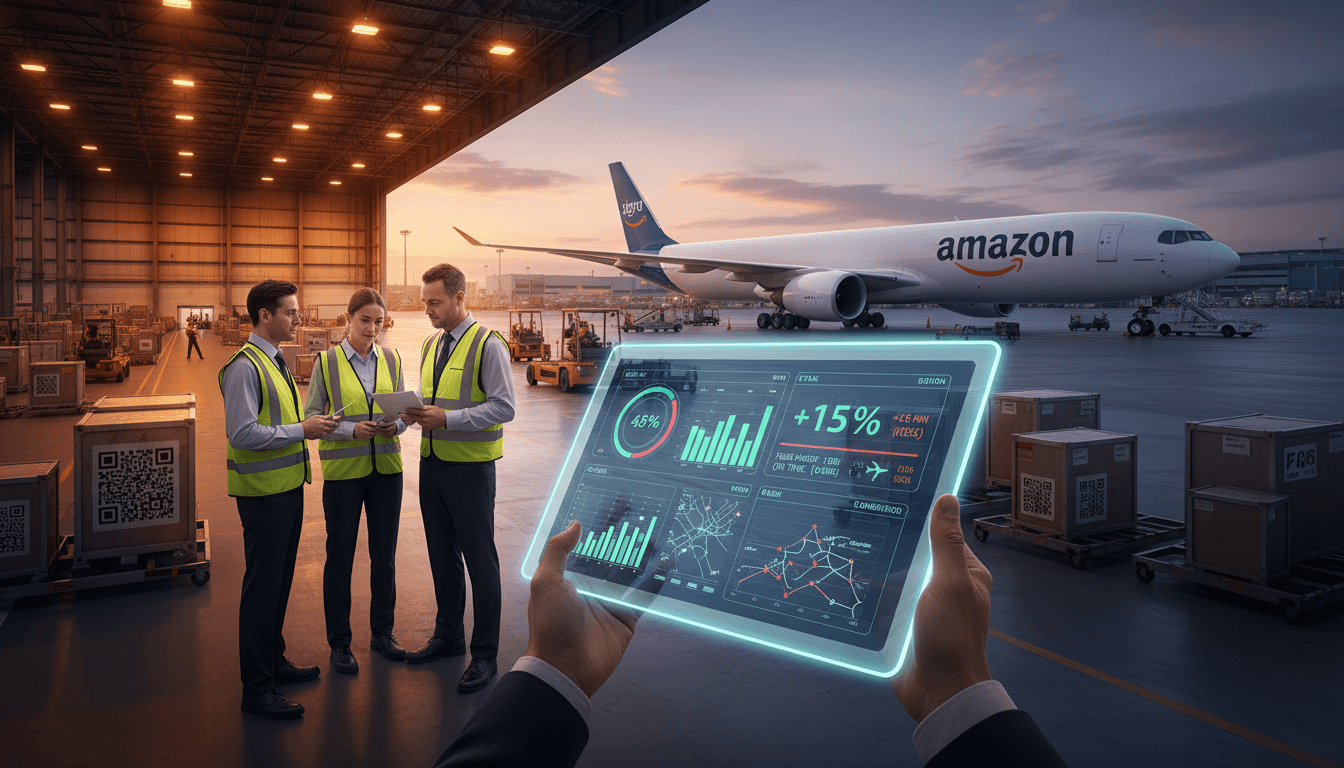
Amazon’s air cargo team is now putting real money behind on-time performance: a money-back guarantee that refunds shipping fees (up to $10,000 per flight) if a shipment arrives more than two hours late due to a service failure. That kind of promise has traditionally belonged to integrators with end-to-end control—think the express networks built for time-definite delivery.
Here’s the part most shippers and forwarders should pay attention to: a guarantee like this isn’t just a commercial tactic. It’s a technology statement. You don’t offer a broad performance guarantee unless you believe your planning, visibility, and exception management are strong enough to keep payouts rare.
This post is part of our AI in Supply Chain & Procurement series, where we focus on how AI forecasting, risk management, and supplier performance tie directly to service outcomes. The headline is Amazon, but the bigger story is the direction of the market: air cargo is shifting from “capacity + hope” to “capacity + provable reliability.”
Why money-back guarantees are suddenly showing up in air cargo
A money-back guarantee in traditional air cargo is uncommon because responsibility is fragmented. A typical move involves multiple entities—forwarders, airlines, ground handlers, warehouses, trucking providers—each with their own systems and incentives. The more handoffs you have, the harder it is to promise a tight delivery window.
Amazon’s play is different because it’s selling access to a network it already runs at massive scale. It operates an air network with 100+ cargo jets and 65+ destinations, and it’s commercializing excess capacity through Amazon Air Cargo. The implication: Amazon believes it can control enough of the journey (or react fast enough when things go sideways) to make on-time delivery predictable.
There’s also a seasonal reality here. Mid-December is when air cargo volatility peaks—capacity tightens, weather risk rises, and every missed connection cascades into customer-facing pain. Offering a guarantee during peak season signals confidence in planning and recovery.
The market pressure behind the promise
A guarantee is partly marketing, but it’s also a response to what procurement teams now demand:
- Service-level agreements (SLAs) with teeth (refunds, penalties, credits)
- Audit-ready performance data (what happened, where, and why)
- Predictable delivery windows that support inventory policy and replenishment
If you manage procurement or transportation, you’ve probably felt the shift. Leadership doesn’t want explanations. They want reliability—and contracts that enforce it.
What Amazon is really selling: “AWS for logistics”
Amazon has a pattern: build internal capability, perfect it under real load, then sell it outward. That’s how Amazon Web Services became the default infrastructure for huge parts of the internet. Amazon Air Cargo is following a similar logic—commercializing the operational system behind fast retail delivery.
The FreightWaves reporting highlighted that Amazon is also upgrading its digital experience with a consolidated console (“Supply Chain by Amazon”) that supports:
- Instant quotes and capacity visibility
- Booking and space reservation
- Real-time shipment monitoring
- Billing, payments, and support workflows
This matters because guarantees require instrumentation. A refund policy is only workable if you can measure service precisely, attribute failure causes, and automate claims decisions without creating a customer-service nightmare.
A guarantee isn’t a promise. It’s a bet that your data and operations are good enough to win.
Why this is a procurement issue, not just a transportation issue
In the AI in Supply Chain & Procurement lens, guarantees change how you evaluate providers:
- You’re no longer buying “airfreight.” You’re buying on-time probability.
- Carrier selection becomes a risk-weighted sourcing decision.
- Your transportation strategy starts affecting working capital more directly because reliability influences safety stock.
That’s exactly where AI should live: at the intersection of cost, risk, and service.
The AI stack you need to meet (and profit from) service guarantees
To hit a two-hour delivery window consistently, you need to behave like a network operator, not a rate shopper. AI helps because it turns messy, real-world logistics into decisions that are fast, repeatable, and measurable.
1) Predictive ETA that’s actually actionable
Most ETAs are status updates dressed up as predictions. A useful predictive ETA answers: “Will this shipment miss its window, and what should we do right now to prevent it?”
To do that, models must ingest more than tracking pings:
- Flight schedules and historical on-time performance by lane
- Ground handling dwell times by airport/warehouse
- Weather patterns and seasonal congestion signals
- Missed-connection probabilities by routing option
- Capacity constraints and cut-off compliance
If you can’t quantify the miss risk early, you can’t prevent late deliveries—you can only apologize.
2) Disruption prediction and recovery orchestration
The operational difference between “late” and “still on time” is often one decision made hours earlier: reroute, expedite the dray, switch hubs, or rebook onto the next best flight.
AI-driven recovery is a closed loop:
- Detect rising risk (weather, crew constraints, late tender, high dwell)
- Simulate alternatives (different hub, different departure, truck to another airport)
- Choose the best option under constraints (cost, SLA, capacity)
- Execute quickly (automated booking workflows, exception tickets, partner messages)
This is where agentic AI becomes practical—not as a buzzword, but as a way to run repeatable playbooks at scale.
3) Network optimization: the unglamorous secret behind reliability
Amazon’s advantage isn’t just aircraft. It’s the ability to treat air, sort, linehaul, and last-mile as one interdependent system. When one link breaks, capacity and routing can shift.
For most shippers and 3PLs, the lesson is clear: you won’t out-fly a giant network, but you can out-decide your competitors by using AI to:
- Optimize routings by risk-adjusted transit time, not just published schedules
- Choose consolidation strategies that reduce handoffs (fewer failure points)
- Pre-position inventory when demand forecasting predicts spikes
Procurement leaders should push for these capabilities in RFPs. If a provider claims they can guarantee service, ask how their optimization engine works when conditions degrade.
How guarantees change shipper expectations (and vendor scorecards)
When one provider offers a money-back guarantee, it raises the bar for everyone else—even if competitors don’t match the policy immediately.
Expect more “integrator-like” air cargo offers
Traditional air cargo will keep existing structures (forwarders + airlines + handlers), but customers will increasingly demand integrator-style characteristics:
- time-definite commitments
- fewer intermediaries
- clear liability rules
- single-pane visibility
Guarantees pull the market toward standardized performance contracts, not informal expectations.
Upgrade your scorecard: measure what drives late deliveries
If your current carrier/forwarder scorecard is mostly “OTD % and cost,” you’re missing the levers that improve performance. Add operational leading indicators:
- Tender-to-cutoff compliance rate
- Airport dwell time variance (by station)
- Rebooking frequency and cause codes
- Exception response time (minutes, not days)
- Shipment-level predicted miss risk vs actual outcome (model calibration)
Those metrics are AI-friendly. They’re also procurement-friendly because they translate into enforceable process improvements.
Reliability is a supply chain cost strategy. Late freight isn’t just a service problem—it’s expedited rework, inventory shock, and customer churn.
Practical next steps: using AI to “buy down” air cargo risk
If you’re a shipper, forwarder, or logistics provider watching Amazon’s move and thinking, “We can’t match that,” start here. You don’t need 100 jets to become more reliable—you need a tighter decision system.
Step 1: Build a lane-level reliability baseline
For your top lanes, calculate (at minimum):
- on-time arrival to promised window
- average and 95th percentile delay
- top 3 delay causes (handoff delays, missed flight, documentation holds, etc.)
This becomes the foundation for AI forecasting and for SLA negotiations.
Step 2: Deploy “SLA-first routing” rules
Even without advanced optimization, you can improve reliability by routing based on probability of success:
- prefer routings with fewer handoffs
- avoid hubs with chronic dwell spikes during peak weeks
- reserve capacity earlier on lanes with high volatility
Then let AI refine those rules with continuous learning.
Step 3: Automate exception playbooks
Late shipments rarely fail for surprising reasons. They fail for familiar ones.
Create playbooks like:
- Missed connection risk > 60%: auto-propose alternate routing + notify customer
- Dwell time exceeds threshold: trigger escalation to station + arrange trucking backup
- Weather forecast risk: pre-approve reroute budget within SLA guardrails
If your team is still managing exceptions through email chains and spreadsheets, a money-back guarantee would be financially dangerous.
Step 4: Treat procurement as an AI data customer
Procurement teams should require vendors to share:
- event-level timestamps (scan in/out, depart/arrive, handoff)
- standardized delay codes
- audit trails for interventions (what was done, when)
If providers can’t supply clean data, you won’t be able to validate performance—or improve it.
What to watch in 2026: reliability becomes the product
Amazon’s money-back guarantee won’t be the last. As logistics becomes more digital, customers will expect reliability to be contractable, measurable, and transparent.
Two things I expect procurement and logistics leaders to prioritize next year:
- Predictive performance commitments: not just “on-time,” but “we’ll tell you 12 hours earlier if we’re going to miss.”
- Outcome-based pricing: base rate + reliability premium + penalty/credit mechanisms tied to SLA windows.
The companies that win won’t be the ones with the loudest AI story. They’ll be the ones that can show, lane by lane, how AI improves delivery reliability and reduces total supply chain cost.
If you’re considering service guarantees—either demanding them from partners or offering them to customers—start with your data and exception workflows. Then bring AI in to predict risk, choose better routings, and prevent misses before they become refunds.
Where could a money-back guarantee create the most value in your network: high-value electronics, perishables, or customer-critical spare parts?