Hainan’s customs closure changes lead times, landed cost, and routing. See how AI planning can model scenarios and optimize China–ASEAN flows.
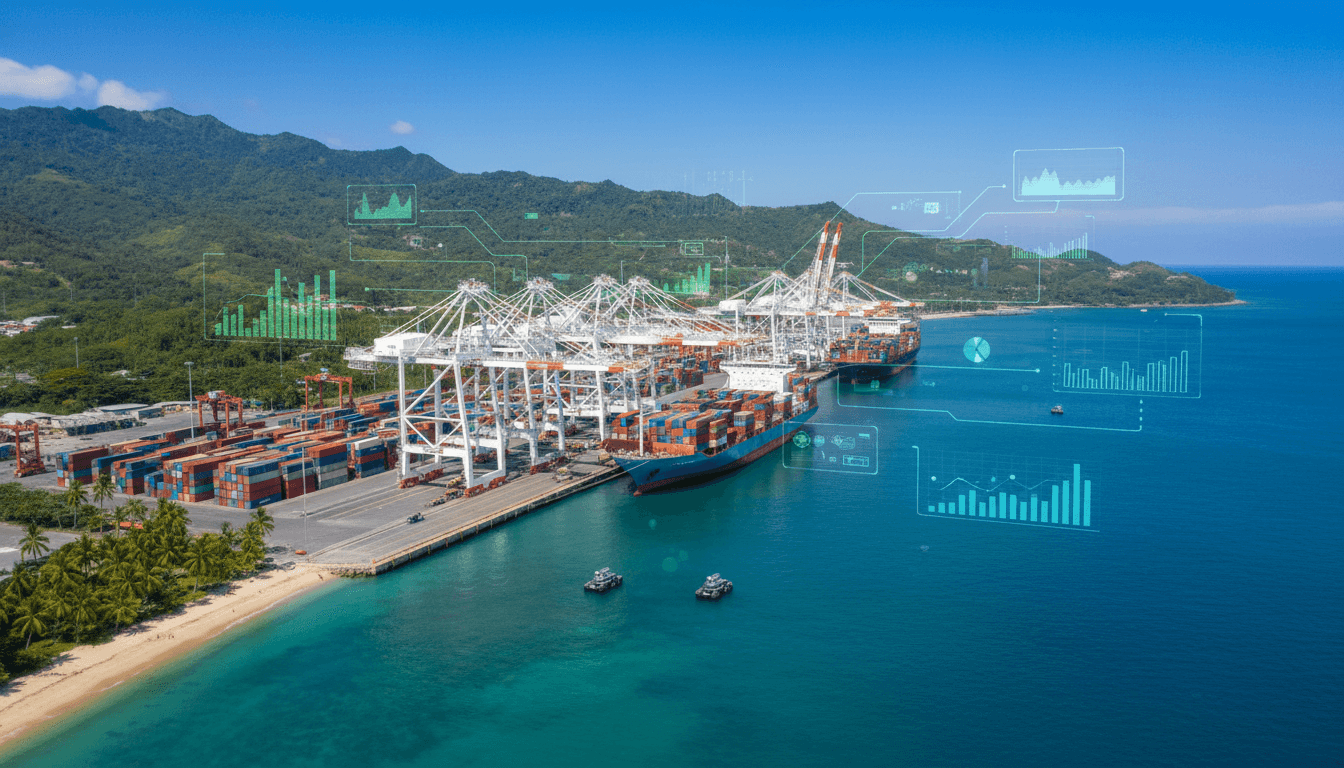
Hainan Customs Closure: What It Means for AI Logistics
On December 18, 2025, Hainan flipped a switch that logistics teams can’t afford to ignore: the Free Trade Port began island-wide customs closure operations. If that sounds like a bureaucratic headline, here’s the practical translation—Hainan just became a testbed for faster cross-border flows, different tax math, and new routing choices between China and Southeast Asia.
Most companies get this wrong: they treat policy shifts like this as a trade-compliance footnote. The bigger story is operational. When a region changes how goods are admitted, processed, and released, it changes the data your planning systems depend on—lead times, landed costs, port choice, and even the “best” inventory position. In the “AI in Supply Chain & Procurement” series, this is exactly the kind of real-world shift where AI either pays for itself—or exposes that your data foundation isn’t ready.
Hainan’s new model creates an emerging “China hub” for processing, postponement, and China-ASEAN distribution. The winners won’t be the companies with the fanciest dashboards. They’ll be the ones that can reconfigure their network fast, with AI models that understand new constraints and opportunities.
Island-wide customs closure, explained in operational terms
Hainan’s customs closure is not about shutting borders. It’s about separating the island’s trade regime from the mainland’s—so goods can move with fewer frictions at the international edge, while still controlling what enters mainland China.
The policy is commonly summarized as:
- Eased access at the “first line” (Hainan ↔ overseas): most goods move with minimal customs procedures unless prohibited or restricted.
- Controlled access at the “second line” (Hainan ↔ mainland China): goods entering the mainland face standard import rules, including taxation and compliance.
- Free flow within the island: goods, capital, and people circulate more freely inside Hainan.
The incentives that change supply chain math
Several parts of the framework directly reshape sourcing and manufacturing decisions:
-
Expanded “zero-tariff” coverage: eligible goods reportedly expand from ~1,900 to ~6,600 tariff lines (coverage from 21% to 74%). The exemption can include import tariffs plus import VAT and consumption tax, with the article noting potential savings of around 20% in tax costs on imported equipment.
-
Upgraded “tariff exemption for value-added processing”: processing in Hainan can qualify finished goods for tariff benefits when entering the mainland if value-added crosses a threshold (often referenced as 30%). The critical change is flexibility—value-added can be calculated more cumulatively across upstream and downstream participants, making compliance more achievable in real supply networks.
-
“Dual 15%” tax incentives: a 15% corporate income tax rate for encouraged industries that register and operate substantively in the Hainan FTP, and a talent individual income tax policy that caps the effective burden above 15% for qualifying high-end/in-demand talent.
Here’s the thing: these incentives don’t just reduce costs. They create new feasible process designs—like shifting final configuration, testing, labeling, or light assembly into Hainan to change the landed-cost equation into the mainland market.
Why this matters to AI in supply chain planning (and why spreadsheets will fail)
Hainan’s customs closure changes three planning inputs that AI systems are built to exploit: variability, constraints, and unit economics. If you’re still “planning” with static assumptions, you’ll miss the opportunity—or worse, you’ll build the wrong buffers.
1) Lead times will change—so forecasts must adapt
The source article claims Hainan can save about 10 days versus eastern coastal ports for certain inland China corridors. Whether your business sees 2 days or 12 days of benefit depends on your origin-destination pairs, sailing schedules, and inland modes—but the planning implication is universal:
- Shorter lead times reduce safety stock requirements.
- More predictable clearance reduces variability (and variability is what drives inventory).
AI demand forecasting and inventory optimization work best when they can learn from stable process signals. A new hub like Hainan introduces a transition period where patterns are shifting. You should expect:
- Temporary “model drift” as historical lead-time distributions become less relevant.
- The need for scenario-based forecasting (base case vs. ramp-up case vs. congestion case).
If you’re evaluating AI in supply chain planning, this is a perfect stress test: can your system detect that lead times are structurally changing, or does it blindly average the past?
2) Landed cost becomes dynamic, not static
Procurement teams often treat landed cost as a table. Hainan makes it a formula.
Zero-tariff eligibility, value-added processing rules, and “second line” controls mean landed cost can vary by:
- BOM composition and HS classification
- processing steps performed in Hainan
- value-added percentage achieved
- destination market (mainland vs. re-export)
AI can help, but only if it has the right features. The most practical approach I’ve seen is a landed-cost digital twin that combines:
- trade compliance logic (rules, thresholds, documentation states)
- logistics cost curves (freight, port fees, drayage, dwell)
- tax and incentive structures
Then you let optimization choose the best policy-compliant path, not a planner’s best guess.
3) Routing decisions become multi-objective
Traditional routing is “cheapest” or “fastest.” Hainan introduces a third axis: regime advantage.
Your transport optimization now needs to weigh:
- first-line clearance speed (overseas ↔ Hainan)
- second-line friction (Hainan ↔ mainland)
- whether processing in Hainan changes duty/tax outcomes
- service levels to China vs. ASEAN customers
This is where AI-enabled network design earns its keep: it can evaluate thousands of combinations of ports, modes, and processing locations while respecting compliance constraints.
How Hainan reshapes China–ASEAN supply chains (the “China hub” effect)
Hainan’s geographic position and new regime are designed to pull flows into a China–ASEAN interface—not just for transshipment, but for processing and market access.
Corridor to hub: why “institutional geography” matters
Ports compete on cranes, berths, and schedules. But increasingly they compete on policy throughput—how quickly and predictably the system can admit goods, clear them, and release them into production.
The source frames Hainan evolving from a geographic “corridor” to an institutional “hub.” That’s a helpful way to think about it, because hubs aren’t only physical—they’re also:
- documentation standards
- clearance workflows
- tax treatment
- data interoperability
In practice, that means a company can treat Hainan as:
- a regional postponement center for China + ASEAN
- a processing node to qualify for tariff outcomes into the mainland
- a staging location for high-value equipment imports (especially for new capacity builds)
Example: postponement and value-added processing for mainland entry
Consider an electronics brand shipping subassemblies from ASEAN suppliers. Two designs are now more plausible:
- Ship subassemblies to Hainan, perform configuration, testing, packaging, and labeling to cross the value-added threshold, then ship into mainland China.
- Keep Hainan as a merge-in-transit node (combine ASEAN components with China-origin items), then distribute both to mainland and re-export markets.
AI’s role is not to “predict the future” in the abstract. It’s to quantify trade-offs fast:
- What processing steps maximize value-added per labor hour?
- How sensitive is the threshold to scrap, yield loss, or rework?
- Where does congestion risk erode the lead-time advantage?
If you can’t model those, you’ll default to what you already do—and you’ll pay for it.
Smart ports and AI customs operations: what to watch in 2026
If Hainan is serious about being a high-throughput hub, it will have to run like a smart port, not a traditional port with nicer marketing.
The article mentions strong clearance efficiency signals (like e-declarations processed within an hour in certain cases at Yangpu). The bigger question for operators is: can the ecosystem scale without reintroducing delays?
Where AI typically improves port and customs performance
In modern trade hubs, AI tends to deliver measurable value in four places:
-
Risk-based inspection targeting
- Better selectivity reduces unnecessary inspections while keeping enforcement credible.
-
Predictive ETA and yard planning
- More accurate ETAs reduce crane and labor mismatch, lowering dwell time.
-
Document automation and exception handling
- AI extraction and validation speeds release, especially when documentation is messy.
-
End-to-end visibility across handoffs
- The real delays hide in handoffs: port → bonded zone → factory gate → second-line move.
For shippers, the practical move is to require machine-readable milestones and integrate them into your control tower or planning stack. If you can’t see first-line and second-line events distinctly, you can’t manage service-level risk.
The hidden constraint: data governance across the ecosystem
AI won’t save a network design that lacks trustworthy event data. When new regimes launch, definitions shift (“released” vs. “cleared” vs. “available for pickup”), and partners interpret milestones differently.
A simple rule: if you’re planning to route meaningful volume through Hainan in 2026, establish a shared data contract with forwarders, customs brokers, and logistics providers:
- milestone definitions
- timestamps and time zones
- document status codes
- exception reason taxonomy
That’s not glamorous. It’s also the difference between AI that works and AI that hallucinates.
Hong Kong and Singapore: competition is real, but the bigger shift is network design
The source article calls out implications for Hong Kong and Singapore, and I agree with the framing: the likely outcome is competition plus complementarity, not a clean displacement.
Hong Kong: “services + Hainan market access” is plausible
Hong Kong’s strengths—legal frameworks, finance, arbitration, offshore RMB infrastructure—aren’t easily copied. Hainan’s strengths are different: policy incentives, processing economics, and direct access into the mainland market.
The interesting model isn’t “Hong Kong vs. Hainan.” It’s a split of labor:
- Hong Kong for ordering, financing, contracting, dispute resolution
- Hainan for processing, configuration, and compliant mainland entry
AI-enabled procurement can support this by optimizing supplier allocation and payment terms around different lead-time and risk profiles.
Singapore: transshipment pressure forces service differentiation
If cargo can route directly to Hainan at materially lower cost (the article notes cases of up to 32% savings), Singapore’s value has to shift upward into:
- digital trade infrastructure
- green shipping services
- maritime law and complex supply chain management
For shippers, this is good news. Multi-nodal networks generally create more optionality, which is exactly what resilience planning needs.
A practical playbook: how to evaluate Hainan in your network with AI
If you’re considering Hainan as a sourcing, manufacturing, or distribution node, don’t start with “Should we move volume?” Start with “What decisions become possible now?”
Step 1: Build three scenarios (not one business case)
- Efficiency scenario: clearance stays fast; lead times compress.
- Ramp scenario: early friction; variability increases for 3–9 months.
- Constraint scenario: second-line controls or documentation gaps create delays.
AI planning tools are at their best when they can run scenarios quickly and show service/cost outcomes.
Step 2: Identify the “value-added candidates” in your portfolio
Not every product should go through a processing hub. Look for SKUs with:
- high duty/tax sensitivity
- meaningful final configuration steps
- high mix / low volume (postponement pays)
- expensive stockouts (service level matters)
Step 3: Instrument the network for learning
Make sure your systems collect the features your models need:
- first-line vs. second-line milestone timestamps
- dwell by node (port, bonded zone, factory)
- document exception codes and resolution time
- yield and rework rates for any Hainan processing
Then let AI do what it’s good at: detecting which lanes and SKUs benefit, and which are a headache.
Step 4: Don’t ignore compliance-as-a-service
Value-added processing policies create upside, but they also create audit exposure. The best setups treat compliance like an operational workflow, not a binder.
If your AI stack can’t explain why it recommended a route (duty/tax logic, threshold achievement, documentation status), you’ll struggle to scale beyond pilots.
What to do next
Hainan’s island-wide customs closure is a clear signal: trade policy is becoming a design variable in supply chain engineering, not an afterthought. For AI in supply chain & procurement teams, it’s also a reminder that models don’t compete on algorithms—they compete on who can ingest new realities faster.
If you’re building a 2026 network plan, treat Hainan as a scenario your AI should be able to evaluate: different lead times, different tax rules, different port performance, and different risk. You don’t need to bet the farm. But you do need to be ready to shift flows when the numbers start to work.
What would change in your cost-to-serve if you could reliably pull a week out of lead time—or qualify a product line for favorable mainland entry through value-added processing?