Foreign Trade Zones in 2025 are about cash flow and exports. See how AI forecasting and automation turn FTZ operations into a measurable ROI strategy.
FTZ Strategy in 2025: Where AI Finds Real ROI
Tariffs didn’t just get higher in 2025—they got harder to manage. When steel and aluminum duties double to 50% under Section 232, and broad reciprocal tariffs reshape landed cost overnight, a lot of supply chain teams learn the same painful lesson: the spreadsheet model you built last quarter is already outdated.
That’s why Foreign Trade Zones (FTZs) are back in the spotlight. Not as a magic tariff escape hatch (they aren’t), but as a structured, regulated way to control when duties are paid, what gets paid on exports, and how operations can be streamlined inside secure logistics sites.
This post is part of our AI in Supply Chain & Procurement series, and I’m going to take a stance: FTZs in 2025 are less about “tariff savings” and more about “decision quality.” The winners won’t be the companies that merely “use an FTZ.” They’ll be the ones that instrument their FTZ operations with AI forecasting, automation, and compliance intelligence so every admission, movement, and weekly entry is optimized.
What changed: the FTZ value proposition is now more conditional
Answer first: FTZs still matter, but the “easy” savings—especially inverted tariff relief for many manufacturers—has been constrained by policy shifts that force more imports into Privileged Foreign (PF) status, locking duty rates at admission.
For decades, many manufacturers used FTZs for inverted tariffs: import higher-duty components, manufacture domestically, then enter finished goods at a lower duty rate. That logic worked when companies could admit parts in Non-privileged Foreign (NPF) status and classify based on the condition at removal.
The reality in 2025 is rougher. With expanded tariff actions and broad reciprocal measures, the practical effect is this:
- PF status locks the classification and duty rate when goods enter the zone
- If components carry higher duty rates than finished goods, you may no longer get the “inversion” benefit
- The business case shifts toward cash flow, export relief, fee optimization, and tax strategy
Here’s the nuance many teams miss: FTZ economics are now a portfolio problem. The savings depend on your mix of SKUs, duty exposure, inventory dwell time, export share, and compliance overhead. This is exactly where AI fits—not as hype, but as math.
The FTZ benefits that still deliver (and how to quantify them)
Answer first: In 2025, the strongest FTZ benefits are typically duty deferral (cash flow), duty elimination on exports, and weekly entry / MPF optimization—but only if your operational data is clean enough to run reliable scenarios.
Duty deferral: cash flow is the headline benefit now
Deferring duty payments until goods leave the FTZ can materially improve working capital. It’s not glamorous, but it’s often the biggest lever left.
Where duty deferral tends to work best:
- Industrial distributors holding inventory for weeks or months
- Seasonal businesses building inventory ahead of Q1 and spring promotions
- Importers managing volatile demand where buffering stock is unavoidable
Where it may disappoint:
- High-velocity cross-dock operations where goods enter U.S. commerce within days
AI angle that matters: If you don’t know your true dwell time distribution by SKU (not averages—distributions), you’re guessing.
A practical approach I’ve seen work:
- Use demand forecasting + inventory segmentation to estimate probability-weighted dwell times
- Simulate duty deferral benefit by SKU class (A/B/C) and replenishment cadence
- Tie the output to finance metrics: cash conversion cycle and cost of capital
When tariffs are high, even small changes in dwell time assumptions can swing the model from “great idea” to “don’t do it.” AI doesn’t replace judgment here—it improves the assumptions.
Export relief: the clearest “real savings” lever for many manufacturers
If a portion of your goods are exported, FTZs can eliminate duties on merchandise that never enters U.S. commerce. In the current environment, that can be the difference between keeping a U.S. assembly line running or shifting work elsewhere.
Export relief is especially attractive for:
- Manufacturers with global customer bases
- Repair/returns workflows (goods can be admitted for repair and re-export)
- Postponement strategies (configure late, ship abroad when demand appears)
AI angle that matters: Export eligibility is operationally fragile. If your systems can’t prove chain-of-custody and disposition cleanly, you’ll either overpay duties or take compliance risk.
This is where AI-enhanced document intelligence can help:
- Auto-classify export documentation and match it to zone inventory movements
- Detect exceptions (missing disposition, mismatched quantities, suspect HTS assignments)
- Predict export volumes to decide whether FTZ administration overhead is justified
Weekly entry and MPF savings: valuable, but only if you can run tight processes
FTZs can enable consolidated weekly customs entries, reducing per-entry processing and potentially lowering annual Merchandise Processing Fee (MPF) exposure because MPF has a per-entry cap.
But the tradeoff is real: weekly entry requires disciplined inventory accuracy, auditable movement records, and strong broker/internal coordination.
AI angle that matters: Think of AI here as an “operations referee.” It can spot patterns humans miss:
- Repeated short-ships that create entry corrections
- Locations or shifts with higher transaction error rates
- SKUs with abnormal adjustments that signal scanning/process issues
If weekly entry is run sloppily, savings evaporate into labor and compliance remediation.
The uncomfortable truth: compliance complexity is now the main cost driver
Answer first: In 2025, the biggest reason FTZ projects fail isn’t tariffs—it’s underestimating the data, controls, and cross-functional effort required to operate compliantly.
An FTZ is a regulated environment. That’s a feature, not a bug. But it means your systems must answer questions like:
- Where is each lot/SKU right now?
- What status is it in (PF/NPF/domestic)?
- What transformations occurred (kitting, assembly, relabel, repair)?
- What was the final disposition (entered, exported, scrapped)?
If you can’t answer those quickly and consistently, you’ll pay in one of three ways:
- Higher broker/compliance labor
- Delays and cycle time penalties
- Audit exposure and forced process rollback
AI in supply chain helps most when it’s pointed at the boring stuff:
- Master data alignment (SKU/HTS mappings, UOM conversions)
- Transaction anomaly detection (negative inventory, impossible movements)
- Automated reconciliation between WMS/TMS/ERP and zone reporting requirements
Here’s the stance: If your WMS inventory accuracy isn’t already strong, don’t use an FTZ to “fix” it. Fix the process first, then use FTZ benefits to amplify the result.
FTZ “Trade Zone 2.0”: what AI can optimize inside the zone
Answer first: FTZs are controlled logistics hubs—exactly the kind of environment where AI-driven automation can produce measurable ROI in throughput, compliance quality, and duty strategy.
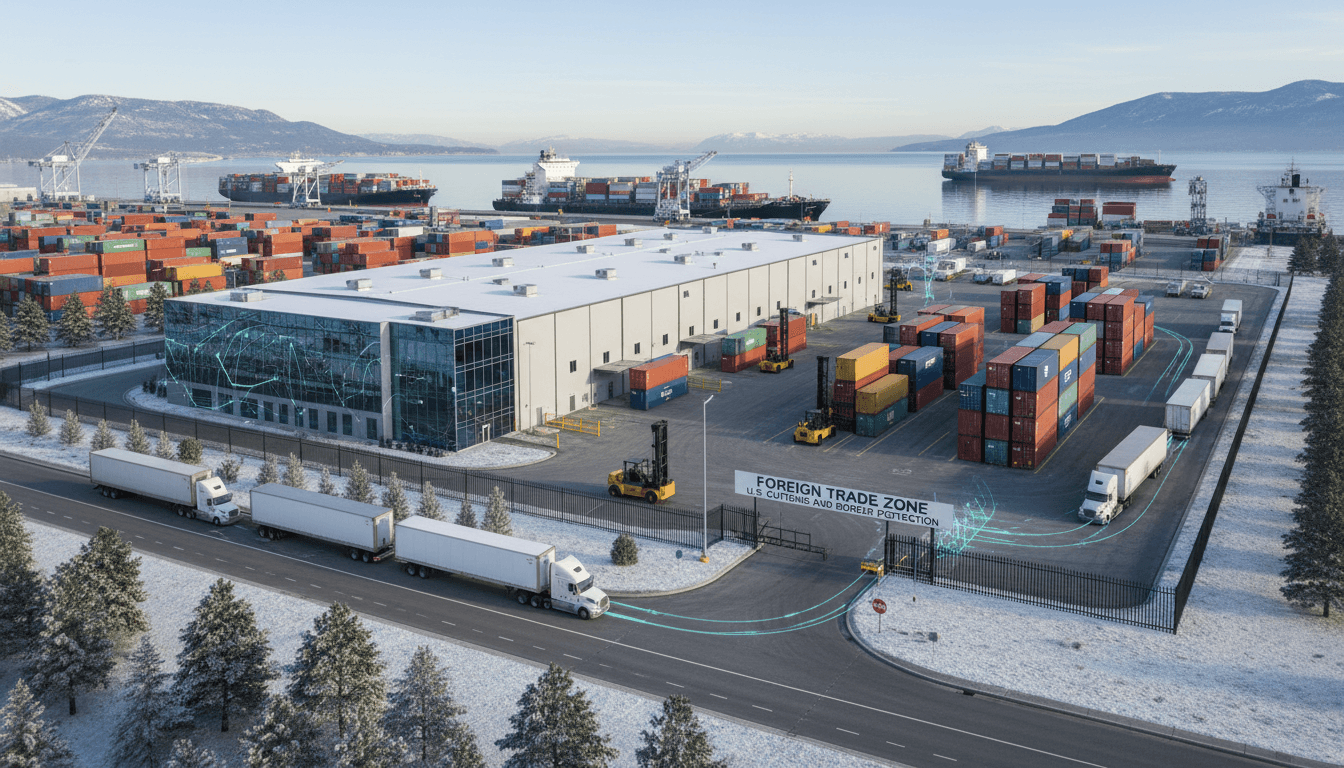
FTZs resemble modern logistics campuses: gated access, defined processes, and high documentation intensity. That makes them ideal for AI because the problem is structured.
1) Predictive analytics for duty and cash planning
Most companies still treat duty as a static cost. In 2025, duty is a variable that should be forecast like freight.
AI-driven models can support:
- SKU-level landed cost forecasting under scenario tariffs
- Cash forecasting for duty payments based on expected withdrawals
- Sensitivity analysis: “If demand drops 12%, what happens to duty deferral benefit?”
A good model produces decisions finance trusts:
“Duty deferral is worth it when median dwell time exceeds X days for this SKU class, given our cost of capital and compliance cost per transaction.”
2) Smart infrastructure planning and labor orchestration
Peak season doesn’t care that your FTZ procedures are complex. December planning for Q1 replenishment is where many teams feel the squeeze.
AI can help reduce congestion and errors:
- Forecast inbound surges and schedule receiving/inspection capacity
- Optimize slotting to reduce touches on high-duty, high-audit-risk SKUs
- Align staffing to the transactions that matter most (admissions, exports, weekly entry cutoffs)
3) Automation in customs operations (without pretending it’s push-button)
No one should be “auto-filing” customs entries blindly. The safer target is automation with verification.
Useful automation patterns:
- Document extraction (commercial invoice, packing lists) into structured data
- Suggested HTS classification with confidence scoring and human approval
- Automated compilation of weekly entry packs with exception flags
When you do this right, your compliance team stops acting like a data janitor and starts acting like a control tower.
A practical decision framework: should you expand or start an FTZ program?
Answer first: An FTZ is worth serious consideration when you have (1) meaningful duty exposure, (2) enough dwell time or exports to create benefit, and (3) systems mature enough to run compliant zone inventory.
Here’s a decision checklist I’d actually use in a steering meeting:
Step 1: Model the benefit drivers (not just “tariffs are high”)
- Duty deferral: median/percentile dwell time by SKU
- Export share: % of volume/value leaving the U.S.
- Weekly entry fit: withdrawal frequency and shipment volume
- State/local tax opportunities: inventory or property tax exposure (location-specific)
Step 2: Price the compliance reality
- Process redesign time (receiving, movements, adjustments, scrapping)
- System changes (WMS configuration, ERP postings, reporting)
- Training and audit readiness
- Broker/internal labor per week
Step 3: Decide where AI belongs
AI is most valuable when it’s tied to a measurable control point:
- Predict duty cash requirements weekly
- Reduce inventory adjustments by X%
- Cut document cycle time by Y hours
- Lower post-entry corrections by Z%
If you can’t attach AI to a metric, it becomes a demo instead of an implementation.
What smart teams are doing next
Foreign Trade Zones are back because trade policy is unstable and tariffs are high. The twist is that the FTZ advantage now comes from operational excellence plus faster decision cycles, not just a regulatory structure.
If you’re in supply chain, procurement, or finance, the next move is straightforward:
- Treat your FTZ evaluation as a data and scenario modeling project, not a compliance checkbox
- Use AI forecasting to quantify duty deferral value at the SKU level
- Use automation to reduce the friction of weekly entry, export proof, and inventory reconciliation
This post sits inside our AI in Supply Chain & Procurement series for a reason: procurement teams can’t negotiate their way out of tariff volatility, and supply chain teams can’t “hustle” their way out either. You need systems that see what’s coming and controls that hold up under audit.
If tariffs shifted again in the next 90 days, would your FTZ strategy adapt quickly—or would you be rebuilding the model from scratch?