AI can’t optimize trucks that are down. Build fleet longevity with disciplined lubrication and the maintenance data your predictive systems depend on.
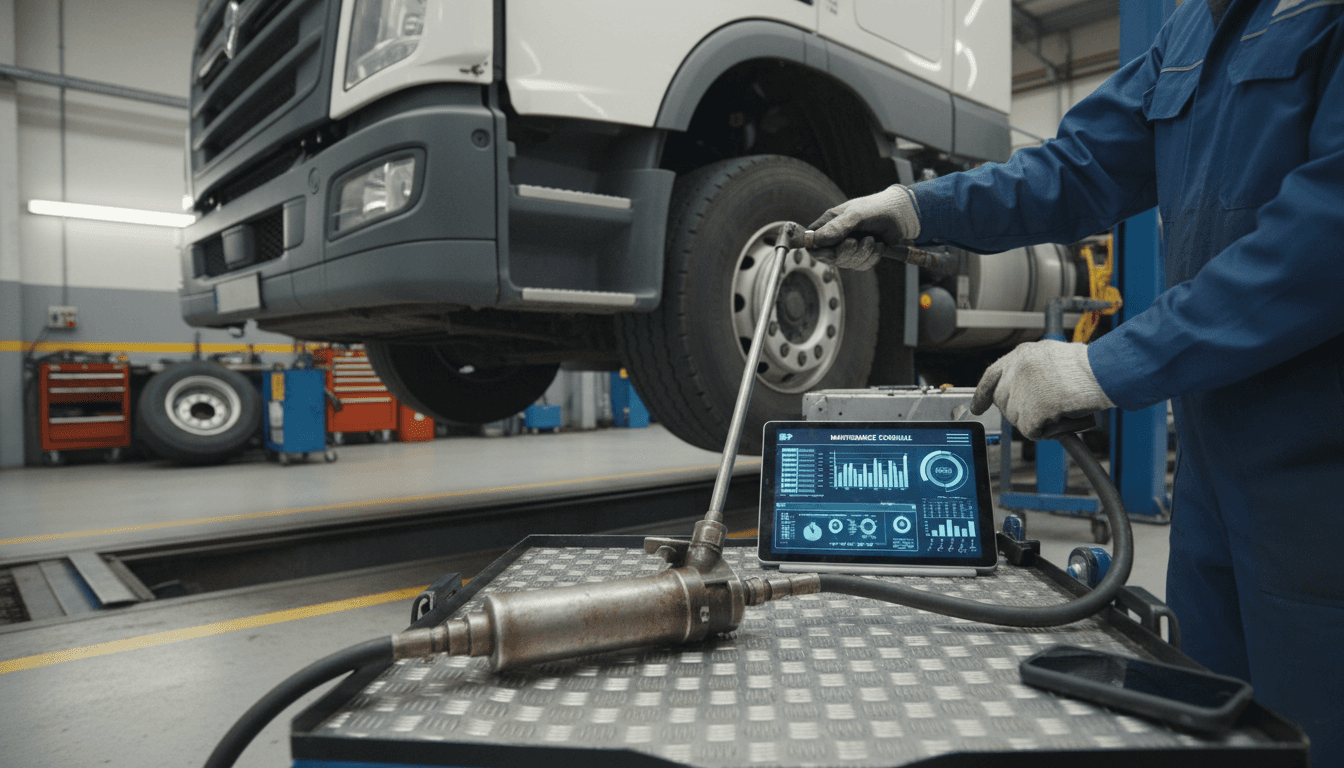
Skip Grease, Pay Later: AI Fleets Need the Basics
Shops don’t lose money because they don’t have enough dashboards. They lose money because a $6 grease cartridge didn’t make it into a kingpin last month.
That sounds almost insulting in a December 2025 conversation about AI route optimization, predictive ETAs, and automated procurement. But here’s what I keep seeing: fleets invest in AI in transportation and logistics to squeeze more productivity out of assets… while ignoring the simplest practice that keeps those assets safe and available. If you want an AI-managed fleet to perform, you need boring reliability underneath it.
Lubrication is the unglamorous foundation of fleet longevity. It’s also one of the easiest places to build a measurable maintenance ROI—especially when you connect it to the maintenance data your AI systems depend on.
Grease is a reliability strategy (not a shop chore)
Greasing is the cheapest way to prevent “silent failures” that AI can’t predict from fault codes alone. Many steering and suspension components don’t throw a dashboard warning before they fail. They wear gradually, then break suddenly—usually on the road, under load, at the worst possible moment.
That matters more now than it did a few years ago. When equipment lead times stretched and replacement units were hard to source, fleets that extended tractors to 1,000,000 miles (and beyond) didn’t do it with magic trucks. They did it with discipline: consistent preventive maintenance, consistent inspection, and consistent lubrication.
AI can help you plan capacity and route assignments. It can’t “optimize” a truck that’s sitting on the shoulder waiting for a tow.
The parts grease protects—and why operations should care
Every grease point exists for a reason: metal is moving against metal. Without lubrication you get heat, friction, accelerated wear, and then expensive downtime.
A few high-impact examples:
- Kingpins (upper/lower): Worn kingpins create sloppy steering and unstable handling. Driver confidence drops, tire wear increases, and safety risk goes up.
- Drag links and tie rod ends: These joints keep steering geometry intact. Run them dry and you invite misalignment and premature component failure.
- Slack adjusters and S-cams (drum brakes): Poor lubrication here isn’t “maintenance debt.” It’s “why did stopping distance increase?” territory.
- Spring pins and shackles: Suspension wear compounds into ride quality issues, tire wear, and eventually out-of-service events.
- Fifth wheel plate and pivot points: Poor lubrication increases friction and wear between tractor and trailer, creating handling issues and coupling/uncoupling problems.
A practical rule: if a component’s failure creates an immediate safety or roadside risk, it deserves a greasing interval that’s treated like oil changes—non-negotiable.
Why “AI fleet optimization” fails without lubrication discipline
AI optimization assumes asset availability. Route optimization, load matching, dynamic dispatch, and automated appointment scheduling all depend on trucks being where the plan says they’ll be.
When lubrication intervals slip, you don’t just get a repair bill. You get operational chaos:
- Unplanned downtime breaks dispatch plans and forces last-minute load reassignments.
- Higher variability in on-time performance reduces the quality of AI forecasting.
- More exceptions (breakdowns, delays, roadside inspections) train your organization to ignore alerts because “something’s always on fire.”
In the “AI in Supply Chain & Procurement” series, we usually talk about demand signals, supplier risk, and inventory positioning. Fleet maintenance belongs in that conversation because it directly impacts service levels. When trucks fail unexpectedly, procurement feels it too: expedite costs, carrier premium rates, missed ship windows, and strained customer SLAs.
A contrarian take: start with greasing before you buy more sensors
Most companies get the order wrong.
They add tech to predict failures while still missing basic tasks. Predictive maintenance is powerful, but only after you’ve nailed preventive maintenance hygiene. Otherwise, you’re just building better analytics on top of inconsistent execution.
If your lubrication program is “we do it when we remember,” you don’t have a program. You have a hope.
Not all grease is the same—and inconsistency is expensive
Using the wrong grease can be nearly as damaging as using no grease. Trucks see temperature swings, water exposure, heavy loads, and contaminant intrusion (dust, salt, grime). A single “universal” choice tends to become a slow-motion failure.
Here’s a straightforward way to think about grease selection:
Match grease to the job (and follow the OEM manual)
- Lithium-based grease: A dependable general-purpose option for many fleet applications due to heat and water resistance.
- Moly grease (molybdenum disulfide): Better for high-friction contact points like kingpins and tie rods where wear protection matters most.
- Synthetic grease: Worth it in extreme heat or cold (think Arizona summers, Minnesota winters) where conventional grease performance can degrade.
- Food-grade grease: Mandatory for certain refrigerated/food operations—this is both a safety and compliance issue.
The simplest policy that works: standardize grease types by component class, label them clearly, and train techs on “what goes where.” The cost difference between cartridges is trivial compared to the downstream cost of premature wear.
Contamination is the hidden enemy
Grease isn’t just lubrication—it’s also a barrier. If fittings are dirty or seals are compromised, you can push contaminants into the joint and accelerate wear.
Operationally, that means two habits matter:
- Wipe fittings before application.
- Watch for purged grease that looks gritty, watery, or discolored.
Those are quick checks that prevent long, expensive failures.
The real reason lubrication intervals get skipped
Greasing doesn’t feel urgent because failure is delayed. A missed greasing doesn’t strand a truck today. It borrows reliability from next month.
That’s why fleets skip it when:
- drivers are pushing to make appointments,
- the shop is backlogged,
- a unit “seems fine,”
- or nobody is tracking intervals in a way that’s visible to operations.
The fix isn’t a motivational poster. It’s accountability plus scheduling.
Put lubrication on rails: intervals, checklists, proof
A lubrication program that survives peak season has three traits:
- Intervals that fit your operation (miles, hours, duty cycle)
- A checklist tied to specific fittings (not “grease truck”)
- Proof of completion (digital sign-off, inspection notes, exceptions)
If you only change one thing, change this: make lubrication a required line item inside every PM event, not an optional add-on when time allows.
Battery grease guns and auto-lube: tools that improve consistency
Manual grease guns work, but they’re slow and physically demanding. That’s how you end up with inconsistent application—especially when techs are rushed.
- Battery-powered grease guns improve repeatability and reduce fatigue.
- Automatic lubrication systems reduce human error by applying grease on a programmed schedule (ideal for specific duty cycles and high-utilization assets).
Technology isn’t the hero here. Consistency is.
Turn lubrication into a data asset for predictive maintenance
The best bridge between “grease gun reality” and AI value is structured maintenance data. If you want AI to schedule maintenance intelligently, you need clean inputs:
- which components were greased,
- when it happened,
- which grease type was used,
- odometer/engine hours at the time,
- notes on abnormal wear or contaminated purge.
This is where fleets can connect preventive maintenance to predictive maintenance without pretending sensors solve everything.
A simple “lube data model” that actually gets used
If you’re implementing fleet maintenance software (or trying to get more value from what you already own), keep lubrication data tight:
- Asset ID (tractor/trailer)
- Service event type (
PM-A,PM-B, seasonal inspection) - Interval trigger (miles/hours/days)
- Component group (steering, suspension, brakes, fifth wheel)
- Grease spec (standardized code)
- Technician ID + timestamp
- Exception flags (fitting inaccessible, seal damaged, excessive play observed)
Once this is consistent, AI can do useful things:
- Predict which units are most likely to miss an interval based on utilization and shop capacity.
- Recommend optimal maintenance windows that minimize load disruption.
- Identify “repeat offenders” (specific component groups failing early) and trigger procurement actions (better parts, better grease, supplier changes).
That last point is the supply chain tie-in people miss: maintenance outcomes inform procurement strategy. If tie rod ends are failing early across a subgroup, that’s a sourcing, spec, or training problem—not bad luck.
The KPI that convinces leadership
If you want buy-in, track one operations-friendly metric:
- Unplanned downtime hours per 10,000 miles (before/after lubrication compliance)
It’s simple. It’s hard to argue with. And it maps directly to service levels and revenue.
The math: a few dollars vs. thousands (or worse)
Lubrication is one of the cleanest ROI stories in fleet management. The spend is small, and the avoided costs stack fast:
- Quality grease: a few dollars per cartridge
- PM service with lubrication: a few hundred dollars
- Kingpin replacement: $1,500–$3,000 parts and labor (plus downtime)
- Steering/braking failure with a crash: potentially millions when you factor litigation, insurance impact, and operational shutdown risk
There’s also a quieter benefit: fuel efficiency. Friction steals energy. Components moving freely reduce parasitic losses. You won’t see a single “grease savings” line on a fuel report, but over a fleet, small inefficiencies become real money.
If you’re spending on AI to reduce empty miles, don’t ignore the maintenance basics that keep the truck efficient on every mile.
A practical lubrication playbook (that supports AI ops)
Answer first: If you want longer asset life and fewer breakdowns, treat lubrication like a tracked, audited process—not a task.
Here’s what works in real fleets:
- Define non-negotiable intervals by duty cycle (regional, long-haul, severe service).
- Standardize grease inventory (fewer SKUs, clearly labeled, mapped to components).
- Build a fitting-level checklist for each tractor model and configuration.
- Digitize sign-off in your maintenance system (with exception codes).
- Audit compliance weekly (random unit checks + record review).
- Feed the data to scheduling so dispatch can plan around PM events instead of reacting to breakdowns.
If you’re already working on AI forecasting and optimization, this is one of the fastest ways to increase the “trustworthiness” of your plans: fewer surprises means better predictions.
Where to go next
Fleet longevity isn’t won with a single purchase order. It’s won with repeatable behaviors. Proper lubrication is the simplest one—and it directly supports your AI investments by keeping assets available, predictable, and safe.
If you’re building an AI-driven logistics stack, start by asking a very operational question: Do we know—confidently—when every unit was last greased, and can we prove it? If the answer is fuzzy, your optimization layer is sitting on a shaky foundation.
What would change in your network planning if unplanned downtime dropped by 20% next quarter—simply because lubrication compliance stopped being optional?