AI weather forecasting reduces grid risk and supply chain chaos. See how balloon-based observations and fast AI models improve resilience and renewables planning.
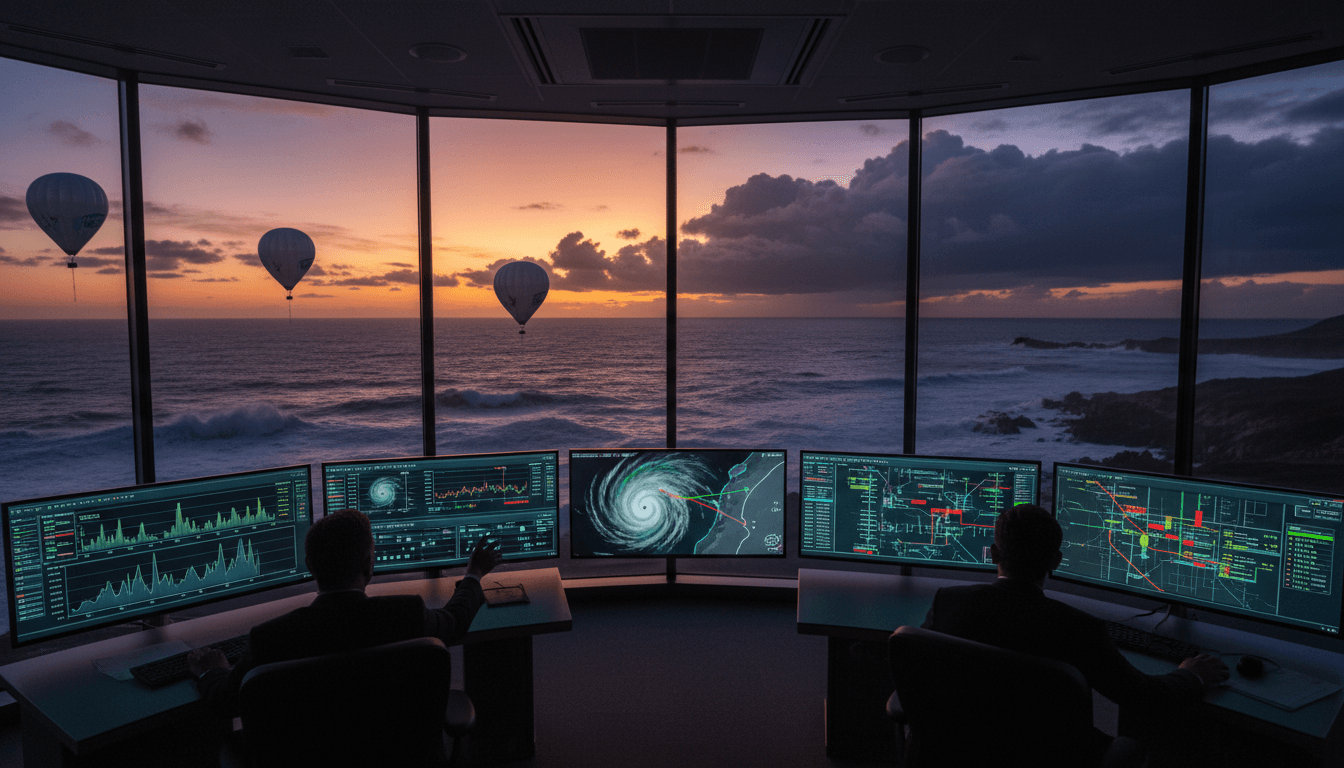
AI Weather Forecasting for Grid Resilience & Planning
Hurricane Milton’s most dangerous feature wasn’t its wind speed. It was the rate of change. In October 2024, Milton intensified so quickly that forecasters and communities lost precious time. The storm killed 15 people and caused about US $34 billion in damages—an expensive reminder that weather risk isn’t only about where a storm goes, but how fast it evolves.
For energy and utilities teams, rapid intensification is the nightmare scenario: crews staged in the wrong place, materials delayed, generation assets exposed, and restoration plans built on forecasts that swing sharply from run to run. Most companies get this wrong by treating weather forecasting as a “nice-to-have” input to operations. It’s actually a core dependency for grid resilience, renewable integration, and supply chain risk management.
This post sits in our AI in Supply Chain & Procurement series because weather is a supplier of constraints. It dictates labor availability, transportation lanes, generation output, and restoration cycle times. We’ll use WindBorne’s balloon-plus-AI approach—described by cofounder John Dean as a “planetary nervous system”—to spell out what energy leaders should do differently in 2026 planning cycles.
The real problem: weather models are starving for data
Better forecasts start with a blunt truth: forecast accuracy is capped by observation coverage. Traditional numerical weather prediction (NWP) systems ingest satellites, radar, surface stations, and conventional weather balloons—then assimilate that data into physics-based simulations. That approach is powerful, but it’s also brittle when observations are sparse.
Here’s the killer detail from WindBorne’s origin story: conventional weather balloons observe only about 15% of the globe. Most pop after a couple of hours, collect a single up-down profile, and rarely drift far beyond their launch continent. The gaps are worst over oceans and remote regions—the same places where many high-impact weather systems are born.
That’s why forecast cones can “jump.” When a model run has incomplete or inconsistent inputs, it compensates with assumptions. Then the next run ingests a slightly different set of observations and the predicted track shifts. For an energy operator, those shifts cascade into procurement and logistics whiplash:
- generators scheduling fuel deliveries that later need to be rerouted n- utilities booking contractors and mutual assistance too early (or too late)
- spare parts staged in the wrong region
- wind/solar bids submitted with uncertainty premiums
The stance I’ll take: utilities shouldn’t accept observation gaps as inevitable. Not when the cost of uncertainty is paid in overtime, outage minutes, and damaged assets.
WindBorne’s approach: long-duration balloons + AI that directs them
WindBorne Systems is betting that the biggest weather improvement won’t come from “more compute.” It’ll come from more in situ data, gathered safely and continuously, then fed into an AI model built to run frequently.
Global Sounding Balloons (GSBs): weeks aloft, steerable by altitude
WindBorne’s Global Sounding Balloons are designed to stay up 50+ days (with a reported record of 104 days) at altitudes from near ground level to roughly 24 km. The balloon envelope is a thin film around 20 micrometers thick, and the full assembly weighs under 2 kilograms. Navigation is clever: change altitude to catch different wind currents.
Each balloon can:
- release ballast (sand) to rise
- vent gas to descend
- communicate via satellite
Instead of one balloon profile and done, these systems create a moving mesh of atmospheric measurements—WindBorne calls its global constellation Atlas—with hundreds of balloons up at a time today.
Dropsondes without risky “hurricane hunter” flights
Milton provided a dramatic test. WindBorne launched six balloons from Mobile, Alabama, carrying dropsondes. Within 24 hours, the balloons entered the developing hurricane and released sensors measuring temperature, pressure, humidity, and wind.
That matters for the energy sector because it proves a new operational pattern: you can fill data gaps near dangerous systems without putting pilots in harm’s way, and do it at scale.
“Forecasting is only as accurate as the data it’s fed.” That sounds obvious—until you map it to grid decisions where a 12–24 hour warning window changes everything.
The AI model side: WeatherMesh and why frequency beats bulk
AI weather models have been outperforming many physics-based models in recent years. Huawei’s Pangu-Weather (2023), DeepMind’s GraphCast, and the ECMWF’s AIFS are widely discussed because they generate forecasts faster and with far less compute than classic NWP.
WindBorne’s WeatherMesh takes a distinctive angle: pair a transformer-based forecast model with hardware that actively gathers the data the model needs next.
A transformer architecture tuned for operational use
WeatherMesh uses a transformer-style encoder–processor–decoder design:
- Encoder compresses weather variables into a latent representation
- Processor steps forward in time (repeated for longer-range forecasts)
- Decoder translates outputs back to real-world variables
WindBorne trained early versions using a few dozen Nvidia RTX 4090 GPUs, reportedly around $100,000 in hardware—far less than the cost of running large training cycles entirely in the cloud. More important than the cost is what the design enables: fast refresh cycles.
“Live” forecasting: adapters that make messy data usable
Most AI forecast models train on curated historical datasets like ERA5 and degrade when moved to real-time feeds. WindBorne describes using U-Net-based adapters to translate real-time observations and agency analyses into the internal format WeatherMesh expects.
For utilities, this is the key operational unlock: real-time assimilation without waiting six hours.
WeatherMesh-4 reportedly:
- forecasts at 25 vertical levels
- produces surface variables important to energy operations (wind, precipitation, solar radiation, cloud cover)
- can generate a full forecast every ~10 minutes
- runs at 0.25° (~25 km) globally, with ~1 km resolution for selected locations
Traditional global models typically update every 6 hours. Ten-minute refreshes change how you run a control room, how you plan crews, and how you manage supply chain commitments under uncertainty.
What this means for energy and utilities (and why procurement should care)
Accurate weather forecasting isn’t just an “ops” upgrade. It’s a supply chain and procurement multiplier. Better forecasts reduce variability, and variability is what forces expensive buffer stock, emergency freight, and last-minute contracting.
1) Grid resilience: pre-staging becomes less wasteful
When forecast cones swing, utilities tend to overcompensate: stage more crews, more trucks, more material—just in case. That’s rational, but it’s also expensive.
Higher-frequency, higher-confidence forecasts allow a different playbook:
- stage incrementally, not all at once
- reposition crews as the risk envelope tightens
- commit to mutual assistance when probability crosses a clear threshold
A practical procurement angle: create tiered contract triggers (e.g., 30%, 60%, 80% event likelihood) tied to forecast confidence bands, not a single deterministic track.
2) Renewable energy forecasting: fewer imbalance penalties
Wind and solar forecasting is often described as a modeling problem. It’s equally an observation problem.
- Wind ramps depend on boundary-layer dynamics that can be underobserved.
- Solar output depends on cloud cover timing and thickness, which can change quickly.
A model that updates every 10 minutes and ingests dense atmospheric profiles can tighten forecasts for:
- day-ahead bids
- intraday re-forecasts
- storage dispatch planning
That’s not abstract value. It shows up as fewer imbalance charges and less conservative bidding.
3) Infrastructure protection: predict conditions, not just storms
Utilities don’t lose assets only to hurricanes. They lose them to conditions: gusts, ice, lightning, saturated soil, heat stress.
WeatherMesh-4’s surface variables (wind at 10m/100m, precipitation, temperature extremes, solar radiation) map directly to asset risk scoring:
- wildfire risk: wind + humidity + temperature
- pole/line risk: gust thresholds + saturated ground (for uprooting)
- transformer thermal loading: temperature + solar radiation
Treat this as predictive maintenance with atmospheric features. The weather forecast becomes another sensor feed in your reliability model.
4) Supply chain risk management: weather becomes a demand signal
In our AI in Supply Chain & Procurement series, we keep coming back to one theme: risk is a demand signal in disguise.
Extreme weather changes demand for:
- poles, crossarms, insulators
- underground vault components
- mobile substations
- vegetation management services
- fuel for backup generation
Better forecasts let you move from reactive buying to probabilistic pre-buying. The win isn’t hoarding inventory; it’s purchasing with intent:
- Reserve supplier capacity early (options, not firm orders)
- Lock transport lanes and warehouse space conditionally
- Convert options to orders as forecast confidence increases
How to operationalize AI weather forecasting in 90 days
Most utilities don’t need a moonshot program to get value. They need a disciplined integration plan that respects how control rooms and procurement teams actually work.
Step 1: Define “decision-grade” forecast requirements
Pick 3–5 decisions that cost real money when wrong. Examples:
- crew pre-staging for named storms
- wind farm ramp response and storage scheduling
- vegetation management stand-down / stand-up calls
- mutual assistance contracting
Then define the forecast variables, update frequency, and spatial resolution required.
Step 2: Build a forecast-to-action translation layer
A forecast isn’t a decision. You need rules, thresholds, and accountability.
- Use probabilistic triggers (confidence bands) rather than single tracks.
- Create a decision log so teams can learn which triggers were too sensitive or too conservative.
Step 3: Connect weather to supply chain systems
If your weather feed lives in a dashboard nobody uses, it won’t change outcomes.
Integrate into the systems where money moves:
- procurement workflows (conditional PO releases)
- contractor management (capacity reservations)
- inventory planning (pre-positioning recommendations)
- logistics (lane risk scoring)
Step 4: Measure value like a CFO would
Track outcomes that weather improvements should move:
- overtime hours avoided n- emergency freight spend
- outage duration (SAIDI/SAIFI contributors during events)
- renewable imbalance penalties
- damaged asset counts per event type
If you can’t quantify it, it’ll get deprioritized before next hurricane season.
What to watch next: the “planetary nervous system” becomes enterprise nervous system
WindBorne’s stated ambition is bold: scale Atlas to ~10,000 balloons in the air, launched from ~30 sites, aiming for near-continuous global observation by 2028. If they (and others like them) succeed, the strategic shift for energy won’t be “better forecasts.” It’ll be faster, more operational forecasts—the kind that match grid tempo.
I’ve found that the organizations that benefit most from AI forecasting aren’t the ones with the fanciest models. They’re the ones that redesign decisions around forecast refresh rates and uncertainty bands. That’s a supply chain skill as much as a meteorology skill.
If you run grid operations, procurement, or energy trading, here’s the forward-looking question worth debating internally: What would you change if you trusted your severe weather forecast 12 hours earlier—and it updated every 10 minutes?