AI weather forecasting can reduce outage risk and storm spend by improving real-time decisions in procurement, logistics, and grid operations.
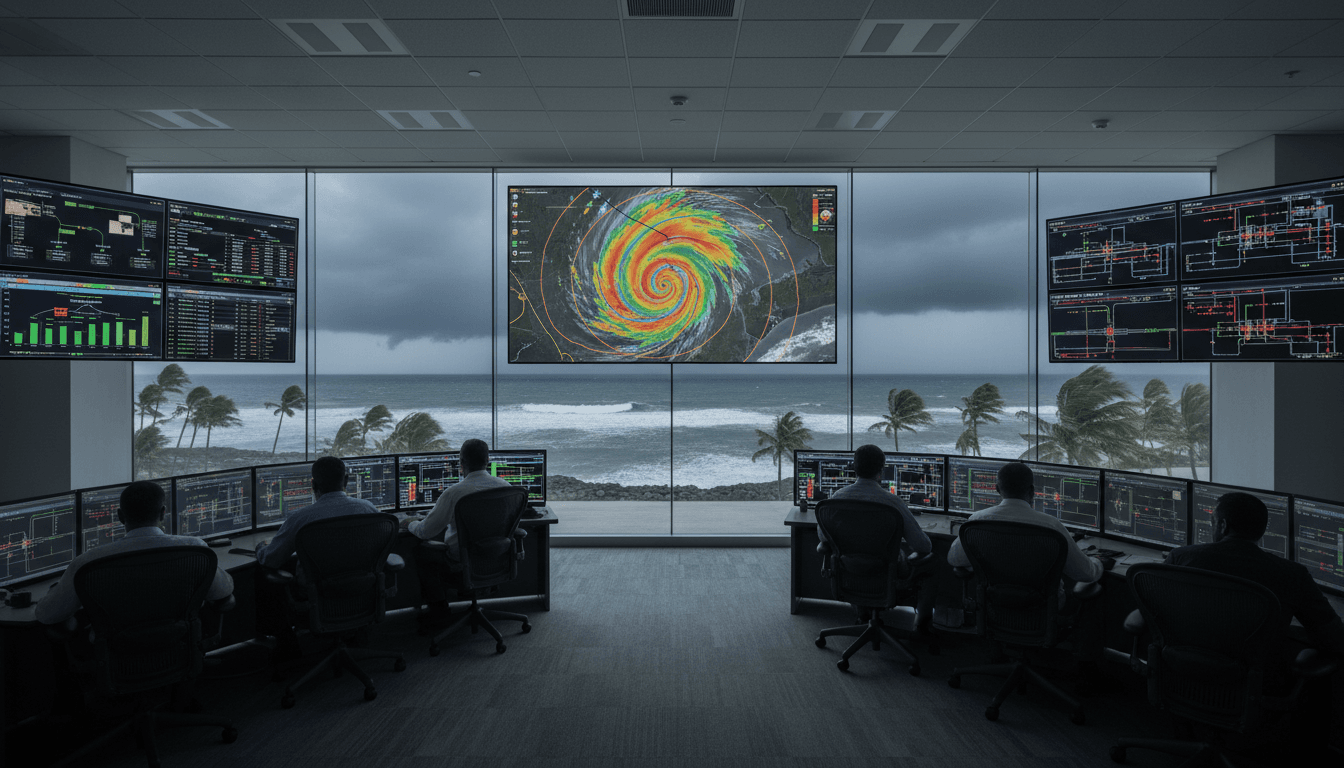
AI Weather Forecasting for Grid Resilience and Procurement
Hurricane Milton’s rapid intensification in October 2024 wasn’t just a meteorology problem—it was an operations problem. When a storm strengthens faster than forecast models anticipate, utilities lose precious time to stage crews, secure critical spares, reposition mobile substations, and coordinate fuel and logistics. Milton ultimately caused 15 deaths and about US $34 billion in damages. The painful part is that many of the decisions that reduce impact are made 12–48 hours before landfall.
Most companies get this wrong: they treat weather as “context” rather than a first-class input to supply chain planning, procurement, and grid operations. If your forecasts are noisy, late, or too coarse, your response becomes reactive—overtime spikes, emergency contracting skyrockets, and restoration takes longer.
WindBorne Systems’ work—long-duration, steerable balloons plus an AI forecasting model called WeatherMesh—is a strong proof point that weather prediction is entering a new phase. And for energy and utilities teams, the real story isn’t “cool balloons.” It’s that better real-time weather data + AI forecasting can tighten the loop between what’s happening in the atmosphere and what you decide to buy, stage, dispatch, and repair.
Why traditional forecasts still fail where utilities need them most
Answer first: Traditional numerical weather prediction (NWP) struggles because it’s constrained by data gaps and expensive compute cycles, especially over oceans and remote regions where high-impact storms often form.
Utilities typically experience forecast pain in three ways:
- Rapid intensification surprises (hurricanes, derechos, winter bombs). You don’t just need the storm track—you need confidence on how fast conditions will deteriorate.
- Local variability that matters operationally (wind gusts by feeder, icing bands, rainfall rates affecting flooding at substations).
- Update latency: legacy global models update on multi-hour cycles. That’s not aligned with real-world grid decisions that change hour-by-hour as new observations arrive.
Physics-based NWP systems (like the U.S. Global Forecast System) ingest observations from satellites, radar, surface stations, and conventional weather balloons, then run large simulations multiple times per day. This works well for many scenarios. But forecasts are only as good as the observations feeding them—and conventional balloons are short-lived.
WindBorne highlights a critical stat: conventional weather balloons observe roughly 15% of the globe. That missing 85% isn’t evenly distributed; it’s concentrated in the very places where early storm dynamics evolve (open ocean, deserts, polar regions). For utilities and energy suppliers, that means risk isn’t just “bigger storms.” It’s bigger uncertainty—and uncertainty is expensive.
The hidden cost of uncertainty in energy supply chains
Procurement teams often see weather as a driver of “surge demand,” but the deeper issue is variance:
- Crew and contractor demand becomes spiky, pushing you into premium rates.
- Critical spares (transformers, reclosers, poles, insulators) either sit idle (cash tied up) or are missing when needed (outage duration increases).
- Fuel and logistics planning for backup generation and restoration fleets becomes a scramble.
Weather uncertainty is a tax on planning. Better forecasts reduce that tax.
What WindBorne changes: the data layer, not just the model
Answer first: WindBorne’s biggest innovation is expanding the observation network with autonomous long-duration Global Sounding Balloons (GSBs) that can stay aloft 50+ days (with a record test of 104 days) and steer by changing altitude to ride different winds.
This matters because extreme weather forecasting has a data acquisition problem. To measure developing storms, meteorologists sometimes fly aircraft into them and deploy dropsondes—effective, but limited, risky, and expensive. WindBorne demonstrated dropsonde deployment from balloons, reducing reliance on dangerous flights.
In the lead-up to Hurricane Milton, WindBorne launched six long-duration balloons that entered the storm within about 24 hours and released dropsondes to measure:
- Temperature
- Pressure
- Humidity
- Wind speed and direction
That’s the kind of in situ data forecasters crave during storm formation and rapid intensification.
“Planetary nervous system” is more than a metaphor
WindBorne describes its approach as a planetary nervous system: sensors everywhere, constantly feeding an AI “brain.” For utilities, the practical translation is simple:
Better observations shrink forecast error, and smaller forecast error improves every downstream decision—from grid operations to supplier commitments.
WindBorne’s balloon constellation (Atlas) typically keeps hundreds of balloons aloft at a time and, by their account, collects more in situ data per day than the U.S. National Weather Service’s balloon operations.
How AI forecasting (like WeatherMesh) becomes operationally useful
Answer first: AI weather models become valuable for energy and utilities when they deliver fast refresh rates, fine spatial resolution, and robust real-time ingestion, not just a slightly better 5-day track.
WindBorne’s model, WeatherMesh, uses a transformer-based encoder–processor–decoder architecture (the same broad family of architecture behind modern language models). The important operational points:
- Lower compute cost: WindBorne trained using a cluster of RTX 4090 GPUs, reported at about $100,000 in hardware. That’s a signal that high-performance forecasting is becoming more accessible.
- Frequent updates: WeatherMesh-4 can produce a full forecast every 10 minutes. Traditional global models often update every 6 hours.
- Relevant variables for energy: WeatherMesh-4 predicts not only upper-atmosphere variables but also surface conditions including precipitation, solar radiation, cloud cover, and wind at 10m and 100m—inputs that matter directly for load, renewables, and storm response.
WindBorne reports benchmarks showing up to 30% more accuracy than a traditional European Centre for Medium-Range Weather Forecasts model on some evaluations, and performance surpassing DeepMind’s GenCast on many tests.
The real breakthrough: closing the loop between sensing and planning
Most organizations still operate in a one-way flow:
Weather forecast → humans interpret → operations react
End-to-end systems (sensing + AI forecasting) enable a tighter feedback loop:
New observations → model refresh → re-optimized decisions → new sensing targets
WindBorne even uses its AI model to tell balloons where to fly next to fill data gaps. That “active sensing” concept is directly applicable to utilities in a different form: active planning.
If forecasts update every 10 minutes with better local fidelity, you can update:
- restoration staging locations
- vegetation and line inspection priorities
- fuel and generator dispatch
- storm material transfers between yards
That’s not theoretical. It’s the difference between having crews two counties away versus already staged near the most likely damage corridors.
What energy and utilities teams can do with better forecasts (beyond the obvious)
Answer first: The highest ROI comes when weather AI is embedded into supply chain and procurement workflows—inventory, contracting, and logistics—rather than treated as a dashboard.
Below are four practical applications that fit naturally into an AI in Supply Chain & Procurement program.
1) Pre-position spares with probabilistic, location-level demand
Most storm playbooks use broad rules (e.g., “Stage poles south of predicted track”). That’s how you end up over-committed in the wrong place.
A better approach is probabilistic staging tied to BOM-level demand:
- Convert forecasts (wind gusts, icing risk, soil saturation) into damage probability by asset class.
- Translate damage probability into material demand distributions (poles, crossarms, fuses, arresters, transformers).
- Optimize transfers between warehouses based on service-level targets (e.g., 95% fill rate for top 20 storm SKUs).
Procurement benefit: fewer emergency buys and less premium freight.
2) Dynamic contracting that triggers before the market spikes
After major storms, contractor capacity gets scarce fast. If you wait for certainty, you pay surge pricing.
With more accurate and frequently updated AI weather forecasting, you can:
- set contract option triggers (reserve crews when a corridor exceeds a risk threshold)
- pre-negotiate rate cards for surge tiers
- allocate contractor scope by region to avoid everyone bidding on the same limited pool
This is procurement maturity: you’re buying response capacity like an option, not like a last-minute commodity.
3) Better renewable integration and hedging decisions
Wind and solar don’t just create operational variability—they create commercial exposure.
WeatherMesh-4 predicts variables that directly affect renewables (wind at 100m, solar radiation, cloud cover). Stronger forecasts improve:
- day-ahead and intraday scheduling
- curtailment minimization
- battery dispatch planning
- hedging strategy (less imbalance cost, fewer conservative bids)
Utilities integrating more renewables should treat improved forecast skill as “invisible capacity.” It doesn’t build a new plant, but it reduces wasted flexibility.
4) Supply chain risk management across the full storm season
December 2025 is a good moment to reflect on a recurring pattern: storm seasons don’t just disrupt the grid—they disrupt your suppliers.
AI-driven weather intelligence supports upstream risk work:
- mapping tier-1 and tier-2 supplier sites against forecasted hazard corridors
- triggering pre-storm expedite windows before ports or highways close
- pre-qualifying alternates for storm-sensitive SKUs
Weather forecasting becomes a supplier resilience input, not just an operational alert.
Implementation checklist: turning AI forecasts into decisions that create leads
Answer first: If you want measurable outcomes, define where forecast improvements translate into dollars—then instrument the workflow.
Here’s what works when I’ve seen teams operationalize weather + AI in supply chain planning:
-
Pick 2–3 decisions to automate first
- crew staging recommendations
- storm SKU transfers between DCs
- contractor option triggers
-
Set a single performance metric per decision
- restoration duration (SAIDI/SAIFI impact)
- emergency freight spend
- fill rate for critical storm materials
-
Use probabilistic forecasts, not a single “most likely” track
- planning should react to distributions (p10/p50/p90), not point estimates
-
Create an “override with reason” workflow
- humans must be able to override, but overrides should be logged to improve policies
-
Run a post-event audit within 30 days
- compare what the model suggested vs what was done vs what happened
- feed learnings into supplier contracts and inventory policies for next season
People also ask: practical questions utilities have about AI weather forecasting
Does AI replace physics-based forecasting models?
No—and that’s a good thing. AI models often still rely on physics-based systems for training data and physical plausibility checks, especially for rare extremes. The winning pattern is hybrid: physics sets guardrails, AI boosts speed and accuracy.
Will better forecasts actually reduce outages?
Forecasts don’t prevent wind from blowing, but they reduce time-to-respond. Faster staging, better material availability, and earlier shutdown decisions (where appropriate) reduce outage duration and restoration risk.
Is 10-minute updating useful, or just noise?
It’s useful if your processes can ingest it. If your operational cadence is daily, you won’t benefit. If your cadence is hourly during major events—common in storm command centers—frequent updates materially improve decisions.
Where this fits in an AI in Supply Chain & Procurement roadmap
The broader theme of this series is simple: AI reduces uncertainty in planning and execution. Weather is one of the biggest uncertainty drivers in energy and utilities, yet it’s often treated as an externality.
WindBorne’s approach shows what happens when you treat weather as a data supply chain—observe more, assimilate faster, forecast more frequently, and feed decisions continuously. I’m firmly in the camp that utilities that operationalize AI weather forecasting will out-plan their peers, not because they “predict perfectly,” but because they commit resources earlier with higher confidence.
The next step is straightforward: map your storm playbook decisions to the weather variables that drive them, identify where forecast accuracy or latency hurts you, and pilot a workflow where procurement and operations act on the same forecast truth.
If extreme weather is becoming the norm, the question isn’t whether you’ll pay the storm tax. It’s whether you’ll keep paying it in emergency premiums—or shift it into planned spend and faster restoration.