AI weather forecasting is improving fast—and it offers a clear playbook for energy supply chains: close data gaps, refresh forecasts frequently, and trigger smarter procurement.
AI Weather Forecasting Lessons for Energy Supply Chains
A single storm can blow up a carefully planned month of procurement in a day.
Hurricane Milton did more than cause US $34 billion in damage and take 15 lives—it also exposed an uncomfortable operational truth: when the underlying data is thin, even sophisticated forecast systems can miss rapid intensification and leave entire regions reacting instead of preparing. For energy and utilities leaders, that same pattern shows up every winter peak and every hurricane season: the biggest costs come from surprises, not from bad plans.
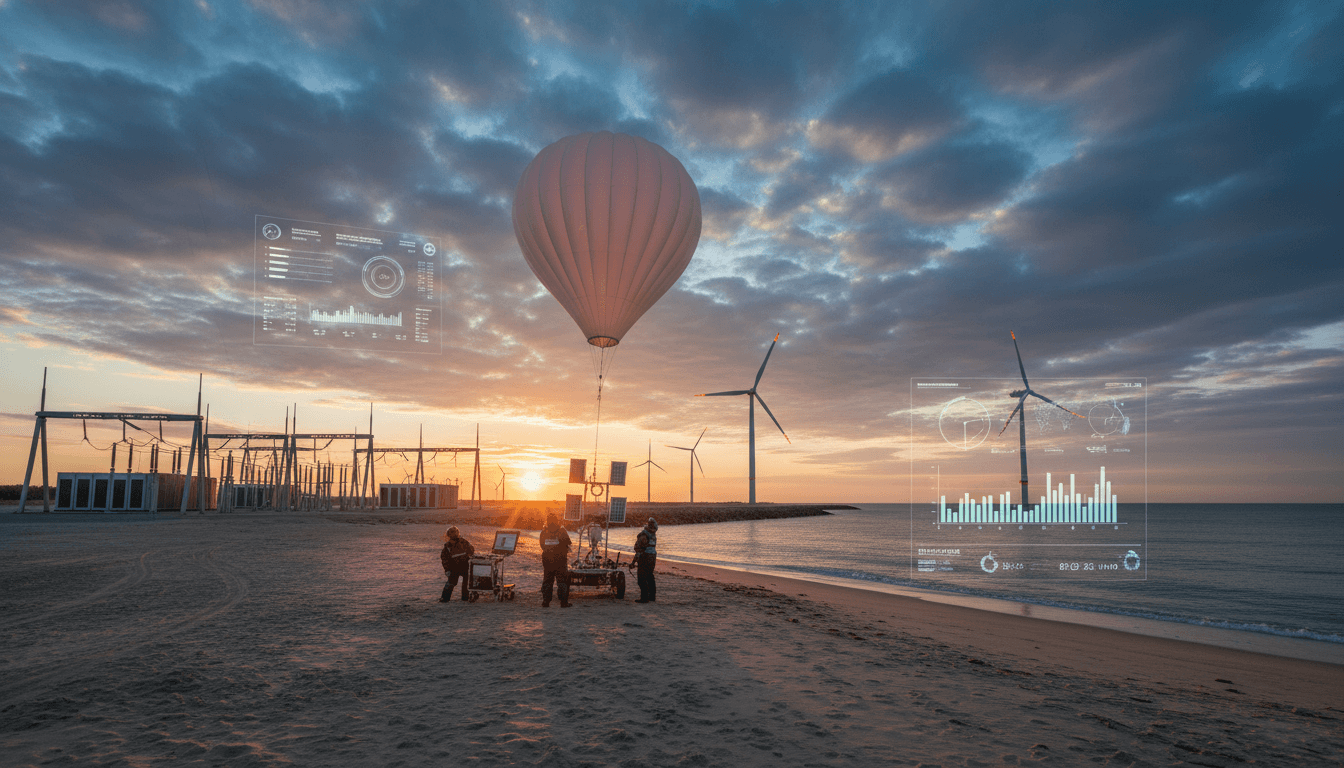
Here’s what’s different now. A new class of AI weather forecasting systems is pairing modern machine-learning models with entirely new ways of collecting atmospheric data—like self-navigating weather balloons that stay aloft for 50+ days and feed fresh observations into an AI model that updates forecasts as often as every 10 minutes. That’s not just a meteorology story. It’s a blueprint for how AI in supply chain & procurement should be built in energy: better sensors, faster refresh cycles, tighter feedback loops, and decision-grade predictions.
Why AI weather forecasting is suddenly relevant to procurement
Answer first: AI weather forecasting matters to procurement because weather is a top driver of demand volatility, logistics disruption, and asset risk—and AI models get dramatically better when they’re fed real-time, high-coverage data.
Energy supply chains are tied to the atmosphere in ways most teams underestimate:
- Demand swings with temperature, humidity, and cloud cover (heating, cooling, lighting)
- Renewable output depends on wind fields and solar irradiance
- Restoration work depends on predicted wind gusts, precipitation timing, and flood risk
- Spot-market exposure often spikes when forecasts are wrong, late, or low-resolution
Most companies treat weather as an “input” they buy, not a capability they design around. That’s the mistake.
The WindBorne story (long-duration balloons + AI model WeatherMesh) highlights a practical lesson for utilities and energy traders: forecast accuracy is constrained by observation coverage, especially over oceans and remote regions where high-impact events start. In procurement terms, it’s the same old problem: you can’t manage what you don’t measure.
The myth: “We already have enough weather data”
Many organizations assume satellites and public models cover it. The reality is that in-situ observations (temperature, pressure, humidity, wind vectors) are still scarce in critical zones. Conventional weather balloons typically fly for only a few hours and rarely provide continuous coverage over the same region.
WindBorne reported that conventional balloons effectively observe only about 15% of the globe. When you translate that to operational risk, it explains why forecast cones jump and why intensity forecasts can be late.
For energy supply chain teams, the analogy is painfully familiar: you can’t forecast transformer failures, vegetation risk, or regional load accurately if your telemetry is patchy or delayed.
The “planetary nervous system” idea maps directly to the grid
Answer first: The winning pattern is an end-to-end loop—sense broadly, predict fast, and task sensors dynamically to fill data gaps. That’s exactly what energy networks and supply chains need.
WindBorne frames its approach as a “planetary nervous system”: a constellation of autonomous balloons (Atlas) that continuously collects data, plus an AI forecasting brain (WeatherMesh) that converts those observations into predictions—and then tells the balloons where to fly next to reduce uncertainty.
That loop is the part energy leaders should copy.
What this looks like in energy operations
Replace balloons with grid and supply chain sensors:
- AMI / smart meters, SCADA, synchrophasors
- Substation environmental sensors and transformer monitors
- Line sensors and fault indicators
- DER telemetry (inverters, batteries)
- Weather stations at renewable sites
- Logistics tracking (ETAs, port/rail constraints, contractor availability)
Then replace WeatherMesh with a forecasting layer that does two things:
- Predict outcomes that matter to decisions (load, outage probability, wind/solar ramp events, crew demand, parts burn rate)
- Actively reduces uncertainty by requesting more data where risk is highest (more frequent reads, higher resolution feeds, targeted inspections)
A lot of “AI for utilities” stops at prediction dashboards. The more valuable move is closing the loop: prediction → action → new data → better prediction.
How AI forecasting gets better: more data, not just bigger models
Answer first: WindBorne’s performance claims hinge on a simple advantage—its balloons collect 30–50x more data than conventional balloons, and the model is built to ingest that data in real time.
Plenty of teams think forecasting is mainly a model selection exercise: pick transformers, tune hyperparameters, buy more GPUs. I’ve found the opposite is more often true in operational settings: data coverage beats model cleverness.
WindBorne’s Global Sounding Balloons use altitude control (ballast release to rise, venting gas to descend) to “surf” winds and move to the places where new observations will matter most. That’s an operations-first approach to AI.
Translating this to AI in supply chain & procurement
If you want better forecasts in energy supply chains, don’t start by asking, “What model should we use?” Start by asking:
- Where are our biggest data gaps (supplier lead times, inventory accuracy, contractor availability, asset health signals)?
- Which missing signals create the most expensive surprises?
- How quickly can we refresh the data feeding our forecasts (daily, hourly, every 10 minutes)?
Then design instrumentation and processes to fill those gaps.
A practical example:
- If storm response drives emergency buys, your forecast should include parts burn rate by feeder type and crew-to-material constraints, not just “expected outage count.”
- If renewable intermittency triggers procurement of balancing services, your forecast should be sensitive to 1 km local wind/irradiance conditions, not only regional averages.
What makes WeatherMesh operationally interesting (even outside weather)
Answer first: WeatherMesh demonstrates three properties procurement leaders should demand from forecasting systems: low run cost, high refresh rate, and high-resolution outputs.
According to the source article, WeatherMesh was designed around:
- Lower compute cost than traditional physics-based supercomputer models
- High spatial resolution (initially ~25 km, with components capable of ~1 km for selected locations)
- Near-real-time operations, producing a full forecast as often as every 10 minutes
That “every 10 minutes” detail is the tell. It means the forecast isn’t a static report—it’s a living operational service.
The procurement parallel: stop doing “monthly forecast theater”
Many energy supply chain organizations still run a cadence like this:
- Monthly demand plan
- Weekly exceptions meeting
- Expediting as the real world breaks the plan
A more resilient pattern looks like:
- Continuous forecasting (automated refreshes as new data arrives)
- Decision thresholds (pre-approved actions when risk crosses a line)
- Closed-loop feedback (what happened vs what we predicted, retraining and process updates)
If weather can be updated every 10 minutes, your critical procurement signals shouldn’t be updated every 10 days.
“Adapters” are the unsung hero for real-time AI
WindBorne also describes a real operational challenge: models trained on clean historical datasets degrade when fed messy real-time data. Their solution was to use specialized adapters (U-Net-based) to translate real-time inputs into the same internal format used during training.
This is exactly what happens when a procurement model trained on curated ERP extracts gets fed live feeds from:
- EDI messages with missing fields
- supplier portals with inconsistent part numbers
- field inventory counts that lag reality
If you’re deploying AI forecasting in procurement, budget for this layer. Data normalization isn’t “plumbing.” It’s the product.
Actionable playbook: applying AI weather lessons to energy supply chains
Answer first: Build forecasting like an end-to-end system: instrument the right signals, refresh frequently, and tie predictions directly to procurement decisions.
Here’s a practical set of steps that works whether you’re forecasting storm-driven outages or transformer lead times.
1) Identify the “Milton moments” in your operation
Milton was a rapid intensification event with high consequences and insufficient data.
Your equivalent might be:
- Sudden regional load spikes that trigger emergency market purchases
- Storm paths shifting late and overwhelming mutual aid plans
- A single supplier delay that strands substation builds
- Unexpected component failure clusters (e.g., arresters, reclosers)
Write them down with costs attached. Forecasting improves fastest when it’s tied to expensive failure modes.
2) Expand observation coverage before you expand the model
Add sensors, feeds, and governance where uncertainty is highest:
- Higher frequency telemetry on critical assets
- Weather + grid data fusion (local stations at substations, renewable sites)
- Supplier lead-time instrumentation (confirmed ship dates, stage gates, PO acknowledgments)
- Field inventory truth (cycle counts, barcode/RFID, truck stock visibility)
Think like WindBorne: go after the blank spots.
3) Demand “operational cadence,” not just accuracy scores
When evaluating AI forecasting vendors (weather, load, outage, or procurement), ask:
- What’s the update frequency?
- What’s the latency from new data to new forecast?
- Can we get location-specific resolution where decisions happen?
- How do you handle messy real-time feeds?
A slightly less accurate forecast that refreshes 6x faster can be more valuable than a perfect forecast that arrives too late.
4) Turn forecasts into procurement triggers
Forecasts create ROI only when they trigger actions. Examples:
- Pre-stage poles, wire, and transformers when outage probability crosses a threshold
- Lock in logistics capacity when port/rail disruption risk rises
- Shift battery dispatch strategy when wind/solar ramps are forecast at sub-hourly granularity
- Issue conditional POs for long-lead items when storm tracks converge
Forecast-to-action mapping is where most organizations stall. Make it explicit.
Where this is heading in 2026: more autonomy, more frequency
Answer first: The next competitive edge will come from autonomous sensing and near-continuous forecasting—then embedding those forecasts into procurement workflows.
WindBorne’s stated aim is to scale to about 10,000 long-duration balloons in the air at any time, with roughly 300 launches per day, moving toward near-continuous global observation by 2028. Whether or not that exact timeline holds, the direction is clear: more coverage, more often, with AI coordinating the whole system.
Energy and utilities are on the same trajectory. The organizations that win won’t be the ones with the prettiest AI dashboards. They’ll be the ones that connect forecasting to decisions across the chain—inventory, sourcing, contracting, restoration, and dispatch.
If you’re following our AI in Supply Chain & Procurement series, this is the thread that keeps showing up: predictive models matter, but systems matter more. The best forecasts come from teams that treat data collection as a first-class capability—and treat procurement as a real-time risk function, not a back-office workflow.
What would your storm response, inventory strategy, and supplier commitments look like if your forecasts refreshed every 10 minutes—and your processes were built to act on them?