AI weather forecasting is improving because data collection is improving. Here’s what utilities and procurement teams can copy to reduce risk and costs.
AI Weather Forecasting for Grid & Supply Chain Risk
A single data gap can cost you days.
That’s one of the uncomfortable lessons from Hurricane Milton (October 2024): a rapidly intensifying storm surprised forecasters, communities, and operators. The event ultimately caused 15 deaths and US $34 billion in damages. The story behind that surprise isn’t just about meteorology—it’s about how fragile prediction becomes when you don’t control the data pipeline.
For energy and utilities teams—and for anyone in AI in supply chain & procurement—this is the real takeaway: better forecasting isn’t only a model problem. It’s a data collection problem, a latency problem, and a decision workflow problem. WindBorne Systems’ approach (autonomous long-duration balloons feeding an AI model) is a clean example of how to close those gaps. And it maps directly to grid reliability, renewable integration, and operational procurement planning.
The real bottleneck: you can’t predict what you can’t observe
Forecast accuracy is capped by observation coverage. If the atmosphere isn’t being measured where risk is forming (over oceans, deserts, polar regions), your forecast isn’t “wrong”—it’s under-informed.
Traditional forecasting still leans heavily on physics-based numerical weather prediction. Those models ingest data from satellites, radar, ground stations, and conventional weather balloons. The issue is that conventional balloons typically last only hours, collect one vertical profile, and rarely travel far from their launch sites. WindBorne’s team estimated that this leaves about 85% of the globe underobserved by routine balloon data.
This matters for energy and utilities because the highest-cost operational surprises—major wind ramps, icing events, severe convective storms, wildfire weather, extreme cold snaps—often begin in places with thin measurement density. When those events roll into your service territory, the grid is already behind.
A supply chain parallel you can’t ignore
Most companies treat supply risk the way legacy forecasting treats the atmosphere:
- They measure what’s easy (Tier 1 suppliers, contracted lanes, visible inventory)
- They miss what’s decisive (Tier 2/3 constraints, port congestion precursors, upstream raw-material disruptions)
- They get “surprised,” then call it volatility
Weather forecasting is showing a simple truth: prediction improves fastest when you expand observation where uncertainty is highest. That’s as true for procurement risk as it is for hurricanes.
Why WindBorne’s balloons matter (even if you don’t care about balloons)
WindBorne built Global Sounding Balloons (GSBs) that can stay aloft for 50+ days, reach up to ~24 km altitude, and adjust their path by “surfing” winds at different elevations—rising by dropping ballast and descending by venting gas. The hardware is lightweight: the balloon film is 20 micrometers thick, and the full assembly weighs under 2 kg.
The big innovation isn’t merely duration. It’s control.
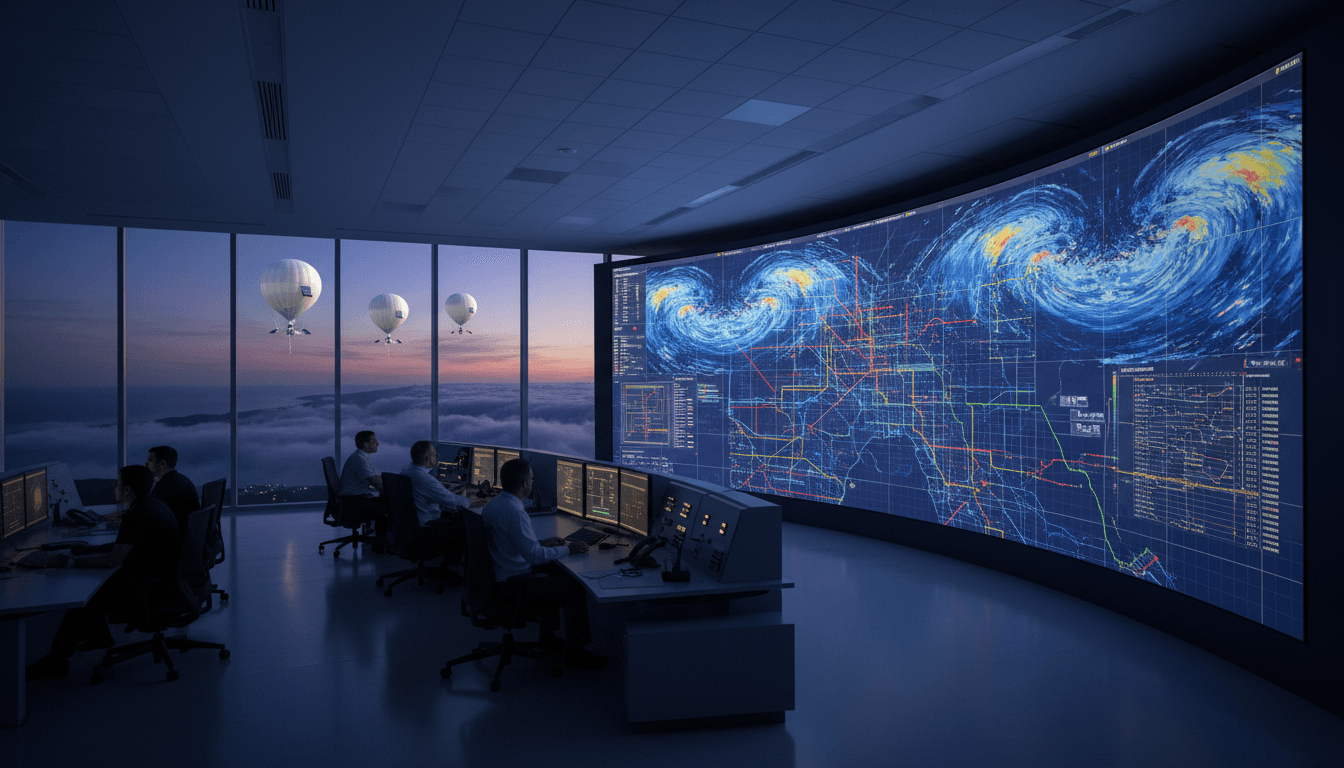
Instead of passively drifting, these balloons can be directed to specific regions to fill data gaps. In the lead-up to Hurricane Milton, WindBorne launched six balloons from Mobile, Alabama, and within 24 hours they entered the storm and released dropsondes measuring temperature, pressure, humidity, wind speed, and wind direction.
WindBorne reports that their AI system, WeatherMesh, produced a path prediction for Milton that was more accurate than the U.S. National Hurricane Center—but because this was an experimental deployment, it wasn’t shared publicly in real time.
Energy takeaway: measurement fleets beat measurement points
Utilities have traditionally monitored the world with fixed points—substations, line sensors, smart meters, weather stations. That’s valuable, but it’s not enough when risk is moving.
WindBorne’s constellation approach suggests a stronger pattern for grid resilience:
- Mobile sensing (drones, patrol vehicles, robot inspection, temporary sensors)
- Adaptive routing to where uncertainty is highest (fire perimeter weather, storm fronts, icing corridors)
- Fast model refresh so operations can act before conditions settle into “known bad”
If you want better decisions, build a system that can seek out missing data, not just log what passes by.
AI forecasting works best when it’s end-to-end
WindBorne describes its goal as a “planetary nervous system”: collect observations everywhere, route them to an AI “brain,” then send guidance back to the sensors on where to measure next.
That loop is the part many energy AI programs skip.
Lots of organizations deploy AI as a dashboard layer on top of existing data. WindBorne built the reverse: data collection is designed around what the model needs, and the model is designed around what the sensors can deliver quickly.
WeatherMesh in plain language
WeatherMesh is a transformer-based forecasting model with an encoder–processor–decoder structure:
- The encoder compresses raw atmospheric variables into a “latent” representation
- The processor predicts how that latent state evolves over time (iterated step-by-step for longer forecasts)
- The decoder converts the latent prediction back into real-world weather variables
WindBorne trained early versions on a local GPU cluster (a few dozen consumer GPUs) rather than relying entirely on cloud resources, reporting about $100,000 in hardware cost and suggesting cloud training would have been roughly 4x higher.
They also made a practical engineering choice that matters to any industrial AI team: models often degrade when moving from curated historical datasets to messy real-time feeds. To bridge that gap, WindBorne built U-Net-based adapters that translate real-time observations into the internal format used during training.
This is the unglamorous work that makes “AI in production” real.
What utilities can copy: faster refresh, finer resolution, better decisions
WindBorne’s WeatherMesh-4 outputs a full forecast every 10 minutes, compared to traditional global models that update every 6 hours. It also predicts a broad set of variables relevant to energy operations: near-surface temperature and dewpoint, wind at 10 m and 100 m, precipitation, solar radiation, cloud cover, and more.
For grid operators, the operational value comes from three improvements working together:
1) Shorter decision cycles (10-minute refresh)
A faster refresh rate changes what’s possible:
- Wildfire shutoff decisions can be tied to updated wind/relative humidity signals
- Crew staging can track evolving storm tracks instead of yesterday’s cone
- Outage restoration logistics can be routed around changing flood or ice risk
In supply chain terms, this is the difference between re-planning weekly and re-planning continuously.
2) Higher-resolution forecasts where it matters
WindBorne reports a component that can provide forecasts for selected locations at ~1 km resolution. For energy, that’s the scale where things get operational:
- wind farm wake effects and localized ramps
- solar irradiance variability due to cloud streets
- freezing rain bands that split counties, not states
This is also where procurement gets sharper: if you can forecast localized damage risk, you can pre-position transformers, poles, insulators, and line hardware with less overstock.
3) Better prediction of extreme conditions (with physics guardrails)
WindBorne isn’t claiming physics-based models are dead. They argue AI models still benefit from traditional models for training baselines and physical plausibility—especially in rare extremes.
That hybrid stance is the right one for utilities.
Pure AI can be fast and accurate, but grid operators need forecasts that are not only accurate on average—they must be credible under stress. A hybrid approach (AI speed + physics constraints + real-time observation) is a practical reliability strategy.
“Forecasts don’t fail because the math is weak. They fail because the system can’t see.”
From hurricane tracking to procurement planning: practical use cases
Weather forecasting may feel distant from procurement, but the mechanics are identical: uncertainty, lead times, and scarce resources.
Here are concrete ways this “AI + adaptive sensing” pattern translates into AI in supply chain & procurement for energy and utilities.
Use case 1: Storm-driven spares procurement and inventory placement
Better track and intensity forecasts can tighten your emergency inventory strategy:
- move from seasonal blanket stocking to event-triggered replenishment
- prioritize long-lead assets (transformers, reclosers, specialized conductors)
- pre-stage based on probabilistic risk corridors rather than county-wide guesses
The operational goal is simple: reduce expedite costs while improving readiness.
Use case 2: Renewable generation forecasting and market exposure
WindBorne-style improvements in wind speed (including at 100 m hub height) and solar radiation forecasting reduce:
- imbalance penalties
- reserve procurement costs
- congestion-driven curtailment
If you buy power or manage PPAs, improved renewable forecasting becomes a procurement advantage. You’re not just “predicting weather,” you’re pricing risk more accurately.
Use case 3: Grid maintenance scheduling and contractor capacity
Weather uncertainty drives maintenance deferrals, overtime spikes, and contractor bottlenecks. A faster, more accurate forecast cycle helps you:
- schedule inspections in safe windows
- pre-approve contractor callouts with fewer cancellations
- align vegetation management around wind and humidity constraints
That reduces cost and improves safety—two metrics regulators and boards actually care about.
Use case 4: Supplier risk sensing as a “balloon constellation” mindset
You can’t launch balloons into Tier-3 suppliers, but you can build a similar structure:
- treat supplier signals (quality escapes, late ASNs, financial stress, logistics disruptions) as “atmospheric variables”
- use AI to route attention to where uncertainty is rising
- refresh risk forecasts frequently, not monthly
If your supplier risk model updates slowly, it’s the procurement version of a 6-hour forecast cycle.
A practical implementation blueprint (what I’d do first)
If you’re in utilities, energy retail, or an equipment-heavy operator, here’s a sensible path that doesn’t require a moonshot.
Step 1: Pick one decision that’s currently weather-fragile
Good candidates:
- crew staging and mutual aid requests
- wind/solar day-ahead schedules
- wildfire mitigation triggers
- spare parts allocation and expedite purchasing
Step 2: Define the “data gaps” in operational terms
Examples:
- “We don’t know wind gust risk at ridge-top circuits within ±6 hours.”
- “We can’t forecast cloud cover variability at solar sites at 1–3 km granularity.”
- “We don’t know which substations are most exposed to flooding until roads close.”
Step 3: Upgrade sensing before you upgrade models
This is the contrarian part: many teams start by buying an AI platform.
Start by improving observation coverage:
- targeted weather stations (temporary and permanent)
- line-mounted sensors and fault indicators
- drone/robot inspection for storm pre-assessment
- third-party atmospheric datasets combined with your internal telemetry
Then use AI to fuse it and refresh it quickly.
Step 4: Operationalize the output
A forecast that doesn’t change an action is trivia.
Make sure every model output maps to:
- a threshold
- an owner
- a playbook step
- and a time window
This is where most “AI transformation” programs quietly stall.
Where this is heading in 2026: faster loops, more autonomy
WindBorne’s stated ambition is to scale to 10,000 balloons in the air, launched from about 30 sites worldwide, aiming for near-continuous global observation by 2028. They recently reported a 104-day balloon flight.
Whether or not that exact roadmap lands, the direction is clear: forecasting is shifting from periodic, centralized modeling to continuous, sensor-driven AI loops.
For energy and utilities, that shift will show up in two places first:
- Grid optimization that treats weather as a continuously updated input, not a daily file
- Supply chain risk management that refreshes exposure (inventory, contractors, supplier constraints) at operational tempo
If you’re building AI capabilities for procurement and operations, the question isn’t “Should we use AI forecasts?” The question is: Do we have an end-to-end system that can see the risk forming early enough to act?