AI supply chain operations reduce decision latency—faster sensing, smarter coordination, and selective autonomy across routing, warehousing, planning, and procurement.
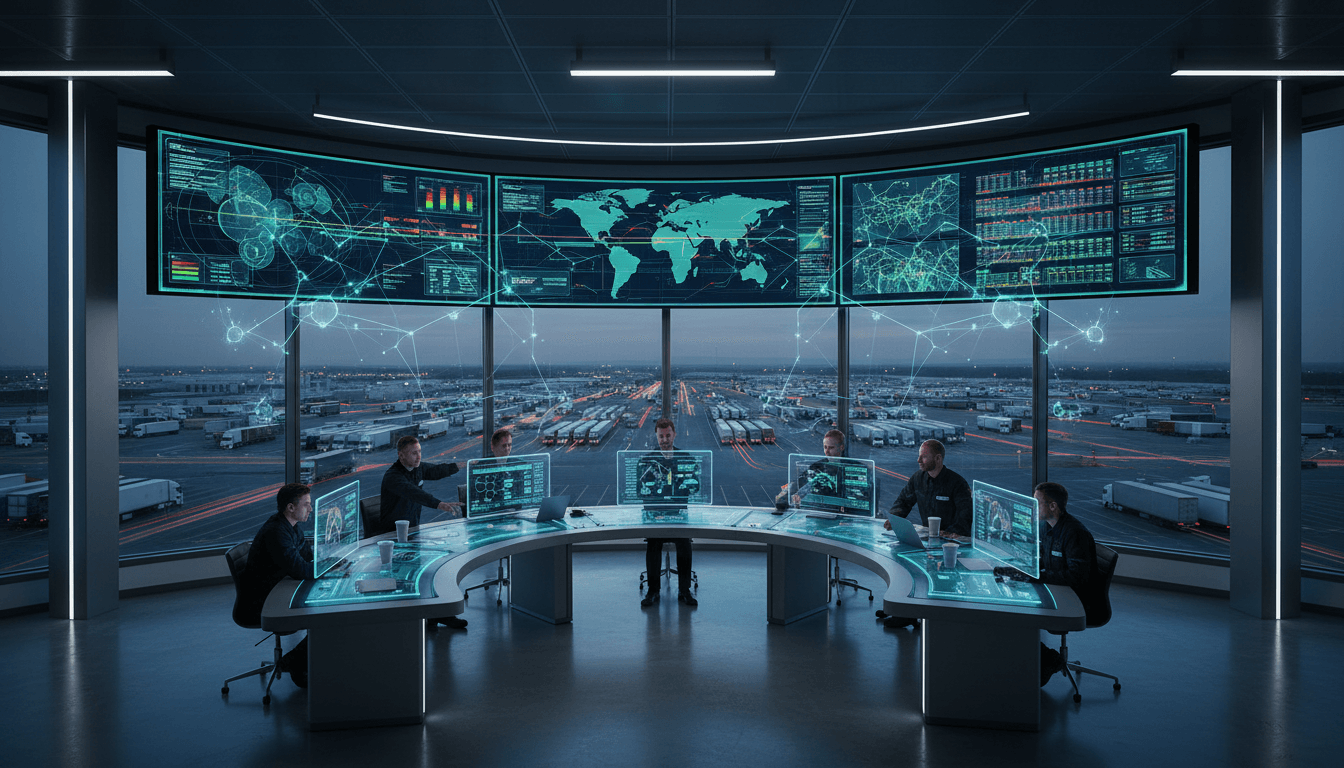
AI Supply Chain Operations: From Insight to Autonomy
Most logistics teams don’t have an “AI problem.” They have a latency problem.
A disruption happens (a late vessel, a carrier tender rejection, a freezer alarm in a DC, a supplier miss). The data exists somewhere—TMS events, WMS tasks, EDI messages, IoT sensors, emails—but the organization reacts slowly because signals are buried, ownership is unclear, and decisions don’t travel across functions.
That’s why the most practical way to think about AI in transportation and logistics in late 2025 is simple: AI shortens the time between “something changed” and “we responded well.” The ARC community has been calling out the same themes repeatedly—real-time awareness, cross-functional coordination, and pattern recognition at scale—and they map directly to what actually improves service, cost, and resilience in supply chain execution.
This post is part of our AI in Supply Chain & Procurement series, where we focus on how AI improves forecasting, supplier performance, inventory, and end-to-end execution. Here, we’ll translate the industrial AI themes into logistics reality—routing, warehousing, planning, reliability, and procurement—plus a practical path to implementation.
AI value in logistics comes from three capabilities
AI creates measurable supply chain value when it delivers (1) real-time awareness, (2) cross-functional coordination, and (3) scalable pattern recognition. Everything else—dashboards, pilots, proofs of concept—only matters if it improves one of those three.
Real-time awareness: less noise, faster response
Logistics networks generate a flood of events: appointment updates, geofence pings, scan data, yard moves, labor productivity metrics, temperature readings, claims, and supplier ASNs. The hard part isn’t collecting it—it’s deciding what deserves attention.
AI helps by:
- Detecting exceptions earlier (late departures, dwell spikes, unusual picking slowdowns)
- Prioritizing what’s actionable (which delays threaten OTIF, which can be absorbed)
- Explaining “why now” (weather + carrier capacity + a specific node constraint)
One “snackable” truth: Your control tower isn’t “real time” if people still need to refresh a report to discover a problem. AI is at its best when it pushes the right alert to the right role with a recommended next step.
Coordination across functions: planning, execution, and procurement finally talk
Production affects outbound. Maintenance affects throughput. Procurement decisions affect lead time and fill rate. Yet many companies still run these as separate worlds with separate metrics.
AI-driven coordination closes that gap by sharing context across systems—ERP, WMS, TMS, MES, asset management, supplier portals—so decisions aren’t made in a vacuum.
Here’s what that looks like in practice:
- A demand spike triggers not just a planning update, but a labor plan adjustment in WMS, a capacity pre-book in TMS, and a supplier expedite request.
- A constrained lane leads to inventory rebalancing recommendations rather than simply paying higher spot rates.
- A packaging shortage in procurement triggers substitution options aligned to production schedules and customer service commitments.
Most companies get this wrong by aiming AI at one department first. The real money is in the handoffs.
Pattern recognition at scale: predicting the problems you used to “notice later”
Humans are good at judgment; we’re terrible at scanning thousands of weak signals consistently.
AI excels at:
- Early signs of asset degradation (conveyors, sorters, refrigeration units)
- “Quiet” shifts in demand (micro-trends by region, channel, SKU)
- Changes in carrier performance (a lane’s tender acceptance slipping before it becomes a crisis)
- Emerging supplier risk (lead-time creep, quality flags, PO confirmation behavior)
The operational win is lead time. A two-day earlier warning is often the difference between a reroute and a stockout.
Where AI is showing up first: 5 high-ROI use cases
AI adoption is shifting from experiments to workflow redesign. In transportation and logistics, the fastest payback tends to come from use cases that touch daily execution.
1) AI-enhanced demand forecasting and inventory positioning
Forecasting is no longer just time series plus promo calendars. Leading teams now fold in:
- Near-real-time sales signals
- Weather and regional events
- Web traffic / search interest (where relevant)
- Supply constraints and substitution behavior
A practical stance: forecast accuracy matters, but “forecast usability” matters more. The best AI forecasting setups translate predictions into decisions:
- How much inventory to stage in each DC
- Which SKUs to prioritize for replenishment
- When to trigger production changeovers
For procurement teams, this also improves supplier collaboration: better forecasts lead to better capacity commitments and fewer expedites.
2) Smart routing and dispatch in transportation management
Routing AI isn’t just “shortest path.” It’s multi-constraint optimization:
- Appointment windows
- Driver hours and preferences
- Facility dwell patterns
- Road restrictions, weather risk, congestion
- Cost-to-serve by customer and lane
The most valuable systems also learn from execution:
- Which carriers actually hit appointments at Facility A
- Which lanes degrade service on Mondays
- Which regions require more buffer due to consistent dwell
If your routing engine doesn’t incorporate facility behavior (yard congestion, unload times), you’re optimizing the wrong thing.
3) Warehouse AI: labor planning, slotting, and exception handling
Warehouses are where small inefficiencies multiply. AI helps when it’s applied to the decisions supervisors make every shift:
- Labor forecasting and dynamic staffing (by wave, zone, and task type)
- Slotting recommendations that adjust as demand changes
- Pick-path optimization that reflects congestion and real layout constraints
- Computer vision for damage detection, dimensioning, and safety
One opinion I’ll stand behind: Warehouse AI pays back fastest when you treat it like an operations tool, not an analytics project. That means putting recommendations inside WMS workflows, not in a separate report.
4) Predictive maintenance for material handling and logistics assets
Downtime is brutally expensive when it hits the wrong hour. Predictive maintenance models can forecast failures using vibration, temperature, motor current, cycle counts, and error codes—then schedule interventions around operational peaks.
For logistics leaders, the key is tying reliability to service:
- Which asset failures would block shipping doors?
- Which sorter downtime impacts next-day cutoffs?
- What’s the cost of downtime by hour and by node?
Maintenance AI isn’t an engineering vanity project if it’s linked to OTIF and throughput.
5) Agentic automation: toward autonomous supply chain execution
You’ll hear “agents” everywhere heading into 2026. The useful version is not a chatbot; it’s an AI system that can:
- Monitor a defined scope (say, top 20 lanes)
- Detect an issue (capacity shortfall)
- Propose options (rebid, mode shift, consolidate, inventory pull-forward)
- Execute within guardrails (send a tender, adjust a plan, notify stakeholders)
This is already happening quietly in pieces—carrier selection rules, auto-tendering, dynamic rebooking, proactive customer comms. The next step is making it coordinated, not fragmented.
A strong definition for leaders: Autonomous supply chain execution means software can take approved actions to protect service and cost, while humans handle exceptions and governance.
Data discipline is the bottleneck (and the opportunity)
AI performance is capped by data quality, data access, and shared definitions. That’s not glamorous, but it’s where serious programs win.
In transportation and logistics, common blockers look like this:
- Different timestamps for the same milestone (carrier vs DC vs customer)
- Inconsistent location master data (facility IDs, dock doors, geo-fences)
- EDI gaps and “email-only” processes
- WMS labor standards that don’t match reality
- Procurement and planning data that doesn’t reconcile with execution
What “good enough” data looks like for AI projects
You don’t need perfection. You need fit-for-purpose reliability:
- A single event model for shipment milestones and exceptions
- Master data governance for products, locations, carriers, suppliers
- Near-real-time integration where decisions depend on freshness (routing, labor, exceptions)
- Feedback loops (what action was taken, what outcome occurred)
If you’re building a roadmap, prioritize one domain where the data can be fixed end-to-end—then expand. AI projects fail when they depend on “someone else’s system” to become clean later.
Human + AI collaboration: the workflow is the product
Successful AI programs don’t replace operators, planners, or dispatchers—they change how those roles work.
The difference between “AI that helps” and “AI that gets ignored” usually comes down to three choices:
- Where the recommendation shows up: inside TMS/WMS/APS screens beats a standalone dashboard.
- How it’s explained: users need a short rationale (top drivers) and confidence level.
- What control exists: people need override, escalation paths, and clear guardrails.
A practical pattern I’ve seen work:
- Start with recommendations only (humans decide)
- Move to auto-actions for low-risk cases (humans audit)
- Graduate to bounded autonomy (humans supervise, focus on exceptions)
That progression also helps with workforce adoption. Nobody trusts a black box on day one—and they shouldn’t.
A 90-day plan to move from pilots to production
If you want leads, savings, and credibility, ship something operational in 90 days. Not “an AI strategy deck.” A working improvement.
Days 1–30: pick a narrow problem with hard metrics
Choose one use case with:
- Clear owner (transportation, warehouse ops, planning, procurement)
- Accessible data
- A measurable KPI tied to money
Examples:
- Reduce detention and dwell at 5 high-volume facilities
- Improve tender acceptance on a constrained set of lanes
- Cut warehouse overtime hours through better labor forecasting
- Reduce stockouts for a specific category via improved forecasting + replenishment
Days 31–60: integrate into the workflow
This is where most teams stall. Don’t.
- Put recommendations in the system people already use
- Create exception queues with priorities
- Add simple “why” explanations
- Define guardrails (what the model can’t do)
Days 61–90: operationalize and govern
- Establish monitoring for drift and false positives
- Set a cadence for model review (weekly at first)
- Create a playbook for exceptions
- Decide what moves from recommendation → automation
One sentence worth repeating to stakeholders: A model without governance is a temporary demo.
What to ask vendors (and internal teams) before you commit
AI in logistics is crowded, and a lot of demos look identical. Cut through that with questions that force specificity:
- What decisions will the AI change in the first 30 days?
- Which data sources are required, and what happens when events are missing?
- How do you measure impact—control group, A/B testing, before/after?
- Can users see the top drivers behind a recommendation?
- What’s automated vs. manual, and what are the guardrails?
- How do you handle exceptions, escalations, and approvals?
- What cybersecurity and access controls exist for agentic actions?
If a provider can’t answer these clearly, you’re buying a promise, not a product.
Where this is heading in 2026
AI in supply chain management is moving toward network-level intelligence: systems that understand relationships across suppliers, plants, DCs, carriers, and customers—then reason about downstream impact. This is where graph-based approaches and context-rich assistants start to matter.
But the direction is already set: faster sensing, tighter coordination, and increasing autonomy in execution. The winners won’t be the companies with the flashiest models. They’ll be the ones that redesign workflows, fix the data that matters, and put governance around automation.
If you’re building your 2026 roadmap now, pick one place where latency hurts—routing, warehouse exceptions, supplier lead times, asset reliability—and make it the proving ground. After that, scaling gets much easier.
What part of your logistics network still runs on “we’ll notice it when it’s bad”?