Truck bridge strikes are preventable. See how new legislation and AI route optimization reduce clearance risks, claims, and supply chain disruption.
Stop Truck Bridge Strikes With AI Route Planning
Pennsylvania logged 600+ bridge strikes between 2013 and 2023. New York saw 350 in 2024 alone. Those aren’t “driver mistakes” in isolation—they’re a systems failure that hits procurement budgets, carrier performance, and service levels all at once.
The loudest signal in this week’s news isn’t the crash itself—it’s the reason lawmakers are targeting: navigation tools that route commercial vehicles like they’re passenger cars. When a truck hits a low-clearance bridge, the cost isn’t just bent metal. It’s emergency response, detours, missed appointments, damaged freight, claims, and weeks of disrupted capacity on a corridor.
A bipartisan proposal, the Bridges Not Bumpers Act of 2025, is being introduced to improve bridge clearance data and coordination. I’m glad it exists. But the more practical takeaway for shippers, 3PLs, and fleets is this: bridge strikes are an AI-route-planning problem today, not a “wait for infrastructure” problem tomorrow.
Why bridge strikes are a supply chain problem (not just a safety issue)
Bridge strikes are predictable disruptions. That’s what makes them so frustrating—and so solvable.
When a truck wedges under a bridge, three things happen immediately:
- Capacity disappears (that tractor/trailer is out of service; sometimes the lane is too).
- Time certainty collapses (detours, police, towing, inspections, transloading).
- Cost cascades (claims, penalties, detention, rework, customer fallout).
This is procurement’s world, too. If you manage transportation spend, you’ve seen the downstream effects:
- Contracted carriers miss tender acceptance because they’re short on drivers/equipment after an incident.
- OTIF performance dips, and you pay for expedites to recover.
- Insurance premiums and claim ratios rise, which shows up later as rate pressure.
And in December—peak retail replenishment, holiday returns, weather volatility—disruptions stack faster than planners can absorb. A single blocked arterial route near a metro area can ripple across an entire region’s appointment schedule.
One-liner worth keeping: A bridge strike is a “local accident” only if you ignore the network.
What the Bridges Not Bumpers Act of 2025 signals
The bill is a policy response to a data problem: clearance and truck-route data is fragmented, inconsistently updated, and not reliably embedded into the tools drivers actually use.
Based on the proposal’s outline, the legislation pushes three practical mechanisms:
A working group to fix public-private data sharing
A federal working group would make recommendations on:
- Sharing bridge/tunnel clearance and truck route data more effectively
- Improving truck-specific routing info and signage inside navigation tools
- Encouraging rental companies to label trucks with height and weight information
Translation: stakeholders finally admitting that “the data exists somewhere” isn’t good enough.
A national clearinghouse for bridge and tunnel clearance strikes
A clearinghouse would collect incident data and distribute best practices.
If it’s implemented well, this matters because AI models and routing engines need:
- A consistent definition of a “strike”
- Location accuracy (exact segment, direction, ramp)
- Contributing factors (bad route guidance, missing signage, driver unfamiliarity)
Without that, everyone’s optimizing locally and learning slowly.
Grants for research and mitigation
Funding research is useful, but the best part is the intent to identify high-risk locations and evaluate what countermeasures actually work.
My stance: the grants should prioritize projects that improve digital infrastructure data (clearance, restrictions, work zones) as much as physical retrofits.
The real root cause: passenger-car GPS in a commercial-truck world
Most companies get this wrong: they treat truck navigation as a driver preference. It’s not. It’s a control point in your transportation system.
Traditional consumer GPS tools optimize for:
- shortest time
- simplest turns
- typical traffic patterns
But they often don’t reliably encode:
- bridge and tunnel clearances
- hazmat restrictions
- weight limits, axle limits
- time-of-day truck restrictions
- construction changes and temporary restrictions
So when lawmakers say inaccurate GPS contributes to bridge strikes, they’re naming the obvious failure mode: a route can be “correct” for a sedan and catastrophic for a 13’6” trailer.
Here’s the thing about bridge strikes: many are pre-trip preventable. If the route was screened against clearance constraints before the driver ever rolled, the “incident” becomes a non-event.
Where AI fits: prevention beats post-incident response
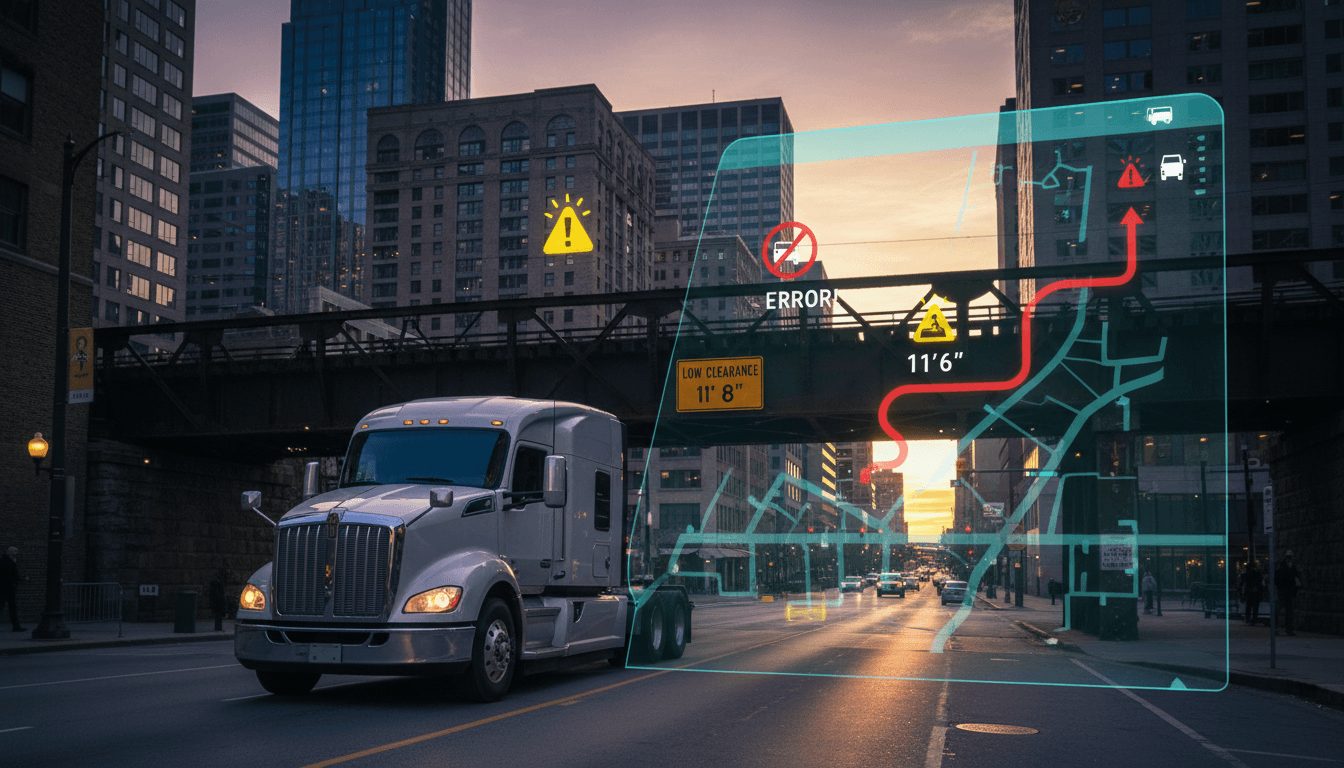
AI doesn’t prevent bridge strikes by being fancy. It prevents them by being constraint-aware, continuously updated, and enforced at the workflow level.
AI route optimization that respects real-world constraints
The clearest win is AI-driven route optimization that treats vehicle specs as first-class inputs:
- vehicle height (including aero kits, reefers, lift axles)
- gross weight and axle configuration
- trailer type (flatbed vs. enclosed; doubles; lowboy)
- commodity and compliance constraints (hazmat classes)
A solid system doesn’t just “suggest” a safe route. It can:
- block unsafe route options
- generate alternates with minimal cost impact
- surface where the plan requires permits or escorts
Answer-first takeaway: If your routing tool can’t model vehicle height as a hard constraint, it’s not a truck routing tool.
Real-time monitoring: catching the last-mile trap
Bridge strikes disproportionately happen near:
- dense metros
- industrial parks with old infrastructure
- last-mile delivery zones
That’s where real-time monitoring matters. AI can combine:
- live traffic and incident feeds
- work-zone updates
- map edits and clearance updates
- telematics breadcrumbs (where trucks actually go)
Then it can detect risky patterns: “Drivers keep deviating here and ending up under this low bridge.” That’s not driver blame—that’s a process defect (bad geofences, poor dock instructions, wrong entrance, confusing signage).
Predictive risk scoring for lanes, customers, and facilities
For the “AI in Supply Chain & Procurement” crowd, this is the underrated piece.
You can build a risk score that flags:
- customers located near known low-clearance corridors
- lanes with frequent detours due to seasonal construction
- facilities with ambiguous approach routing (multiple entrances; mixed truck routes)
Procurement can then act before contracting or tendering:
- require truck-safe routing compliance in carrier agreements
- include facility approach instructions in tenders
- adjust appointment buffers where risk is higher
This is what it looks like when AI reduces risk and protects service.
What shippers, 3PLs, and carriers should do now (a practical playbook)
Legislation is slow. Your exposure isn’t.
Here’s a pragmatic sequence I’ve seen work—without boiling the ocean.
1) Standardize vehicle dimension data (yes, this is boring—do it anyway)
You can’t route safely if you don’t know what you’re routing.
- Capture true operating height by equipment type
- Track exceptions (lifted suspensions, specialized trailers)
- Make it accessible to dispatch and routing (not trapped in PDFs)
If you run mixed fleets, don’t settle for “all vans are 13’6”.” Reality is messier.
2) Put “truck-safe routing” into the tendering workflow
Make it a process requirement, not a training reminder.
- For shipper TMS users: attach approved approaches for tricky facilities
- For 3PLs: include route constraints in carrier instructions
- For carriers: require dispatch to generate a truck-safe route for first-time stops
Procurement angle: Add a compliance clause that defines acceptable navigation (truck routing mode, approved route adherence, or telematics confirmation). If a carrier can’t support that, price them accordingly.
3) Use AI to learn from near-misses, not just crashes
Most organizations only analyze incidents that become claims. That’s late.
Look for signals like:
- repeated hard-braking events near a low bridge
- frequent U-turns or missed turns within a geofence
- recurring “driver called for help” locations
Those are the breadcrumbs that AI models can convert into prevention rules.
4) Fix facility approach instructions (the silent bridge-strike multiplier)
A surprising number of routing failures happen because:
- the dock pin is wrong
- the facility address routes to a car entrance
- receiving instructions are outdated
Create a “truck approach card” for high-risk locations:
- best entrance and turn-by-turn approach
- prohibited streets
- clearance warnings
- staging guidance
If you’re serious about OTIF, treat this like master data.
5) Build a bridge-strike KPI that procurement and operations both see
If it’s only a safety KPI, it won’t get funded. If it’s only a cost KPI, it won’t get adopted.
Track:
- bridge/clearance incidents and near-misses per million miles
- detention and rework hours tied to routing errors
- claims dollars tied to route noncompliance
- lane-level risk score trends
The goal is simple: make the “hidden cost” visible.
People also ask: practical questions about AI truck GPS and compliance
Can AI route optimization replace driver judgment?
No—and it shouldn’t. The job is to remove predictable hazards (like low-clearance bridges) so drivers can focus on what humans are good at: situational awareness, road conditions, safe maneuvering.
Isn’t this solved by buying a truck GPS unit?
Sometimes, but not reliably. The bigger issue is governance: map updates, vehicle profiles, facility instructions, and whether routing is enforced through dispatch and planning.
What should procurement require from carriers?
At minimum:
- confirmation they use truck-safe navigation with vehicle profiles
- willingness to follow shipper-provided approach routes for sensitive facilities
- incident reporting that includes location and routing context (not just “hit bridge”)
If a carrier can’t provide any of that, you’re buying risk.
The better way to approach bridge-strike prevention
The Bridges Not Bumpers Act of 2025 is a strong signal that government is finally treating bridge strikes as a data coordination problem, not a string of one-off mistakes. The states pushing it—like Pennsylvania and New York—have the incident volume to justify action.
But the fastest results will come from the private side: AI-powered route planning and real-time monitoring that make unsafe routes impossible to select and easy to avoid. For teams working in AI in supply chain & procurement, this is a clean example of AI doing what it does best: turning scattered operational data into fewer disruptions and more reliable service.
If you’re building your 2026 transportation strategy right now, here’s the question worth answering internally: Where can a routing error create a safety incident—and what would it cost us in claims, service failures, and lost capacity if it happened next week?