Overpass strikes are preventable. See how AI route optimization and real-time monitoring reduce over-height risk and keep oversize loads compliant.
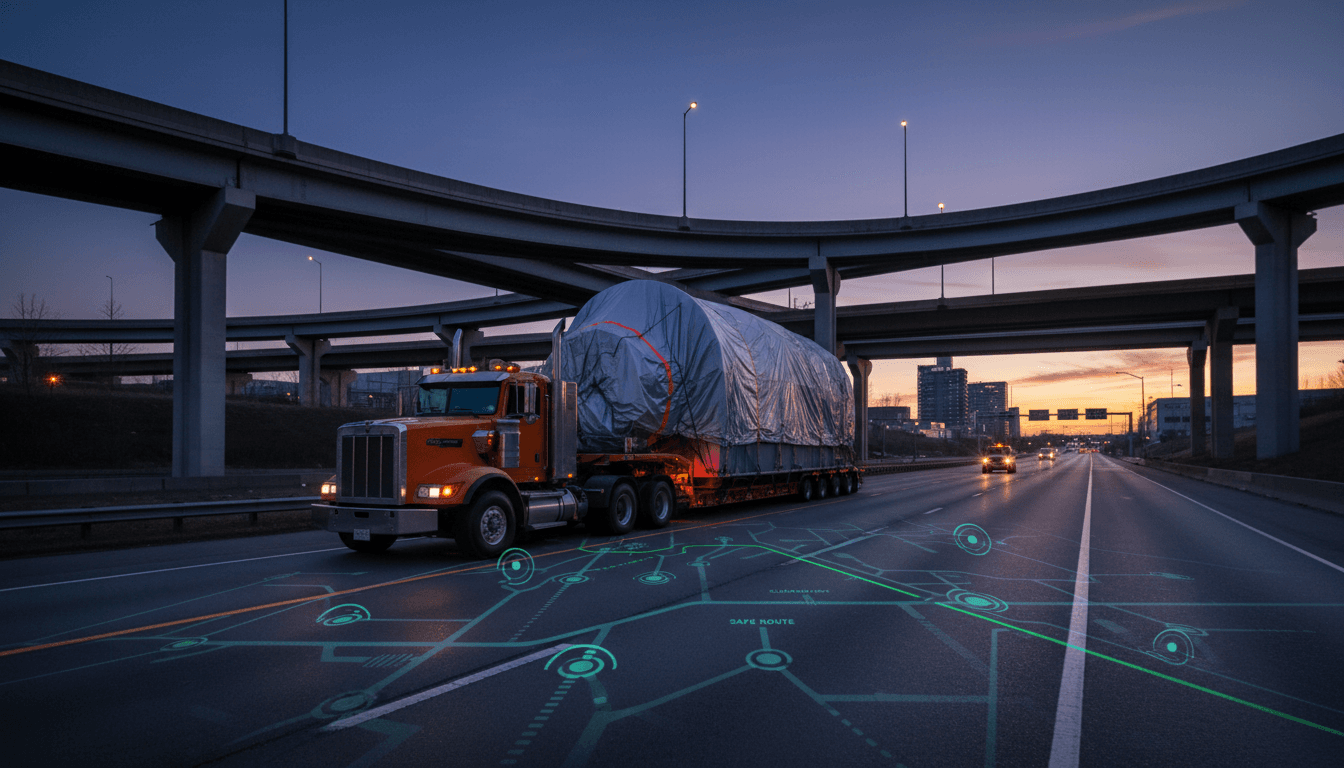
Stop Overpass Strikes: AI Routing for Oversize Loads
A single over-height truck recently struck six overpasses in northeastern Oklahoma, forcing bridge closures and triggering an emergency repair response. The load was measured at more than 15 feet, above Oklahoma’s 14-foot height limit, and officials said it wasn’t properly permitted for the route. Repairs were expected to take up to two weeks, with lane closures planned as work begins.
Most companies treat over-dimensional (OD) moves like a paperwork exercise: get a permit, assign a pilot car, pick a route that “should” work, and go. This incident is the clearest reminder that permit compliance isn’t the same thing as route safety—and that the cost of getting it wrong isn’t just a fine. It’s infrastructure damage, service disruption, and a public safety story that lingers.
This post is part of our AI in Supply Chain & Procurement series, where we focus on practical ways AI reduces risk, waste, and avoidable surprises. Overpass strikes are one of those “avoidable surprises” that still happen far too often—and they’re exactly the kind of problem AI-powered route optimization and predictive logistics planning are built to prevent.
What happened in Oklahoma—and why it matters for shippers
An over-height strike isn’t a “trucking problem.” It’s a supply chain risk event.
According to officials, a flatbed hauling oversized cargo struck and damaged bridge beams on multiple county road crossings above the I-44/Will Rogers Turnpike corridor in Rogers and Mayes counties. Three bridges were closed, while the turnpike stayed open with nightly lane closures expected during repairs. The driver was stopped shortly after the first strike and placed out of service.
Here’s what supply chain leaders should take from it:
- The direct costs are only the start. Bridge repairs, equipment inspections, and claims add up fast.
- The indirect costs hit procurement and customer service. Detours, missed appointments, expediting, and ripple effects on downstream production schedules can dwarf the initial bill.
- These incidents are repeatable. Oklahoma previously saw nine turnpike bridges damaged in 2023 with reported repair costs of more than $1.6 million.
If you manage inbound equipment, plant projects, energy components, or capital goods, you’re in the blast radius. Over-height events are a predictable failure mode in heavy haul logistics.
The unseen cost of an overpass strike (it’s bigger than repairs)
The most expensive part of an overpass strike is usually the operational shockwave.
Operational fallout: the supply chain version of “unplanned downtime”
When bridges close or lanes restrict, carriers reroute. Reroutes burn hours, not minutes—especially in rural corridors where alternate crossings are limited. That knocks delivery windows, triggers detention, and often forces re-planning of multi-stop networks.
For shippers and 3PLs, common cost buckets include:
- Accessorials: detention, layovers, reconsignment fees
- Expedite premiums: hot-shotting components to protect production
- Inventory impacts: safety stock consumption or line stoppage
- Administrative load: incident management, claims, customer comms
Contract and compliance exposure
Over-dimensional moves live at the intersection of procurement, risk, and compliance. A strike can pull in:
- permit disputes (who secured what, and when)
- routing adherence questions (was the approved route followed?)
- shipper-of-record scrutiny (were dimensions accurate?)
- insurer investigations and subrogation
One strong stance: if your organization moves OD freight and you can’t reconstruct the planned route vs. actual route with dimension and clearance assumptions, you’re not managing risk—you’re guessing.
Why over-height strikes still happen (and where planning breaks)
Most strikes come from a small set of recurring failures.
Bad data in, bad route out
If the shipment’s height is wrong—because a cradle was added, tires were inflated differently, the trailer deck height was assumed, or the load shifted—every decision after that is compromised.
A painful reality in heavy haul: dimensions aren’t always measured the same way across shippers, yards, and carriers. “15 feet” might be the cargo, not cargo-on-trailer.
Static permitting in a dynamic world
Permits and approved routes are necessary, but they’re often built on static assumptions:
- clearance databases may be outdated
- construction zones appear after planning
- temporary signage, resurfacing, or detours change effective height
- local road restrictions vary by time of day
Fragmented responsibility
Shippers, 3PLs, carriers, permit services, and escorts each own a slice of the move. The cracks show up when:
- the permit is correct but the dispatch route differs
- the driver follows truck GPS that isn’t OD-aware
- the escort plan doesn’t include “last mile” surprises (county roads, local bridges)
That’s why “we had a permit” is not a defense; it’s just evidence you did one step.
How AI-powered route optimization prevents overpass strikes
AI prevents over-height strikes by turning routing into a constraint-solving problem with continuous validation, not a one-time plan.
1) Clearance-aware routing that understands real constraints
Basic route tools optimize for time, tolls, and distance. OD freight needs optimization under constraints:
- maximum height by segment (bridges, overhead signs, utilities)
- maximum weight by axle/group
- turning radius and lane width restrictions
- grade limits for heavy equipment
- curfews and lane restrictions
An AI routing system can treat these as hard constraints (never violate) while still optimizing cost and time.
Snippet-worthy truth: If your routing engine can’t model clearance constraints, it’s not a routing engine for oversize loads—it’s a map.
2) Predictive analytics to flag “strike risk” before dispatch
A practical application I’ve found works well is adding a risk score to OD loads during procurement and tendering.
Inputs that predict trouble:
- height close to the legal threshold (e.g., 13’6”–15’ range depending on state)
- unfamiliar lanes/carriers for OD moves
- routes with many bridge crossings or county-road transitions
- high frequency of construction activity
- low confidence in dimensional data (manual entries, no photo verification)
Outputs that matter:
- “requires engineer review” flags
- mandatory escort/pilot requirements
- alternative route suggestions with lower clearance variance
The goal isn’t perfection. It’s catching the obvious “this is a bad plan” cases early.
3) Real-time monitoring: route adherence and exception handling
Over-height incidents often start with one small deviation: a missed turn, a detour, an “I’ll just take this road.”
AI-enabled monitoring can:
- compare GPS traces to the approved OD route
- alert when a vehicle approaches a low-clearance segment
- trigger escalation to dispatch/escort lead before the driver commits
This is where modern logistics stacks shine: routing + telematics + geofencing + workflow automation.
4) Better procurement decisions for OD freight
Because this is an AI in Supply Chain & Procurement series, here’s the procurement angle: preventing strikes starts before a truck is booked.
AI can help procurement teams:
- qualify OD-capable carriers using historical inspection/compliance patterns
- standardize dimensional data collection (photos + measurement workflows)
- enforce bid rules: “no tender unless clearance-validated route is attached”
- model total landed cost including escorting, permits, and route constraints
Procurement should demand evidence, not assurances.
A practical playbook: “No-Strike” workflow for over-dimensional cargo
A repeatable workflow beats heroics. Here’s a field-tested structure you can implement with or without a full platform overhaul.
Step 1: Standardize measurement and verification
- Measure cargo-on-trailer height, not cargo height
- Capture photos from front/side with a visible measurement reference
- Store dimensions in a single system of record tied to the load ID
Step 2: Clearance-validated route planning (before tender)
- Generate at least two feasible routes
- Identify “critical segments” (lowest clearance points)
- Require sign-off when clearance margin is thin (for example, under 6 inches)
Step 3: Permit + route + dispatch must match
- Lock the approved route into dispatch instructions
- Prevent non-OD GPS use for OD moves
- Brief escorts on the exact constraints and decision points
Step 4: In-transit monitoring and escalation rules
- Geo-alert at critical segments
- Alert on deviation beyond a small corridor buffer
- Escalation: driver → escort lead → dispatch → safety
Step 5: Post-move learning loop
- Record near-misses and route deviations
- Update clearance confidence levels
- Feed outcomes back into the risk model
AI becomes more valuable when you treat every move as training data.
“People also ask” (OD routing and AI)
Can AI replace permitting for oversized loads?
No. Permits are a legal requirement. AI complements permits by validating feasibility, improving routing accuracy, and monitoring adherence so the plan stays the plan.
What data do you need for AI route optimization for oversize loads?
At minimum: accurate shipment dimensions (especially height), trailer specs (deck height), axle/weight details, origin/destination access constraints, and a clearance/road restriction dataset. Telematics data improves monitoring and learning.
Is this only for heavy haul carriers?
Not anymore. Shippers that move occasional OD freight—construction materials, plant equipment, energy components—benefit because the risk per move is high, even if OD volume is low.
Where to start if you want fewer incidents in 2026
Overpass strikes are a preventable category of disruption. The Oklahoma incident is a blunt example: a load above the state limit, not properly permitted for the highway system, damages multiple bridges and forces closures. Nobody in the chain wins.
If you’re building a safer, more predictable supply chain, this is low-hanging fruit:
- tighten measurement workflows
- require clearance-aware routing for OD tenders
- add real-time deviation alerts
- use predictive analytics to flag high-risk loads before dispatch
If you’re reviewing your 2026 transportation strategy, ask one question internally: Can we prove—using data—that our oversize routes are clearance-safe and actually followed? If the answer is “not really,” you’ve found a priority project.