On-demand delivery is now table stakes. Here’s how AI improves forecasting, inventory accuracy, and supplier coordination to make real-time fulfillment profitable.
AI-Ready On-Demand Delivery: What Retailers Must Fix
Last week, three very different retailers—Pacsun (apparel), Camping World (outdoor gear), and Lush (beauty/self-care)—expanded on-demand delivery through Uber’s apps (Uber, Uber Eats, and Postmates). That’s not just a holiday-season convenience play. It’s a signal that real-time fulfillment is becoming a default expectation even for non-essentials.
Most companies get this wrong: they treat on-demand delivery as a “channel launch” when it’s actually an operating model change. The front-end button is easy. The hard part is making inventory, labor, picking, and exception management work at on-demand speed—without destroying margin or customer trust.
This post is part of our AI in Supply Chain & Procurement series, and I’m going to take a stance: the next wave of winners won’t be the retailers that add more delivery partners. It’ll be the ones that use AI to run real-time fulfillment profitably and predictably.
Why on-demand delivery is really a supply chain design decision
On-demand delivery forces a retailer to answer one question: Which nodes in your network are you willing to treat like micro-fulfillment centers—today?
A traditional e-commerce order can tolerate batching, planned carrier pickups, and slower exception handling. On-demand can’t. A 45–120 minute promise compresses everything:
- Inventory accuracy has to be store-level and near real-time.
- Picking and packing can’t rely on “when we get to it.”
- Substitutions, cancellations, and address issues happen while the customer is still watching.
For Pacsun, Camping World, and Lush, partnering with Uber helps solve the last-mile capacity problem quickly. But it also exposes every upstream weakness:
- a phantom inventory unit that was actually stolen/damaged,
- an endcap display that isn’t mapped to the digital catalog,
- a store team that isn’t trained for pick/pack standards,
- a procurement contract that doesn’t account for surge fees or service-level penalties.
Real-time fulfillment isn’t about speed. It’s about removing uncertainty. That’s where AI earns its keep.
What Uber-style delivery partnerships mean for procurement and supplier risk
These partnerships look like marketing deals, but procurement teams should view them like any other strategic supplier relationship—because that’s what they are.
When you add a third-party delivery platform, you’re effectively outsourcing part of your customer experience to a network you don’t directly control. Procurement and supply chain leaders need to harden three areas.
1) Contracting for outcomes, not “access”
The common mistake is contracting for platform presence and a general service promise. Instead, treat this like performance procurement:
- On-time delivery rate by geography and time-of-day
- Cancellation rate (driver no-shows, out-of-stock, store delays)
- Damage/return handling and responsibility split
- Chargeback rules when the root cause is inventory accuracy or store readiness
If you don’t define the outcome metrics, you’ll measure the wrong thing and argue about the bill later.
2) Managing surge pricing and peak volatility like a risk category
December is the obvious stress test. When demand spikes, delivery marketplaces price capacity dynamically. If you’re not modeling that, you’ll see margin erosion that looks “mysterious” until finance digs in.
AI-driven scenario planning can help procurement teams run better decisions like:
- When should we pause on-demand offers to protect margin?
- Which SKUs can absorb delivery fees without creating negative contribution margin?
- Which zones should be capped because cancellations are spiking?
3) Building resilience across multiple delivery providers
Relying on one network is a single point of failure. The smarter pattern is multi-carrier orchestration (even if customers only see one checkout option).
AI can support this by routing orders based on:
- real-time capacity,
- cost-to-serve,
- promised time window,
- store workload,
- historical cancellation risk by driver pool and zone.
That’s not theoretical. It’s the difference between “we offer on-demand” and “we deliver on-demand reliably.”
Where AI makes on-demand delivery 30% more efficient (practically)
AI doesn’t need to be flashy to pay off. In on-demand delivery, it wins by tightening three loops: forecast → allocate → execute.
Demand forecasting at the level that matters: store + hour
Most forecasting is built for replenishment cycles—days and weeks. On-demand needs a different lens: intra-day demand forecasting.
What AI does well here:
- Predicting hourly spikes by store and trade area (payday effects, local events, mall traffic, temperature swings)
- Recognizing “giftable” product runs (beauty sets, trending apparel items) that behave differently in December
- Separating marketing-driven demand from organic demand so you don’t overreact operationally
If you can predict that a cluster of stores will get hit between 4–8pm, you can pre-stage labor and reduce cancellations. That alone can materially lift conversion.
Inventory planning that protects the promise (not just the fill rate)
On-demand delivery punishes the retailer that treats store inventory as a single pool. AI helps by creating promise-aware inventory:
- Reserving scarce units for higher-probability fulfillment nodes
- Detecting when inventory accuracy is deteriorating (based on mismatch patterns) and restricting that store from on-demand offers
- Recommending substitutions that preserve customer satisfaction and margin
A useful internal rule I’ve seen work: don’t offer on-demand for SKUs with unstable inventory accuracy until the store’s cycle count and shrink controls are back under control. AI can flag those SKUs automatically.
Smarter pick-paths and labor scheduling
A delivery partner doesn’t fix store execution. The store still has to pick and stage orders quickly.
AI-driven workforce and task optimization can:
- Assign picks to the right associate (experience, department, proximity)
- Generate pick-paths that reduce walking time
- Predict when fitting rooms, returns, and checkout will overload the floor—and throttle on-demand availability before service collapses
This matters because in on-demand, the bottleneck is often inside the store, not the driver.
A blunt truth: if picking takes 18 minutes, it doesn’t matter how fast the driver is.
The operational playbook: making real-time fulfillment sustainable
Retailers often launch on-demand delivery in weeks. Making it profitable takes quarters. Here’s the playbook I’d use.
1) Start with a tight assortment, then expand
Don’t put your entire catalog on on-demand delivery. Begin with SKUs that are:
- high availability,
- easy to pick and pack,
- low damage risk,
- predictable in demand.
For Lush, that could mean core body care and gift sets with standardized packaging. For Pacsun, it might be accessories and basics rather than complex size runs. For Camping World, prioritize items that are not bulky or regulated.
2) Engineer the “out-of-stock moment”
Out-of-stocks aren’t rare in on-demand; they’re a daily event. The question is how you handle them.
AI can support better customer outcomes by:
- proposing substitutions that match intent (not just category)
- predicting acceptance likelihood (based on past customer behavior)
- offering a smarter choice: substitute, switch store, or schedule delivery
Retailers who ignore this end up with higher cancellation rates and lower repeat usage.
3) Put procurement at the same table as operations
On-demand delivery is a blended problem: supplier contracts, labor policies, packaging supply, and platform fees all interact.
A practical governance model:
- Weekly joint review: supply chain + store ops + procurement + finance
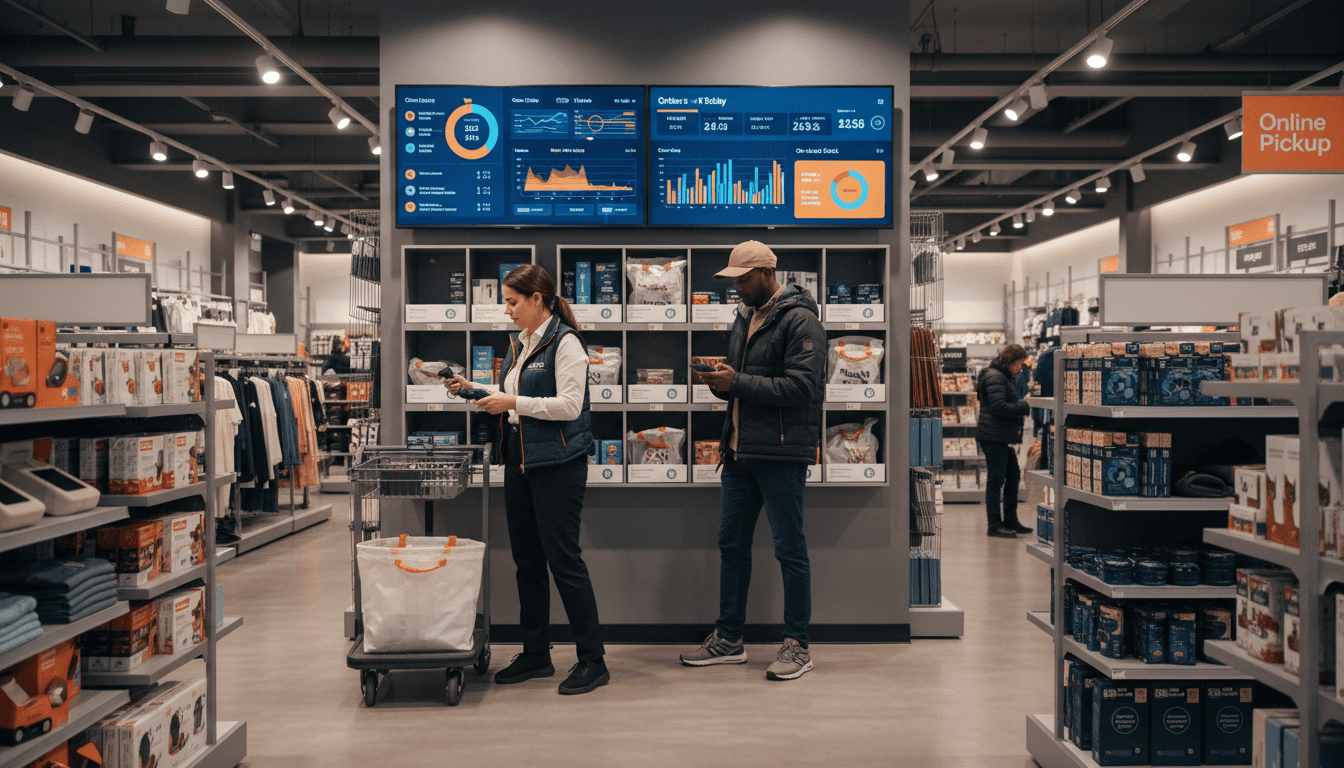
- Shared dashboard: on-time %, cancellation %, substitution rate, cost per order, contribution margin
- Clear owners for root causes (inventory accuracy vs. store latency vs. carrier capacity)
If you’re only reviewing this in e-commerce meetings, you’re missing half the levers.
4) Use AI for exception triage, not just planning
The hidden cost in on-demand delivery is exceptions:
- customer changes address mid-order,
- a SKU scans wrong,
- driver can’t find the pickup point,
- store is out of bags or dunnage,
- a high-theft SKU disappears.
AI can route exceptions to the right resolution path faster, for example:
- auto-refund vs. re-pick vs. substitute
- escalate to store manager only when the predicted customer impact is high
- trigger an inventory recount when mismatch patterns cross a threshold
That’s how you reduce operational risk without adding headcount.
People also ask: what leaders should know before adding on-demand delivery
Is on-demand delivery profitable for non-essential retail?
Yes, but only when you control cost-to-serve. Profitability depends on delivery fees, picking time, cancellation rates, and whether on-demand creates incremental orders or just shifts existing demand.
What KPIs matter most for same-day and on-demand fulfillment?
Track a small set relentlessly:
- Perfect order rate (right item, right condition, on time)
- Cancellation rate and top root causes
- Pick time and store latency (order-to-ready)
- Cost per order (including platform fees and labor)
- Repeat usage (proves the experience is actually working)
Where should AI be applied first?
Start where data is available and the feedback loop is fast:
- Store-level demand forecasting (hourly)
- Inventory accuracy detection and promise gating
- Carrier/provider routing based on cost and reliability
What this means for 2026 planning
The holiday rush is the perfect backdrop for these announcements because it’s when customers are least forgiving and operations are most stressed. But the bigger story is structural: delivery marketplaces are becoming a standard last-mile layer for retail, the same way card networks are a standard payments layer.
Retailers will still compete on brand, assortment, and experience. But on-demand delivery shifts a chunk of that competition into operations—specifically, into how well you can predict demand, coordinate suppliers and partners, and manage risk in real time.
If you’re building your 2026 roadmap, don’t frame this as “Should we add Uber/DoorDash/Instacart?” Frame it as: Do we have the AI and operating controls to make real-time fulfillment worth scaling?
If you want a practical place to start, audit your current on-demand readiness in three numbers: inventory accuracy for eligible SKUs, median pick time, and cancellation rate by store. Those three metrics will tell you whether you’re ready to grow—or about to sponsor a very expensive promise.
What would change in your network if you treated on-demand delivery as a core channel, not a holiday add-on?