AI cost and supplier intelligence turn category management into continuous steering. Learn what to implement, what to buy, and how to get results in 90 days.
AI Cost & Supplier Intelligence for Category Wins
Most category strategies still start the same way: a spreadsheet export, a couple of supplier calls, and whatever market “intel” the team can pull together before the next steering meeting. It works—until it doesn’t. When prices swing, lead times jump, or a supplier’s financial health deteriorates, the category plan you signed off on in Q2 becomes a polite fiction by Q4.
Cost intelligence, supplier intelligence, and analytics are the parts of category management that separate “we negotiated hard” from “we engineered an advantage.” The Spend Matters CatMan vendor series (Part 3) puts the spotlight on exactly these outside‑in intelligence capabilities—because without them, category management is mostly internal narrative.
This post is part of our AI in Supply Chain & Procurement series, and I’m going to take a stance: if your category strategy isn’t continuously fed by AI-driven cost and supplier intelligence, it’s not a strategy—it’s a snapshot. Here’s how modern teams are doing it, what to look for in technology, and how to avoid the most common adoption traps.
Outside-in intelligence is now the backbone of category management
Answer first: The most valuable category management analytics shift is moving from internal spend visibility to external market visibility—and using AI to connect the two.
Classic category management is strong on “inside-out” understanding: spend baselines, consumption patterns, compliance, supplier performance history. The gap is “outside-in”: cost drivers, supply market dynamics, peer benchmarks, and early warning signals about suppliers.
That gap matters more in December 2025 than it did a few years ago for a simple reason: volatility has become routine. Between lingering logistics fragility in certain lanes, energy price sensitivity in manufacturing-heavy categories, and increasingly strict ESG reporting expectations, category managers are being judged on decisions made under uncertainty.
Outside‑in intelligence providers and analytics platforms earn their keep by answering the questions procurement teams can’t reliably answer alone:
- What should this item/service cost right now, and why?
- Which suppliers are gaining/losing capability, capacity, or financial resilience?
- Where are we exposed by geography, sub-tier dependencies, or single points of failure?
- How fast will the market move if demand spikes or supply tightens?
AI adds the missing layer: it doesn’t just store the signals—it helps interpret them, connects them to your categories, and pushes them into workflows before you’re already in a firefight.
AI-powered cost intelligence: stop negotiating blind
Answer first: Cost intelligence is best used as a decision system, not a one-off should-cost report—AI makes it continuous, explainable, and actionable.
Cost intelligence spans a range of capabilities: commodity indices, clean-sheet models, labor and energy inputs, regional cost curves, inflation tracking, and contract price benchmarking. What’s changed is the expectation that you can update views quickly and explain drivers credibly to finance, ops, and suppliers.
What “good” looks like in 2025
A mature AI cost intelligence capability usually includes:
- Driver-based models, not only index feeds: It’s not enough to say “steel is up 8%.” You need the bill-of-materials logic, yield, scrap rates, conversion costs, and logistics inputs—so you can argue what portion should affect your price.
- Granularity aligned to categories: Category managers don’t buy “copper.” They buy harnesses, transformers, heat exchangers, and assemblies. AI helps map cost drivers to the thing you actually buy.
- Scenario modeling in hours, not weeks: “If energy rises 15% and ocean freight drops 10%, what happens to landed cost?” The teams that can run scenarios fast make fewer emotional decisions.
- Negotiation narratives that hold up: The point of a model is not the number—it’s the story. AI-assisted analytics can generate defensible “cost stack” explanations and sensitivity ranges.
A practical example: packaging, simplified
Let’s say you’re buying corrugated packaging across North America. A cost intelligence approach that works:
- Build a cost stack: linerboard + medium + conversion + labor + energy + freight.
- Track linerboard indices and regional freight rates monthly.
- Use AI to classify SKUs and map them to similar cost stacks (because your master data is never as clean as you want).
- Run a quarterly “should-cost refresh” and flag supplier quotes that exceed the expected range.
The impact isn’t just savings. It’s speed. Teams move from arguing about whose spreadsheet is right to deciding what to do next.
Where cost intelligence fails (and how to prevent it)
Cost intelligence programs stall for three predictable reasons:
- They don’t connect to sourcing events. If the should-cost model lives in a slide deck, it won’t change outcomes.
- They ignore spec and demand management. You can’t index your way out of over-spec.
- They don’t define “decision thresholds.” Decide upfront what triggers action (e.g., renegotiation at +5% vs. re-source at +12%).
AI helps, but governance is the multiplier.
AI supplier intelligence: the fastest path to smarter supplier evaluation
Answer first: Supplier intelligence becomes valuable when it’s predictive and contextual—AI turns disconnected signals into risk and opportunity actions at the category level.
Supplier intelligence used to mean D&B reports, an annual scorecard, and maybe a news alert if you were lucky. Now it’s broader and more operational:
- Financial health and payment behavior
- Capacity indicators and expansion signals
- Geographic and geopolitical exposure
- ESG and compliance signals
- Cyber posture (in tech-heavy supply chains)
- Sub-tier dependencies and concentration risk
The core shift: from “risk dashboards” to “risk decisions”
A dashboard that says “Supplier A is medium risk” doesn’t help you choose between:
- awarding them the next tranche of volume,
- dual-sourcing,
- changing specs,
- increasing safety stock,
- or negotiating different payment and liability terms.
AI supplier intelligence is useful when it answers:
- Risk to what? (a specific plant, lane, part family, region)
- In what time window? (next 30/60/90 days vs. 12 months)
- What’s the recommended mitigation? (and what’s the cost/lead time trade-off)
What to look for in supplier intelligence technology
If you’re evaluating platforms or providers, prioritize:
- Entity resolution: Can the tool reliably match supplier records across systems and subsidiaries? If it can’t, you’ll spend your life cleaning data.
- Signal transparency: When it flags a supplier, can you see why (inputs, weighting, recent changes)? Black boxes don’t survive audits.
- Category relevance: Can you tune risk models per category? A “high risk” threshold for MRO is not the same as semiconductors.
- Workflow integration: Does it push actions into SRM, sourcing, or intake workflows? Alerts without owners become noise.
A stance I’ll defend: supplier intelligence should drive segmentation, not just monitoring
Most teams segment suppliers once a year (strategic, preferred, approved, etc.) and then treat the segmentation as static truth. That’s backward.
Supplier segmentation should be dynamic:
- A supplier’s position should change as capacity shifts, risk signals change, or innovation performance changes.
- AI can update segmentation recommendations and suggest where to invest relationship effort.
That’s how you stop over-managing low-impact suppliers while under-managing the ones that can actually disrupt your revenue.
Analytics solutions: where category management becomes a system
Answer first: Analytics platforms create category advantage when they connect spend, cost, supplier, and demand signals into one operating rhythm—AI is the glue.
Spend analytics is the familiar starting point, but category management analytics is broader. The best setups use analytics to create a repeatable cadence:
- Monthly cost driver updates
- Quarterly category strategy refreshes
- Continuous supplier risk monitoring
- Event-level sourcing decision support
- Post-award compliance and variance tracking
Three analytics patterns that consistently work
These are the patterns I see outperforming (and they’re all AI-friendly).
1) Category “control towers” that are actually usable
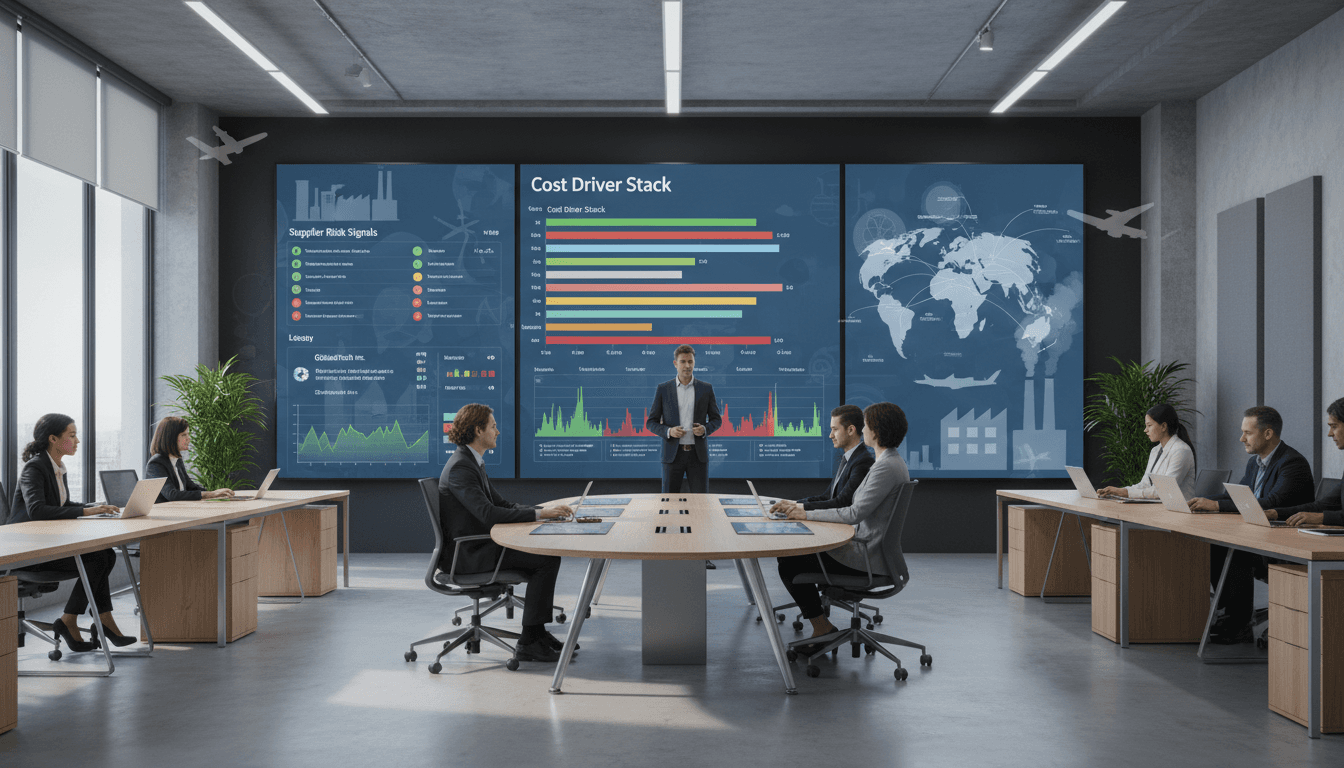
A category control tower isn’t a massive dashboard wall. It’s a small set of metrics and triggers that match how category managers work.
A usable set typically includes:
- Price vs. should-cost variance (by supplier, region, and item family)
- Supplier risk movement (directional change matters more than absolute score)
- Demand variance (forecast vs. actual consumption)
- Contract compliance and leakage
The AI part: anomaly detection, explanation (“variance driven by freight change + mix shift”), and recommended actions.
2) Forecast-to-category planning
Here’s the bridge to supply chain planning: cost intelligence gets more accurate when it’s paired with demand forecasting.
If demand is expected to spike for a component, you don’t just need a price forecast—you need a capacity view and a negotiation plan. AI demand forecasting and AI cost intelligence belong in the same conversation.
3) Sourcing feedback loops
The analytics system should learn from outcomes:
- Did the negotiated price hold for 6 months?
- Did promised lead times improve?
- Did quality incidents rise after switching suppliers?
When you feed that back, AI models become category-specific over time. Without feedback loops, you’re just buying reporting.
A practical selection guide: matching tools to your CatMan maturity
Answer first: The right cost and supplier intelligence solution depends less on features and more on where your category process breaks today.
Use this quick diagnostic to decide what to prioritize.
If you’re stuck at “we can’t trust our data”
Prioritize:
- Spend classification accuracy and refresh cycles
- Supplier master cleansing and entity matching
- Basic dashboards that reduce manual reporting
AI value here is mostly automation: classification, normalization, and deduplication.
If you’re strong on spend, weak on external reality
Prioritize:
- Cost driver models mapped to your top categories
- Supplier intelligence feeds with transparent scoring
- Scenario planning (cost and supply)
AI value here is interpretation: connecting signals to categories and explaining drivers.
If sourcing is strong, but results don’t stick
Prioritize:
- Contract-to-pay compliance analytics
- Price variance monitoring vs. index/should-cost
- Supplier performance analytics tied to business outcomes
AI value here is control: continuous monitoring and early warnings for leakage.
Implementation: the 90-day plan that avoids the “pilot trap”
Answer first: A 90-day rollout should focus on one category, one decision cycle, and measurable outcomes—otherwise AI analytics becomes shelfware.
Here’s a realistic plan that works even with limited bandwidth.
Days 1–30: Pick the category and define the decisions
- Choose one category with high spend and frequent pricing conversations (packaging, logistics, resins, IT services, MRO).
- Define 3 decisions you want to improve (e.g., renegotiation triggers, supplier segmentation updates, re-source timing).
- Set baselines: price variance, cycle time, sourcing outcomes.
Days 31–60: Build the intelligence spine
- Build a cost stack or driver model for the category.
- Integrate supplier intelligence signals relevant to that category.
- Set alert thresholds and assign owners.
Days 61–90: Put it into the workflow
- Use the system in a live sourcing event or QBR.
- Capture outcomes (what changed, what didn’t, why).
- Decide whether to scale to the next category based on measurable impact.
If you can’t measure time saved or price variance reduced in 90 days, the issue usually isn’t the model—it’s the lack of decision integration.
What happens next: category management becomes continuous
Category management is shifting from periodic planning to continuous steering. Cost intelligence, supplier intelligence, and analytics solutions are the foundation—and AI is the force multiplier that keeps them current, interpretable, and connected to action.
If you’re building an AI in supply chain & procurement roadmap for 2026, I’d prioritize this order:
- Get your supplier and item data usable.
- Stand up cost intelligence for the categories where you negotiate most.
- Add supplier intelligence that drives segmentation and mitigation.
- Build analytics loops that learn from outcomes.
Want a simple litmus test? If your category managers still need a week to answer “should we accept this increase?”, you’re leaving money and resilience on the table.
Where could outside-in cost and supplier intelligence make the biggest difference in your categories over the next quarter—pricing, risk, or speed of decision-making?