Cold chain e-commerce is now year-round. Learn how AI improves temperature control, packaging, and delivery promises to cut spoilage and refunds.
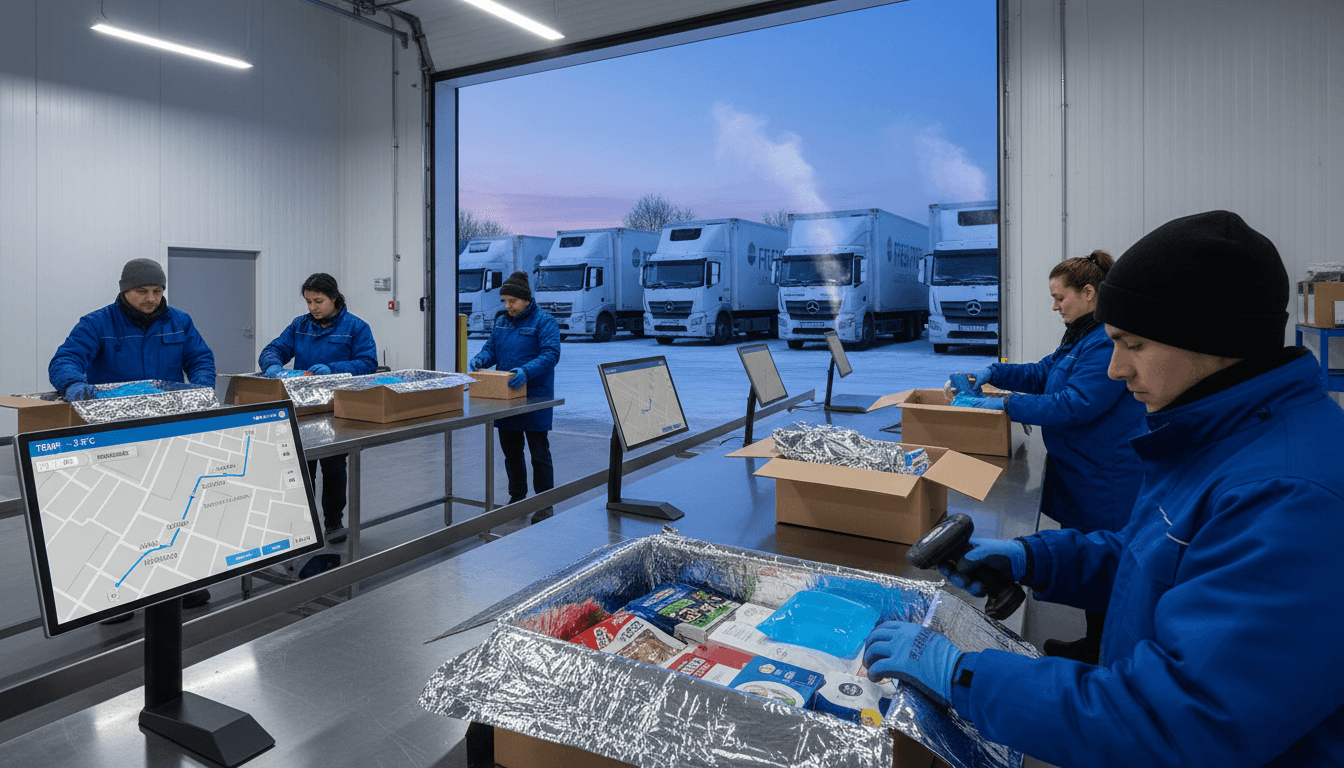
AI Cold Chain E-commerce: Beyond the Holiday Gift Box
A decade ago, most people associated temperature-controlled shipping with a very specific moment: a holiday box of steaks, pears, or chocolates landing on the porch with just enough dry ice to make it through the weekend. Now it’s Tuesday. And the box might be meal kits, specialty seafood, probiotic drinks, frozen dumplings from a regional restaurant, or pharmacy-adjacent wellness products.
Cold chain e-commerce didn’t just “grow.” It changed shape—from a seasonal novelty into a year-round operational discipline that lives or dies on execution. Mary O’Connell’s reporting captures the core driver: after COVID, consumers got comfortable ordering food online, and the industry matured as costs and liabilities became more manageable at scale.
For this AI in Supply Chain & Procurement series, that shift is more than a retail trend. It’s a case study in why AI belongs in transportation and logistics programs that have real P&L pressure: perishables force you to be right, fast, and consistent—or you refund the order and lose the customer.
Cold chain e-commerce scaled because shoppers stopped treating it as “special”
Cold chain e-commerce scaled for one simple reason: behavior normalized. When households started ordering groceries and prepared foods online more regularly, the holiday surge didn’t disappear—it became a volume spike on top of an already active baseline.
That matters operationally. Seasonal gift shipping can tolerate a “white glove” approach: manual pack-outs, limited SKUs, a narrow set of shipping lanes, and plenty of buffer. Year-round D2C cold chain can’t. It needs:
- Faster order cutoffs and later ship windows
- Higher SKU variety (and more complex pick paths)
- More zip-code coverage with fewer service failures
- Tighter packaging cost control
- Better exception management when weather and carrier networks wobble
Here’s the stance I’ll take: most companies underestimate how quickly cold chain turns into a forecasting and control problem, not a branding problem. Great marketing might win the first order. Reliable cold chain wins the second.
Marketplaces proved logistics can be “borrowed,” not built
The rise of curated marketplaces (think the “regional favorites shipped nationwide” model) expanded cold chain beyond legacy gifting brands. Small producers didn’t have to build their own carrier contracts, packaging science, and customer service playbooks from scratch.
But “borrowing” infrastructure creates a new requirement: your data has to travel with the product. If your marketplace partner can’t see your production schedule, lead times, and temperature risk profile, you’ll end up paying for it in expedited shipments and claims.
That’s where AI in procurement and supply chain planning starts to pay off: it’s the difference between guessing and knowing what demand, labor, and transit risk look like next week.
The hidden bottleneck isn’t transportation—it’s pre-shipment control
The fastest way to lose money in cold chain is to focus only on the truck (or the parcel label) and ignore what happens before the package leaves the building.
Cold chain e-commerce succeeds when you control three variables before tendering the shipment:
- Thermal protection (insulation, refrigerant type/quantity, pack-out method)
- Time (cutoff discipline, dwell time, handoff speed)
- Product state (initial temperature and handling during pick/pack)
O’Connell’s source highlights packaging as central: right box size, insulation, protection from damage. That’s not “nice to have.” Packaging is your first line of temperature control—and one of your biggest margin levers.
Where AI fits: packaging decisions that aren’t guesswork
A lot of brands still use broad rules like “2 gel packs in winter, 4 in summer.” That’s how you end up overpacking (wasted cost) or underpacking (spoiled product).
AI-enabled packaging optimization typically improves decisions by modeling:
- Lane-level transit time distributions (not just averages)
- Weather risk by origin/destination (including cold snaps and heat waves)
- Carrier service variability by region and week
- Product-specific thermal tolerance (how long it can ride at different temps)
The output shouldn’t be a fancy dashboard. It should be a simple operational instruction such as:
- Use
Box B+liner 3+3x gelfor Zone 5 shipments leaving Wed/Thu - Switch to
dry iceabove a defined risk threshold for frozen SKUs - Block economy services for specific zips during peak weeks
That’s how AI protects margin: fewer failed deliveries and fewer unnecessary materials.
Why the cold chain is still “brutally difficult” (and how AI reduces the pain)
Cold chain is difficult because you’re paying for speed, materials, and precision—while customers expect perfection.
Three pressures collide:
- Thin margins: Packaging and expedited services can eat profit quickly.
- High cost of failure: One late delivery becomes spoilage, refund, and reputation damage.
- Peak volatility: Holiday volume + winter storms creates a stress test for every handoff.
O’Connell describes the holiday season as a stress test, and that’s exactly right. In December 2025, you’re also dealing with the usual seasonal realities: constrained carrier capacity in key metros, weather whiplash, and customers shipping to unfamiliar addresses (gifts, travel destinations, family homes).
Predictive exceptions beat reactive firefighting
Most operations teams still manage exceptions with a “find out when it’s late” approach:
- Customer emails: “Where is my order?”
- A carrier scan shows a delay
- A refund decision happens after the product is already compromised
AI-driven exception management flips it:
- Predict late risk at label creation using lane history + real-time network signals
- Auto-upgrade service (selectively) for shipments above a spoilage-risk threshold
- Trigger proactive customer comms when risk crosses a defined line
- Route high-risk orders to the nearest fulfillment node (even if pick cost is higher)
That last point is an important procurement tie-in: you’re buying risk reduction when you invest in distributed inventory, better carrier mix, and smarter packaging—not just buying “shipping.”
Carrier networks got more diverse—and that’s an AI opportunity
The article calls out a quiet but critical change: growth of regional carriers adding competitive pressure to national players. That’s good news for shippers, but it adds complexity:
- Different pickup windows and cutoff times
- Different scanning behavior (which affects visibility)
- Different damage patterns and claims processes
- Different actual-on-time performance by lane
Most companies get this wrong by selecting carriers primarily on published rates.
A better approach is to score carriers by total landed cost, including:
- Spoilage/refund rate by lane and season
- Damage rate by packaging configuration
- Delivered-on-time-to-promise (not just on-time-to-carrier-standard)
- Customer service workload per 1,000 shipments
AI helps because the data volume is too high for humans to evaluate weekly, especially during peak. Your transportation team needs a system that can say:
“For these 20 zip codes this week, regional carrier X has lower end-to-end cost despite a higher base rate, because it reduces late deliveries.”
That’s not theory. It’s how cold chain e-commerce stays profitable.
Route optimization isn’t only for fleets
When people hear “route optimization,” they think company-owned last-mile fleets. In cold chain e-commerce, route optimization often shows up as:
- Node selection (which DC/3PL ships the order)
- Induction strategy (where parcels enter a carrier network)
- Cutoff design (which orders ship today vs tomorrow)
Even without owning trucks, you still have routing decisions—just at the network level. AI-driven network optimization is how you keep delivery promises realistic without padding them so much that conversion drops.
Real-time feedback turned cold chain into a reputation algorithm
O’Connell points out something that doesn’t get enough attention: e-commerce has a tight feedback loop. Reviews and rapid customer responses quickly separate brands that execute from brands that don’t.
In perishables, the review isn’t “the color was off.” It’s “this arrived unsafe to eat.” That’s existential.
The operational takeaway: your cold chain is part of your customer acquisition strategy. If your refund rate spikes in December, your January paid media gets more expensive because your brand signals weaken.
What to measure (and what to stop measuring)
If you want AI to help, you need the right targets.
Track these weekly (minimum):
- Promise accuracy: % delivered within the customer-facing promise window
- Temperature integrity proxy: refunds/complaints tagged as melt/spoilage/leakage
- Packaging cost per order by lane + service level
- “No first scan” rate within 12 hours of pickup
- Weather-adjusted on-time performance by carrier and region
Stop obsessing over these in isolation:
- Average transit time (it hides variability)
- Base shipping rate (it ignores failure cost)
- Overall on-time (it ignores the promise you made)
Cold chain performance is about distributions, not averages. AI is good at distributions.
Practical playbook: 30 days to a smarter cold chain operation
If you’re responsible for supply chain, procurement, or transportation and you want an actionable starting point, this is what I’d do first.
Week 1: Build a “cold chain truth table”
Document the rules you actually run:
- Which SKUs ship with which packaging configurations
- When you switch refrigerant types
- Service levels allowed by zone/region
- Cutoffs by day of week
Most teams discover they’ve got tribal knowledge, not a system.
Week 2: Segment customers and promises
Not every order needs the same promise. Segment by:
- Product sensitivity (fresh vs frozen vs shelf-stable)
- Margin contribution
- Customer lifetime value indicators (subscriptions, repeat buyers)
Then set promise windows that reflect physics and network reality.
Week 3: Add predictive exception triggers
Start simple:
- Flag high-risk lanes during peak weeks
- Upgrade service only for high-risk + high-value orders
- Automate proactive notifications for “likely late” shipments
Week 4: Turn procurement into a control lever
Procurement can reduce spoilage more than customer service ever will:
- Negotiate carrier performance reporting, not just rates
- Qualify at least one regional carrier per major market
- Standardize packaging SKUs to reduce pack-out variability
- Require 3PLs to share scan + dwell-time data daily
You’re not buying transportation. You’re buying reliability under variability.
Where cold chain e-commerce goes next
Cold chain e-commerce outgrew the gift box because consumer trust and operational maturity met in the middle. The next phase is less romantic and more profitable: instrumentation and prediction.
As this AI in Supply Chain & Procurement series keeps repeating, AI earns its keep when it helps you decide faster than your constraints change—demand swings, carrier performance shifts, weather hits, and packaging costs move.
If you’re scaling cold chain e-commerce in 2026 planning cycles, the question isn’t whether you’ll adopt AI. It’s whether you’ll adopt it before peak season forces your hand—when every late scan becomes a refund and every refund becomes a review.
What would your cold chain look like if you could predict the next 5% of failures before they shipped?