CDL fraud and labor arbitrage are reshaping trucking costs. Here’s how AI-driven compliance analytics helps shippers avoid risky “cheap capacity.”
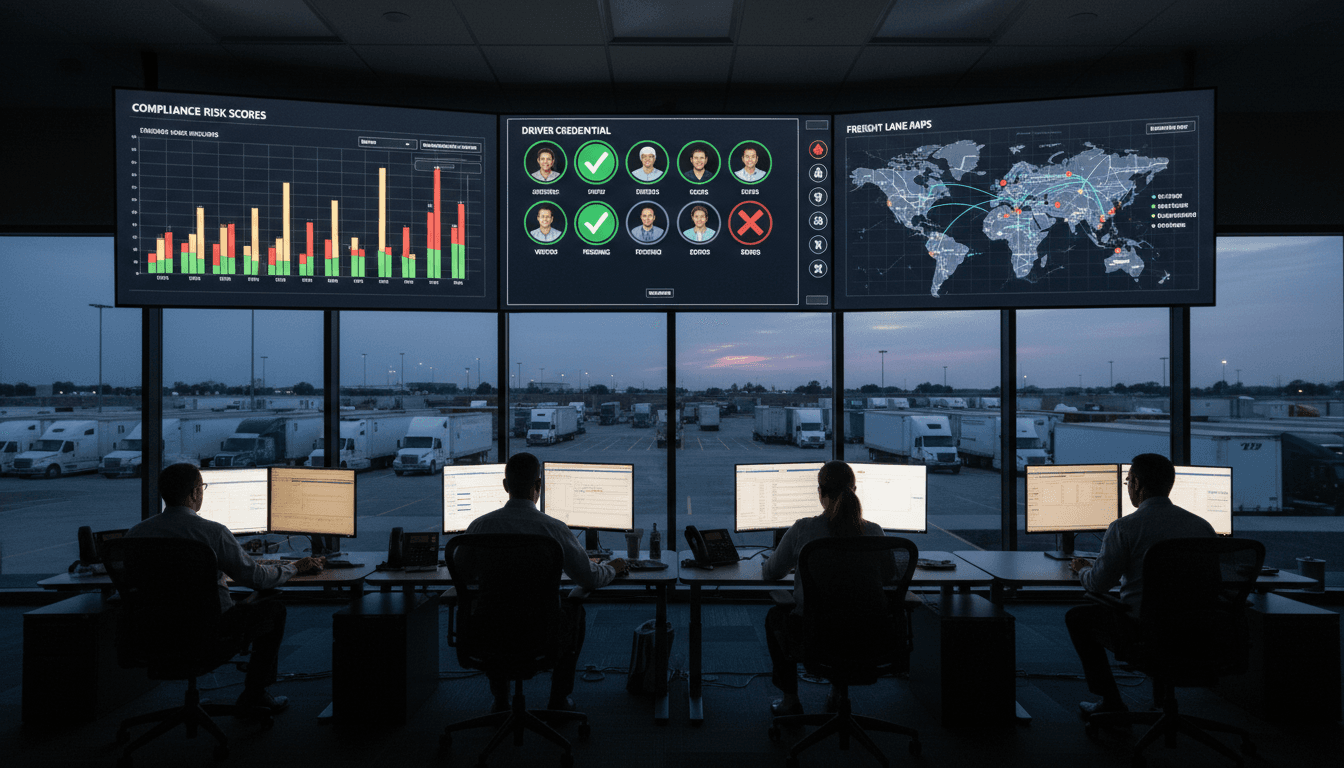
AI Can Spot CDL Fraud Before It Breaks Your Network
Freight can’t move for 25 to 75 cents per mile below operating cost for years unless something is fundamentally off. That’s the point a small fleet owner recently made when describing how compliant carriers are being undercut by ultra-low-cost operations tied to labor arbitrage, non-domiciled CDLs, and fraudulent licensing.
If you lead transportation procurement, manage a brokerage desk, or run carrier compliance for a shipper, this isn’t just “driver drama.” It’s a supply chain risk event hiding in plain sight—one that shows up as cheaper rates right up until it shows up as missed tenders, cargo claims, audits, and service failures.
This post is part of our AI in Supply Chain & Procurement series, and I’ll take a clear stance: compliance has become a pricing variable, and that’s a procurement problem. The practical fix isn’t a bigger spreadsheet or another portal. It’s building a data-backed compliance layer—and yes, AI can help—so your network stops rewarding the riskiest operators.
This isn’t a normal freight cycle—your carrier base is being reshaped
A typical downcycle squeezes margins. This one is reportedly squeezing below cost for a long stretch, which changes how you should think about capacity.
When one carrier says brokered freight over 500 miles has been paying well below their operating costs since mid-2022, the takeaway for shippers and 3PLs is blunt: somebody is running with a cost structure you can’t explain with fuel, tires, or insurance. Those costs are mostly common across the industry.
So what explains the gap?
- Labor arbitrage: paying drivers far less than market norms, often in ways that are hard to audit.
- Credential irregularities: fraudulent or improperly issued CDLs, mismatched identities, or licensing loopholes.
- Weak enforcement: when detection is slow, noncompliance becomes “competitive strategy.”
This matters because procurement teams often treat transportation like a commodity during downturns: take the lowest bid, tighten the routing guide, move on. The reality? Cheap freight can be the most expensive freight when it increases your risk exposure.
The procurement trap: rate-first decisions reward the wrong behaviors
Answer first: When compliance is under-verified, the market selects for noncompliance.
If your bid event or spot desk focuses primarily on rate, the system unintentionally rewards carriers that:
- rotate drivers in ways that don’t line up with Hours-of-Service reality
- can’t consistently pass roadside inspection scrutiny
- show unusual patterns in claims, dwell, or “ghost capacity”
A lot of companies don’t realize they’re training their network. Every tender you accept at an unrealistic rate signals, “This is acceptable.”
CDL fraud and labor exploitation aren’t just ethical issues—they’re operational risk
CDL integrity is an identity problem, a safety problem, and a performance problem.
When credentials are questionable, you can see second-order effects across operations:
- Service volatility: missed appointments, late pickups, inconsistent transit times
- Claims and damage: higher probability of incidents, cargo loss, or improper securement
- Network fragility: capacity that appears during spikes and disappears during enforcement waves
- Legal exposure: negligent selection risk, especially after a serious incident
One claim can erase months of “savings” from lower rates. And Q4 into year-end (where we are right now in December) is exactly when many shippers have the least tolerance for disruption—holiday volumes, retail peak returns, and tighter dock schedules make variability more painful.
The safety signal: tech mandates didn’t solve governance
Answer first: Technology doesn’t fix incentives.
Electronic logging devices were expected to improve safety outcomes. Yet industry stakeholders continue pointing to troubling safety trends in recent years. Whether or not any single metric tells the full story, the operational lesson is consistent: compliance theater (having the tools) is not the same as compliance reality (the tools being used correctly by verified people).
If you’re a shipper, your job isn’t to police the whole industry. Your job is to ensure your freight isn’t moved by a network optimized for corner-cutting.
Where AI actually helps: turning “compliance” into a measurable signal
AI doesn’t replace enforcement. It helps your organization stop being blind.
Answer first: AI can surface irregularities that humans miss because the data is fragmented. Carrier onboarding data, telematics, claims, detention, ELD behaviors, insurance, and roadside inspection outcomes usually live in separate systems. AI is useful because it can connect the dots and score risk in near-real time.
Here are three practical, high-value use cases that align with what the industry is describing.
1) Detecting CDL and identity irregularities with data matching
You don’t need sci-fi biometrics to improve credential integrity. You need disciplined entity resolution.
AI-supported matching can flag:
- inconsistent driver identifiers across loads (name variants, phone reuse, repeated “new driver” patterns)
- unusual concentration of drivers tied to a small set of contact points (emails, addresses)
- rapid churn in driver rosters that doesn’t match fleet size or lanes
- mismatch between driver location patterns and dispatch origin
Think of this as a fraud filter, similar to what banks do for payments—but tuned for transportation.
2) Spotting “impossible operations” in Hours-of-Service and transit patterns
Answer first: If a carrier’s on-time record requires physics to bend, something’s wrong.
Even without raw ELD files, your shipment data can reveal patterns:
- repeated long-haul moves executed with suspiciously consistent transit times regardless of weather/traffic
- frequent repowers with minimal dwell and unclear custody chain
- lane performance that’s “too perfect” compared to peer carriers
AI models can benchmark carriers against peers on the same lanes and identify outliers that warrant review.
3) Building a “compliance-adjusted rate” for procurement decisions
This is the big one for leads and outcomes.
Answer first: The right KPI isn’t lowest cost per mile—it’s lowest cost per compliant mile.
A practical approach I’ve found works is creating a composite score that procurement can actually use:
- Safety indicators (inspections, OOS rates, preventable incident trends)
- Operational reliability (tender acceptance, late pickup/delivery, dwell volatility)
- Financial/coverage signals (insurance continuity, authority age stability, claim frequency)
- Credential confidence (identity consistency, driver churn anomalies)
Then you price risk explicitly:
- Carrier A: $2.05/mi, low risk
- Carrier B: $1.82/mi, high risk
If Carrier B’s risk-adjusted expected cost is $2.20/mi after claims and failures, it’s not cheaper. It’s a bad buy.
What to do next: a practical playbook for shippers, 3PLs, and brokers
The goal isn’t to build a surveillance machine. The goal is a repeatable procurement and compliance workflow that doesn’t collapse under volume.
Step 1: Tighten onboarding around verifiable signals
Answer first: Most fraud slips through at onboarding, not at renewal.
Strengthen your process with:
- structured document checks (license, insurance, operating authority) plus consistency checks across systems
- mandatory contacts and escalation paths (who answers after-hours issues?)
- lane-fit validation (does their history make sense for what they’re bidding?)
Step 2: Monitor continuously, not annually
Annual carrier reviews are too slow for today’s environment.
Set triggers for:
- sudden changes in insurance
- spike in claims or service failures
- unusual driver/contact churn
- inspection or out-of-service event clusters
AI helps because it can watch all carriers all the time and only escalate what’s abnormal.
Step 3: Align procurement incentives with compliance outcomes
If your teams are bonused on rate alone, you’ll keep buying risk.
Balance scorecards with:
- cost per shipment plus claim rate
- on-time performance variance (not just averages)
- tender acceptance reliability
- compliance exceptions per 100 loads
Step 4: Make “level playing field” a network design choice
Stakeholders in the industry are calling for enforcement of existing rules. While that plays out, shippers can do something immediately: stop subsidizing noncompliance with your freight.
That doesn’t mean blacklisting broad groups or making assumptions about people. It means insisting on verifiable, data-backed proof that the carrier moving your freight is who they say they are—and operates the way they claim.
The bigger picture for AI in Supply Chain & Procurement
This story fits a pattern we see across procurement: when verification is weak, bad actors turn complexity into margin. The same thing happens in supplier fraud, invoice fraud, counterfeit parts, and now—more visibly—transportation capacity.
Answer first: Supply chain AI is most valuable when it reduces risk you can’t see in spreadsheets.
If you’re treating trucking as an interchangeable commodity, you’ll keep getting surprised by volatility—capacity that vanishes, service that swings, and incidents that trigger executive attention at the worst possible time.
A better posture is simple: build a compliance intelligence layer that procurement can act on in real time, then buy capacity based on total network value, not just the rate line.
If you’re planning your 2026 routing guide, ask one question that’s uncomfortable but clarifying: Which carriers in my network are cheap because they’re efficient—and which are cheap because they’re unverifiable?