AI-driven lab robots are accelerating bio-based materials qualification. Learn what it means for procurement risk, supplier strategy, and sustainable sourcing.
AI Robots Speed the Shift to Bio-Based Materials
A procurement team can usually tell you the price of a solvent to the cent and the lead time to the day. Ask a harder question—what’s the real replacement for an oil-derived ingredient inside a paint or soap formula without breaking performance?—and the answer gets messy fast.
That mess is exactly why the transition from fossil-based to bio-based materials has been slower than many sustainability roadmaps promised. The bottleneck isn’t intent. It’s formulation complexity: products like paints, coatings, soaps, and polymers depend on mixtures where tiny molecular interactions decide whether a batch is stable, waterproof, or shelf-safe.
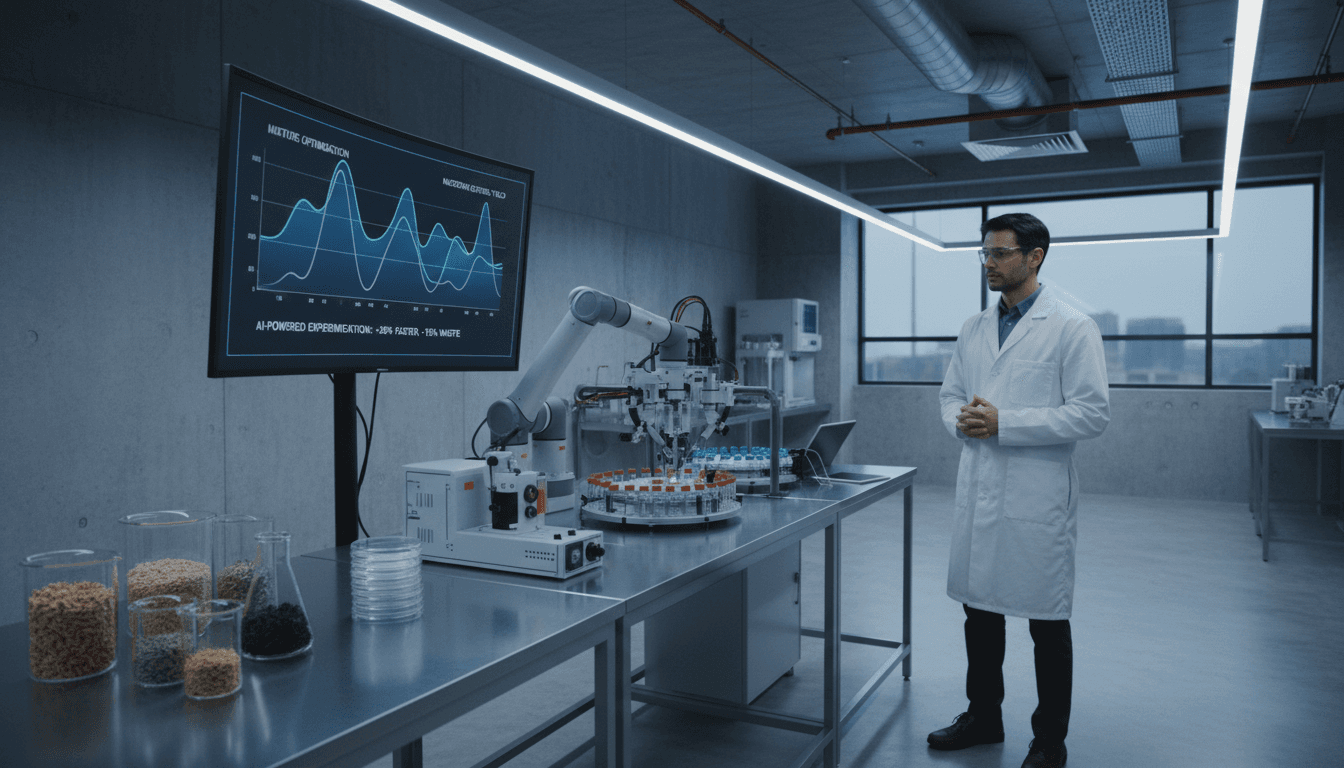
Researchers at Radboud University are attacking this in a very supply-chain-relevant way: they’re building robotic labs that generate high-quality data and training AI models that predict which bio-based mixtures will work. For leaders in AI in Supply Chain & Procurement, the lesson is straightforward: when your materials portfolio depends on formulations, AI-driven automation isn’t a nice-to-have—it’s how you de-risk substitutions, qualify suppliers faster, and keep products compliant.
The real bottleneck: mixture chemistry breaks “common sense”
If you’re sourcing bio-based alternatives, the hardest part is that mixture behavior is non-additive. In plain terms: knowing how ingredient A behaves and how ingredient B behaves doesn’t tell you what A+B will do.
A simple example: dissolving one sugar cube versus ten is predictable—more sugar, sweeter water. But in formulations (paints, detergents, cosmetics), molecules form structures together: micelles, networks, emulsions, films. Those structures can dramatically change viscosity, cleaning strength, water resistance, and stability.
That’s why Radboud’s Wilhelm Huck emphasizes that you’re not optimizing a single molecule; you’re optimizing a mixture. And the search space explodes quickly:
- Specialty ingredient catalogs can contain tens of thousands of possible components
- Formulations combine multiple components in different ratios
- The combinations create hundreds of millions of plausible interactions
This matters for procurement because “drop-in replacement” is often a myth. The practical outcome is more painful:
- More lab cycles to qualify substitutes
- More supplier iterations (and more NDAs, samples, and back-and-forth)
- More risk of performance regressions after scale-up
- More exposure to compliance deadlines when certain substances become restricted
If your organization is trying to reduce Scope 3 emissions or meet 2026–2028 sustainability targets (a lot of programs are in that window right now), formulation uncertainty becomes a supply risk just like capacity constraints or geopolitical disruption.
Why AI + lab robots are the missing link for sustainable sourcing
AI models need data, and formulation data is expensive to generate manually. That’s where robotics changes the economics.
Radboud’s approach is essentially a feedback loop:
- Robots mix and measure many candidate formulations
- AI learns from the measurements and predicts promising next experiments
- The robot runs those next experiments, producing more data
- The model improves and the search narrows
This is more than automation for automation’s sake. It’s a speed and coverage problem.
What robotic labs do better than traditional R&D workflows
A skilled formulation chemist can run a lot of experiments, but manual workflows hit limits: time, consistency, and the tendency to test “reasonable” options instead of weird combinations that might outperform.
Robotic platforms help because they:
- Run continuous measurement cycles with consistent procedures
- Explore broader composition ranges (including counterintuitive mixtures)
- Use smaller volumes, reducing the cost of scarce bio-based samples
- Capture data in a structured way that’s ready for machine learning
Mabesoone (Radboud) describes a practical setup: you supply a robot with a few base solutions; the robot handles testing, mixing, and measuring, and it can even decide which samples to make next.
From a supply chain perspective, this is basically designing new materials with the same mindset as demand planning: iterative forecasting, fast feedback, and continual model improvement.
“Material intelligence” becomes a procurement capability
When formulation knowledge lives only in people’s heads or scattered lab notebooks, procurement teams struggle to scale decisions. AI-backed mixture models can turn that into a reusable asset:
- Faster supplier qualification (less trial-and-error)
- Better substitute materials identification (beyond obvious one-to-one swaps)
- More reliable spec-setting (what actually matters for performance)
- Stronger should-cost and risk models (because you understand the formulation’s sensitivities)
The stance I’ll take: procurement shouldn’t treat this as “R&D’s problem.” If bio-based transition is on your scorecard, you want shared ownership of the data and decision logic.
Three real-world formulation arenas: paint, soap, and polymers
The fastest path to bio-based materials is to target high-impact product categories where performance requirements are unforgiving. Radboud’s three projects—paint, soap, and polymers—are good examples because each shows a different kind of complexity that buyers and product teams run into.
Paints & coatings: water resistance without oil-derived chemistry
Paint is a procurement headache because it’s a bundle of competing constraints: stability, spreadability, drying behavior, washability, UV resistance, durability, and crucially waterproofing.
Radboud researcher Peter Korevaar is working with a paint manufacturer (Van Wijhe Verf) on the data problem: if you try to design bio-based formulations, you need lots of experiments because small tweaks can swing viscosity or film formation.
Supply chain takeaway: paint formulations are a classic case where switching to bio-based isn’t a single sourcing event—it’s a portfolio project.
- You may need dual sourcing across transitional formulations
- You’ll likely qualify families of ingredients (binders, dispersants, coalescents) rather than a single replacement
- Your contracts should anticipate iterative spec updates as the model improves
Soaps & surfactants: “100× effects” that break intuition
Soap mixtures can show dramatic emergent behavior. Mabesoone notes that a property like cleaning capacity might appear at 100× lower concentration in a mixture than in a pure solution.
That’s not just a chemistry curiosity. It changes the economics:
- If the same performance occurs at lower dosage, your cost-in-use may improve even if the bio-based ingredient is more expensive per kilogram.
- Lower dosage can reduce packaging needs and transport emissions.
- It can also shift supplier risk: a constrained ingredient becomes less critical if the formulation needs less of it.
Procurement takeaway: stop evaluating bio-based materials only on unit price. For formulations, negotiate and forecast on cost-in-use and performance windows.
Polymers: the data gap that blocks prediction
Polymers are everywhere—packaging, coatings, adhesives, medical materials—and they’re often used in complex mixtures. Huck points out a painful reality: for many polymers, there isn’t enough data to rely on theory alone.
So the third project focuses on collecting more polymer data with industry partners so AI models can become predictive.
Supply chain takeaway: polymer transition is going to create winners and losers among suppliers. The suppliers who can provide consistent characterization data (and collaborate on testing) will qualify faster and stick longer.
What this means for supply chain & procurement leaders in 2026
AI-driven automation in chemistry is becoming a supply assurance strategy. Not because procurement teams need to run robots, but because your ability to source compliant, stable, scalable bio-based inputs depends on the speed of formulation qualification.
Here’s how I’d translate Radboud’s approach into procurement actions you can start in 2026 planning cycles.
1) Treat formulation change as a supplier risk program
If a substance becomes restricted or scarce, the risk isn’t just “find an alternative.” The risk is “find an alternative formulation that keeps performance.” Build a formal risk register for:
- High-volume fossil-derived inputs
- Single-sourced functional additives
- Ingredients with known regulatory pressure
- Materials with volatile supply due to crop yield or regional concentration
2) Write data-sharing into supplier collaboration (without losing IP)
The companies that move fastest will be the ones that can learn from experiments. That requires data. You don’t need to expose trade secrets, but you can require:
- Standardized certificates of analysis fields
- Batch-to-batch variability reporting
- Agreed test protocols and measurement formats
- Joint scorecards for performance and sustainability
This is one of those cases where “good procurement hygiene” directly accelerates science.
3) Optimize for time-to-qualification, not just time-to-delivery
Traditional supply chain KPIs focus on lead times and OTIF. Bio-based transition adds a new critical metric:
- Time-to-qualification: how long it takes to validate a new ingredient or formulation at lab, pilot, and production scale
AI + robotics primarily compress this metric. If you’re budgeting, fund the bottleneck.
4) Use AI to reduce experiment count, not to “guess” outcomes
A practical stance: the value of AI in formulation work is experiment selection. The model’s job is to decide what to test next so you don’t waste months.
If you’re evaluating vendors or internal projects, ask:
- Does the system support active learning (choosing the next best experiment)?
- Can it handle mixture spaces and constraints (ratios, processing windows)?
- Does it produce outputs your teams can act on (e.g., stability probability, viscosity range, cost-in-use)?
What consumers will notice (and what they shouldn’t)
If the transition goes well, consumers won’t notice anything—except that products become more biodegradable and more resilient to supply disruptions. Huck’s point is blunt: if we don’t do this work, some products may become unavailable because key substances are no longer permitted or available.
That’s the often-missed procurement angle: sustainability isn’t only a brand story. It’s continuity planning.
The upside is bigger than “keeping the same performance.” When robots and AI can test far more combinations than humans can reasonably attempt, teams can discover new behaviors—formulations that are stable with less material, clean better at lower concentration, or form tougher films with bio-based inputs.
If you’re running supply chain strategy into 2026 and beyond, the forward-looking question is simple: are you building the data and partnerships now so bio-based materials become a controlled transition—rather than an emergency substitution later?
Want to operationalize this in procurement? Start by choosing one high-risk fossil-derived ingredient family (surfactants, binders, plasticizers) and build a qualification “learning loop” with suppliers: shared test protocols, structured data capture, and AI-supported experiment planning.