AI-driven life sciences research acceleration is shortening R&D cycles in the U.S. Learn where it works, how to implement it, and what to measure.
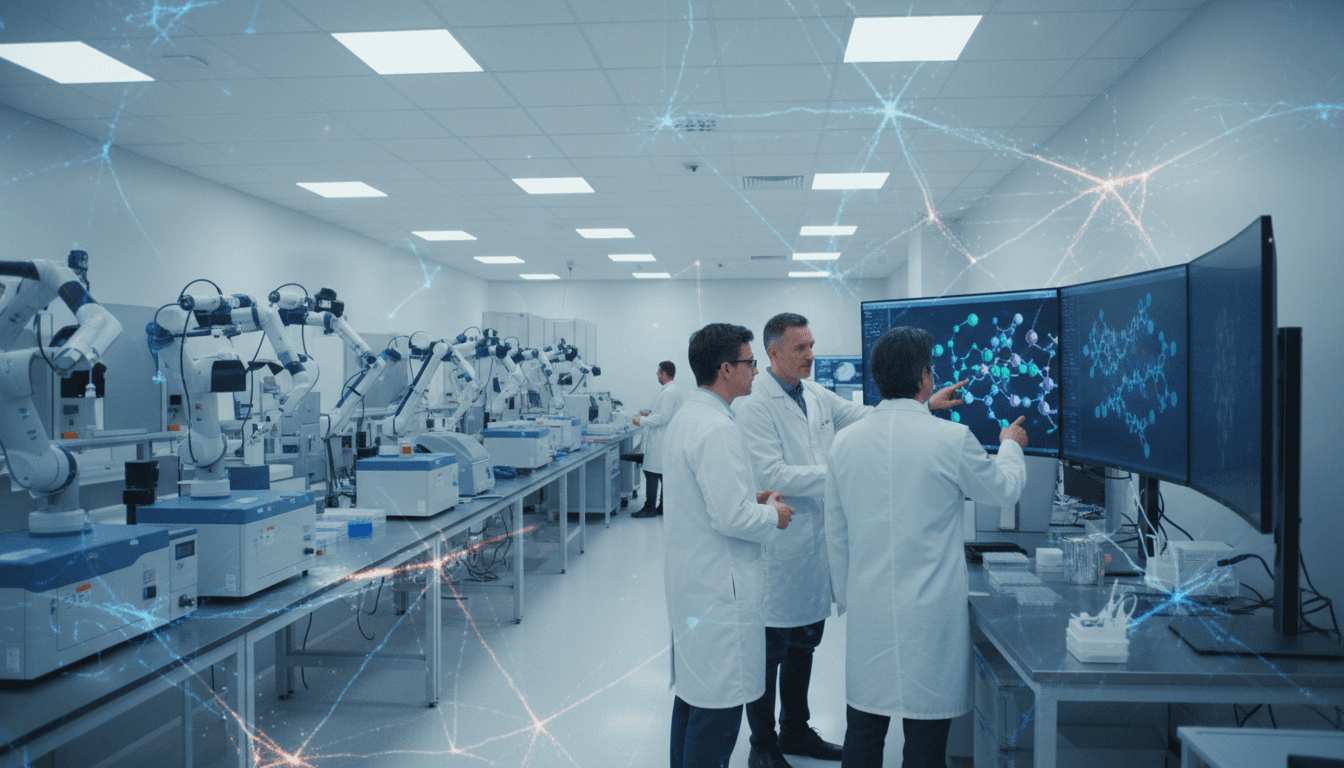
AI Is Accelerating Life Sciences Research in the U.S.
Drug discovery has a reputation for being slow because, frankly, it is. A single approved drug can take 10–15 years and cost $1–$2B+ when you include failed programs—numbers that have been repeated across industry analyses for years. The part most people miss is why it’s so slow: not just lab work, but the constant cycle of choosing what to test, running experiments, interpreting results, and documenting everything well enough to trust the next decision.
AI is starting to compress those cycles. Not by “replacing scientists,” but by acting like a high-throughput decision engine: ranking hypotheses, proposing candidates, catching errors, and turning messy research artifacts into reusable knowledge. That’s the core idea behind today’s theme in our AI in Pharmaceuticals & Drug Discovery series: AI-driven life sciences research acceleration is a practical template for how U.S. companies can scale digital services, automation, and customer-facing workflows too.
Snippet-worthy take: AI speeds research when it reduces the number of “dead-end” experiments and shortens the time between question → test → learning.
Why life sciences needs AI more than most industries
Life sciences is a worst-case environment for decision-making: high uncertainty, expensive experiments, long timelines, and strict quality expectations. AI fits here because it’s good at two things research teams constantly need: prioritization and pattern-finding.
The bottleneck isn’t ideas—it’s throughput
Most R&D teams don’t lack ideas. They lack the capacity to evaluate them quickly. A typical discovery pipeline gets clogged in places like:
- Target identification: too many plausible biological mechanisms, too little certainty
- Hit-to-lead: medicinal chemistry iterations are slow and resource-heavy
- ADMET risk: toxicity and metabolism surprises arrive late, when fixes are expensive
- Assay interpretation: data is noisy; conclusions often depend on who’s looking
AI helps by making early stages more selective—pushing the best options forward sooner and killing weak options earlier. When it works, you don’t just “go faster”; you waste less.
The U.S. advantage: digital infrastructure + research density
The U.S. life sciences ecosystem benefits from a rare combination:
- Dense research networks (universities, biotech hubs, pharma campuses)
- Cloud-scale compute and mature MLOps tooling
- Deep capital markets that fund long R&D arcs
That matters because modern AI in drug discovery is not a single model. It’s an operational system: ingestion, governance, evaluation, feedback loops, and human review. U.S. tech maturity makes it easier to build that system and run it reliably.
Where AI accelerates life sciences research (and where it doesn’t)
AI acceleration is real, but uneven. Some tasks are ready now; others still require major scientific or data breakthroughs.
What AI is good at today
1) Literature and evidence synthesis
Research teams drown in papers, preprints, protocols, and internal reports. Language models can summarize, compare, and trace claims back to evidence—especially valuable when you’re evaluating a target or MoA.
Practical win: a team can move from “we should look into this pathway” to a structured evidence memo in hours, not weeks.
2) Hypothesis generation and prioritization
Models can propose plausible target–disease links, biomarker panels, or combination strategies—then score them using multi-factor criteria (genetics support, pathway redundancy, tractability, safety flags).
Practical win: fewer meetings spent arguing from intuition; more time testing the top-ranked ideas.
3) Molecule design and iteration support
Generative models can propose novel structures or modifications constrained by medicinal chemistry rules. They don’t replace chemists; they widen the option set and speed iteration planning.
Practical win: chemists get more “starting points” per sprint, with rationale attached.
4) Experimental planning and automation
The underrated accelerant is workflow AI: planning experiments, auto-populating ELNs, checking reagent compatibility, and flagging protocol deviations.
Practical win: fewer re-runs caused by documentation gaps or small procedural errors.
What AI is not automatically good at
AI struggles when the underlying data is thin, biased, or inconsistent. Three common failure modes:
- Domain shift: training data doesn’t match your biology, assay, or patient population
- Label noise: “ground truth” endpoints are ambiguous or inconsistently measured
- Overconfident outputs: models sound certain even when evidence is weak
My stance: if an AI system can’t clearly state why it believes something and what would change its mind, it shouldn’t be making high-impact research calls.
A practical operating model: AI as a research copilot, not a lab oracle
The best teams treat AI as an integrated set of services. Not a demo. Not a “one-off model.” Here’s a structure that works in U.S. biotech and pharma settings.
Step 1: Start with a decision you already make every week
Pick a decision point like:
- Which targets go into validation?
- Which compounds advance to in vivo?
- Which patient subgroup should the next trial enrich for?
Then define what “better” looks like in measurable terms: fewer failed follow-ups, reduced cycle time, improved signal-to-noise, or earlier safety detection.
Step 2: Build a “research memory” layer
Most discovery organizations have knowledge trapped in:
- slide decks
- PDFs
- ELN entries
- instrument logs
- emails and chats
A high-leverage move is creating a governed, searchable layer where AI can:
- retrieve prior experiments and outcomes
- connect them to protocols and reagents
- summarize results with citations to internal artifacts
This is where life sciences research acceleration starts to look like enterprise digital services: the same retrieval + workflow patterns used in customer support automation or contract analysis apply here too.
Step 3: Put evaluation before scale
If you can’t evaluate the system, you can’t trust it. In discovery, evaluation should include:
- Retrospective tests: would AI have made the same decisions as the team?
- Prospective shadow mode: AI recommends; humans decide; outcomes are tracked
- Error taxonomy: categorize failures (missing evidence, wrong assumptions, hallucination, poor retrieval)
Snippet-worthy take: In R&D, “accuracy” is less useful than “decision quality under uncertainty.”
Collaboration is the differentiator: AI + life sciences is a team sport
The most productive deployments happen when computational and experimental teams share ownership. That’s harder than it sounds.
What strong collaboration looks like
- Biologists help define what the model should optimize, not just provide data
- Chemists set constraints and review outputs, keeping suggestions realistic
- Data scientists own evaluation and monitoring, not just model training
- QA/regulatory partners shape documentation standards early, not at the end
In practice, this becomes a new kind of specialized digital service inside the company: an internal “AI research platform” that behaves like a product.
A note on incentives
Most companies get this wrong by measuring AI success with vanity metrics (number of summaries generated, number of molecules proposed). Better metrics are outcome-linked:
- Cycle time reduction: days from idea → designed experiment
- Experiment success rate: fewer invalid or low-informational runs
- Attrition shift: earlier elimination of toxic/ineffective candidates
- Reproducibility: fewer “can’t replicate” surprises across sites
From lab acceleration to U.S. digital services: the bridge most leaders miss
Life sciences is a high-stakes proving ground. If AI can improve decisions where mistakes cost millions and timelines are years long, it can absolutely improve other U.S. technology and digital services.
Here are direct transfers I’ve seen work:
The same patterns power enterprise automation
- Research memory ↔ knowledge bases for support and sales
- Protocol checking ↔ compliance checking for contracts and policies
- Evidence synthesis ↔ competitive intel and market research briefs
- Experiment planning ↔ project planning and resource scheduling
The scalability story is the same: once the workflow is instrumented (inputs, outputs, review steps, logging), AI can assist thousands of times per week with consistent quality.
Why this matters for lead-generation audiences
If you’re evaluating AI vendors, platforms, or internal builds, life sciences is a useful stress test. It forces you to answer:
- Can the system handle messy, multi-modal data?
- Is governance built in (access control, audit trails, retention)?
- Can we measure performance without fooling ourselves?
- Does it improve real outcomes, not just productivity theater?
Those answers translate directly to customer communication automation, back-office processing, and analytics programs.
“People also ask” answers (without the fluff)
Does AI actually reduce drug discovery timelines?
Yes, when it reduces iteration loops and improves early prioritization. The biggest gains typically come from fewer low-value experiments and faster decision cycles, not from a single “magic model.”
What data do you need to start using AI in pharma R&D?
Start with what you already have: internal assays, compound registries, ELN records, protocols, and prior decision memos. The key is making it accessible, governed, and linkable so AI can retrieve it reliably.
Is generative AI safe to use with sensitive research?
It can be, if you treat it like any other regulated system: access controls, logging, clear data boundaries, and human review for high-impact outputs. “Safe” is an operational property, not a model feature.
What to do next if you want AI-driven research acceleration
If you’re in pharma, biotech, or a supporting digital services firm, the next step isn’t buying a bigger model. It’s choosing one workflow and making it measurable.
Here’s a practical starting plan for Q1 2026:
- Pick one decision point (target triage, hit-to-lead, trial cohort definition)
- Inventory the evidence trail (where the data and rationale currently live)
- Stand up a governed retrieval layer (role-based access, audit logs)
- Run 6–8 weeks in shadow mode (AI recommends, humans decide)
- Track outcomes (cycle time, error rates, downstream success)
This post fits into our broader AI in Pharmaceuticals & Drug Discovery series for a reason: life sciences forces discipline. The teams that learn to operationalize AI here tend to build stronger AI programs everywhere else.
Where do you think your organization loses the most time today—finding the right evidence, deciding what to test, or operational follow-through after decisions are made?