AI planning helps manage a Europe-lighter U.S. posture by optimizing resources, ISR, and coalition coordination. Learn practical steps to operationalize it.
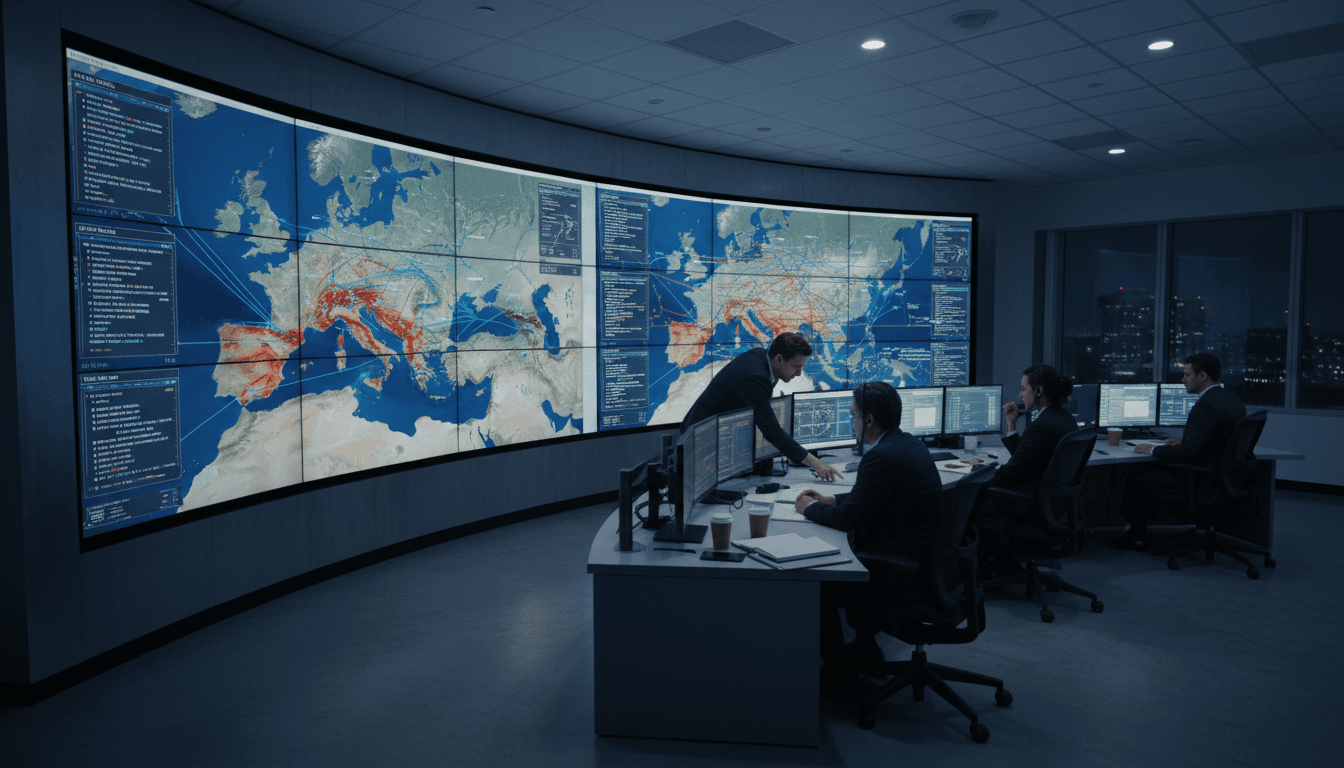
AI Planning for a Europe-Lighter U.S. Posture
A NATO ally can do “everything right” on paper—meet spending targets, modernize forces, align to capability plans—and still feel less covered than it did two years ago. That’s the unsettling signal coming out of Washington’s current posture: Europe isn’t the default center of gravity anymore. It’s increasingly treated as a supported theater, not the supported-by theater.
This matters beyond diplomacy and troop numbers. A Europe-lighter U.S. posture turns resource allocation into a real operational constraint—munition stocks, ISR coverage, sealift capacity, cyber teams, space support, and decision-maker attention. If you’re building systems for national security or critical infrastructure (including AI in payments and fintech infrastructure), you’re now living in a world where trade-offs are the strategy.
Here’s my stance: If priorities are shifting faster than institutions can adapt, AI isn’t “nice to have.” It’s the only scalable way to keep plans coherent across theaters—without guessing. The point isn’t to automate grand strategy. It’s to make strategy executable under constraints.
Why Europe is sliding down the priority list (and why that’s structural)
Europe’s demotion in U.S. strategic focus isn’t a single policy choice; it’s an accumulation of incentives, political signals, and opportunity costs.
The source article argues that Europe now ranks behind the Western Hemisphere, the Indo-Pacific, and the Middle East. Whether you agree with that exact ordering, the operational consequence is clear: Europe competes for assets rather than receiving them by default.
Three forces are doing the work:
- A hemispheric turn: more military attention and resources pulled toward border operations, Caribbean posture, and coercive diplomacy in the Americas. That absorbs ready units, ISR capacity, logistics bandwidth, and senior-level focus.
- Reduced “Europe as force multiplier” thinking: less appetite to treat Europe as a platform for China competition or global governance. The U.S. acting more bilaterally shrinks the perceived value of allied scale.
- Values and ideology drift: a widening gap between MAGA politics and mainstream European politics increases friction, uncertainty, and the temptation to treat alliances as transactional.
If you’re a planner, strategist, or technologist, translate all of that into one sentence: the planning problem is no longer “how to reinforce Europe,” it’s “how to allocate scarcity across four competing theaters without breaking deterrence anywhere.”
The operational problem: deterrence fails at the seams
Deterrence doesn’t fail only because of tanks crossing borders. It fails when adversaries spot seams:
- A gap in air defense coverage because an interceptor shipment got reprioritized.
- A readiness dip because spare parts are tied up in a different theater.
- A political delay because allied messaging isn’t synchronized.
- An ISR blind spot because collection platforms are allocated elsewhere.
Those seams show up first in logistics, budgeting, and decision cycles—not in headlines.
And that’s where AI can actually help: not as an abstract “strategy tool,” but as a set of systems that compress the time from signal → decision → resourcing → execution.
A useful analogy from fintech: liquidity and settlement risk
In payments infrastructure, you don’t go insolvent only when the bank account hits zero. You go insolvent when timing mismatches and settlement delays cascade across counterparties.
Defense posture is similar:
- Munitions are your “liquidity.”
- Sealift/airlift and maintenance are your “settlement rails.”
- Interoperability and standards are your “messaging formats.”
A Europe-lighter posture increases the chance of timing mismatches. AI-driven planning is how you detect them early and correct them before they turn into crisis.
Where AI actually fits: from grand strategy to executable plans
AI won’t resolve political disagreements about NATO or Ukraine. But it can reduce the number of unforced errors that come from complexity.
Here are four AI application zones that map directly to the pressures described in the article.
1) AI-driven resource allocation across theaters (the “portfolio” problem)
Answer first: AI helps by optimizing constrained resources across competing demands, using explicit trade-offs instead of gut feel.
When Europe drops in priority, the hidden question becomes: What’s the minimum viable deterrence package for Europe, and what’s the marginal cost of pulling one more brigade or squadron away?
AI planning systems can:
- Model force availability (readiness, training cycles, deployment histories)
- Quantify risk exposure by region (threat indicators + posture + response times)
- Optimize allocation under constraints (munitions, crews, maintenance windows)
- Run scenario stress tests (“If Taiwan crisis indicators rise 20%, what breaks in Europe?”)
This isn’t magic. It’s applied operations research plus modern machine learning to keep models updated as real-world conditions change.
2) AI-enhanced intelligence and surveillance for “underprioritized” regions
Answer first: If fewer assets are stationed forward, AI has to squeeze more value from every sensor and every collection hour.
A drawdown doesn’t only remove combat power. It reduces the day-to-day sensing that supports deterrence: pattern-of-life baselines, anomaly detection, logistics tracking, and early warning.
AI can fill gaps by:
- Automating multi-INT fusion (imagery, SIGINT, cyber indicators, open-source)
- Running anomaly detection on air/maritime movements and procurement signals
- Prioritizing collection tasking based on predicted adversary windows of action
If Europe truly must “do more alone,” then European ISR needs to be more autonomous and more scalable. AI is the multiplier.
3) AI for coalition coordination: interoperability is a data problem
Answer first: Coalition effectiveness increasingly depends on shared data standards and decision workflows, not just shared political intent.
The article’s call for Europe to reform defense industrial fragmentation points to a reality that technologists recognize instantly: fragmented suppliers produce fragmented data.
If every nation buys different systems with different interfaces, you get:
- Slow integration
- Poor interoperability
- Short production runs
- Higher sustainment cost
AI won’t fix protectionism. But AI systems can force clarity by requiring:
- Common data schemas for readiness, inventory, and sustainment
- Shared operating pictures built from federated data access (not one giant database)
- Automated compliance checks against NATO capability targets
This is similar to modern payment orchestration: multiple rails, multiple risk models, one coherent user experience.
4) AI-driven budget and logistics planning (the “rearmament bottleneck”)
Answer first: Bigger budgets don’t automatically create capability; production capacity, supply chains, and maintenance throughput do.
Europe’s core constraint isn’t only spending levels—it’s how quickly that spending translates into deployable capability. AI helps by revealing bottlenecks early:
- Which suppliers are single points of failure
- Which components have 18–36 month lead times
- Which maintenance depots cap readiness
- Which munition lines can’t surge without new tooling
In practical terms, AI can support:
- Predictive maintenance for fleets
- Demand forecasting for spare parts
- Production scheduling for munitions and air defense interceptors
- Logistics routing under contested conditions
This is where the AI in payments & fintech infrastructure parallel is strongest: the best fraud model in the world won’t help if your transaction routing is broken. Likewise, the best deterrence messaging won’t help if your sustainment pipeline can’t deliver.
“Europe-first autonomy” without breaking NATO: what good looks like
Europe taking more ownership doesn’t require a NATO divorce. It requires measurable outcomes that reduce dependence on U.S. day-to-day enablers.
Here’s what I’d watch in 2026–2028 if you want to separate rhetoric from progress.
Capability indicators (measurable, not aspirational)
- Air and missile defense capacity: interceptor stockpiles and layered coverage across key corridors
- Munitions production rate: not total orders, but monthly output and surge capacity
- Strategic mobility: sealift, rail compatibility, and prepositioning throughput
- C2 resilience: redundant comms, hardened data links, cyber recovery time
Data indicators (the quiet determinant)
- Shared logistics and readiness data models across major European forces
- Federated identity and access controls for coalition data sharing
- Real-time inventory visibility for critical classes of supply
If those data indicators lag, capability will lag, even with higher defense spending.
What leaders in defense and critical infrastructure should do next
A Europe-lighter U.S. posture creates two immediate management tasks: clarify priorities and instrument the system.
Here’s a practical checklist I’ve found useful when organizations try to operationalize AI planning in high-stakes environments.
-
Define the decision you’re optimizing
- “Allocate ISR hours across theaters” is a decision.
- “Be more data-driven” is not.
-
Choose risk metrics that executives will actually use
- Time-to-reinforce
- Stockpile days-on-hand
- Maintenance backlog
- Early-warning confidence
-
Start with a thin-slice MVP
- One capability class (e.g., interceptors)
- One theater interface (e.g., Europe ↔ Indo-Pacific trade-offs)
- One planning horizon (e.g., 90-day readiness)
-
Treat interoperability like payments infrastructure
- Standard message formats
- Strong identity
- Clear audit trails
- Redundancy and fallback routes
-
Bake in governance from day one
- Who can override the model?
- What gets logged?
- What data is sensitive, and how is it protected?
That last point matters because adversaries will target the planning layer. If they can corrupt inputs, they can induce bad allocations—just like fraudsters attacking weak points in transaction routing.
The real question for 2026: can AI keep deterrence coherent?
A U.S. posture that treats Europe as a lower priority doesn’t automatically mean Europe is unsafe. It means deterrence becomes more conditional, more complex, and more dependent on execution quality.
AI planning and mission optimization systems are now part of that execution quality. They’re how governments and coalitions keep readiness, intelligence coverage, budgets, and logistics aligned—especially when political signals are noisy and resources are finite.
If you’re building in this space—defense AI, risk analytics, secure data sharing, or even AI in payments and fintech infrastructure—the shared lesson is blunt: the winners aren’t the ones with the most ambition; they’re the ones with the tightest control loops.
What would change in your organization if you had a live, auditable view of cross-theater trade-offs—before the crisis forces your hand?