See how Sora is reshaping AI video generation for creatives—speeding up pre-vis, pitches, and surreal storytelling across modern media workflows.
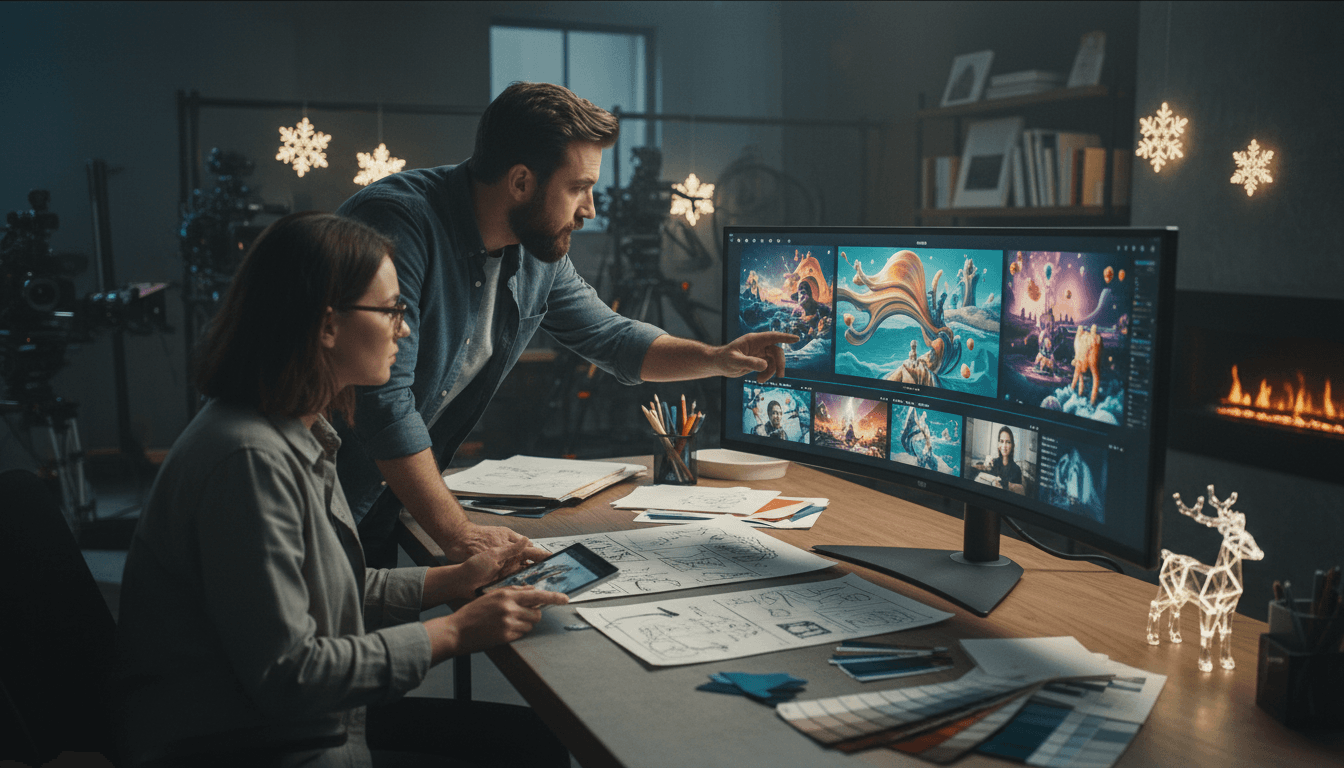
Sora in Real Creative Work: Faster, Weirder, Better
Most creative teams don’t fail because they lack ideas. They fail because the ideas can’t survive the jump from imagination to production reality—time, budget, gear, approvals, and a long line of “maybe next quarter.” Sora (AI video generation) changes that bottleneck in a very specific way: it turns early concepts into watchable motion faster than traditional pipelines can schedule a kickoff.
That matters for the U.S. digital economy right now. It’s late December, budgets are resetting, content calendars for Q1 are getting locked, and teams are being asked to produce more video for more channels (short-form, CTV, product explainers, social ads) with the same headcount. In the AI in Media & Entertainment series, we’ve covered personalization, recommendations, and audience analytics; this chapter is about production itself—how AI is becoming part of the creative workflow rather than just the distribution engine.
Sora’s early artist collaborations give a useful lens: not “AI replaces filmmaking,” but “AI collapses the cost of iteration.” And iteration is where campaigns, storyboards, pilots, and pitches either get sharper—or get killed.
What Sora changes in AI video generation (and why it’s different)
Sora’s practical impact is compressing the concept-to-preview loop. Instead of spending days to get a rough animatic, mood film, or pre-vis sequence that only approximates the final, teams can generate motion studies and narrative beats quickly enough to make creative decisions while the idea is still fresh.
Traditional production has a hidden tax: you don’t just pay for the final shoot; you pay for the uncertainty before the shoot. Location tests, lighting tests, VFX tests, and reshoots exist because you can’t fully “see” the idea until it’s expensive. AI-generated video doesn’t remove uncertainty, but it changes where uncertainty lives—earlier, cheaper, and easier to explore.
Creators testing Sora consistently describe two things:
- Freedom to experiment without permission (time, money, and staffing constraints loosen)
- A bias toward the surreal and impossible (not merely photoreal imitation)
That second point is easy to miss. Many teams will initially use AI to mimic what they already do. The stronger use case is the opposite: using Sora for visuals you wouldn’t even attempt with conventional production.
“Sora is at its most powerful when you’re not replicating the old but bringing to life new and impossible ideas…”
Real workflow shifts: how artists are using Sora day-to-day
The most valuable early pattern is “Sora as a creative accelerant,” not a finishing tool. The artists collaborating with Sora are editing, combining, and shaping outputs as part of a broader process—closer to how you’d treat stock footage, pre-vis, or experimental plates.
Surreal storytelling without the usual production drag
A Toronto-based multimedia team created a short film concept around a balloon man—exactly the kind of premise that can get trapped between “too weird for a client” and “too expensive to test properly.” Their takeaway is telling: realism is cool, but surrealism is where the tool starts to feel like a new medium.
For agencies and studios, that’s not just art talk. It’s market differentiation. When every brand is running similar social templates, “we can show you something you’ve never seen” becomes a commercial advantage.
Filmmakers regaining iteration velocity
One director described working with Sora as feeling “unchained”—not because it eliminates craft, but because it removes the early-stage friction. If you’ve ever waited a week for a motion test just to confirm a camera move won’t work, you understand the value.
Here’s what that looks like in practice:
- Generating multiple versions of a scene idea (composition, action, mood)
- Using outputs as editable building blocks for a proof-of-concept
- Testing unusual transitions and visual metaphors before committing to a full pipeline
Agencies using Sora for concepting and rapid iteration
An Emmy-nominated creative agency in Los Angeles is using Sora to visualize brand concepts quickly. This is where AI in media production connects directly to lead generation: the agencies that win work are often the ones who present the clearest, most cinematic pitch materials.
If your pitch deck currently relies on static frames, mood boards, and references, you’re competing against teams who can show a moving concept that feels like a trailer.
Music and art: expanding scope without expanding budget
A multidisciplinary artist and musician framed Sora as a “turning point” because it closes the gap between imagination and means. That’s a real constraint in independent creation: you can have a strong narrative vision and still be blocked by production logistics.
In 2026, expect more music visuals, tour visuals, and episodic social storytelling to be prototyped with AI video tools first—then selectively “up-res’d” into higher-cost production when it’s justified.
AR/XR creators prototyping faster for spatial experiences
For AR/XR creators, Sora is less about final footage and more about rapid prototyping—getting an idea into motion before building full 3D assets. One artist called the model’s “weirdness” its best feature because it isn’t bound by physical conventions.
That’s a useful mindset for spatial computing teams in the U.S. market: prototyping isn’t just about realism; it’s about emotional impact, silhouette, timing, and presence. AI video can help you pressure-test those creative decisions earlier.
From video to physical objects: the “video-to-3D” thread
An artist-in-residence described using Sora as a starting point for sculpture, thinking about photogrammetry and transforming video into 3D models.
Even if your team isn’t building sculptures, the implication is big: AI-generated video can become upstream data for other pipelines—3D exploration, AR concepts, product form studies, or experiential design.
Where Sora fits in the modern U.S. content pipeline
Sora fits best where speed matters more than perfection: pre-production, iteration, and pitch-stage storytelling. That’s not a limitation—it’s where most money and time get wasted.
The strongest use cases (right now)
If you’re a brand team, studio, or agency, the near-term ROI typically shows up in:
- Pitch visuals: motion concepts that sell an idea faster than slides
- Pre-vis and animatics: sequences to validate pacing and transitions
- Creative testing: multiple narrative angles for short-form ads
- Style exploration: surreal or abstract directions that would be costly to mock
- Internal alignment: getting stakeholders to react to motion, not imagination
The practical difference is decision quality. Teams argue less about what a thing “could be” when they can watch a version of it.
The “two-track” production model
I’ve found the healthiest way to adopt AI video tools is to run a two-track system:
- Track A (AI exploration): rapid ideation, variations, motion sketches, rough sequences
- Track B (production craft): the parts that need exact control, performance, legal clearance, and brand safety
This avoids the trap of forcing AI to do everything. You use it where it’s strongest: generating options and surfacing unexpected creative paths.
Brand safety, rights, and trust: what teams must operationalize
If AI video is entering your workflow, governance can’t be a slide deck; it has to be operational. Media & entertainment teams already manage music rights, talent releases, and location permits. AI adds a new category of risk: provenance, consistency, and policy.
Here’s a practical checklist that creative ops teams in the U.S. should adopt alongside any AI video experimentation:
- Usage policy: define what can be generated (and what can’t) for your brand
- Review gates: add a human review step for claims, logos, public figures, and sensitive topics
- Asset logging: keep prompts, versions, and approvals for traceability
- Disclosure guidance: decide when you label AI-generated content (internal and external)
- Consistency rules: create a style guide for AI outputs (palette, pacing, motion language)
A blunt stance: if you wouldn’t ship a video without clearing music rights, don’t ship AI video without a provenance process. The teams that treat governance as part of the creative workflow will move faster long-term, not slower.
People also ask: practical questions about Sora in creative workflows
Is Sora replacing filmmakers or designers?
No—Sora is reducing the cost of iteration. The people who benefit most are the ones who already have taste, storytelling instincts, and editing skill. AI expands what they can test quickly.
What’s the biggest advantage of Sora for agencies?
Pitch clarity and speed. In competitive bids, a moving concept can communicate tone, pacing, and emotional arc in seconds.
Where does AI video struggle today?
Control and repeatability. Brand work often needs precise continuity, product accuracy, and exact messaging. That’s why the two-track model (AI exploration + traditional craft) works.
How does this connect to the broader “AI in Media & Entertainment” theme?
It’s the production-side counterpart to personalization and distribution. Recommendation engines decide what gets watched; AI video tools influence what gets made—and how quickly teams can respond to audience behavior.
What to do next: a 30-day plan for teams testing AI video
The fastest way to get value is to pick one workflow choke point and measure it. Don’t start with a big “AI transformation” program. Start with one repeatable deliverable.
Try this 30-day rollout:
- Week 1 — Choose one use case: pitch trailer, animatic, or creative testing for short-form ads
- Week 2 — Build a prompt + review playbook: define style rules, prohibited content, approval steps
- Week 3 — Produce 10 variations of one concept: measure cycle time vs. your baseline
- Week 4 — Decide what graduates to production: select the best ideas and execute with human craft
The measurable outcome you want is simple: fewer meetings spent debating hypotheticals, more decisions made from watchable options.
Sora first impressions from working artists point to the same future: the winners won’t be the teams who generate the most clips. They’ll be the teams who build a dependable workflow where AI-generated video supports stronger storytelling, faster iteration, and more ambitious creative risks.
If 2025 was the year AI proved it could write and design at scale, 2026 is shaping up to be the year motion becomes just as iterative. What story would your team attempt if “testing the impossible” was cheap enough to do this week?