AI video “world simulators” help U.S. brands scale content faster, test more creative, and personalize campaigns—without sacrificing trust.
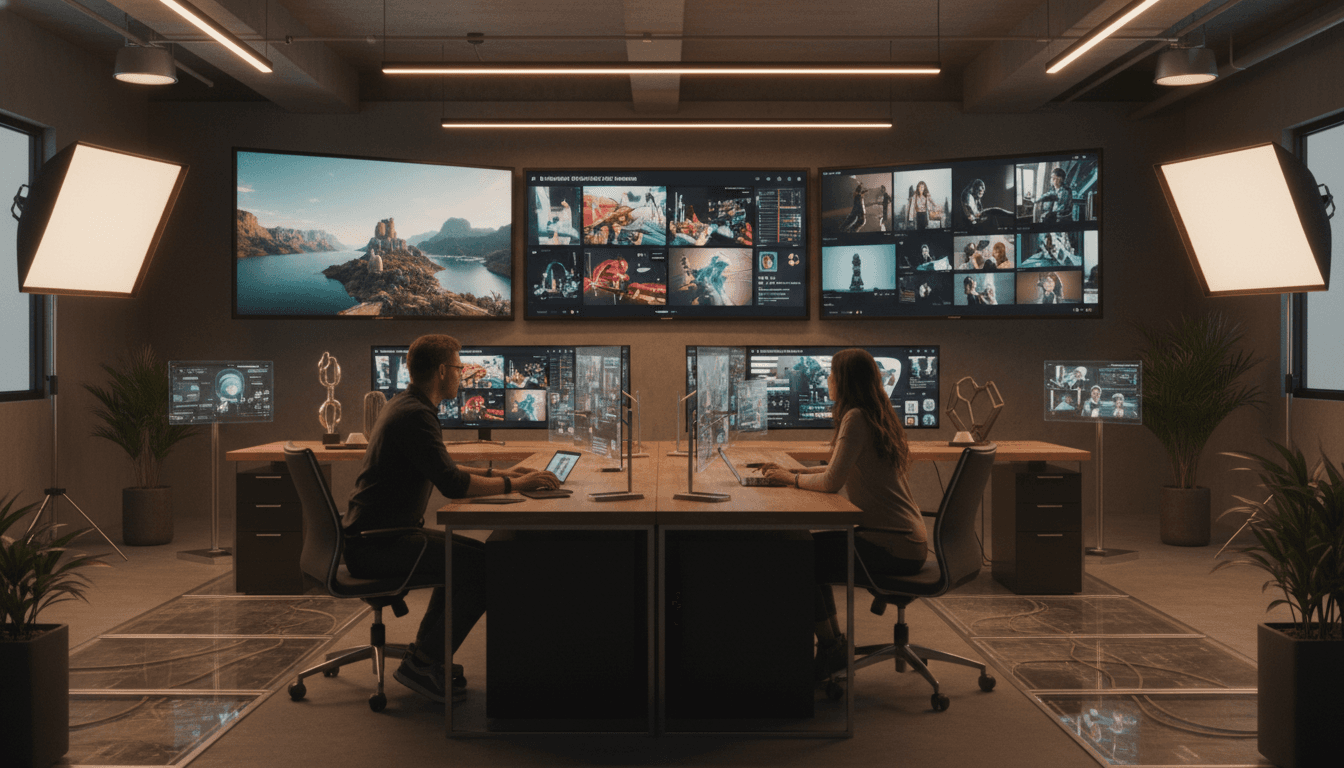
AI Video World Simulators: Faster Content for U.S. Brands
Most companies still treat video like it’s expensive, slow, and hard to scale. That used to be true—especially if you needed multiple versions for different audiences, products, and channels.
Now video generation models are being built and discussed as “world simulators”: systems that don’t just animate pixels, but predict how scenes evolve over time. Even though the RSS source content itself is inaccessible (blocked behind a 403/CAPTCHA), the core idea behind “video generation models as world simulators” is already reshaping how U.S. digital teams think about creative production, personalization, and speed.
This matters in the U.S. market because attention is fragmented and the expectation for fresh content is constant—holiday campaigns in December, annual planning for Q1, product launches, and always-on social. If you’re in marketing, media, or digital services, the question isn’t “Will AI video show up in our workflow?” It’s “Are we setting ourselves up to use it safely and profitably?”
What “world simulator” video models actually mean
A video generation model as a world simulator is a model that learns patterns about motion, lighting, object behavior, camera movement, and cause-and-effect—then generates short clips that behave like a coherent scene, not just a slideshow of frames.
In practice, that implies three big capabilities:
- Temporal consistency: Objects and characters stay recognizable across frames.
- Physical plausibility: Motion looks “right” enough to be believable (even if it’s not perfect physics).
- Controllable storytelling: The user can specify prompts, constraints, and edits so the scene follows direction.
Here’s the stance I’ll take: the “simulator” framing is useful for business teams because it clarifies where the value comes from. It’s not only about making pretty clips. It’s about generating scenes you can iterate on—like a sandbox for creative and communication.
Why this is showing up now
This shift is happening because model training has moved beyond static images to video and multimodal data. When a model sees countless examples of “a dog running across grass,” it begins to internalize typical motion trajectories, camera shake, shadows shifting, and background parallax.
For U.S. digital services, that translates into a practical promise: more versions, faster approvals, and lower production friction—especially for short-form content.
How AI video is changing U.S. marketing and digital services
AI video generation is already pulling three levers that matter to lead generation and revenue: speed, personalization, and testing volume.
1) Speed: from campaign briefs to usable drafts
Teams are using AI video to produce:
- Concept previews for stakeholders (before spending on shoots)
- Social-first variants (different hooks, different openings)
- Simple explainers (animated scenes that match the script)
This matters because time-to-first-draft is where many creative pipelines stall. When you can show a believable draft quickly, approvals get easier. And if approvals get easier, you ship more.
2) Personalization: “one video” becomes “a family of videos”
Personalized video used to require heavy templates, motion graphics labor, or expensive dynamic video platforms. World-simulator-style generation points toward something broader: scene-level personalization.
Examples that are especially relevant for U.S. brands:
- Regionalized visuals (city cues, seasonal settings, local landmarks)
- Industry-specific variations for B2B (healthcare vs. finance vs. retail)
- Audience-aware creative (different pacing or tone for different channels)
If you’re doing lead gen, personalization isn’t a vanity metric. It’s a way to reduce mismatch between your ad and your landing page promise.
3) Testing volume: creative becomes an experiment, not a bet
Most marketing teams A/B test headlines and call-to-action buttons while treating video as “too precious to test.” AI video flips that.
You can run structured creative experiments:
- 5 hooks × 3 value props × 2 visual styles
- Different spokesperson formats (animated presenter vs. product-only)
- Different scene metaphors for the same concept
The payoff isn’t that every variant wins. The payoff is that you can find winners without burning your quarter’s production budget.
Snippet-worthy reality: AI video doesn’t replace your brand strategy—it replaces the waiting.
Practical use cases: where “world simulation” shows real ROI
The best early wins aren’t blockbuster commercials. They’re repeatable workflows where video is needed constantly.
Performance creative for paid social
Answer first: AI video is ideal for short, iterative paid social because the economics reward quick testing.
A workable workflow looks like this:
- Generate 10–20 rough cuts around a single offer
- Pick 3–5 that match brand style and compliance
- Edit in your real product UI, screenshots, or pack shots
- Ship, learn, and regenerate the next wave based on performance
This is a particularly strong fit for U.S. DTC, local services, and SaaS—anyone competing on crowded ad inventory.
Product storytelling without always needing a shoot
If your product changes frequently (apps, dashboards, consumer packaged goods seasonal SKUs), AI-generated scene footage can fill gaps:
- Lifestyle scenes around product benefits
- Abstract “problem/solution” visuals
- Background b-roll to support a voiceover
I’ve found teams get better results when they treat AI footage as modular b-roll rather than trying to generate the entire ad end-to-end.
Internal communications and enablement
A quiet win: internal video.
Sales enablement, training, and customer success teams in the U.S. often need:
- New feature walkthrough intros
- Scenario-based training clips
- Short “what changed” updates
AI video can reduce friction for content that needs to be “good enough and on time,” not “festival quality.”
What to watch: quality, control, and trust (the real blockers)
Answer first: the biggest risks aren’t technical—they’re operational. Teams struggle with brand consistency, legal approvals, and governance.
Brand control: consistency is the hard part
World-simulator models can produce striking visuals, but brands need repeatability:
- Consistent characters and environments
- Stable color palettes and typography (often added in post)
- Predictable framing and pacing
A strong approach is to establish a “creative system”: approved styles, prompts, shot lists, and do-not-use rules.
Rights and compliance: don’t improvise here
If you’re generating marketing content, you need clarity on:
- Whether generated outputs can be used commercially
- Whether prompts or reference images introduce infringement risk
- How you avoid generating real people or protected marks unintentionally
Treat AI video like any other production tool: document inputs, review outputs, and keep approvals auditable.
Misinformation and authenticity
As AI video improves, the line between “illustration” and “evidence” gets blurry.
My opinion: marketing teams should adopt an internal rule—AI video is for storytelling, not for claiming real-world proof. If a clip depicts a customer, a lab, a factory, or a medical scenario, be cautious. Use real footage or clearly illustrative visuals.
A workable implementation plan for marketing teams (lead-gen friendly)
Answer first: start with a narrow pilot that’s measured, repeatable, and safe. You’ll learn more in three weeks than in three months of debating.
Step 1: Pick one funnel and one channel
Good pilots:
- Paid social top-of-funnel (TOFU)
- Landing page hero video alternatives
- Retargeting creative refresh
Bad pilots:
- Brand anthem video
- High-stakes regulated claims
- Celebrity-style spokesperson content
Step 2: Define success metrics before you generate anything
Choose 2–3 metrics tied to leads:
- Cost per lead (CPL)
- Click-through rate (CTR)
- Conversion rate on the landing page
And one production metric:
- Time-to-first-usable-draft (hours, not days)
Step 3: Build a prompt library like it’s a design system
Create reusable building blocks:
- Brand-safe adjectives and visual references
- Camera language (close-up, wide shot, slow pan)
- Lighting and mood rules
- “Never include” list (logos, real faces, certain scenarios)
Step 4: Add human editing where it counts
A strong hybrid workflow:
- AI generates scenes and motion ideas
- Humans add product truth: UI captures, real packaging, pricing, disclaimers
- Editors polish timing, audio, captions, and pacing
This is where a lot of U.S. teams land: AI for volume, humans for accuracy and brand trust.
People also ask: quick answers your team will need
Is AI video generation “good enough” for ads?
Yes—for many short-form placements. It’s strongest when the goal is attention and concept communication, then you reinforce credibility with real product visuals.
Will AI video replace production agencies?
It’ll change agency value. Agencies that lean into creative direction, brand systems, and multi-variant testing will win. Pure execution-only work will get squeezed.
How do you keep AI video on-brand?
Use tight constraints: a prompt library, style references, and a review checklist. And expect iteration—brand consistency improves when you treat prompts like creative assets.
Where this fits in our “AI in Media & Entertainment” series
This post sits at the production layer of the broader theme: AI is already personalizing content, supporting recommendations, and analyzing audience behavior. Video generation adds a new piece—automating the creation of the content itself.
For U.S. media and entertainment teams, that means faster prototyping of trailers, social teasers, and localized promos. For U.S. digital services and B2B marketers, it means something simpler: more shots on goal.
The forward-looking question for 2026 planning is straightforward: when video models behave more like simulators—and less like novelty generators—will your team have the governance, creative system, and measurement discipline to use them well?