Use Breakdown: 1975 as a lens on AI storytelling, audience insights, and personalization—plus a practical playbook for modern media teams.
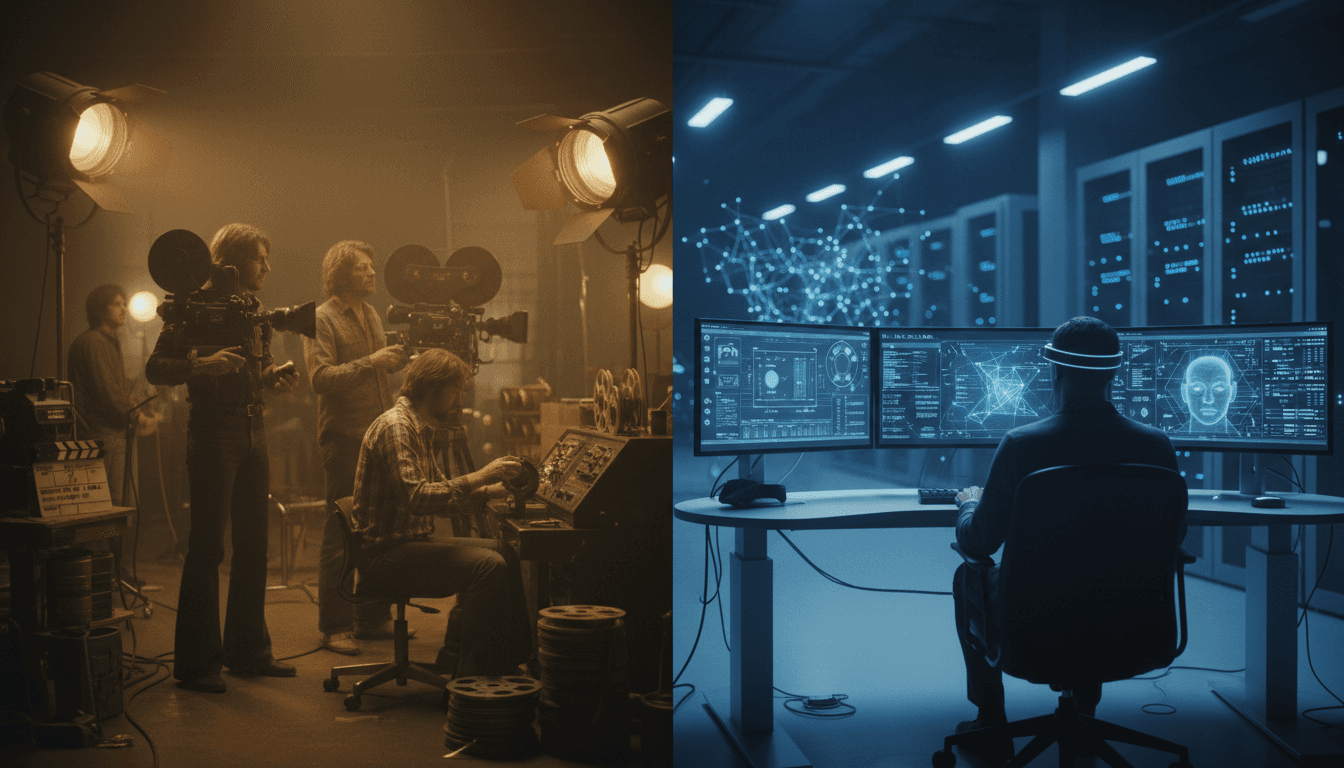
What “Breakdown: 1975” Teaches About AI Storytelling
1975 wasn’t just “a good year for movies.” It was the moment Hollywood started acting like modern Hollywood—bigger bets, louder cultural arguments, and audiences splitting into more identifiable tribes. Netflix’s documentary Breakdown: 1975 (directed by Morgan Neville) treats the year as a pivot point, pulling in voices like Patton Oswalt, Martin Scorsese, and Seth Rogen to connect the dots between pop culture and politics.
Reviews of the doc (including Daniel Fienberg’s) land in a similar place: it’s fun and full of great anecdotes, but it can feel unfocused—like a highlight reel of the mid-’70s rather than a single, sharp thesis. I actually think that “unfocused but compelling” quality is the most useful thing to talk about, especially for anyone working in AI in media & entertainment.
Because AI is pushing today’s content industry into its own turning point—one where the winners won’t be the teams who generate the most footage, scripts, or trailers. They’ll be the teams who can turn culture into story with enough precision that audiences feel seen, not studied.
1975 proves culture beats “content” every time
1975 matters because it shows what happens when entertainment stops being just entertainment and starts functioning like a national conversation. Films like Jaws and Dog Day Afternoon didn’t succeed because they were “more content.” They succeeded because they hit anxieties, aspirations, and identities that audiences were already carrying.
That’s the real lesson behind a doc like Breakdown: 1975: when you tell the story of a year, you’re not cataloging releases. You’re mapping what people cared about.
Here’s the uncomfortable parallel for 2025: a lot of AI-driven content workflows are optimizing for throughput—more variations, more cuts, more posts, more “personalized” everything. But the audience doesn’t reward volume. The audience rewards relevance.
A production pipeline can be automated. Cultural resonance can’t.
AI can help you get closer to resonance, but only if you treat AI as an insight engine and a craft amplifier, not a slot machine.
The “fun but unfocused” trap (and why it matters now)
Fienberg’s read—fun, but scattered—is a common risk for modern media teams too. When you have endless data and endless generation, you can end up with endless fragments.
- Too many angles
- Too many audience segments
- Too many cuts optimized for clicks
- Not enough editorial spine
1975 storytelling works when it has a point of view. The same is true for AI-assisted storytelling: AI can produce options; humans still have to pick a lane.
Audience insight: 1975 did it with instinct; 2025 does it with models
One reason Breakdown: 1975 is such a useful mirror is that it highlights a world where audience understanding was built from messy signals: box office receipts, critics, word of mouth, and the lived experience of the people making the work.
Now we have audience analytics, recommendation engines, content personalization, and real-time feedback loops. That’s not automatically better. It’s just more measurable.
The modern challenge is translating measurement into meaning.
What AI can do (well) for audience understanding
Used responsibly, AI is excellent at pattern recognition across massive datasets—viewing completion rates, rewatch behavior, thumbnail testing results, search trends, social sentiment, and even when people pause or abandon.
In practical terms, AI audience insights can help you answer questions creative teams actually care about:
- Which moments create drop-off? Not “the episode was boring,” but this scene structure or this exposition pattern causes exits.
- What do different audience clusters respond to emotionally? Comedy fans who love improvisational dialogue may not respond to the same pacing as thriller fans.
- What’s the real promise of the title and trailer? AI can compare marketing assets to audience retention to spot mismatches.
This is where the 1975 comparison gets interesting: the doc is basically doing cultural analytics by hand—collecting voices, anecdotes, and context. AI can scale that kind of analysis without losing the story—if you design the workflow to protect narrative coherence.
The key is “editorialized analytics”
If your dashboards don’t lead to decisions a showrunner, producer, or head of marketing can make, you don’t have insights—you have trivia.
I’ve found the best teams do a simple handoff:
- Data team provides 3–5 findings max (not 30)
- Creative lead decides what changes the work (and what doesn’t)
- Marketing tests messaging that matches what the work truly is
That’s how you avoid the “unfocused documentary” problem in your own pipeline.
How AI could have changed Hollywood in 1975 (for better and worse)
If you drop modern AI tools into 1975, a few things happen immediately.
Better: fewer blind bets, smarter positioning
Studios in the ’70s were often betting on instinct and limited signals. With AI, they’d have:
- Predictive demand modeling: early indicators of which concepts might travel across regions
- Audience segmentation: clearer pictures of who shows up for what (and why)
- Marketing optimization: trailer edits and poster concepts tested at scale
Jaws almost certainly still hits, but the marketing machine might tighten faster. A film like Dog Day Afternoon might be positioned less as “true-crime drama” and more explicitly as a social-pressure cooker—if the models detect which themes drive completion and discussion.
Worse: safer choices and narrower culture
The risk is obvious: if the models reward what already works, you get less weirdness.
1975 was fertile because mainstream film could still take uncomfortable swings—politically, stylistically, morally. AI can encourage risk-aversion if it’s used as a gatekeeper instead of a creative partner.
Here’s the stance I’ll defend: AI should advise, not decide. The minute AI becomes the reason a risky story doesn’t get made, you’ve turned audience insights into cultural stagnation.
The middle path: “risk with guardrails”
The best application isn’t “make everything data-approved.” It’s:
- Greenlight bold ideas
- Use AI to identify execution risks (pacing, clarity, marketing mismatch)
- Protect the work’s intent
That’s how you get more of what made 1975 feel alive—without pretending you can run a modern slate on vibes alone.
AI-assisted production: where it genuinely helps creators (without killing taste)
AI in media & entertainment is often framed as replacing people. In real production environments, the healthier frame is: reduce grunt work so humans can spend more time on taste and story.
Pre-production: concept testing without creative hostage-taking
AI can support:
- Rapid mood boards and visual references for pitch decks
- Early script diagnostics (structure, redundancy, exposition density)
- Competitive landscape summaries (what audiences have been overserved vs. underserved)
The rule: don’t let automated notes become the loudest notes.
Post-production: faster iteration, clearer choices
AI can support:
- Rough cut assembly and scene grouping
- Transcription, logging, and searchable dailies
- Versioning for trailers and promos (without burning out editors)
This is where “fun but unfocused” becomes operational: if your team can generate 40 trailer variations, the question becomes which 3 actually express the same promise. Consistency beats novelty.
Distribution: personalization that doesn’t feel creepy
Content personalization is powerful when it’s respectful and transparent in effect—even if not explicit in language. The goal isn’t to make people feel tracked. The goal is to make discovery feel easier.
A practical guideline:
- Personalize entry points (thumbnails, trailers, summaries)
- Keep the work itself stable
Audiences hate feeling manipulated, but they love feeling understood.
A practical playbook: build “cultural analysis” into your AI workflow
If Breakdown: 1975 is a reminder that culture drives attention, then your AI strategy should make culture measurable without stripping it of humanity.
Step 1: Define the narrative promise (one sentence)
Before you touch models or dashboards, write one sentence:
- “This is a paranoid thriller about trust collapsing inside a family.”
- “This is a workplace comedy about ambition and embarrassment.”
If you can’t write this, AI won’t save you—because you’re optimizing an undefined product.
Step 2: Map signals to creative decisions
Pick signals that correspond to choices you can actually make:
- Drop-off points → pacing, clarity, scene order
- Rewatch spikes → highlight moments for marketing
- Search queries → adjust positioning and metadata
- Sentiment clusters → understand what themes are landing
Step 3: Keep a human “story editor” in the loop
This isn’t corporate process fluff. It’s essential.
Appoint someone responsible for coherence across:
- Creative intent
- AI audience insights
- Marketing output
One owner. One point of view.
Step 4: Measure what matters (not what’s easiest)
A lot of teams overweight click-through rate because it’s fast feedback. Pair it with metrics that track real relationship-building:
- Completion rate by segment
- Second-episode conversion
- Repeat viewing within 7 days
- Subscriber retention impact (where you can measure it)
You’re not just earning a click. You’re earning trust.
What 1975 teaches us about the future of AI-driven content
The documentary’s year-as-story approach is a reminder that audiences don’t separate “media” from “life.” They experience entertainment as part of how they understand the world.
That’s the core opportunity for AI storytelling in 2025 and beyond: not more noise, but better signal—tools that help creators locate the emotional center of a project and help distributors match that project to the people who’ll genuinely care.
If you’re building in the AI in Media & Entertainment space, I’d aim for one north star: use AI to strengthen the relationship between story and audience, not to maximize output.
The next big turning point won’t be the model that generates the most scripts. It’ll be the teams who can combine human taste with AI audience insights to make work that feels specific, timely, and worth talking about.
So here’s the forward-looking question I keep coming back to: when people look back at 2025 the way Breakdown: 1975 looks back at its moment, will they see AI as a tool that helped culture find new stories—or as a machine that sanded the edges off the ones we needed most?