AI can help TV newsrooms fight viewer fatigue: smarter workflows, better clip packaging, and responsible personalization that strengthens trust.
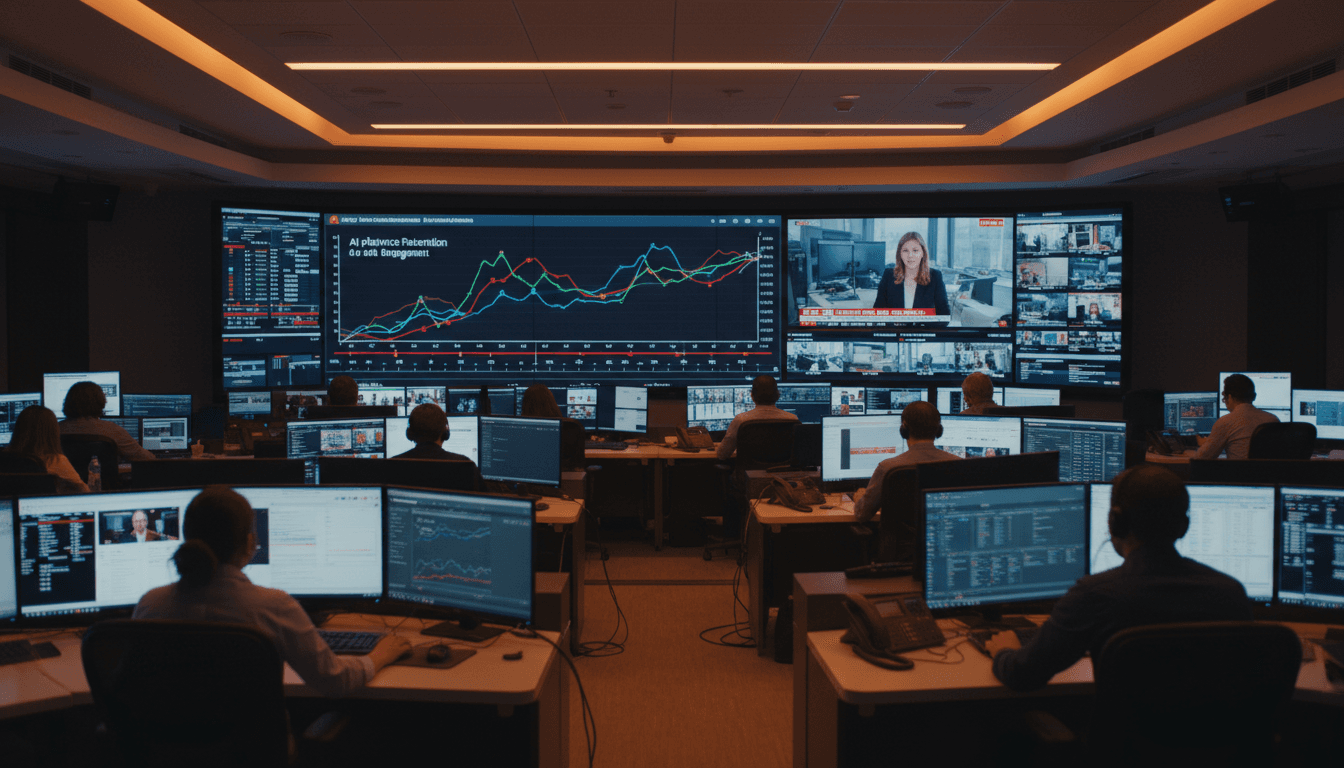
AI Newsroom Playbook for a Polarized, Tuned-Out Audience
About 32% of U.S. adults say they often get news from local TV, and about 31% say they often get news from national TV. Those numbers (from Pew Research Center’s recent years of tracking) are still big—yet they hide a brutal reality inside many newsrooms: even if broadcast remains a habit, attention is getting thinner, trust is getting harder to earn, and politics is sucking the oxygen out of everything.
That’s the context behind The Hollywood Reporter’s conversation with ABC News president Almin Karamehmedovic and World News Tonight executive producer Chris Dinan about staying number one during the Trump era—and during the “people are tuning out” era. Their problem isn’t unique to ABC. It’s the modern TV newsroom problem: how do you cover a polarizing figure and a chaotic news cycle without exhausting your audience, burning out your staff, or flattening your journalism into predictable outrage TV?
In this installment of our AI in Media & Entertainment series, I’m going to reframe that challenge through a practical lens: where AI can support newsroom operations and audience engagement without turning journalism into a slot machine. Not “replace producers with robots.” More like: reduce the grind, sharpen editorial judgment, and make distribution smarter.
The Trump-era newsroom problem: volume, velocity, and viewer fatigue
A Trump-driven news cycle is high-velocity by design. The story count spikes, the tone gets hotter, and the “must-cover” list grows faster than your rundown can adapt.
For a flagship broadcast like World News Tonight, the stakes are even higher. When you’re number one, you’re defending a habit. And habits break when viewers feel two things at once: overwhelmed and under-informed.
Viewer fatigue isn’t just “too much politics”—it’s too much sameness
A lot of people don’t tune out because they suddenly stopped caring about current events. They tune out because coverage can start to feel like a loop:
- The same clip plays everywhere.
- The same panel dynamics repeat.
- The same emotional temperature stays stuck on “urgent.”
Newsrooms can’t solve polarization. But they can avoid conditioning audiences to expect only conflict.
AI’s role here: reduce sameness by increasing editorial options
AI can help a newsroom generate more options without increasing headcount—as long as humans keep final say. The goal is not auto-writing the show. The goal is giving editorial teams better raw material faster:
- Topic clustering: Group breaking developments into distinct story threads (policy impact, legal status, voter response, international reaction), so the show isn’t “Trump, Trump, Trump” as one blob.
- Angle sensing: Detect which angles are over-covered across competitors (based on transcript monitoring) and propose under-served angles that still meet news value.
- Explainer suggestions: Identify where audience confusion is rising (based on comments, search trends, drop-off points) and recommend a 30–45 second “what this means” explainer.
A line I use with teams: AI shouldn’t decide what matters. It should help you show your work—and show it faster.
Running a TV newsroom like a product team (without losing your soul)
Broadcast news has always had “product” constraints: time blocks, tease structure, packages, live hits. What’s changed is that distribution is now a portfolio: linear, clips, YouTube, OTT, social, podcasts, newsletters, and platform-native formats.
The operational question becomes: How do you build once and publish many without turning your newsroom into a content farm?
Where AI actually helps operations (and where it doesn’t)
Here’s the realistic split.
AI is good at:
- Transcription at scale (including speaker ID)
- Rough-cut suggestions (timecodes for key moments)
- Metadata generation (who/what/where, topics, entities)
- Duplicate detection (spotting repeated segments across days)
- Search across internal archives ("find every time we used this map")
AI is not good at (and shouldn’t be used for):
- Final editorial decisions
- Sensitive framing around tragedy and identity
- Confirming truth (it can summarize; it can’t verify)
- Legal risk judgment (defamation, privacy, minors)
Newsrooms that win treat AI like an assistant editor with infinite stamina—not like an executive producer.
A practical workflow: “assist, don’t publish” guardrails
If you’re piloting AI in a TV newsroom, adopt a workflow that forces human accountability:
- AI creates options (draft script variants, suggested teases, clip timecodes).
- A producer chooses (and edits) the option that fits editorial intent.
- A second human verifies key facts, names, and context.
- Systems log provenance (what was AI-assisted vs. fully human authored).
That last step matters more in 2025 than it did in 2023. With synthetic media and rising skepticism, auditability is a trust feature, not compliance theater.
AI-driven audience engagement: earn attention instead of chasing it
When viewers tune out, the knee-jerk move is to chase whatever spikes clicks. That’s how you end up with a news brand that feels loud but not valuable.
The better goal is earned attention: viewers come back because the program helps them understand what’s happening and why it matters.
Personalization doesn’t have to mean filter bubbles
A lot of newsroom leaders hear “AI personalization” and immediately think “echo chambers.” Fair. But personalization doesn’t have to be ideological. It can be format-based and needs-based:
- Some viewers want a fast 90-second recap.
- Some want a calm explainer.
- Some want local relevance (“How does this affect prices/jobs/schools here?”).
AI can support responsible content personalization by tailoring how the news is delivered, not which truths are presented.
Concrete examples a newsroom can deploy:
- Dynamic clip packaging: One story, three edits—(a) headline, (b) explainer, (c) “what happens next.”
- Audience intent labeling: Identify whether viewers are seeking “update,” “background,” or “impact,” then route them to the right version.
- Smart notifications: Trigger alerts based on meaningful updates, not noise (a big reason people mute news apps).
Measure what matters: attention quality, not just reach
Most companies get this wrong. They optimize for views, then wonder why loyalty collapses.
If you’re serious about combating declining viewership, track:
- Completion rate (especially on explainers)
- Return frequency (7-day returning viewers)
- Topic trust signals (survey snippets, sentiment trends, complaint rate)
- “Confusion” indicators (rewatches, pauses, comments asking basic questions)
AI helps by turning messy signals (comments, emails, call-ins, social replies) into structured insights that producers can act on before a format starts failing.
Keeping “number one” in 2026: the newsroom systems that scale
Being number one is less about a single anchor or a single franchise. It’s about systems: how quickly you adapt, how consistent your standards are, and how efficiently you convert reporting into storytelling across platforms.
System 1: A modern newsroom knowledge base (that producers actually use)
Most newsrooms have archives. Fewer have a usable institutional memory.
An AI-powered internal knowledge base can let teams search:
- Prior coverage (scripts + rundowns + raw interviews)
- Fact patterns (“when did we first report X?”)
- Approved language guidance (how you describe sensitive topics)
- Style rules and standards
This is one of the highest-ROI uses of AI in media operations because it reduces re-reporting and prevents avoidable mistakes.
System 2: Story “atoms” that reassemble cleanly across platforms
The future of TV news production is modular. A package shouldn’t be a one-and-done.
Build stories as reusable components:
- Verified facts block
- Context block
- Timeline block
- Local impact block
- “What’s next” block
AI can help generate first drafts of these blocks from transcripts and notes, but your editorial team approves the final.
When this is done right, you can publish a coherent version for broadcast, a shorter version for social, and a deeper version for streaming—without rewriting from scratch.
System 3: Burnout prevention as an operational KPI
Covering national politics at full blast is a burnout machine. If you want to stay competitive, treat burnout like a production risk.
AI can reduce the grind in ways that directly protect people:
- Auto-transcription and searchable notes (fewer late-night rewinds)
- Draft scripts that producers refine (fewer blank-page hours)
- Automated shot lists and timecode markers (fewer manual logs)
This isn’t indulgent. It’s how you keep your best producers and editors.
A newsroom that protects its staff’s attention will produce better journalism than a newsroom that treats attention as infinite.
“People also ask” newsroom questions (answered fast)
Can AI help a TV newsroom increase viewership?
Yes—if it’s used to improve relevance and reduce friction, not to manufacture sensationalism. The strongest levers are better clip packaging, smarter distribution timing, and faster explainers.
Will AI replace producers and editors in broadcast news?
No. But it will change the job. The producers who thrive will be the ones who can direct AI tools, validate outputs, and make sharper editorial calls with more inputs.
How do you use AI without hurting trust?
Use clear guardrails: human editorial ownership, verification steps, provenance logs, and strict rules around synthetic audio/video. Trust grows when audiences sense consistency and transparency.
A realistic AI roadmap for TV news leaders (next 90 days)
If you’re leading a newsroom team—or advising one—here’s a pragmatic sequence that works without boiling the ocean:
- Start with transcription + search. Make every interview and presser instantly searchable.
- Add clip intelligence. Auto-suggest timecodes and build a repeatable clipping workflow.
- Stand up an editorial knowledge base. Include standards language, prior rundowns, and evergreen explainers.
- Pilot audience insight summaries. Weekly AI-assisted digest: top confusion points, drop-off moments, and format wins.
- Only then test personalization. Needs-based formats first, ideological segmentation never.
This order matters because it builds capability while protecting standards.
Where this fits in AI in Media & Entertainment
In this series, we’ve talked about AI as a force multiplier across content businesses: recommendation engines, production automation, and audience analytics. TV news is a special case because the product isn’t just entertainment—it’s public understanding. That’s why the right posture is conservative: use AI to strengthen journalism, not to automate judgment.
ABC News leaders are focused on staying number one in a high-stakes environment where viewers are tuning out. The lesson I take from that: winning now means operational excellence plus audience empathy. AI can help with both—if you treat it like infrastructure, not a headline.
If you’re mapping your 2026 newsroom strategy, the question isn’t “Should we use AI?” It’s: Which parts of the workflow are stealing time from judgment—and how fast can we fix that without weakening trust?