Build your 2026 HR plan with AI: cross-functional redesign, scenario planning, and resilient leadership—plus metrics that prove ROI.
HR’s 2026 To-Do List: How AI Turns Plans Into Results
Most companies learned the hard way in 2025 that buying AI tools isn’t the same as adopting AI.
One stat says it cleanly: 59% of organizations are still taking a tech-first approach to AI, and they’re 1.6x more likely to say those investments are falling short. The problem isn’t that the models don’t work. It’s that organizations don’t redesign work, decision rights, and talent systems around them.
That’s why the most useful “HR trends” for 2026 aren’t trendy at all. They’re operational. They’re the basics—collaboration, scenario planning, and resilient leadership—done with far better data and far faster feedback loops. And this is where AI in Human Resources & Workforce Management stops being a side project and becomes the operating system for how HR runs.
Below is a practical 2026 HR to-do list, inspired by what leading advisors are seeing across Deloitte, Heidrick & Struggles, and McLean & Company—plus the AI moves that make each priority measurable.
1) Stop running AI as an HR project—run it as an enterprise redesign
Answer first: The fastest way to get ROI from AI in HR is to treat it as work redesign across functions, not an HR tech rollout.
One of the clearest signals from 2025: when AI is framed as “a technology initiative,” ownership lands in IT or a transformation office, and HR gets asked to “support change management” after key decisions are already made. That’s backwards. AI changes how work is done, how roles are structured, what skills matter, and what good performance looks like. That’s HR’s lane—but only if HR is operating with Finance, Operations, and IT from day one.
What cross-functional HR leadership looks like in practice
If you want a simple test: can you answer who owns work redesign for AI? Deloitte’s survey finding that only 12% of organizations say HR is leading work redesign for AI should worry every CHRO. It’s a missed leadership moment.
A better operating model for 2026:
- HR + IT co-own the AI roadmap for workforce use cases (not just HR system upgrades).
- Finance agrees upfront on value metrics (time saved, quality, risk reduction, retention lift).
- Operations leaders validate what “better work” means on the ground (cycle time, handoffs, error rates).
- Legal / risk helps set guardrails early so you’re not “fixing governance” after rollout.
AI use cases that force real collaboration (in a good way)
These are the use cases that naturally pull the enterprise together—because they touch everyone:
- Skills intelligence and talent matching (internal mobility, project staffing, recruiting)
- Workforce planning with scenario modeling (demand forecasts, cost constraints, location strategy)
- Performance analytics that connect work outputs to capability building (not personality ratings)
When you anchor on those, you stop arguing about “which chatbot” and start deciding which decisions should be faster, more consistent, and less political.
2) Make HR + IT a non-negotiable partnership (and define the rules)
Answer first: In 2026, HR + IT either build an “AI-ready workforce system” together—or AI adoption stays fragmented, risky, and quietly abandoned.
McLean’s stance that the HR–IT partnership will “make or break” AI transformation is dead on. I’ve seen organizations buy three different AI tools for similar purposes because HR, IT, and a business unit each acted independently. The result: conflicting data, inconsistent employee experience, and a governance mess.
The 5 rules that keep HR + IT aligned
If you implement only one thing in Q1, implement this.
- One source of truth for people data
- Define what’s authoritative for job architecture, skills, pay bands, performance signals, and learning records.
- A shared “approved use cases” backlog
- Rank by value and risk; don’t let pilots multiply without a scaling plan.
- Clear model governance
- Bias testing, privacy review, audit logs, and escalation paths for employee complaints.
- Integration standards
- If it can’t plug into your HRIS/ATS/LMS/identity systems cleanly, it’s not “fast,” it’s technical debt.
- Employee-facing transparency
- Tell people where AI is used, what data is considered, what humans review, and how to appeal.
The AI architecture HR leaders should be asking for
You don’t need to be technical to ask the right questions. In plain English, you want:
- A skills layer (how you describe people and work consistently)
- A workflow layer (how recruiting, mobility, learning, and performance processes actually run)
- A measurement layer (dashboards that show adoption, fairness, quality, and business impact)
If your vendor pitch doesn’t clearly map to those layers, you’re shopping for features, not outcomes.
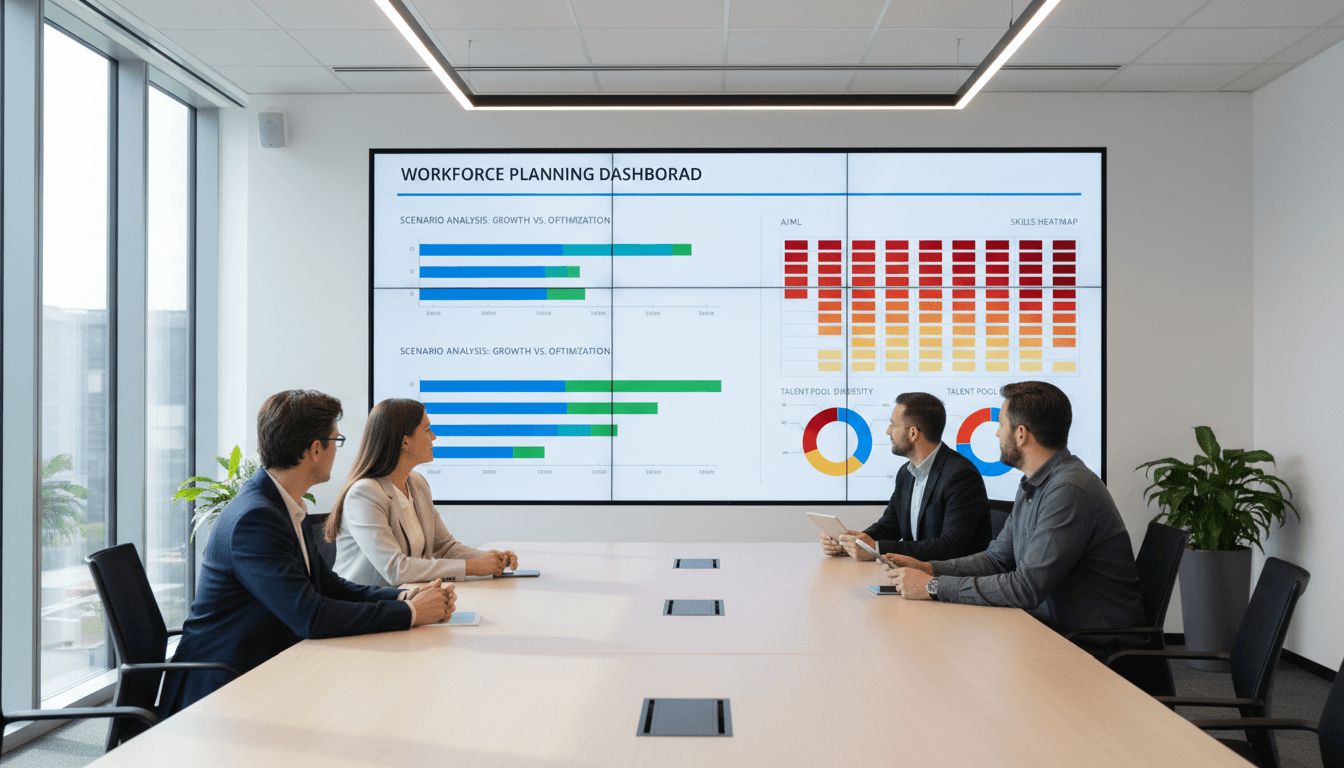
3) Turn scenario planning into a quarterly discipline—powered by AI
Answer first: Scenario planning becomes practical in 2026 when you use AI to model staffing demand, skills gaps, and risk exposure in weeks—not quarters.
In 2025, scenario planning was the thing many HR teams promised and few operationalized. The reason is predictable: it’s hard to keep scenarios updated when your inputs are scattered across spreadsheets, leaders disagree on assumptions, and every refresh takes a month.
AI changes the workflow. Not by “predicting the future,” but by making it fast to explore tradeoffs.
What to model (and what not to)
Model scenarios where decisions are expensive to reverse:
- Hiring freeze vs targeted hiring in critical roles
- Location changes and hybrid policy shifts
- Automation impact on role volumes and job families
- Leadership bench strength under different attrition assumptions
Don’t model scenarios that are basically vibes:
- “How engaged will employees feel next year?” (unless you have real drivers mapped)
A simple 90-day scenario planning setup
Here’s a workable cadence that doesn’t crush your team:
- Weeks 1–2: Baseline the workforce system
- Headcount, cost, role families, critical skills, attrition hotspots, time-to-fill.
- Weeks 3–6: Build 3 scenarios
- Conservative, expected, aggressive. Keep assumptions explicit.
- Weeks 7–10: Run impact and mitigation
- Skills gaps, recruiting load, internal mobility targets, learning investment.
- Weeks 11–12: Decision meeting + refresh schedule
- Lock actions and owners; refresh quarterly.
AI-driven workforce planning tools help most with steps 2 and 3: generating structured scenarios, quantifying skills gaps, and showing the downstream effect on recruiting and internal mobility.
Succession planning is now an enterprise risk register item
Heidrick & Struggles highlights a sharp reality: in 2026, succession planning stops being an HR “program” and becomes a board-level risk conversation. They cite that only 43% of CEOs and boards feel confident in their ability to attract and grow executive talent—which means most organizations are one resignation away from a strategic stall.
AI can help here, but only if you use it responsibly:
- Build capability-based successor slates (what experiences and skills matter, not who’s “liked”)
- Use network and project data to identify hidden leaders (with human review)
- Track readiness progress with evidence (assignments completed, outcomes delivered)
4) Redesign leadership development for human–machine work
Answer first: Leadership resilience becomes a competitive advantage in 2026 because AI increases pace, complexity, and employee scrutiny—leaders must handle all three.
McLean’s view that leadership development became a major challenge in 2025 matches what many HR teams saw: managers were asked to absorb change, calm nerves, adopt new tools, and keep performance up—often with less support than ever.
The mistake I’d avoid in 2026: running leadership development as generic content consumption.
What “resilient leadership” actually means now
In an AI-enabled workforce, resilient leaders do three things well:
- Make good calls with imperfect data
- They understand confidence levels and avoid false precision.
- Run psychologically safe teams
- People need to surface errors, risks, and ethical concerns early.
- Redesign work continuously
- They don’t cling to last year’s role boundaries.
Where AI improves leadership development (without turning it creepy)
Done right, AI supports leaders without surveilling employees:
- Personalized coaching plans based on role expectations and feedback themes
- Manager nudges (timely prompts: recognition, 1:1s, workload signals)
- Team health dashboards focused on aggregate patterns, not individual spying
A useful internal policy line: AI can recommend; people decide.
5) Measure AI ROI in HR with “business + human” outcomes
Answer first: The best AI ROI frameworks in HR track both business performance and employee impact, because ignoring either one creates failure later.
Deloitte’s point about “human outcomes as well as business outcomes” is the right stance. If your ROI story is only cost savings, you’ll get short-term buy-in and long-term resistance. If it’s only employee experience, Finance will tune out.
A practical metrics set for 2026
Pick a small set you can defend. Example scorecard:
Business outcomes
- Time-to-fill for critical roles (days)
- Productivity proxy (cycle time, throughput, quality metrics)
- Contingent labor spend (monthly)
Human outcomes
- Internal mobility rate (moves per quarter)
- Regrettable attrition in key roles (%)
- Manager time returned to coaching (hours/month)
Risk and trust outcomes
- Bias audit pass rate (per model / per quarter)
- Candidate/employee appeal resolution time
- Adoption by role group (to detect inequity)
If you can’t measure it quarterly, it’s not a 2026 metric—it’s a research project.
The 2026 HR to-do list (printable version)
If you’re building your plan for January, this is the clean checklist:
- Create an HR–IT–Finance operating group for AI work redesign (with decision rights).
- Standardize skills and job architecture enough to power talent matching and planning.
- Launch quarterly scenario planning with three scenarios and explicit assumptions.
- Rebuild succession planning as an enterprise risk discipline with evidence-based readiness.
- Train leaders for human–machine work (decision quality, psychological safety, redesign).
- Adopt an ROI scorecard that includes business, human, and trust metrics.
The reality? Your 2026 plan doesn’t need 30 initiatives. It needs 6 that actually ship.
Where this fits in the “AI in Human Resources & Workforce Management” series
This series is about a simple idea: AI earns its place in HR when it makes workforce decisions faster, fairer, and easier to scale—from recruitment to talent planning to performance analytics.
If your team is heading into 2026 with a stack of pilots and no enterprise alignment, take the three consultant-backed resolutions seriously: break out of the silo, operationalize scenario planning, and build leadership resilience. Then use AI as the engine that keeps those disciplines running week after week.
If you’re planning your first 90 days of 2026, what’s the one workforce decision you’d most like to make with better data—and less drama?