Build hybrid and remote work policies that hold up under RTO pressure. See how AI improves engagement, performance analytics, and workforce planning.
AI-Powered Hybrid Work Policies That Actually Stick
A lot of leaders spent 2025 trying to “win” the remote vs. office argument. What we actually learned is less dramatic and more useful: workplace flexibility is now a permanent operating constraint, like compensation bands or compliance. You don’t debate whether payroll exists—you design around it.
The year’s flashpoint was the federal return-to-office mandate issued on President Trump’s first day back in office. It didn’t just ripple through government agencies; it gave private-sector leaders political cover to tighten in-person requirements. At the same time, remote-first and hybrid-first companies didn’t suddenly backpedal. They refined.
Here’s the practical takeaway for HR and workforce leaders: the “right” model isn’t a single policy—it’s a system. And in 2026 planning season (yes, even during December’s budget crunch and headcount approvals), the fastest way to improve that system is to pair clear people principles with AI in HR—not to surveil employees, but to make smarter decisions about performance, engagement, and workforce planning.
What 2025 settled: mandates create headlines, systems create results
Answer first: 2025 proved that return-to-office mandates can force behavior short-term, but they also create measurable friction—attrition, accommodation requests, and manager burnout—unless you build an operating model that supports how work actually gets done.
When organizations go “hard line,” they often get compliance… plus consequences. One widely discussed example from the year: companies that effectively paid for exits after stricter in-office rules. That’s not just a culture problem; it’s a budgeting problem.
At the same time, some organizations took a softer approach—framing office time around culture, collaboration, or the employee experience rather than punishment. Others shifted the conversation from “days in seats” to workplace experience: why would someone choose the office?
The common thread is simple:
- If your work model relies on pressure, you’ll keep paying for enforcement.
- If your work model relies on clarity, you’ll invest upfront and spend less later.
This is where AI belongs in the conversation. Not as a shiny tool. As the instrumentation layer for a system that’s already in motion.
Myth to drop: “We just need to pick a model”
Most companies get this wrong. They treat remote, hybrid, and office work like three doors—and leadership just has to choose one.
The reality? Most enterprises are already multi-model. Finance may be in-office. Engineering may be hybrid. Customer support may be remote-heavy. Field teams are… field.
So the real job is designing governance, measurement, and fairness across different work patterns.
Why hybrid work keeps “winning” (and why it’s still hard)
Answer first: Hybrid keeps gaining ground because it balances talent access, resilience, and cost control—but it fails when companies don’t redesign management, coordination, and performance expectations.
Hybrid work became a cornerstone for many organizations in 2025 because it solves real constraints:
- Hiring and retention: you can compete in more labor markets.
- Business continuity: weather, transit strikes, health outbreaks, and local disruptions hit less hard.
- Real estate costs: you can right-size space when utilization is predictable.
But hybrid has a dirty secret: it punishes ambiguity. If two teams interpret “hybrid” differently, you get:
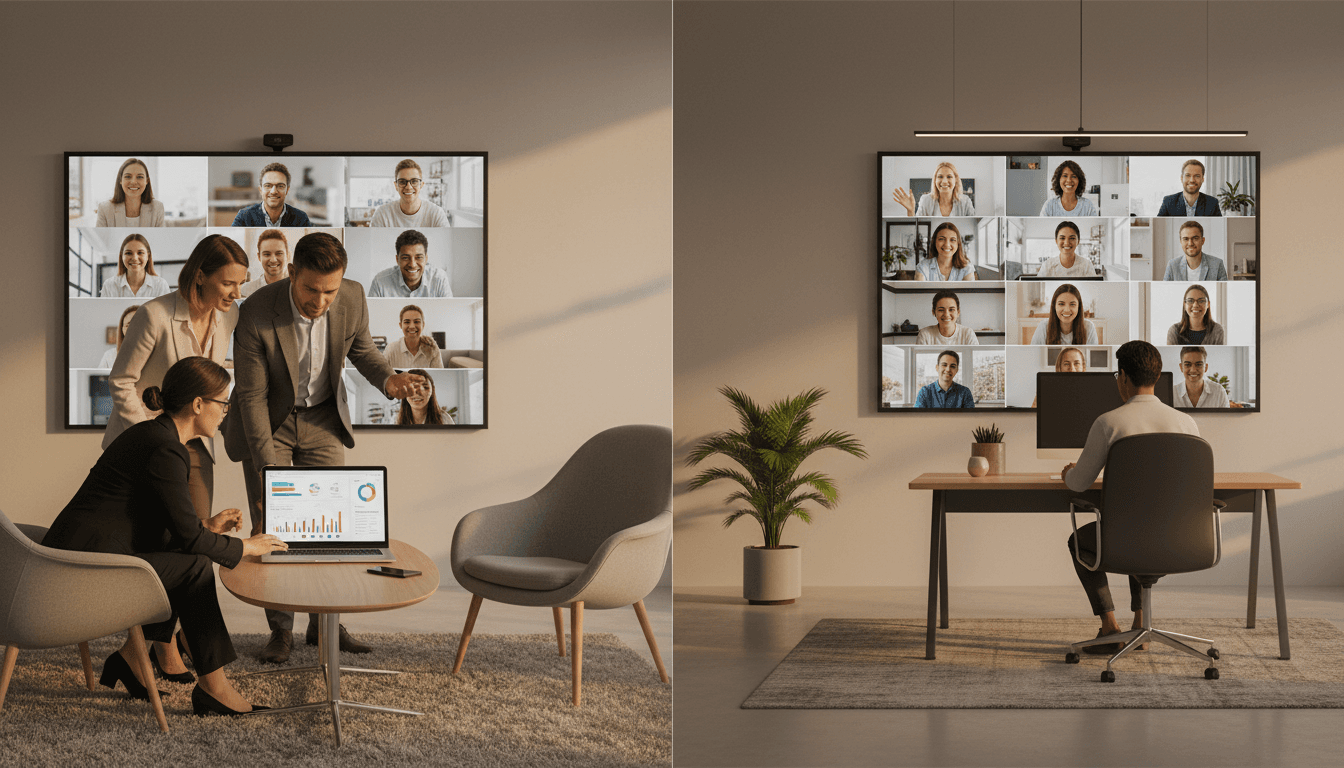
- meeting inequity (remote people always “on screen”)
- slower decisions (everyone waits for the “in-office day”)
- manager conflict (different standards by leader)
- performance confusion (“visibility” becomes a proxy)
The hybrid design problem HR needs to own
Hybrid isn’t a perk. It’s a workflow design.
The baseline questions HR should force the business to answer:
- Which work requires co-location? (Be specific: whiteboarding a roadmap? onboarding? quarterly planning?)
- What’s the coordination cadence? (team days, anchor days, role-based schedules)
- How do decisions happen when people aren’t together? (documentation, async approvals)
- What does great performance look like? (outputs, quality, customer impact)
If you can’t answer those, you’re not managing hybrid—you’re improvising it.
Remote-first companies didn’t “get lucky”—they built trust on purpose
Answer first: Remote-first organizations that performed well in 2025 treated trust, communication, and intentional connection as non-negotiable operating practices.
Remote-first leaders kept repeating a theme that’s easy to underestimate: trust is productive—but only when paired with strong execution habits.
Remote-first organizations tend to standardize things many hybrid workplaces leave optional:
- written goals and decision logs
- clear response-time norms
- manager training for coaching and feedback
- predictable rituals for connection (not forced fun, actual belonging)
That “intentional connection” piece matters. Without it, you get social drift: weaker networks, fewer stretch opportunities, and slower learning for new hires.
A stance I’m comfortable taking
If your company says it’s “performance-driven” but can’t describe performance without mentioning office attendance, you don’t have a performance culture. You have a proximity culture.
AI can help fix that—but only if you measure what matters.
Where AI fits: three high-impact use cases for flexible work
Answer first: The best AI in human resources for hybrid and remote work focuses on (1) engagement signals, (2) workload and coordination health, and (3) skills-based workforce planning.
AI shouldn’t be a monitoring layer. It should be a decision-support layer. Here are three ways HR teams are using AI in workforce management without turning the workplace into a panopticon.
1) AI for employee engagement: measure drift before it becomes attrition
Engagement is the first domino in flexible work. When engagement drops, productivity and retention follow.
Modern AI-driven engagement tools can combine signals like:
- pulse survey themes (natural language analysis)
- sentiment and topic trends in open-text feedback
- participation patterns (not message content)
- manager effectiveness indicators (coaching frequency, 1:1 regularity)
What you’re looking for is trend detection, not “who said what.” Example: if onboarding sentiment declines for remote hires over a 6-week period, that’s a process issue you can fix—fast.
Practical move for Q1 2026:
- Define 5–7 engagement drivers you’ll track across work modes (belonging, clarity, workload, growth, manager support).
- Use AI to summarize themes monthly and flag statistically meaningful changes.
- Require a response plan from leaders when two consecutive months trend down.
2) AI for performance analytics: stop using visibility as a proxy
Hybrid and remote work broke the old shortcut: “I see you working, so you must be working.” That shortcut was always flawed; now it’s unusable.
AI-enabled performance analytics can help you anchor on:
- goal attainment (OKRs, project milestones)
- quality metrics (defect rates, customer satisfaction, rework)
- cycle time and bottlenecks (handoff delays, approval lag)
- collaboration effectiveness (network health, cross-team dependencies)
Used well, this shifts performance conversations from “where are you?” to “what outcomes did we produce, and what got in the way?”
Guardrail HR should insist on: no secret scoring. If AI influences performance decisions, employees deserve to know the inputs, the logic at a high level, and how to appeal errors.
3) AI for workforce planning: match flexibility to business reality
Flexible work changes staffing math:
- You can hire in more locations.
- Teams may need different overlap hours.
- Some roles require periodic co-location for security, equipment, or customer needs.
AI-powered workforce planning can forecast scenarios such as:
- how many roles can shift to hybrid without impacting service levels
- which teams need “anchor days” due to dependency density
- where skills gaps will appear if you expand hiring geography
This is where AI earns its keep: turning policy debates into scenario planning.
A simple framework:
- Demand: what work is coming (projects, customer volume, regulatory changes)
- Capacity: who can do it (skills inventory, availability, constraints)
- Constraints: location, security, equipment, collaboration intensity
Then use AI to run “if we change X, what happens to Y?” modeling—before you announce the next policy.
The RTO pressure test: accommodations, fairness, and HR workload
Answer first: As in-office requirements rise, accommodation requests and HR casework rise too—so you need consistent decisioning and documentation.
One under-discussed 2025 impact: return-to-office rules increased requests for remote work accommodations, and that created stress for HR teams managing consistency, compliance, and manager expectations.
AI can help here in a grounded, responsible way:
- triage case volume (categorize requests, route to the right specialist)
- standardize documentation checklists
- summarize case notes for audit readiness
- identify patterns (which business units generate the most conflicts)
The goal isn’t to automate judgment. It’s to remove administrative drag so HR can do the human part well.
A fairness principle worth publishing internally
If flexibility is allowed for “top performers” but denied for caregivers or employees with health constraints, you’ve created a policy that looks merit-based and functions like privilege.
AI-assisted policy enforcement can reduce inconsistency—if you set the rules clearly and audit outcomes for bias.
A practical 30-day plan for HR teams heading into 2026
Answer first: You can stabilize your flexible work strategy in 30 days by defining role requirements, setting measurable outcomes, and deploying AI for trend detection—not surveillance.
If you’re reading this in late December, you’re probably juggling end-of-year reviews, budget negotiations, and a 2026 headcount plan that keeps changing. Don’t try to redesign everything. Do this instead:
-
Create a role-based work mode map
- Remote-eligible, hybrid, office-required
- Document the “why” in one sentence per role family
-
Publish two non-negotiables for hybrid meetings
- Example: every meeting has a doc-first agenda; remote attendees are never second-class
-
Replace attendance targets with output targets
- Pick 2–3 metrics per function that reflect outcomes (quality, cycle time, customer impact)
-
Stand up an AI-powered listening loop
- Monthly pulse + open-text theme analysis
- One dashboard for leaders: engagement drivers by team and work mode
-
Train managers where it hurts most
- Coaching remotely, running hybrid meetings, writing clear goals
- Measure manager effectiveness with employee feedback and goal clarity scores
If you do only one thing: stop letting workplace flexibility be decided in hallway conversations. Put it into an operating rhythm.
What comes next for AI in HR and workforce management
Flexible work isn’t fading. The debate is just changing shape—from “where should people work?” to “how do we run the company well across multiple work modes?”
That shift is exactly why this post belongs in the AI in Human Resources & Workforce Management series. AI is becoming the practical layer that helps HR teams see around corners: engagement drift, coordination breakdowns, skills shortages, and inconsistent policy decisions.
If your 2026 plan includes any form of hybrid or remote work, you’ll need more than a mandate or a memo. You’ll need measurement, feedback loops, and better forecasting. AI can do that—without sacrificing trust—if you design it for transparency and fairness.
Where is your flexibility strategy most fragile right now: engagement, performance measurement, or workforce planning?