Thea Energy’s Helios fusion design points to software-defined generation. Here’s where AI will matter most: control, maintenance, and safety at utility scale.
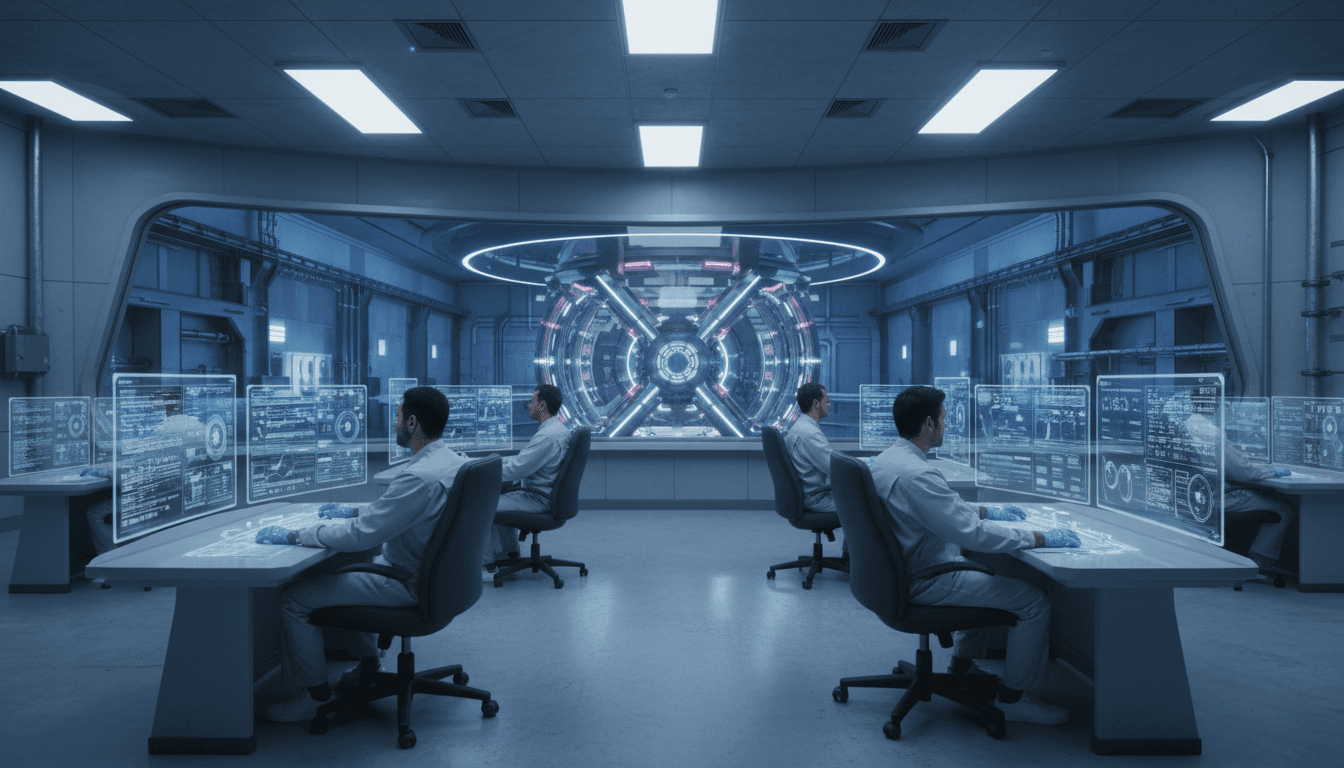
AI Readiness for Fusion: What Helios Signals
A fusion power plant design that targets 400 MW net electricity with 1.1 GW thermal output is no longer just a physics headline—it’s an operations and software headline. Thea Energy’s recently completed preconceptual design for its Helios stellarator power plant is full of the kinds of details that utilities, independent power producers, and energy infrastructure teams care about: continuous operation, maintainability, realistic magnet limits, and long-life components.
Here’s the part that should catch the attention of anyone following our AI in Energy & Utilities series: Thea’s architecture is explicitly built around software-controlled, individually configurable magnets and the idea of AI-enabled performance improvements over time. That’s a rare signal in the fusion space—less “wait for the next scientific breakthrough,” more “engineer a plant you can run like an industrial asset.”
This post breaks down what Thea Energy’s Helios design claims, why it matters for grid planners and power operators, and where AI in energy becomes practical—not theoretical—when fusion plants move from labs to real balance sheets.
What Thea’s Helios design actually changes
The core point: Helios is designed for steady-state (continuous) operation and maintainable uptime, not short experimental pulses. That’s a different mindset from much of the historical fusion conversation.
Thea Energy, a 2022 spin-out linked to Princeton Plasma Physics Laboratory and Princeton University, is advancing a stellarator approach in its Helios system. The company has submitted an integrated preconceptual design study to the U.S. Department of Energy as part of the Milestone-Based Fusion Development Program, and it’s also published a technical overview of Helios and related subsystems.
Helios, as described, is built around several practical targets:
- Net electric output: about 400 MW to the grid
- Thermal output: about 1.1 GW
- High capacity factor: >85%
- Major radius: 8 meters, positioned as a compact optimized stellarator design
- Superconducting coil field: 20 T maximum on coils (within parameters previously achieved by large-bore high-temperature superconducting magnets)
- Estimated magnet lifetime: 40+ years (enabled by space for shielding/blankets)
Those numbers matter because they anchor the design in the world that utilities live in: siting, outages, parts replacement, and long-term asset planning.
The real story: “programmable” magnets
Thea’s standout claim is its planar coil stellarator architecture where hundreds of magnets can be individually controlled by a software stack. That combination—hardware designed to be “tunable” in the field plus software designed to adapt—creates a natural home for machine learning.
If you’ve worked in grid operations or plant O&M, you’ll recognize the analogy: a fusion plant like this starts to look less like a monolithic reactor and more like a complex industrial system whose performance depends on continuous sensing, control, and optimization.
Why stellarators are back (and why maintenance is the deciding factor)
A simple, defensible take: fusion won’t be commercial because it’s scientifically elegant; it’ll be commercial because it’s maintainable.
Stellarators have long been appealing because they’re inherently suited to steady-state operation and avoid certain disruption risks associated with other magnetic confinement concepts. Thea’s design leans hard into those benefits and adds a commercial layer: a sector-based maintenance scheme meant to minimize downtime and support a multi-decade service life.
Sector-based maintenance: fusion meets outage planning
Thea describes a maintenance approach where entire toroidal sectors can be removed with a low number of unique parts, reducing outage complexity. If you’re used to planning refueling outages, turbine overhauls, or major transformer replacements, this is the kind of thinking you want to see early.
One concrete target: the fusion-facing first wall is expected (using known and developed materials) to have an average lifetime of 15 years before replacement.
That doesn’t make fusion easy. It makes it operationally imaginable.
Heat exhaust: the “unsexy” problem that kills designs
Many fusion concepts stall not on plasma physics headlines, but on thermal reality: removing heat reliably, continuously, and without destroying the machine.
Thea claims Helios uses the world’s first tokamak-like “X-point” divertor in a stellarator power plant architecture, designed to exhaust gas 10× more effectively than prior stellarator divertors, while also tapping into decades of tokamak experience.
That “boring” engineering detail is one of the biggest tells that a team is thinking about commercial operation.
Where AI fits in a fusion power plant (beyond marketing)
The straight answer: AI is most valuable in fusion when it reduces uncertainty and downtime, not when it chases theoretical peak performance.
Thea explicitly describes using software control to account for manufacturing and assembly errors and system wear and tear across the operational lifetime. That’s exactly the territory where modern AI techniques shine.
1) Digital twins for magnets, shielding, and thermal systems
Fusion plants will be sensor-dense. They’ll also be model-heavy: magnetics, plasma stability, thermal cycling, radiation effects, and mechanical stress all interact.
A pragmatic AI approach is a layered digital twin:
- Physics-based simulations provide the guardrails (what’s allowed).
- Machine learning models learn plant-specific reality (what actually happens).
- Optimization + control decides the best next action under constraints.
If you’ve seen digital twin programs succeed in combined-cycle fleets, rotating equipment, or grid substations, the pattern is familiar. The difference is the stakes: the environment is harsher, and the interactions are tighter.
2) Adaptive control to correct real-world drift
Thea’s “programmable magnets” concept points toward closed-loop magnetic field shaping that can be updated over time. That implies a control system that can:
- Detect drift (thermal movement, mechanical settling, gradual degradation)
- Separate real drift from sensor noise
- Recommend or apply compensating coil adjustments
- Do it safely, repeatably, and auditable for regulators
This is where utilities should be opinionated: a fusion plant’s AI can’t be a black box. Explainability and change management will be part of the operating license, formal or informal.
3) Predictive maintenance that’s actually predictive
Predictive maintenance in today’s power industry often means one of two things:
- A rules engine with thresholds
- A model trained on years of failure history
Fusion won’t have years of failure history at first. So “predictive” will need to mean hybrid: physics-informed models plus Bayesian or probabilistic learning that updates as evidence accumulates.
High-value early targets include:
- Superconducting coil health and quench precursors
- Vacuum integrity and leak detection
- Divertor and first-wall thermal performance
- Radiation-induced sensor drift (and calibration strategies)
Utilities already do versions of this for transformers, breakers, and turbines. Fusion will demand the same discipline—just with less tolerance for uncertainty.
4) Safety monitoring and anomaly detection in extreme environments
Fusion advocates often emphasize that fusion safety profiles differ from fission. Fine. Operators still need a safety case that regulators and communities can trust.
AI-based anomaly detection becomes useful when it’s paired with:
- Conservative operating envelopes
- Redundant sensing
- Deterministic fallback control
- Clear incident playback and root-cause workflows
If your organization is investing in AI for grid reliability—wildfire monitoring, storm response, fault prediction—this is the same muscle group applied to next-gen generation assets.
What utilities and energy developers should do now (even if fusion is “2030s”)
Thea says it’s on track to operate Helios in the 2030s, following its Eos demonstration system, which it schedules to be online by 2030, with siting conversations underway and a location announcement expected in 2026.
Whether those timelines land exactly or slip (most first-of-a-kind energy projects slip), fusion is already influencing infrastructure planning. Data center load growth, electrification, and winter reliability debates are pushing utilities to consider firm, clean capacity options—and to think earlier about interconnection, land, and community acceptance.
Here’s what works if you want to be ready.
Build an “AI-ready generation” checklist
Most companies get this wrong: they treat AI as a software add-on instead of a design constraint.
A better approach is to define what “AI-ready” means for any next-gen asset (fusion included):
- Data architecture: time-synced telemetry, retention policies, governance
- Control system integration: safe APIs, separation of duties, fail-safe modes
- Model risk management: validation, monitoring, versioning, audit trails
- Cybersecurity: zero trust assumptions for control-adjacent analytics
- Human factors: operator UX, alarm design, training, escalation rules
This is directly aligned with how AI is already being deployed in energy and utilities for grid optimization and predictive maintenance.
Ask better questions in partnership conversations
If you’re a utility, developer, or large-load customer evaluating fusion partnerships, don’t just ask “When will it be online?” Ask questions that reveal operational maturity:
- What subsystems are designed for modular replacement and how long is a sector outage?
- What are the expected inspection intervals and what data supports them?
- Which control functions are deterministic vs. AI-assisted?
- How will software updates be tested, staged, and rolled back?
- What are the data rights and responsibilities between operator and vendor?
Those questions also apply to advanced nuclear, long-duration storage, and hydrogen plants. Fusion just raises the bar.
Treat fusion as a future grid asset—not a science project
The grid doesn’t care that a plant is innovative. It cares about:
- capacity value
- ramp characteristics
- outage rates
- maintenance windows
- interconnection constraints
If Helios-class designs succeed, fusion becomes part of the same planning toolkit as SMRs, gas with carbon capture, geothermal, and storage portfolios. AI will be a key differentiator in which designs achieve bankable reliability.
What Helios suggests about the next decade of AI in energy
The most useful way to read Thea Energy’s Helios preconceptual design is as a preview of software-defined generation. Not in the “everything is an app” sense—more in the sober sense that long-life physical plants will increasingly be improved, maintained, and kept safe through software.
If fusion plants aim for >85% capacity factor and 40+ year component lifetimes, the organizations that win won’t just have good physics. They’ll have strong AI operations: digital twins, rigorous control governance, and predictive maintenance that holds up under audit.
If you’re building AI capability in energy and utilities right now—forecasting, grid optimization, asset health—fusion is a reminder that those skills won’t stay at the grid edge. They’re headed straight into generation.
What would it take for your organization to trust an AI-assisted control layer on a 400 MW firm power asset—and to prove that trust to regulators and customers?