Helios is a 400 MW fusion plant design built for steady operation. Here’s what it signals for AI-driven grid optimization, maintenance, and clean power integration.
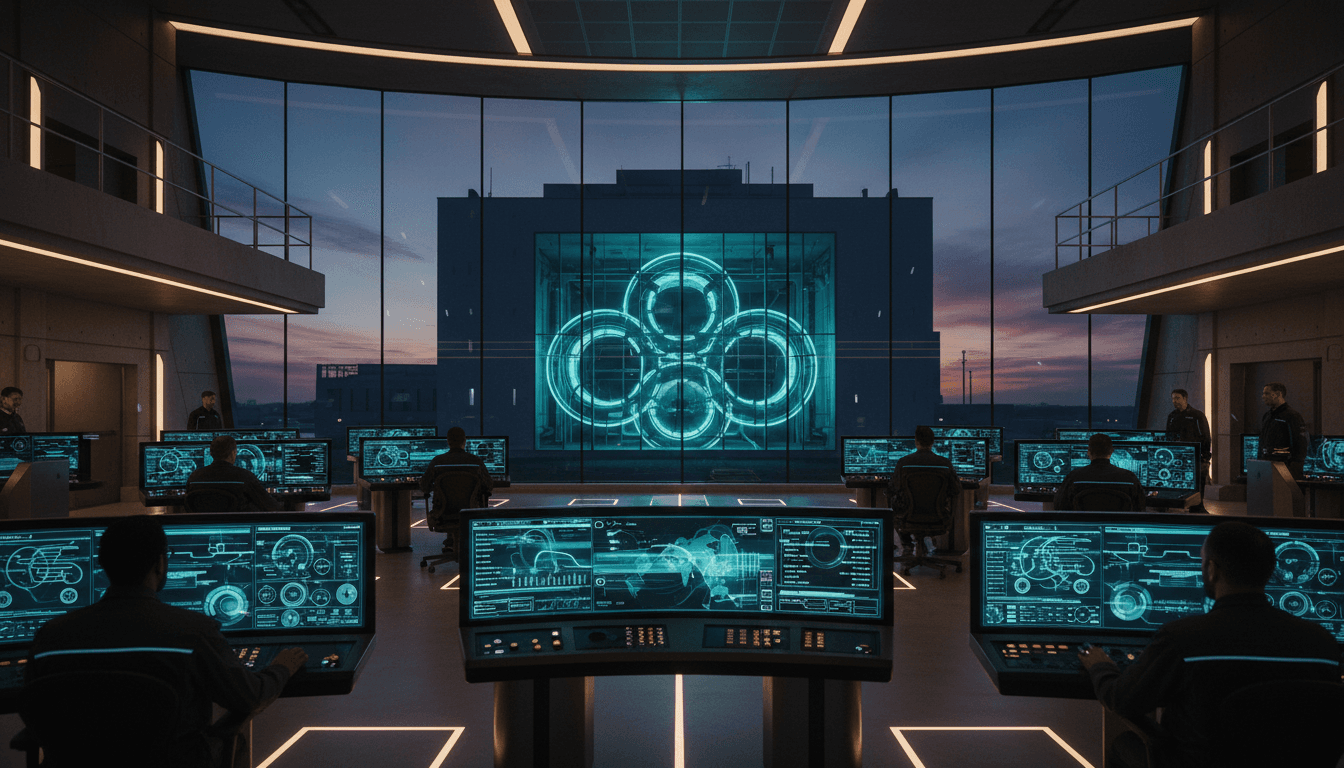
Fusion Plant Design Meets the AI-Powered Grid
A 400 MW fusion power plant on paper sounds like science fiction—until you read the engineering choices that make it boringly practical. Thea Energy just completed a preconceptual design for Helios, a stellarator-based fusion plant intended to deliver ~400 MW net electricity to the grid from ~1.1 GW thermal output. The headline is fusion, but the real story (especially for utilities) is how the design leans on software control, maintainability, and operational predictability—the same ingredients that make AI valuable in today’s grid operations.
For readers following our AI in Energy & Utilities series, this matters for one simple reason: if fusion moves from lab to grid in the 2030s, it won’t be “plug and play.” It’ll be another complex, high-value asset that needs to be dispatched, maintained, secured, and integrated into markets—likely alongside renewables, storage, and fast-growing large loads like data centers. That integration problem is already here. Fusion just raises the stakes.
Here’s what Thea’s Helios milestone tells us about where fusion is heading—and what utilities and energy leaders should start doing now to prepare for an AI-enabled, fusion-capable grid.
What Thea Energy’s Helios design actually changes
Helios is a fusion plant concept built around continuous operation and maintainable hardware, not heroic one-off experiments. Thea Energy’s approach is a modern take on the stellarator, using planar, software-controlled magnet coils that can be adjusted to real-world imperfections (manufacturing tolerances, assembly errors, wear over time). That’s a big departure from the stereotype of fusion systems as brittle, “perfect-or-fail” machines.
A few design claims stand out for grid planners and asset owners:
- Net electric output: ~400 MW (utility-scale, not micro-demo)
- Thermal output: ~1.1 GW
- Operating mode: continuous / steady-state (a core stellarator advantage)
- Capacity factor target: >85%
- Plant size: major radius ~8 meters, described as a compact optimized stellarator architecture
- Magnet field: up to 20 T on superconducting coils (within engineering precedent for large-bore high-temperature superconducting magnets)
- Maintenance concept: sector-based replacement to minimize downtime and support 40+ year lifetime
Thea positions Helios as not requiring “future scientific breakthroughs.” Whether you agree with that phrasing or not, the intent is clear: reduce unknowns by leaning on demonstrated plasma parameters, established materials, and practical maintenance. That’s the mindset utilities expect from any generation asset that plans to earn revenue for decades.
The overlooked breakthrough: making fusion “operationally legible”
Most fusion news focuses on physics milestones. Helios is more interesting because it tries to make fusion operationally legible:
- Programmable magnets mean operators can tune performance over time.
- A maintainable architecture means planned outages can look more like today’s major maintenance cycles.
- A divertor exhaust approach (tokamak-like X-point geometry) targets one of the hardest problems: heat and particle exhaust.
From an AI perspective, operational legibility is everything. AI doesn’t magically fix broken physics. It thrives when systems generate measurable signals, can be controlled through defined actuators, and have clear objective functions (availability, heat-rate equivalent, ramp limits, component lifetime).
Why AI is showing up inside fusion designs
AI enters fusion in two places: controlling the plasma-facing machine, and running the plant like an industrial asset. Helios explicitly points to using AI to increase performance and apply software-level updates over its operating life. That’s not hype—it’s a natural consequence of a design built around many individually controllable magnets.
1) Control complexity is exploding
Thea’s architecture emphasizes hundreds of magnets that can be controlled individually. Any time you move from “a few knobs” to “hundreds of knobs,” you get a classic controls challenge:
- Many variables interact
- Delays and nonlinearities matter
- Constraints are strict (thermal limits, stability limits, component protection)
Modern AI control (especially reinforcement learning paired with robust safety constraints) can help optimize within those boundaries. Not by improvising, but by learning how to keep performance high while staying inside hard limits.
2) Compensation for real-world drift becomes a software problem
Manufacturing and assembly errors aren’t theoretical. They’re a fact of life in large machines. Thea’s claim that its software stack can account for errors and wear is one of the more commercially meaningful statements in the entire announcement.
This is the same pattern we see across the energy sector:
- Wind farms use controls and analytics to manage turbine-to-turbine variance.
- Gas plants use digital twins and condition monitoring to schedule outages.
- Grids use AI forecasting to deal with load volatility.
Fusion will likely follow the same trajectory: more of the value shifts from “perfect hardware” to “adaptable operations.”
3) Predictive maintenance becomes revenue protection
If Helios is aiming at >85% capacity factor, downtime is expensive—especially unplanned downtime. AI-based predictive maintenance won’t be optional; it’s how operators protect availability targets.
Expect heavy use of:
- Anomaly detection on cryogenics, power electronics, pumps, vacuum systems, and superconducting magnet health
- Remaining useful life (RUL) models for plasma-facing components
- Computer vision for inspection (remote handling, in-vessel inspection, erosion and damage tracking)
- Digital twins to simulate degradation scenarios and optimize outage timing
Fusion is “new,” but the O&M playbook is familiar to any utility with large rotating assets or nuclear maintenance programs.
Fusion doesn’t replace renewables—fusion stabilizes the portfolio
Fusion’s most credible grid role is firm, clean, high-capacity-factor power that reduces the cost of balancing renewables. If Helios-class plants become real, they won’t be built to chase peak pricing. They’ll be built to run—because their economics likely depend on high utilization.
That creates a useful planning complement:
- Solar and wind deliver low marginal cost energy but variable output.
- Storage handles short-duration balancing and fast response.
- Fusion (if commercialized) provides firm energy without fuel price volatility.
The tension: grids are already dealing with volatility from weather-driven generation and new load patterns (industrial electrification, EV adoption, and data centers). Adding fusion introduces a different complexity—large, high-value units that must integrate into markets and reliability planning.
What utilities should expect from fusion interconnection requirements
If you’re thinking ahead to the 2030s, a Helios-like plant will likely be treated less like a “renewable interconnection” and more like a hybrid of nuclear and combined-cycle expectations:
- stringent protection and fault ride-through expectations
- high standards for telemetry and operational transparency
- robust cybersecurity controls (especially if magnets are software-defined)
- long-lead coordination with transmission planners
And yes, even “steady-state” plants will have ramps, constraints, and maintenance cycles. AI-based dispatch and outage optimization will matter.
Three practical AI plays utilities can start now (that map to fusion later)
You don’t need a fusion plant in your service territory to benefit from the operational lessons fusion developers are baking in. Here are three AI initiatives that pay off today and also prepare your organization for firm clean generation technologies later.
1) Build forecasting that treats large loads as first-class citizens
Data centers, crypto (in some regions), industrial electrification, and hydrogen pilots are making demand less predictable. Fusion is supply-side, but the integration challenge is two-sided.
What works in practice:
- probabilistic load forecasting (not single-line forecasts)
- feeder-to-bulk coordination so distribution volatility doesn’t surprise transmission operations
- scenario planning that includes new large-load queues and curtailment rules
If your forecasting stack can’t explain yesterday’s error bars, it won’t be ready for tomorrow’s complexity.
2) Treat maintenance scheduling as an optimization problem, not a calendar problem
Sector-based maintenance in Helios is essentially a design optimized for downtime reduction. Utilities should mirror that logic on existing fleets.
AI-enabled outage planning can:
- prioritize work based on risk and revenue impact
- coordinate outages across generation and transmission constraints
- reduce forced outages by catching early failure signatures
Most companies get this wrong by focusing on predictive maintenance models without integrating them into planning and work execution. The value shows up when predictions change what you do on Monday.
3) Prepare a cybersecurity model for software-defined power assets
Fusion plants with programmable magnets will be software-centric industrial systems. The grid is already moving that way (DERMS, ADMS, inverter controls, substation automation).
A practical stance:
- segment operational networks aggressively
- baseline “normal” behavior and alert on drift
- test incident response with realistic OT scenarios
If your governance assumes generation assets are mostly mechanical, you’ll be behind.
The “divertor problem” is a good proxy for grid integration risk
Hard engineering problems rarely disappear; they shift into operations, cost, or availability. Helios highlights a tokamak-like X-point divertor intended to exhaust gas 10x more effectively than prior stellarator divertors. If that claim holds up through prototypes and operation, it’s a big deal because heat exhaust has been a stubborn barrier for stellarators.
For utilities evaluating fusion timelines, this is the right pattern to watch:
- Is a solution demonstrable at relevant operating conditions?
- Does it simplify maintenance or add complexity?
- Does it introduce new supply chain constraints?
- Does it improve availability or just improve peak performance?
AI can help optimize operation around constraints, but it can’t fix a design that’s inherently unmaintainable or fragile.
What to watch in 2026–2030 if you’re serious about fusion readiness
The most useful signals won’t be press releases—they’ll be project choices that force realism. Thea says its integrated fusion system Eos is scheduled to be online by 2030, and that it expects to announce a siting location in 2026.
If you’re tracking fusion as part of long-range resource planning, watch for:
- Siting and permitting path: which jurisdiction, what community engagement model, what environmental footprint.
- Supply chain decisions: magnets, cryogenics, tritium handling approach (if applicable), remote handling vendors.
- Grid integration posture: interconnection studies, transmission needs, reactive power strategy.
- Operational transparency: published performance targets, reliability assumptions, maintainability demonstrations.
Fusion has a credibility problem because timelines have slipped for decades. The way out is simple: show hardware, show operating hours, show maintainability.
Where this fits in the AI in Energy & Utilities roadmap
Fusion isn’t the next quarter’s procurement decision. But the operating model implied by Helios—software-defined controls, high-availability targets, and maintenance designed into the architecture—is already the direction of travel for the broader grid.
If you’re leading digital transformation in a utility or IPP, the right takeaway is not “bet the farm on fusion.” It’s this: the future grid rewards operators who can run complex systems with high confidence. AI is how you scale that confidence across forecasting, dispatch, maintenance, and risk.
If you want to pressure-test your readiness, start with a blunt question: when a new class of firm clean power shows up—fusion, advanced nuclear, geothermal—can your organization integrate it faster than your peers without increasing reliability risk?
That answer will decide who wins the next decade of energy buildout.