AI-optimized clean mobile power cuts diesel use on remote sets. Learn how forecasting, dispatch, and predictive maintenance improve reliability and cost.
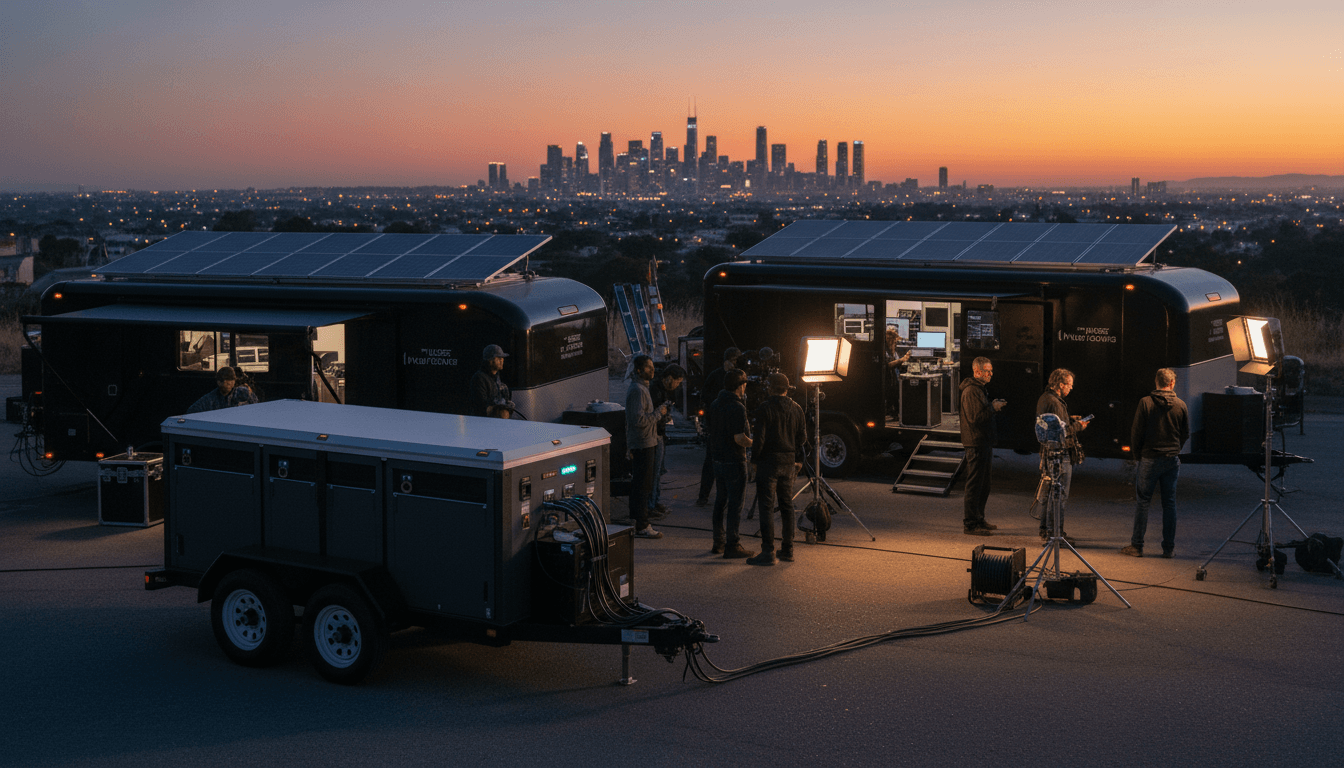
AI-Optimized Clean Mobile Power for Remote Productions
A modern film set can pull power like a small pop-up village — lighting, camera gear, basecamp trailers with HVAC, catering, and now EV charging too. What’s surprising isn’t the size of the load. It’s how often that load is served by oversized diesel generators running at single-digit utilization.
That same mismatch shows up in energy and utilities every day: assets sized “just in case,” run inefficiently “to be safe,” and managed with limited real-time visibility. Film and TV production is a tight, high-stakes environment — a zero-failure operating model — which makes it a perfect proving ground for something utilities care about deeply: how to run distributed energy resources reliably when the grid is weak, unavailable, or expensive.
Clean mobile power (solar trailers, battery energy storage systems, and emerging hydrogen power units) already works on real productions. The next step is scale — and that’s where AI in energy & utilities thinking becomes practical: forecasting, optimization, predictive maintenance, and dispatch control. The real value is not “cleaner power” in the abstract; it’s better reliability with fewer headaches.
Clean mobile power is a microgrid problem in disguise
A film production is essentially a temporary microgrid with messy, shifting loads and hard constraints.
On a typical shoot you’re powering:
- Set loads (often on location): lights, camera equipment, and sometimes HVAC
- Basecamp (often the biggest energy need): talent and office trailers, hair/makeup, costume, HVAC
- Transportation: charging electric vehicles on-site where feasible
- Catering: cooking appliances, refrigeration, HVAC, and lighting
Historically, on-location shoots often rely on multiple 1,400–1,600 A (roughly 210–240 kVA) diesel generators for lighting and basecamp needs. RMI’s analysis highlights a major driver of cost and emissions: productions routinely oversize. One Vancouver case study showed an average load of just 4% of generator nameplate capacity, peaking around 16%.
Here’s the blunt takeaway: diesel looks reliable because we pay for massive redundancy and waste.
Utilities will recognize the pattern. It’s the same reason distribution upgrades get overbuilt when load shapes aren’t well measured, or why peakers stay online “just in case.” If you can measure, forecast, and dispatch intelligently, you can shrink the safety margin without raising risk.
Where AI fits immediately
AI doesn’t need to “run the set.” It needs to do four useful jobs that utilities already care about:
- Load forecasting: predict the next 15 minutes, 2 hours, and full day
- Optimal dispatch: decide when batteries discharge, when they recharge, and when to call backup
- Asset health monitoring: spot battery thermal issues, inverter anomalies, connector faults
- Crew-friendly decision support: translate analytics into actions (“swap unit B at lunch”)
In other words: the film set is a mobile version of what utilities call distributed energy resource management.
The clean mobile power stack: what works, what breaks
The winning approach on productions isn’t one technology. It’s a mix — grid tie-ins when available, solar where it’s useful, batteries as the flexible backbone, and hydrogen where long run-time and fast refueling matter.
Solar trailers: cheap energy, not always enough
Roof-mounted solar on modern basecamp trailers has already proven it can eliminate a big chunk of diesel burn in the right season and latitude.
Real-world traction is strong:
- A Disney production in Los Angeles (summer 2024) ran on solar + batteries 97% of the time from June–August, saving about 4,900 gallons of diesel.
- A Netflix production in New Mexico (Ransom Canyon, 2024) used solar trailers plus a large battery microgrid and cut diesel fuel use across all power needs by more than 50%, saving 8,000 gallons.
But winter teaches humility. A Disney series in New Jersey (summer/winter 2023) saw diesel-free runtime drop to roughly 50%–70% in winter weeks due to heating loads and limited solar production.
The practical lesson for energy leaders: seasonality and resistive heating loads dominate. AI forecasting can’t create sunlight, but it can prevent bad plans — and that’s where money is.
Battery energy storage systems: the operational sweet spot
Battery energy storage systems (BESS) are the workhorse because they’re:
- Near-silent (major on-set advantage)
- Flexible across loads (no “low-load failure” behavior like diesel)
- Highly compatible with grid charging and solar charging
Mobile BESS units now commonly deliver 100 kW+ sustained output, and purpose-built towable systems around 90–100 kW with 200–300 kWh storage are already being used as diesel replacements for many production applications.
One Netflix pilot in the UK (2025) deployed a single 300 kWh-class system for six days in a remote location; diesel generators were only used 16% of the time, and the stack ran silently on the weekend under lighter demand.
Where batteries get tricky:
- Charging time (hours, not minutes)
- Permitting and safety approvals for larger packs (often >20 kWh thresholds)
- Temperature impacts on capacity and peak output
This is exactly where AI-driven energy management becomes valuable: predicting depletion, scheduling recharge windows, and reducing unnecessary peaks.
Hydrogen power units: a niche that matters
Hydrogen power units (HPUs) are earlier-stage for film/TV, but they solve one real operational problem: fast refueling with long continuous run time.
Fuel cell–based units can deliver 100 kW sustained power and store on the order of 1 MWh onboard in some configurations, with refueling measured in under 30 minutes. Hydrogen’s energy density is also the big differentiator: about 33.3 kWh/kg versus roughly 0.15–0.25 kWh/kg for batteries.
So when does hydrogen win?
- Long, continuous days (think 12+ hours/day) or multi-day remote deployment
- Extreme temperatures (fuel cells operate effectively from about −10°C to 50°C)
- Areas with practical hydrogen supply and refueling logistics
The catch: infrastructure and regulation. Hydrogen availability is still sparse compared with grid access and EV charging. And if you care about emissions, the hydrogen pathway matters — “clean” isn’t always “green.”
My stance: hydrogen is a strategic complement, not a default. Batteries will dominate most production (and most utility field) scenarios until hydrogen logistics become boring.
AI-driven optimization: from “diesel backup” to confident dispatch
Most productions that try clean mobile power still keep diesel nearby because the perceived cost of failure is huge. The fastest way to reduce diesel dependency isn’t arguing about sustainability. It’s building confidence through data.
1) Forecast the load like a utility forecasts demand
Productions have patterns:
- Morning ramp (setup, HVAC, lighting checks)
- Midday spikes (catering + full crew + charging)
- Evening taper
AI load forecasting can use:
- Call sheets and shooting schedules (what scenes, what gear)
- Weather forecasts (heating/cooling load driver)
- Historical telemetry from prior shoot days
- Real-time metering at distribution panels
Output should be simple: expected kW peak, expected kWh for the day, and confidence bands.
2) Optimize dispatch across solar, batteries, grid, and hydrogen
Dispatch optimization is the core “AI in energy & utilities” bridge.
A practical control strategy on a set looks like:
- Use solar directly for base loads when available
- Keep batteries in an efficient operating band (avoid deep cycling when unnecessary)
- Schedule grid charging during low-cost windows when grid tie-in exists
- Reserve hydrogen (or limited diesel) for rare peaks or long overnight runs
The important part: don’t guess. If you’re still guessing, you oversize, and oversizing is how diesel stays “cheaper.”
3) Predictive maintenance for mobile power assets
Mobile equipment fails for mundane reasons: connectors, inverters, cooling fans, vibration wear, firmware issues, temperature management. AI-driven predictive maintenance can reduce downtime by catching:
- Rising inverter temperature at the same load (cooling degradation)
- Increased harmonic distortion under certain lighting rigs
- Battery modules drifting out of balance
- Abnormal charge/discharge efficiency trends
This is directly transferable to utilities managing field-deployed storage, temporary substations, and mobile transformers.
4) Turn the interface into a crew tool, not a data science project
A lot of energy management systems fail because they’re designed for engineers, not operators.
A production-ready dashboard should answer:
- How many hours do we have left at current load?
- What’s the next likely overload window?
- What do we shut off first if we need to shed load?
- When should we swap batteries or refuel?
If the system can’t make decisions easier for a gaffer or generator operator, it won’t get used when things get stressful.
What utilities and energy providers can learn from film sets
Film and TV is a buyer with urgency, money, and public visibility. That combination accelerates adoption — and it’s why utilities should pay attention.
The “oversizing tax” is real (and measurable)
Productions routinely run diesel generators far below optimal loading. Diesel performs best closer to 70%–80% load; many sets operate at 10%–20% efficiency when oversized and lightly loaded.
Utilities see the same dynamic when backup generators, temporary power, or peaker assets run inefficiently due to planning conservatism.
Efficiency beats heroics
RMI estimates efficiency measures can reduce production energy demand by roughly 49% on average, and peak load by about 63% in modeled scenarios.
That’s the same lesson utilities repeat every heat wave: the cheapest kilowatt is the one you don’t have to serve.
On sets, the biggest wins come from:
- Efficient basecamp trailers (some designs use ~20% of the energy of legacy trailers)
- LED lighting and smarter controls
- Planning and rightsizing instead of defaulting to 1,400 A tow plants
AI amplifies these gains by identifying where load is wasted and when peaks are avoidable.
Mobile power is becoming grid-edge infrastructure
As EV adoption grows, productions will increasingly charge fleets on site. That makes clean mobile power more than “generator replacement.” It becomes a flexible grid-edge resource — similar to how utilities deploy mobile storage for resilience, events, outages, and constrained feeders.
If your organization sells, rents, or operates mobile storage, the film industry is giving you a high-pressure test lab for:
- Energy-as-a-Service models
- Interoperability standards
- Fast deployment playbooks
- Operator training and safety procedures
A practical action plan for clean mobile power (with AI baked in)
If you’re a studio, rental house, utility partner, or clean mobile power provider, the path to scale is straightforward — but it’s not “buy a battery and hope.”
- Instrument the load first: metering at distribution and major subpanels; log kW/kWh at 1–5 minute intervals.
- Build a forecasting baseline: even a basic model tied to schedule + weather will cut oversizing.
- Standardize deployment bundles: common set-ups for basecamp, catering, and set lighting; pre-approved cabling and safety layouts.
- Add AI dispatch gradually: start as advisory (“recommended plan”), then move to supervised automation.
- Adopt predictive maintenance: simple anomaly detection on temperature, voltage, harmonics, and cycling metrics.
- Design for operator trust: clear run-time estimates, alarm logic that’s not noisy, and post-day reports that explain what happened.
A clean mobile power fleet without AI control will still beat diesel on noise and local air quality. A clean mobile power fleet with AI control can beat diesel on reliability economics.
Where this is headed in 2026: clean power gets operational, not symbolic
The film industry’s clean mobile power story is moving from “pilot projects” to operational standardization, largely because the benefits are tangible: quieter sets, fewer community complaints, less fuel logistics, and better creative flexibility.
For the AI in Energy & Utilities world, the bigger point is this: film sets are demonstrating what happens when microgrids, storage, and alternative fuels collide with real operational constraints. They’re also proving the value of the same capabilities utilities are investing in — demand forecasting, grid optimization, predictive maintenance, and renewable energy integration — just in a mobile, temporary form factor.
If you’re building or buying AI for grid-edge optimization, don’t ignore mobile power. It’s where reliability expectations are unforgiving, and where better forecasting and dispatch pays back immediately.
What would it take for your organization to treat mobile storage and temporary power as a first-class grid asset — with the telemetry, controls, and operational playbooks to match?