AI data center demand is straining interconnection and transmission. Learn how utilities can use AI forecasting, grid optimization, and predictive maintenance to deliver power faster.
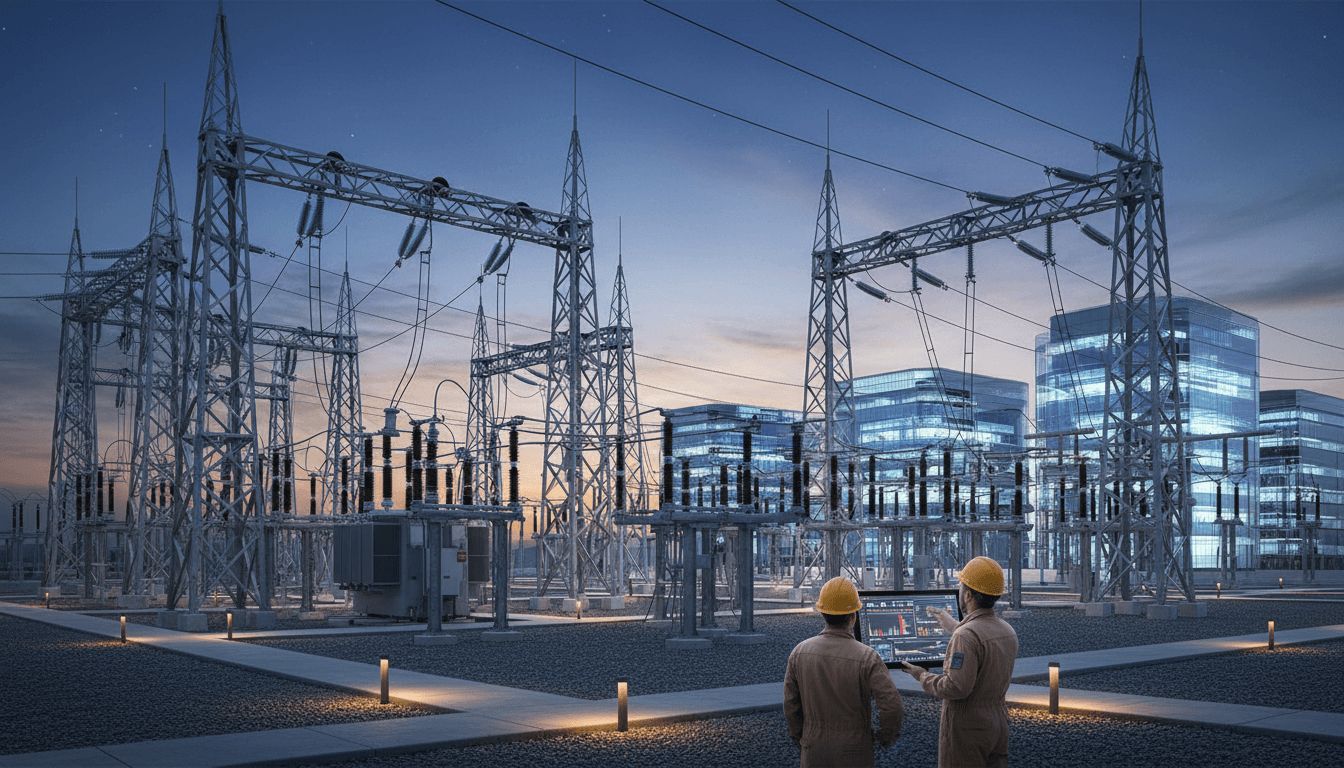
AI Data Center Demand: Build an AI-Ready Grid
Global data centers could consume 1,720 TWh of electricity by 2035 under certain scenarios—more than Japan uses today. That single number explains why utilities and energy leaders are suddenly fielding the same urgent question from customers, regulators, and boards: can the grid keep up with AI data center demand?
Here’s my take: most people frame this as a “data center problem.” It isn’t. It’s a grid execution problem—planning, interconnection, transmission, and operations—all happening on a timeline the power sector wasn’t designed for. And since it’s late December 2025, you can feel the timing pressure: 2026 budgets are set, load forecasts are being revised (again), and every utility with a major AI campus in its territory is facing the same reality—the queue is the product now.
This post is part of our AI in Energy & Utilities series, and it focuses on what actually helps: using AI for grid optimization, demand forecasting, predictive maintenance, and renewable integration so utilities can add capacity faster without betting the system on heroic assumptions.
The energy race is the AI race—because “power delivered” beats “power planned”
AI growth is constrained less by chips and more by electricity delivered at the busbar. The modern AI stack runs on dense compute, high utilization, and tight uptime requirements—so the power requirement isn’t just big, it’s also continuous and quality-sensitive.
Traditional grid planning assumes comparatively smooth load growth, long lead times, and slow-moving industrial additions. AI data centers break those assumptions:
- Speed: Site selection to load request can happen in months.
- Scale: Campuses are arriving as multi-phase projects that look like small cities.
- Shape: Loads are flatter and more constant than many regions planned for.
- Sensitivity: Voltage/frequency excursions and outages have outsized economic impact.
The hard part isn’t acknowledging the demand. The hard part is delivering power through permitting, interconnection, and transmission at the pace of AI investment.
The bottleneck isn’t generation—it's the “middle mile” of the grid
Plenty of regions can build generation (or contract for it). The delays pile up in:
- Interconnection studies and queue management
- Transmission upgrades and siting
- Substation capacity, breakers, transformers, and protection updates
- Construction labor and equipment lead times
This is why policy and regulation are moving. The U.S. has recognized that large loads—especially AI-driven—need faster, clearer pathways to service. That shift matters, but it won’t fix execution by itself.
What utilities should do first: treat AI load as a forecastable asset, not a surprise
Utilities that win this next phase will out-forecast and out-operate, not out-hype. AI data center demand feels chaotic because the traditional information flow is weak: developers don’t want to overcommit, utilities don’t want stranded upgrades, and regulators don’t want rate shock.
The better approach is to use AI demand forecasting and scenario planning to turn “mystery megawatts” into bankable planning cases.
Build a demand forecasting playbook designed for AI loads
A practical AI load forecasting approach combines three layers:
- Deal pipeline signals: land options, fiber plans, permitting milestones, tax incentives, construction mobilization
- Grid-side signals: feeder constraints, substation loading, transformer temperatures, congestion and LMP patterns (where relevant)
- Customer-side signals: power purchase posture, redundancy requirements, cooling strategy, GPU refresh cycles
You’re not trying to predict the future perfectly. You’re trying to reduce uncertainty enough to commit to the right grid upgrades.
Here’s a tactic I’ve seen work: probabilistic load blocks.
- Instead of a single point forecast (“500 MW by 2028”), model blocks with confidence bands (e.g., 150 MW @ 90%, 250 MW @ 70%, 500 MW @ 40%).
- Tie each block to specific triggers (signed lease, equipment procurement, substation design approval).
- Align capital deployment to triggers so you’re not waiting until certainty is 100% (it never is).
“Fast yes, safe yes”: shorten time-to-service without degrading reliability
Utilities don’t get credit for speed if reliability drops. The goal is fast interconnection with transparent constraints, which usually requires:
- Standardized service levels for large loads (including curtailment options)
- Pre-approved substation designs where feasible
- Queue reforms that reward readiness (site control, deposits, milestones)
- Clear rules for cost allocation and upgrade ownership
This is also where grid optimization AI becomes operational, not theoretical—helping operators understand hosting capacity, congestion, and contingency impacts faster than manual study cycles.
The “three-path” strategy to serve AI data centers without breaking the grid
No single resource mix will meet AI data center demand everywhere. The winners will run a portfolio approach that blends speed, cost stability, and emissions goals.
Path 1: Grid-enhancing technologies to create capacity from what you already own
Grid-Enhancing Technologies (GETs) are the fastest way to increase throughput on constrained corridors when new transmission is slow. They’re not magic, but they’re often the best near-term ROI.
Common GETs utilities are prioritizing:
- Dynamic line ratings to increase usable capacity when conditions allow
- Topology optimization / power flow control to route around congestion
- Advanced conductors on targeted spans for higher ampacity
- High-resolution grid monitoring to reduce conservative operating margins
AI helps here by converting massive operational telemetry into actionable limits and dispatch guidance, shrinking the gap between “engineering safe” and “operationally usable.”
Path 2: Storage + renewable integration designed for 24/7 service, not marketing
If you’re integrating renewables to serve data centers, the mismatch is obvious: AI loads want steady power; wind and solar don’t provide steady output.
The fix isn’t hand-waving “24/7 clean energy.” It’s engineering:
- Battery storage sized to manage ramps and peak constraints
- Hybrid plants (solar + storage, wind + storage) with firming contracts
- Load flexibility agreements for non-critical workloads where possible
- Granular carbon accounting that matches hourly reality, not annual averages
AI in energy management systems can continuously optimize charge/discharge, forecast renewable output, and schedule maintenance so the portfolio behaves like a firm resource.
Path 3: Dedicated supply and “behind-the-meter” deals (useful, but risky at scale)
Large tech buyers are increasingly willing to fund dedicated generation—often “behind-the-meter” or effectively dedicated through contract structures—to bypass congested grids and reduce schedule risk.
This can accelerate service, but it introduces system-level questions utilities can’t ignore:
- Does it shift reliability risk onto the customer or back onto the grid during contingencies?
- Does it create inequitable cost allocation for network upgrades?
- Does it complicate planning if multiple large loads self-supply inconsistently?
My stance: dedicated supply has a place, especially for speed. But the grid can’t be treated as an infinite battery that’s only there when private assets fail. Contract terms and protection schemes need to reflect that.
Predictive maintenance is how you protect reliability while adding load
When large loads arrive, weak points show up fast: transformer overheating, breaker wear, relay miscoordination, and cascading impacts from a single failed component.
Predictive maintenance is one of the few levers that improves reliability and frees capacity.
Where AI predictive maintenance pays off quickest
Utilities typically see the fastest returns by focusing on high-impact, hard-to-replace assets:
- Power transformers: dissolved gas analysis patterns, thermal models, bushing diagnostics
- Circuit breakers: operation counts, timing deviations, SF6/leak patterns (where applicable)
- Substation equipment: partial discharge, IR hot spots, vibration signatures
- Transmission: conductor temperature anomalies, vegetation risk, insulator contamination
A practical rule: if an asset has long lead time and high system impact, it belongs in the first wave.
Reliability is a data problem now
As AI data center demand grows, operators need earlier warning and better coordination across teams.
A strong predictive maintenance program isn’t just a model—it’s:
- consistent data capture
- clear failure modes and action thresholds
- work management integration
- measurable outcomes (forced outage rate, SAIDI/SAIFI impact, avoided replacements)
AI can flag anomalies. Your maintenance system has to act on them.
“People also ask” (and what to do about it)
Will AI data centers force higher electric rates?
They can, but they don’t have to. Rates rise when upgrades are large, urgent, and poorly allocated. Transparent cost allocation, phased upgrades, and flexible service options reduce rate shock.
Can renewables alone power AI data centers?
Not reliably without firming. Wind and solar can supply large shares of energy, but firm capacity generally requires storage, dispatchable generation, demand flexibility, or contracted firm supply.
What’s the fastest way to add capacity for AI loads?
GETs + substation upgrades + queue reform usually beats building new long-distance transmission on timeline alone. Generation additions help, but interconnection and delivery are the gating items.
What an “AI-ready utility” does in 2026: a focused checklist
Utilities don’t need a hundred initiatives. They need a few that actually change cycle time.
- Stand up an AI load program office that combines planning, interconnection, commercial, and operations.
- Adopt probabilistic load forecasting tied to customer milestones.
- Accelerate interconnection studies with automation and standardized engineering templates.
- Deploy GETs where congestion is already monetized (or already constraining service).
- Expand predictive maintenance on critical substations and transformers serving large-load corridors.
- Design renewable integration for hourly matching (or be honest about what’s being matched).
- Offer service tiers (firm, interruptible, phased, curtailable) so “fast” doesn’t mean “fragile.”
Snippet-worthy truth: AI-ready grids are built by reducing uncertainty and cycle time, not by making perfect long-range plans.
The AI boom isn’t slowing down in 2026. If anything, the demand is getting more clustered and more urgent. The utilities that treat AI data center demand as a strategic planning input—and use AI for grid optimization, demand forecasting, predictive maintenance, and renewable integration—will serve more load with fewer surprises.
If you’re mapping your 2026 priorities now, focus on one question: what would it take for your utility to say “yes” faster—without asking reliability to do the impossible?