AI and the DOE signal a shift from pilots to production in energy. See what it means for grid AI, security, and utility digital services in 2026.
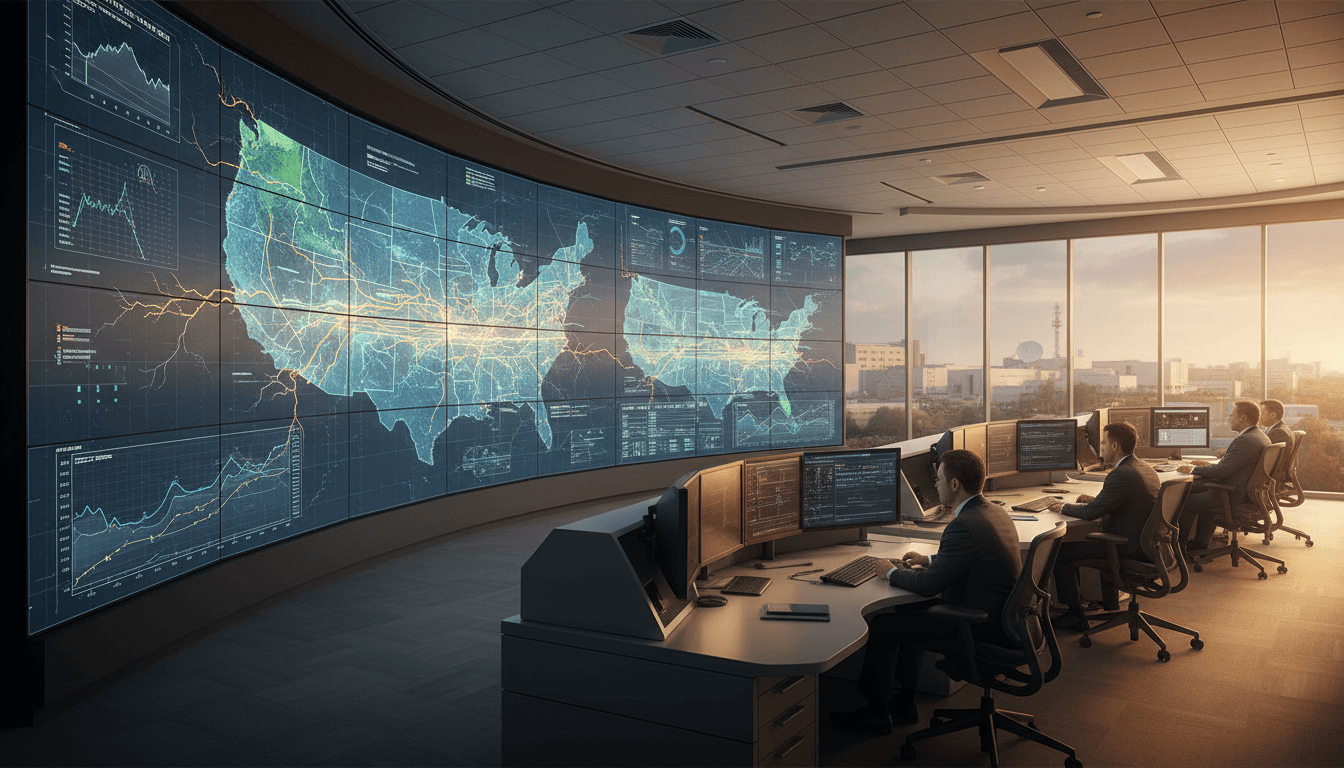
AI and the DOE: What This Partnership Means in 2026
A lot of energy-and-utilities AI talk is still stuck at the “pilot project” stage. Meanwhile, the U.S. Department of Energy (DOE) runs some of the most complex physical systems and digital services in the country—national labs, high-performance computing, grid research, cybersecurity programs, and major funding initiatives. When a major AI provider deepens collaboration with the DOE, it’s not a PR milestone. It’s a signal that AI is being operationalized inside U.S. critical infrastructure.
The source article we received was blocked (a 403 error), so it didn’t provide the details you’d expect from a typical announcement. But the headline—deepening collaboration with the U.S. Department of Energy—is still worth unpacking because it points to a real trend that’s accelerating going into 2026: government-led AI deployments that prioritize safety, reliability, and scale—the same attributes utilities need.
This piece is part of our “AI in Energy & Utilities” series, and it’s focused on one practical question: What does an AI–DOE collaboration usually enable, and what should energy leaders do with that signal right now?
Why an AI–DOE collaboration matters for energy digital services
Answer first: Partnerships with the DOE matter because they pressure-test AI in environments where failure is expensive, audits are normal, and operational rigor is non-negotiable.
Utilities and energy tech providers sometimes treat “AI in energy” as a set of analytics features. The DOE treats it as a national capability: something that must work across diverse sites, stakeholders, data classifications, and threat models. That difference forces better engineering.
If you’re running digital services for energy—grid analytics, outage management, customer programs, DER orchestration, field operations—this kind of collaboration is a preview of what “enterprise-grade” will mean in 2026:
- Governance that’s real: model documentation, access controls, change management, and audit trails.
- Security and resilience: assumptions about adversaries, not just “best practices.”
- Scale + heterogeneity: multiple data sources, legacy systems, and a long tail of edge cases.
Here’s the stance I’ll take: the most valuable part of these collaborations isn’t the model—it’s the operating model. The teams that learn how to deploy AI with DOE-level discipline will outperform those that only buy tools.
Where AI typically shows up in DOE-energy work
Answer first: In energy contexts, AI delivers the most value when it reduces the time from “data exists” to “operational decision,” especially across planning, reliability, and incident response.
Even without the blocked announcement details, the likely zones of collaboration are well known across energy and national lab work. They map directly to utility-grade use cases.
Grid optimization and reliability at operational speed
Answer first: AI improves grid operations by turning noisy, real-time signals into ranked actions operators can trust.
Grid optimization isn’t just forecasting load. It’s handling constraints—generation mix, congestion, maintenance schedules, weather, interconnection queues, and fast-changing DER behavior.
In practice, the most effective AI patterns look like this:
- Predict (short-term load, renewable output, equipment risk)
- Simulate (what-if scenarios with physics-informed constraints)
- Recommend (actions, tradeoffs, confidence)
- Verify (human review + automated guardrails)
If you’ve been frustrated by AI models that perform well in a notebook but fall apart in production, DOE-grade work pushes teams toward validated workflows: versioned models, scenario testing, and operator-facing explanations.
Predictive maintenance that’s more than anomaly alerts
Answer first: Predictive maintenance works when AI connects condition signals to maintenance decisions, not when it just flags “weird stuff.”
Utilities already collect SCADA signals, vibration data, thermal imagery, and work-order history. The hard part is turning that into decisions maintenance crews will act on.
The most useful AI systems:
- Combine time-series telemetry with maintenance logs and asset hierarchies
- Output a probability of failure tied to a clear maintenance window recommendation
- Explain which signals drove the risk score (so engineers can sanity-check it)
DOE-linked efforts tend to raise the bar on proof: not “the model is accurate,” but “the model reduced unplanned downtime and improved safety outcomes.” That’s a standard utilities should steal.
Cybersecurity for critical infrastructure
Answer first: AI helps security teams by triaging alerts and correlating signals across IT/OT—but only if it’s tightly governed.
Energy cybersecurity is a special kind of hard: operational technology can’t be patched like consumer devices, and downtime isn’t an option. AI can reduce response time by summarizing incident context, correlating logs, and prioritizing actions.
But the risk is obvious: if an AI system is fed sensitive telemetry or incident data, you need clear answers on:
- Data retention and access boundaries
- Model behavior under prompt injection or adversarial inputs
- Separation between confidential OT data and less sensitive IT signals
A government partner like the DOE tends to demand disciplined controls here. For utilities, that’s a helpful forcing function.
Accelerating science-to-deployment (the overlooked opportunity)
Answer first: The DOE’s national labs are a bridge between research and deployment, and AI can shorten the distance.
Energy companies often complain that promising research takes too long to reach production. AI—especially when combined with high-performance computing and strong MLOps—can compress the timeline from insight to deployable workflow.
Examples of what that can look like in the energy world:
- Faster evaluation of grid expansion scenarios
- Improved battery management strategies using large-scale simulation data
- Better integration of renewables through probabilistic forecasting
This is where the “digital services” angle really matters: the deliverable isn’t a paper—it’s an operational system that can be maintained, monitored, and improved.
What “deepening collaboration” usually means in practice
Answer first: A deeper collaboration typically expands from experimentation to repeatable deployment: more production workloads, more teams, and more formal safety and governance.
Announcements often sound vague, but the operational meaning is usually one (or more) of the following:
1) Broader access to AI tools across programs
Instead of a single research group testing a model, multiple DOE teams (or lab groups) adopt a shared platform—often with standardized identity, logging, and policy enforcement.
For utilities, the parallel is moving from one “innovation team” to a governed internal AI service that business units can use safely.
2) Stronger security posture and compliance alignment
Energy systems touch regulated environments and sensitive data. Deepening a partnership often implies that security reviews, deployment patterns, and data-handling controls are mature enough to scale.
If you’re buying AI solutions, don’t settle for vague assurances. Ask vendors how they handle:
- Tenant isolation and data boundaries
- Audit logs and admin activity trails
- Incident response processes
- Model update controls and rollback plans
3) Deployment into mission workflows (not just prototypes)
A prototype answers “can it work?” A mission workflow answers “can it keep working?”
In energy, “keep working” includes:
- Seasonal shifts (winter peaks, summer storms)
- Rare events (ice storms, wildfires, geomagnetic disturbances)
- Changing assets and grid topology
The practical requirement is continuous evaluation and monitoring. That’s where many AI programs fail—because teams budget for model building, not for model operations.
A pragmatic playbook for utilities watching this trend
Answer first: If you want DOE-level reliability without DOE-level bureaucracy, start with three moves: pick a mission use case, build governance early, and design human-in-the-loop from day one.
Here’s what works when you’re trying to move from pilots to production in AI for utilities.
Choose one mission-critical workflow and measure outcomes
Not 12 use cases. One that matters.
Good candidates:
- Outage prediction + crew staging
- Transformer failure risk ranking
- Vegetation management prioritization
- DER forecasting for feeder-level congestion
Pick metrics that executives and operators both respect:
- Reduction in SAIDI/SAIFI during major events (where applicable)
- Fewer truck rolls per resolved incident
- Reduced unplanned downtime
- Faster mean time to detect (MTTD) and respond (MTTR) for security incidents
Treat data readiness as a product, not a task
Most companies get this wrong: they “clean data” once and call it done.
For production AI in energy systems, you need ongoing routines:
- Data contracts between source systems and AI pipelines
- Drift detection (sensor changes, new feeder configurations, new asset types)
- Labeling workflows for maintenance outcomes and field notes
If you can’t explain where the data came from and how it changed, you can’t trust the model when it matters.
Design for human trust, not just accuracy
Operators don’t need an AI that’s impressive. They need an AI that’s predictable.
Practical design choices that build adoption:
- Show top drivers behind a recommendation (signals, thresholds, comparisons)
- Provide confidence bands and “I don’t know” states
- Offer decision logs: what the AI recommended, what humans did, and why
A useful one-liner I come back to: Accuracy earns attention; reliability earns adoption.
Put guardrails around generative AI in operational environments
Generative AI is great at summarizing, drafting, and explaining—but you don’t want it improvising in an OT environment.
Safer patterns utilities are using:
- Use generative AI for incident summaries and work-order narratives
- Restrict it to read-only access for sensitive systems
- Route actions through deterministic rules engines or operator approvals
- Maintain a clear separation between public knowledge and internal SOPs
This is also where collaborations with government agencies matter: they normalize the idea that capability without controls is a liability.
“People also ask” (fast answers for energy teams)
Is AI actually improving grid reliability in the U.S.?
Yes, when it’s deployed with operational controls. The gains typically come from better forecasting, faster detection of emerging failures, and improved crew/resource planning.
What’s the biggest blocker to AI in utilities?
Data + change management. The model is rarely the hard part. Making outputs trusted, auditable, and integrated into workflows is where programs stall.
How do government collaborations affect private-sector energy tech?
They set expectations for security, documentation, and repeatability—and they often accelerate shared standards and procurement patterns that spill into the commercial market.
What to do next as we head into 2026
DOE collaborations are a clear indicator of where the market is going: AI will be judged on operational performance, safety, and governance—not demos. If you’re building digital services in energy and utilities, use this moment to tighten your own program.
If I were advising a utility leader this week (right between year-end planning and 2026 budgeting), I’d push for two decisions in January:
- Fund one AI use case to production with a measurable reliability or cost outcome.
- Stand up a lightweight AI governance layer—logging, access control, evaluation, and incident playbooks.
The bigger question for 2026 isn’t whether AI will be used in energy systems. It’s whether your organization will treat AI as a collection of tools—or as a managed operational capability that’s built to hold up under pressure.