A carbon-neutral campus offers a practical model for utilities: modernize aging assets, electrify heat, and use AI for forecasting, optimization, and maintenance.
AI-Powered Decarbonization Lessons From a Campus
Catawba College didn’t become certified carbon neutral by chasing shiny projects. They did it the unglamorous way: fix aging infrastructure, reduce energy waste, and replace fossil systems with clean thermal and solar—while keeping the finances honest.
That’s why this story matters beyond higher education. Utilities and energy leaders are staring at the same problem Catawba tackled on a smaller map: old assets, rising reliability expectations, tighter carbon constraints, and customers who won’t accept disruption as the price of progress.
Here’s the angle I care about for our AI in Energy & Utilities series: Catawba’s blueprint gets easier—and scales faster—when you pair it with AI for forecasting, optimization, and predictive maintenance. The tech won’t “solve climate” on its own, but it absolutely changes the speed and cost of getting to operational decarbonization.
Why Catawba’s story is a real infrastructure play (not a PR play)
Answer first: Catawba treated decarbonization as an infrastructure modernization program, not a standalone sustainability initiative.
A lot of organizations try to “decarbonize” as an add-on: buy offsets, install a small solar array, publish a report, and hope the math works out. Catawba’s approach was more practical: align carbon goals with the unavoidable work of deferred maintenance—the expensive backlog of equipment replacements, envelope fixes, and controls upgrades that every campus (and every utility) eventually faces.
Their capital projects focused on three levers that utilities will recognize immediately:
- Demand reduction (energy efficiency and better building envelopes)
- Electrification of heat (geoexchange / geothermal heat pump infrastructure)
- On-site renewables (solar)
Catawba has been building toward this for decades: solar thermal in the 1980s, about 837 kW of solar PV in 2015 with projected savings of $5 million over 20 years, and an additional 55 kW in 2024 with more planned. Those aren’t vanity numbers; they’re proof that small institutions can stack incremental wins until they become strategic.
For utilities, the parallel is obvious: you don’t modernize a grid through one mega-project. You modernize it through a portfolio—and the portfolio only works when you can prioritize, sequence, and operate it well.
District energy + geoexchange: the “thermal grid” utilities should watch
Answer first: Catawba’s District Energy and Modernization (DEM) project shows how a shared thermal backbone can cut fuel use, improve resilience, and simplify electrification.
Utilities talk constantly about the electric grid. But the next big frontier is often thermal—because space heating and cooling are massive energy loads, and they’re still commonly served by gas.
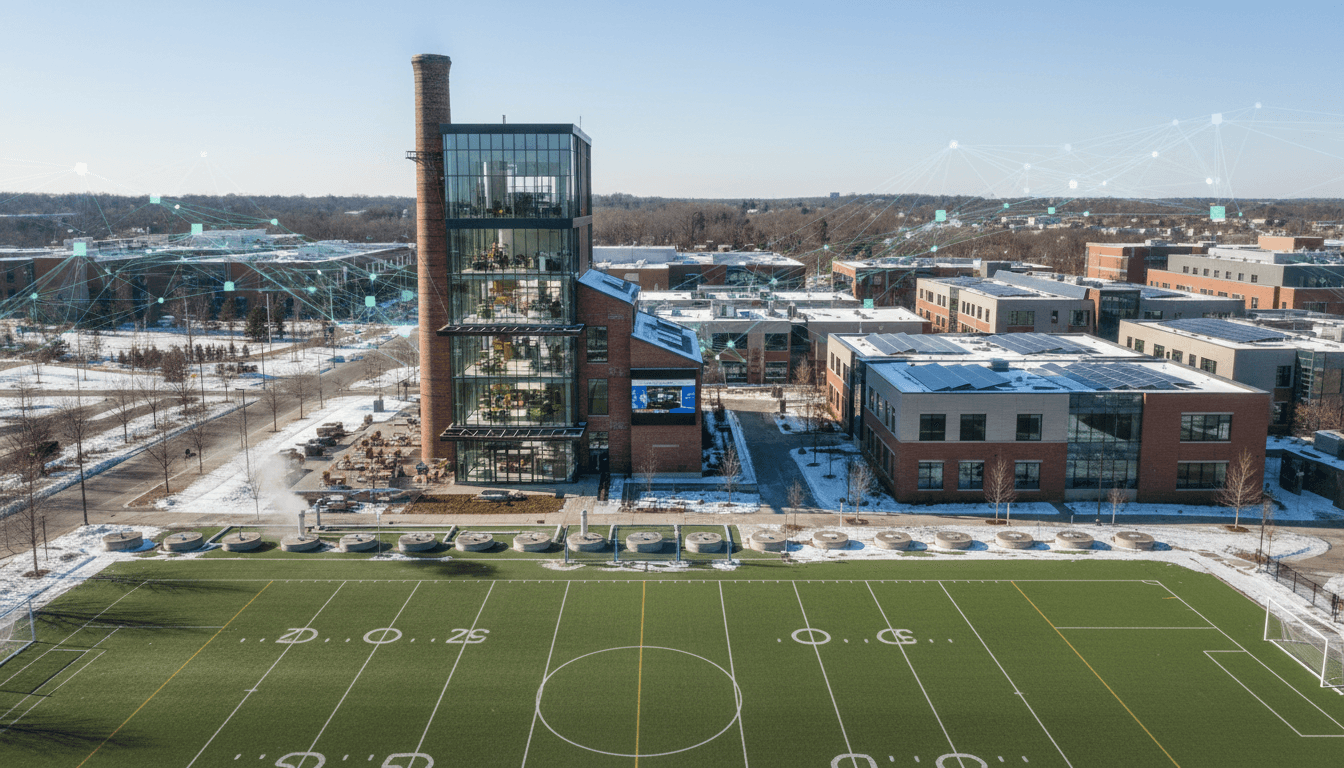
Catawba’s DEM project centers on a closed-loop geoexchange system. In 2024, the college drilled 39 wells as part of a four-phase buildout planned to ultimately serve 26 campus buildings. The project estimates annual reductions of at least 265 MMBtu of gas and 145,724 kWh of purchased electricity, lowering emissions by 51 metric tons.
The implementation details are what make this a useful case study:
- Centralized maintenance: locating wells beneath the soccer field concentrates service access.
- Phased rollout: the system expands building-by-building instead of demanding a disruptive “big bang” cutover.
- Compatibility with legacy choices: older buildings already tied into an original geoexchange system can connect with minimal incremental cost.
Where AI fits: operating a thermal network like a grid
Geoexchange doesn’t run itself. The value depends on controls, setpoints, pump scheduling, and anticipating weather and occupancy. This is where AI earns its keep.
In a campus-scale thermal grid, AI can:
- Forecast thermal demand using weather, schedules, and historical occupancy patterns
- Optimize pump and heat pump dispatch to reduce peak electric demand charges
- Detect equipment drift (valves, pumps, heat exchangers) before comfort complaints start
A blunt truth: electrification without intelligence often just shifts costs and peaks. Electrification with AI reduces both.
Utilities can apply the same playbook in district energy partnerships with cities, healthcare systems, airports, and campuses—especially in regions where winter peak heating is becoming an electric reliability challenge.
Modernization means comfort, not just carbon (and that’s the selling point)
Answer first: Catawba tied decarbonization to occupant comfort and asset performance—because that’s what keeps projects funded.
One example in the source story is the Abernethy Physical Education complex: a 90,000-square-foot facility with a pool and limited air conditioning, creating uncomfortable conditions in North Carolina heat and humidity.
This matters because many decarbonization plans fail politically inside organizations. People don’t rally around “MMBtu avoided.” They rally around:
- buildings that aren’t humid and moldy
- classrooms that aren’t freezing in the morning and overheating by noon
- fewer surprise outages
- maintenance teams that aren’t constantly firefighting
Jason Volz (CMTA) captured the systems reality with a line that every utility engineer will appreciate:
“If I address the HVAC but I don’t address the envelope, I’m just heating and cooling the outside.”
Where AI fits: predictive maintenance for aging infrastructure
Utilities know this pattern: a failing asset doesn’t fail all at once. It degrades—efficiency drops, power factor shifts, vibrations increase, temperatures trend upward, alarms become “normal.”
The campus version is similar: old HVAC equipment, insufficient insulation, weak vapor barriers, and controls that were never tuned to work together.
AI-driven predictive maintenance and anomaly detection can help institutions (and utilities) prioritize work when budgets are tight:
- Predictive failure risk (compressors, pumps, air handlers, boilers)
- Automated fault detection and diagnostics (FDD) to catch simultaneous heating/cooling or stuck dampers
- Condition-based maintenance scheduling that reduces overtime and emergency procurement
If you’re trying to sell modernization to a board or city council, the pitch that lands is simple:
“We’ll spend less time reacting, and more time running the system well.”
From coal plant to net-zero hub: reuse beats replacement
Answer first: Rehabilitating high-carbon legacy assets is often cheaper—and more meaningful—than starting from scratch.
Catawba’s Smokestack building is the kind of symbol organizations love, but there’s a serious lesson underneath. A coal-fired power plant that ran from the 1950s to the 1990s is being converted into a 10,000-square-foot student life hub and living laboratory, connected to the DEM project and supported by photovoltaics, aiming for net-zero (or better).
This is a strong model for communities dealing with retired fossil infrastructure: reuse the structure, keep the story, change the function.
It’s also slated for high performance certifications (LEED Platinum and Living Building Challenge Core Imperative). Whether you care about certifications or not, the deeper point is: the project treats performance as measurable, not assumed.
Where AI fits: measurement and verification that doesn’t become a burden
Many decarbonization programs fall apart after ribbon-cutting because nobody has the staff time to prove performance month after month.
AI can reduce that overhead by automating measurement and verification (M&V):
- create baselines from historical utility meter data
- normalize for weather (degree days)
- flag when post-retrofit performance drifts from design intent
- quantify savings in financial terms, not engineering jargon
For utilities running demand-side management or beneficial electrification programs, that same M&V automation is how you scale beyond pilot projects.
The Passive House dorm lesson: load reduction is the cheapest capacity
Answer first: Aggressive efficiency standards shrink electrification costs because they shrink the equipment and peak demand needed.
Catawba broke ground in April 2025 on a 130-bed residence hall targeting Passive House US certification, designed to tie into the DEM system. The college expects, compared to typical North Carolina construction:
- 55% lower energy use
- 44% lower heating loads
- 75% lower cooling loads
Those percentages are the “quiet superpower” of high-performance buildings: they reduce peak loads, not just annual consumption.
Utilities should care because every avoided kilowatt of peak demand is capacity you don’t have to build, buy, or defend in an IRP. High-efficiency buildings are a grid resource when they’re built and operated correctly.
Where AI fits: demand forecasting and peak management
For campuses and utilities alike, the hardest days are the peaks—cold snaps, heat waves, and the shoulder-season weirdness that breaks simple schedules.
AI demand forecasting helps you:
- anticipate peak hours days ahead (and plan preheating/precooling)
- coordinate flexible loads (EV charging, thermal storage, building preconditioning)
- reduce coincident peaks that drive demand charges or strain feeders
The practical outcome is fewer “surprises,” which is a polite way of saying fewer painful bills and fewer emergency operational decisions.
The finance angle boards actually approve: one plan, multiple wins
Answer first: Catawba won approval by bundling decarbonization with deferred maintenance, risk reduction, and enrollment strategy.
Catawba leaders didn’t pitch DEM as a narrow ROI exercise. They pitched it as a combined plan for:
- carbon and sustainability goals
- student recruitment and retention
- comfort and livability
- fixing what’s aging out anyway
A preliminary net present value analysis projects the DEM approach will save about $10 million between 2025 and 2054 versus business-as-usual when considering energy, operations, and maintenance.
That’s the template utilities can reuse when proposing AI programs:
- Don’t sell AI as “innovation.” Sell it as risk control.
- Tie it directly to reliability SAIDI/SAIFI outcomes, maintenance cost reduction, and faster interconnection of renewables.
- Make the business case legible in one slide: capex avoided, opex reduced, emissions reduced, reliability improved.
A practical “start here” checklist for utilities and campus energy teams
If you’re trying to translate this case study into action in 2026 planning cycles, I’d start with these steps:
- Inventory your worst-performing assets (energy intensity, comfort complaints, outage history).
- Pick one district-scale zone (a campus loop, a medical district, a dense downtown) where thermal electrification pencils.
- Stand up an AI-ready data layer: meters, BMS points, maintenance logs, weather, and occupancy proxies.
- Deploy two AI use cases first:
- predictive maintenance (fast payback)
- demand forecasting (fast operational value)
- Use automated M&V to keep savings credible and defend budgets year over year.
Most companies get the sequence wrong. They buy software first and wonder why the data is messy and the savings are hard to prove.
What this campus gets right about the energy transition
Catawba’s story is a reminder that decarbonization is an operations discipline. The solar is visible. The geoexchange wells are impressive. But the real win is the systems thinking: fix the envelope, modernize the backbone, electrify intelligently, and measure performance continuously.
For the AI in Energy & Utilities series, the takeaway is even more specific: AI is the scaling mechanism. It helps organizations prioritize modernization, run complex thermal/electric systems efficiently, and maintain performance long after the press release.
If a 1,200-student college can turn a coal-fired smokestack into a net-zero learning hub while modernizing 26 buildings’ worth of heating and cooling, what could your organization do with the same playbook—plus AI that spots failure early, predicts peaks, and optimizes dispatch in real time?