AI data centers are forcing a faster grid buildout. Learn how utilities can use AI for demand forecasting, grid optimization, and predictive maintenance.
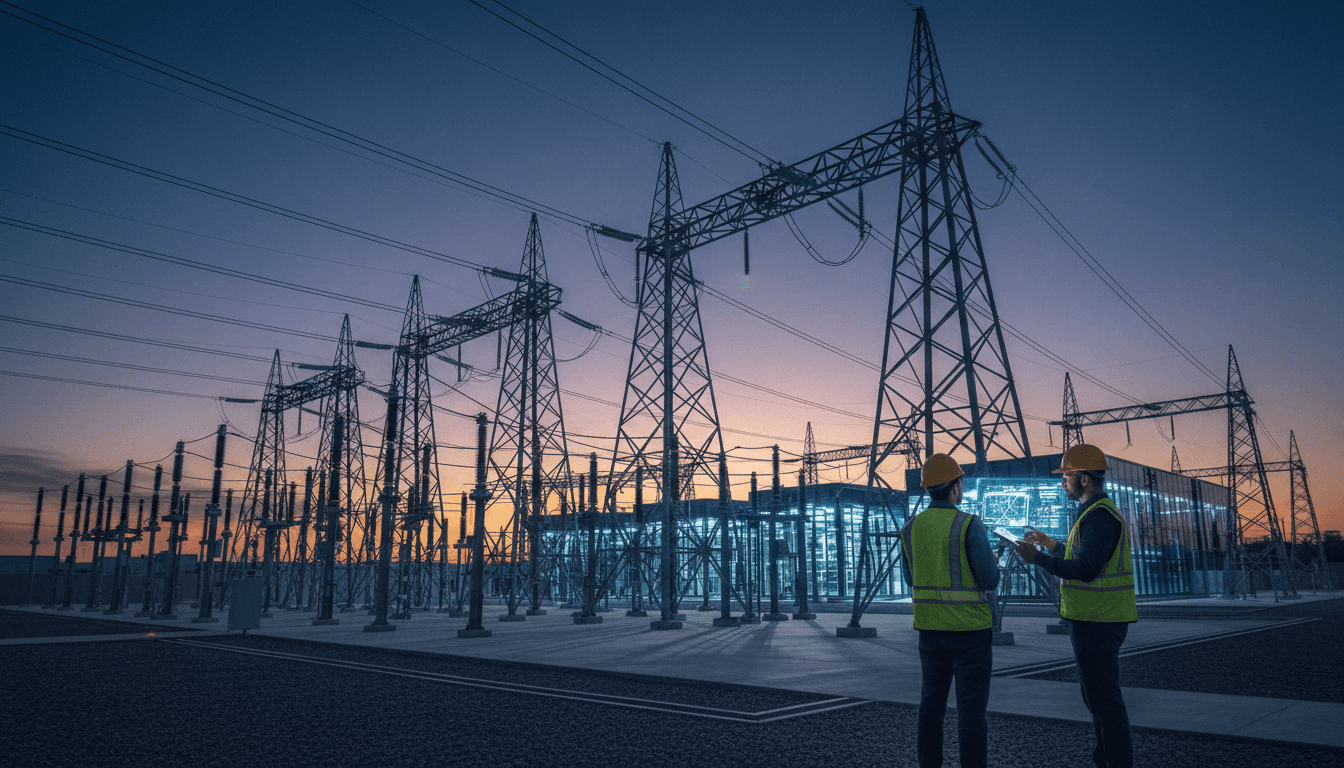
AI Data Centers Are Driving a New Grid Buildout
Data centers have always used a lot of electricity. What’s different in late 2025 is the speed and shape of the demand. AI training runs in big bursts, inference is always-on, and the biggest operators want capacity measured in hundreds of megawatts, not a few extra feeders.
One forecast that keeps getting repeated for a reason: the International Energy Agency projects global data center electricity consumption could reach 1,720 TWh by 2035 under certain conditions—more than Japan uses today. That’s not a “tech industry” number. That’s a grid planning number.
This post is part of our AI in Energy & Utilities series, where we focus on practical ways AI supports grid optimization, demand forecasting, predictive maintenance, and renewable energy integration. Here’s the stance I’ll take: the energy race is the AI race, and utilities that treat data center growth like “just another large customer” are setting themselves up for reliability headaches and political blowback.
The real bottleneck isn’t generation—it’s delivery
If you’re trying to power AI at scale, the biggest constraint in the U.S. isn’t a lack of molecules, megawatts, or ambition. It’s the time-to-power: permitting, interconnection queues, transmission availability, transformer lead times, and the operational limits of an already stressed network.
The RSS source points to a critical truth: our grid expansion model was designed for a different era. Many processes assume load growth is gradual and predictable. AI load isn’t. It shows up as:
- Large step changes (a campus that wants 300 MW instead of 30 MW)
- Aggressive schedules (power in 18–36 months, not 5–10 years)
- High uptime expectations (downtime isn’t tolerated, so redundancy is priced in)
Why interconnection queues are now a competitiveness issue
When large loads or new generation sit in queue for years, two things happen:
- Costs rise (studies get redone, equipment prices move, financing gets harder)
- Projects relocate (loads chase faster timelines)
That’s why recent federal attention—like DOE pushing FERC to initiate rulemaking around transmission service for large loads—matters. The policy signal is clear: AI data centers are a new class of grid customer, and the rules are going to change to accommodate them.
But regulation alone won’t fix the bottleneck. Execution will.
Data center demand changes how utilities must forecast load
Traditional load forecasting is built around weather, GDP, population shifts, and customer classes that behave… like customer classes. AI data centers behave more like industrial megaprojects with continuous expansion plans.
The “hidden cost of AI” for utilities is that uncertainty gets expensive. If you underbuild, you risk reliability events and emergency procurement. If you overbuild, you risk stranded investment and rate pressure.
AI-powered demand forecasting is one of the few tools that actually fits the new problem. Done right, it blends:
- Interconnection and economic development pipelines
- Data center construction indicators (permitting, land, substations, fiber)
- Probabilistic scenarios for ramp timing (not a single date)
- Locational constraints (where the grid can actually deliver)
What good looks like: scenario forecasts tied to grid actions
A useful forecast doesn’t stop at “load will grow 18%.” It outputs decisions:
- Which substations must be uprated first
- Where new transmission capacity has the highest option value
- How much flexibility (demand response, storage, on-site backup) is required
- When to trigger long-lead orders (transformers, breakers, switchgear)
A simple operational rule I’ve found effective: every forecast scenario should map to a build plan and a reliability plan. If it doesn’t, it’s an academic exercise.
“Behind-the-meter” power is rising—utilities should respond, not resist
The source article notes a trend that’s already shaping negotiations: tech companies increasingly finance dedicated power supplies—often behind-the-meter—to bypass congested grid paths. In practice, that can mean co-located generation (often gas today), solar plus storage, or hybrid arrangements.
Utilities sometimes view this as load “escaping” the regulated system. I think that’s the wrong frame.
Behind-the-meter power is a market signal that says: time-to-power is worth more than perfect market structure.
The better utility strategy: make grid power faster and more valuable
Utilities can compete by offering a package that behind-the-meter projects struggle to match:
- Clear timelines (credible milestones, not hopeful ones)
- Firm delivery backed by planning (not just a queue position)
- Flexibility products (curtailment programs, capacity options, fast DR)
- Clean energy pathways (renewable integration with firming strategies)
This is also where AI in grid optimization becomes real, not theoretical. If you can use AI-driven network models to reduce congestion, optimize switching, and improve contingency analysis, you can often create incremental capacity faster than building brand-new lines.
Grid-Enhancing Technologies (GETs) and storage are the fastest capacity you can buy
You don’t meet AI-driven load growth with only one tool. You meet it with a stack, and the fastest layer of that stack is usually:
- Grid-Enhancing Technologies (GETs) such as dynamic line ratings, power flow control, topology optimization, and advanced monitoring
- Utility-scale battery storage to reduce peak stress, provide reserves, and defer upgrades
GETs matter because they increase the usable capacity of what you already have. Storage matters because it buys time and reduces the need to build for a handful of peak hours.
Where AI fits: turning GETs into operational advantage
GETs produce lots of data, but data doesn’t run a grid. AI helps by:
- Detecting emerging constraints before they become outages
- Recommending switching actions that reduce congestion
- Improving state estimation and anomaly detection from sensor streams
- Automating “what-if” contingency screening faster than manual workflows
If you want a one-liner that’s true in the field: GETs are the hardware; AI is what makes them behave like capacity.
Reliability is becoming a commercial term, not just an engineering one
Most utilities already treat reliability as sacred. The change is that AI campuses put reliability into contracts, penalties, and reputational risk. When a single site can equal the load of a mid-size city, the planning stakes rise.
Here’s where the predictive maintenance side of this topic series becomes directly tied to data center growth.
Predictive maintenance: the cheapest megawatt is the one you don’t lose
AI-driven predictive maintenance can reduce forced outages and equipment failures that suddenly constrain delivery:
- Transformer health scoring (dissolved gas analysis + thermal + loading history)
- Asset failure probability models for breakers and switchgear
- Vegetation risk prediction for feeders serving high-value loads
- Condition-based maintenance scheduling to avoid peak seasons
A practical stance: if you’re adding 200–500 MW of new load in a constrained pocket, you should treat the upstream assets like a critical care unit—monitor more, inspect smarter, fix earlier.
Funding the buildout: the old playbook won’t cover what’s coming
The RSS article calls out an uncomfortable reality: traditional approaches—regulators setting customer rates to fund grid expansion—won’t be sufficient by themselves at the pace AI demand is pushing.
Whether you love it or hate it, capital is already shifting:
- Private equity and infrastructure funds are hunting “time-to-power” plays
- Tech companies are willing to co-invest where it accelerates delivery
- Utilities are being pushed toward new deal structures (cost sharing, dedicated assets, phased energization)
Deal structures that reduce risk for both sides
The most workable structures I’m seeing (and recommending) tend to share three traits:
- Milestone-based commitments (money moves when timelines are met)
- Flexible ramp clauses (because load doesn’t always arrive on schedule)
- Shared infrastructure logic (assets should benefit more than one customer when possible)
This is also where regulators have to get practical. If the policy goal is economic growth and grid reliability, then the approval process has to reward projects that shorten time-to-power without dumping undue risk on ratepayers.
A utility-ready checklist for the 2026 AI load wave
Planning for AI data centers can feel abstract until you turn it into a playbook. Here’s a concrete checklist utilities and energy providers can use in Q1 2026 planning cycles.
- Build a “large load SWAT” process
- One intake, one timeline, clear ownership across planning, interconnection, T&D, and regulatory
- Upgrade load forecasting to probabilistic scenarios
- Three ramps minimum: conservative, expected, aggressive
- Identify constrained pockets and pre-permit solutions
- Substations, transmission corridors, and equipment long-lead items
- Deploy AI for grid optimization where it frees near-term capacity
- Congestion prediction, topology optimization, contingency automation
- Harden reliability with predictive maintenance on critical corridors
- Prioritize assets upstream of data center clusters
- Use storage and flexible load programs as first-response capacity
- Batteries, demand response, managed curtailment options
- Offer a clear pathway for renewable integration
- Firming strategy, hourly matching options, and realistic delivery plans
A useful internal metric: time-to-power (months) should be tracked like safety—visible, owned, and reviewed at the executive level.
What utilities should do next—and what to ask internally
The energy transition and the AI boom are colliding at the grid edge. That collision can produce reliability problems, or it can produce the fastest modernization push the industry has seen in decades. The outcome depends on whether energy providers treat AI load as a threat—or as a forcing function to fix what’s been slow for too long.
If you’re leading planning, operations, or digital transformation, your next step is straightforward: pick one near-term constraint (a congested corridor, a delayed interconnection cluster, a high-failure asset class) and apply AI where it changes the timeline, not just the dashboard.
The question worth carrying into 2026 budget season is simple: When the next 300 MW AI campus asks for power, will your answer be a date—or an apology?