AI data center demand is straining the grid. See how utilities can use AI forecasting, grid optimization, and faster interconnection to keep up in 2026.
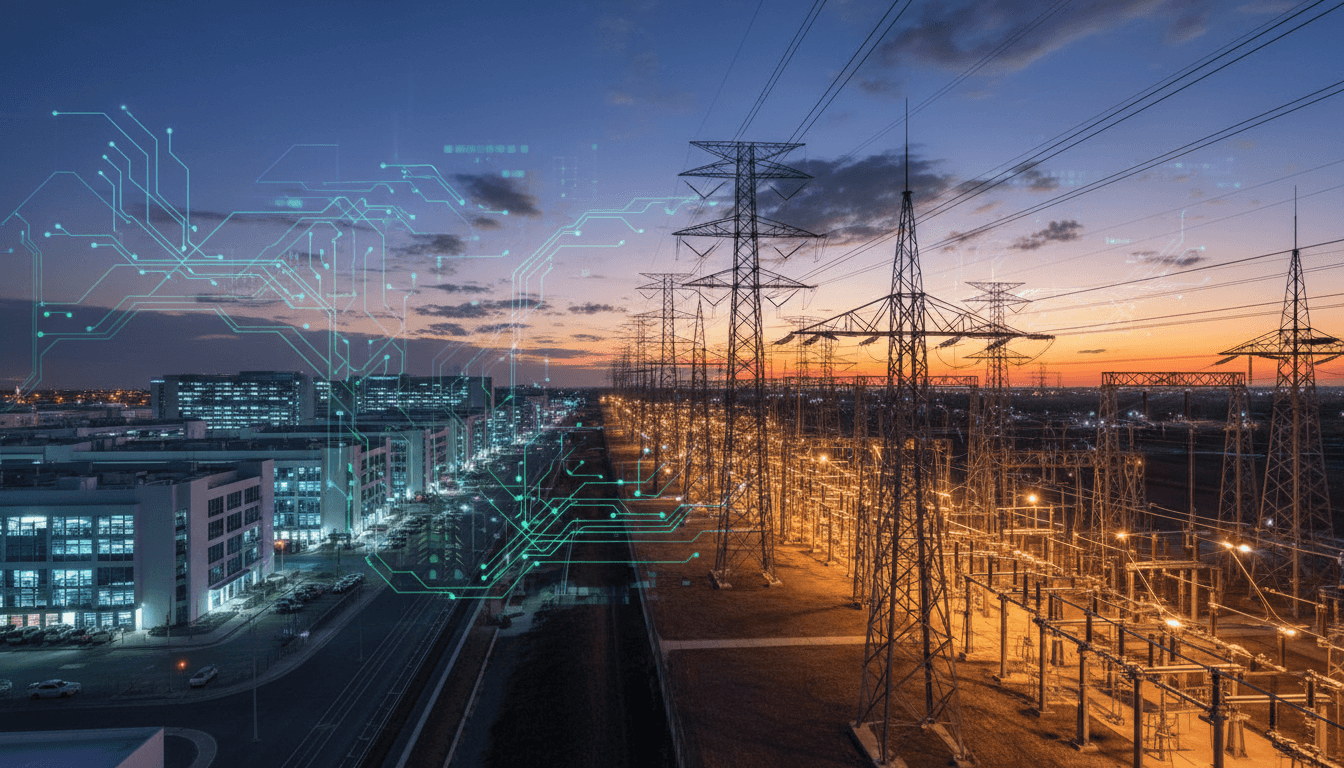
AI Data Center Demand: How Utilities Keep Up in 2026
Global data center electricity use could hit 1,720 TWh by 2035—roughly more than Japan’s current annual electricity consumption under certain scenarios. That one number explains why so many utility executives are suddenly having the same conversation: the AI boom isn’t a “tech sector” story anymore; it’s a grid capacity, interconnection, and reliability story.
Most companies get this wrong at first. They treat AI-driven load growth like a typical large commercial forecast problem—add it to the model, update the IRP, and wait for the next rate case. That approach is already failing in regions where data centers are stacking up in interconnection queues and local substations are the hard limit.
This post is part of our AI in Energy & Utilities series, and the stance here is simple: the energy race is now the AI race—but utilities can use AI to keep up. The fastest path isn’t just building more generation. It’s modernizing how the grid is planned, operated, and financed so new load can connect without blowing up reliability or costs.
The bottleneck isn’t generation—it’s delivery
If you’re staring at data center load requests and thinking “we just need more megawatts,” you’re only seeing half the constraint. The grid’s real limiter is delivery: transmission capacity, substation upgrades, feeder constraints, protection schemes, and interconnection studies that were designed for a slower world.
AI load growth has three traits that make “business as usual” planning fragile:
- Speed: AI deployments ramp in months, not years.
- Size and concentration: campuses can be hundreds of MW and cluster geographically.
- Operational profile: many loads want high uptime and may run close to flat, stressing local infrastructure continuously.
Permitting and interconnection are now balance-sheet risks
Permitting and application delays don’t just push COD dates—they inflate capital costs and introduce uncertainty that spooks investors and boards. That’s why regulators are paying attention. Federal attention to large load and transmission service reforms signals a shift: process throughput is becoming a reliability issue.
Utilities that treat permitting/interconnection as a paperwork function will keep losing time. Utilities that treat it as a program—complete with analytics, workflow automation, and scenario planning—move faster and reduce rework.
Why “just build more lines” won’t be fast enough
New transmission is essential, but long-cycle builds won’t match near-term data center timelines. That’s why we’re seeing aggressive interest in:
- Grid-enhancing technologies (GETs) to squeeze more capacity out of existing assets
- Battery storage for peak shaving, congestion relief, and contingency support
- Co-located, behind-the-meter supply where the bulk grid is constrained
Each of these options works better when paired with AI-based forecasting and operational controls.
The new load reality: data centers behave like industrial megasites
Utilities need a different mental model. AI data centers look less like “commercial load” and more like a portfolio of industrial megasites with unique reliability and power quality needs.
What utilities should ask data center developers early
The interconnection queue is the wrong place to discover basic load truths. I’ve found that utilities move faster when they standardize a pre-application intake that answers:
- What’s the ramp schedule (MW by quarter for 24–36 months)?
- What’s the load flexibility (curtailment, load shifting, on-site gen, storage)?
- What’s the reliability requirement (N, N+1, 2N) and how is it achieved?
- What’s the power factor and harmonic profile plan?
- What’s the cooling and water strategy, and will it constrain siting?
These details shape everything from transformer selection to protection design—and they’re also the raw material AI models need.
Myth: efficiency alone will solve it
Data centers are improving efficiency, and AI hardware is evolving quickly. But efficiency gains don’t cancel out volume growth when adoption scales. Utilities should plan for both to be true at once: better PUE, but far more total load.
Where AI helps utilities most: four practical use cases
The fastest wins come from applying AI where it removes friction in planning and operations. Not flashy demos—production-grade systems that cut weeks from decisions and reduce risk.
1) AI-driven load forecasting for AI-driven load
Answer first: Utilities should use AI forecasting because data center demand is too dynamic for traditional models.
Classic econometric forecasting struggles with step-changes and clustered growth. AI models can fuse:
- Interconnection pipeline signals (stage gates, probability of completion)
- Developer activity (construction milestones, equipment orders)
- Local constraints (substation headroom, feeder thermal limits)
- Market indicators (GPU supply, colocation pricing, vacancy)
A practical outcome is a probabilistic “MW by node” forecast that operators and planners can act on.
What to implement:
- Hierarchical forecasts (system → zone → substation)
- Confidence intervals tied to specific drivers
- Automated re-forecasting weekly, not annually
2) Dynamic hosting capacity and faster interconnection studies
Answer first: AI speeds interconnection by reducing manual study time and prioritizing the right upgrades.
Interconnection delays compound because engineering teams are forced into bespoke analysis for every request. With the right data foundation, utilities can automate parts of:
- Screening studies and constraint identification
- “What-if” upgrade options and cost ranges
- Queue prioritization based on readiness and system benefit
This isn’t about skipping rigor. It’s about standardizing repeatable work so humans focus on exceptions.
3) Grid optimization and congestion management with GETs
Answer first: GETs deliver capacity faster when AI tells you where and when to deploy them.
GETs (like dynamic line ratings, advanced power flow controls, topology optimization) can add meaningful capacity—sometimes quickly—without waiting for a new corridor build.
AI helps by predicting:
- Thermal constraints under weather and load scenarios
- Congestion patterns by hour/season
- The best asset-level interventions (and their ROI)
4) Demand response built for hyperscale loads
Answer first: Demand response for data centers works when it’s designed as a product, not an emergency tactic.
Many data centers can provide flexibility if the commercial terms and telemetry are clear. Utilities should offer programs that define:
- Curtailment blocks (e.g., 10–50 MW increments)
- Response time (seconds vs minutes)
- Duration and number of events
- Measurement and verification requirements
- Payments tied to performance and availability
AI supports this by forecasting event value, verifying performance, and optimizing dispatch.
Power supply strategies: what’s working (and what’s risky)
Utilities and developers are already experimenting with multiple pathways to serve large AI loads. The right answer depends on regional grid strength, permitting timelines, fuel access, and policy.
Behind-the-meter generation: fast, but not free
Co-located generation can bypass congested interconnections and shorten timelines. The risk is system fragmentation—a patchwork of private solutions that reduce coordinated planning and can create operational blind spots.
If behind-the-meter grows, utilities should insist on:
- Clear operating envelopes and telemetry sharing
- Protection coordination and islanding rules
- Agreements on black-start and restoration roles
Storage and hybrid resources: strong for peaks, limited for baseload
Batteries shine for:
- Peak shaving at constrained substations
- Reliability support during contingencies
- Smoothing renewable output
They don’t replace long-duration firm capacity on their own, but they can defer upgrades and buy time.
The financing shift: rates won’t cover the whole buildout
The old model—recovering most infrastructure through customer rates—strains under the speed and size of data center-driven builds. We’re seeing more:
- Direct investment from large load customers
- Alternative deal structures for substation/transmission upgrades
- Private capital partnering on generation and grid assets
Utilities that modernize contracting and cost allocation will connect load faster and reduce political blowback.
A 90-day action plan for utilities heading into 2026
You don’t need a five-year transformation program to get traction. A focused 90-day plan can put you ahead of the next wave of load requests.
- Stand up a “large load SWAT team.” Planning, interconnection, ops, regulatory, and commercial in one room with weekly cadence.
- Build a single source of truth for large-load pipeline data. One dataset, one governance model, clear stage gates.
- Deploy probabilistic forecasting at the substation level. Not perfect—useful. Make it operational.
- Pilot a dynamic hosting capacity map. Start with the highest-growth corridor.
- Create two standard interconnection/upgrade deal templates. One for substation-heavy upgrades, one for transmission-heavy upgrades.
- Launch a data-center demand response offer. Start with a small cohort and tight telemetry requirements.
Snippet you can share internally: If your interconnection queue is growing faster than your engineering throughput, you don’t have a “queue problem.” You have an operating model problem.
What to do next
The energy race is now the AI race because AI’s constraint is increasingly electrical: megawatts, interconnection capacity, and the ability to deliver power where compute is being built. Utilities that respond with AI-based grid optimization, demand forecasting, and faster interconnection workflows will add capacity sooner and protect reliability while doing it.
If you’re leading grid modernization in 2026, pick one area where AI reduces cycle time—forecasting, hosting capacity, congestion management, or demand response—and push it into production. The organizations that win won’t be the ones with the most pilots. They’ll be the ones that can connect large load quickly without surprises.
Where is your organization feeling the most pressure right now: forecasting, interconnection throughput, local substation constraints, or regulator expectations?