AI climate risk modeling is moving to the asset level. See how insurers can price and underwrite extreme weather risk with granular data and workflows.
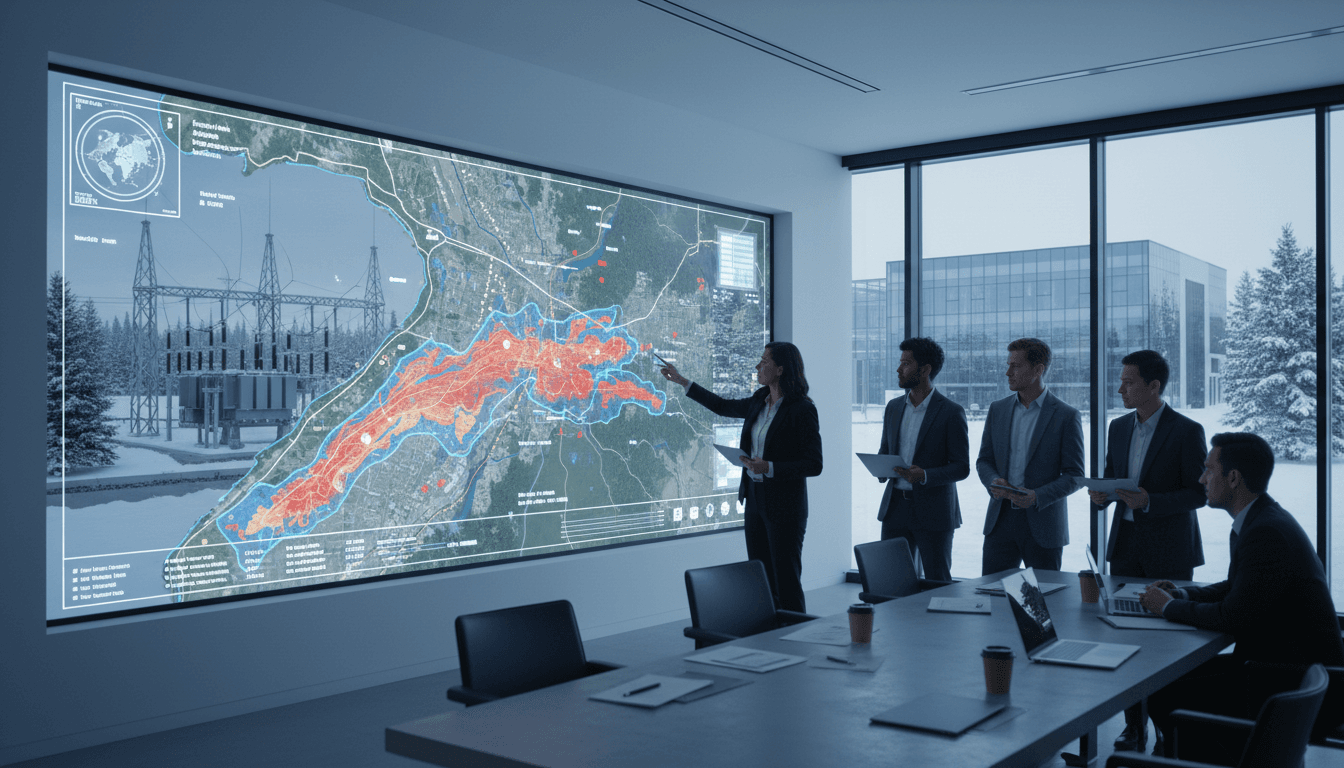
AI Climate Risk Modeling for Asset-Level Insurance
Swiss Re estimates that 2025 natural catastrophes produced $107 billion in global insured losses and $220 billion in total economic losses. That number isn’t just a headline for insurers—it’s a signal that the “average year” has changed.
Apollo’s recent move to expand asset-level risk reviews for extreme weather is a useful tell. Private capital firms don’t spend money adding diligence steps unless they believe those steps will protect valuation and reduce surprise losses. For insurers, the implication is even sharper: if investors are underwriting climate physical risk at the asset level, carriers can’t keep pricing, underwriting, and portfolio management stuck at a coarse ZIP-code or county view.
This post is part of our AI in Energy & Utilities series, where we look at how AI turns volatile, infrastructure-heavy realities into better decisions. The same logic that helps utilities forecast peak demand and harden the grid applies to insurers evaluating power plants, substations, wind farms, data centers, and the real estate around them: granular data + models that learn + operational workflows that act on the output.
Why asset-level climate risk is now a valuation issue
Asset-level climate risk is now a valuation issue because extreme weather can change collateral value and cash-flow durability quickly, and markets are starting to price that in.
Apollo’s shift from top-down analysis (portfolio-wide views) toward bottom-up, asset-by-asset evaluation reflects a broader reality: flood, wildfire, heat, and storm exposures don’t hit “a region” evenly. They hit a site. Two facilities five miles apart can have different elevation, vegetation, drainage, building materials, access roads, and fire response capability.
For insurers, valuation pressure shows up in three places:
- Underwriting margin erosion: rates lag risk when risk changes faster than rating plans.
- Claims severity inflation: correlated losses stack up across portfolios, vendors, and supply chains.
- Capacity and reinsurance dynamics: higher cat loss baselines push attachment points, pricing, and availability.
Here’s the stance I take: If you’re not doing asset-level climate analytics, you’re guessing—just with better spreadsheets.
“Physical” vs. “transition” risk—why carriers must model both
Asset-level reviews typically split climate risk into:
- Physical risk: acute events (hurricanes, floods, wildfires) and chronic trends (heat, drought, sea-level rise).
- Transition risk: policy, technology, and market shifts as economies decarbonize.
Insurers often treat transition risk as “ESG reporting.” That’s a mistake. Transition risk becomes underwriting risk when, for example, a utility asset faces accelerated retirement, new compliance costs, stranded equipment, or community opposition that slows projects and disrupts revenue.
AI helps because it can fuse heterogeneous signals—engineering data, geospatial hazard layers, maintenance logs, vegetation indexes, and climate projections—into a decision-ready risk score you can actually use at quote time.
What Apollo’s move signals for insurers (especially in energy & utilities)
Apollo’s move signals that climate diligence is becoming deal-standard, and insurers will be expected to match that sophistication in underwriting and portfolio steering.
Apollo described expanding loan-level mapping in mortgage portfolios and evaluating exposures like drought, flood, heat, and wildfire in “hard-asset sectors” where risks influence collateral values and cash-flow durability. That language should sound familiar to carriers writing:
- property coverage on industrial sites
- builder’s risk for energy projects
- business interruption/contingent BI
- inland marine for equipment
- liability around wildfire-caused third-party loss
And Apollo called out data centers—an energy-and-utilities adjacent focal point because data centers drive new load, new interconnection work, and new infrastructure buildout.
Data centers are a perfect example of asset-level underwriting pressure
Data centers force a blended view of risk:
- Power is one of the largest operating expenses (so energy sourcing, redundancy, and grid constraints matter).
- Water sourcing and recycling can materially influence cost and regulatory exposure.
- Heat waves and smoke events can affect cooling performance, filtration, and uptime.
For insurers, this means the “location” question can’t stop at an address. It has to extend to operational resilience: backup generation, fuel contracts, onsite storage, cooling architecture, and dependency on single transmission corridors.
Asset-level AI risk modeling is how you scale that rigor across hundreds or thousands of submissions without burning out underwriting teams.
How AI enables asset-level risk reviews in insurance
AI enables asset-level risk reviews by converting messy, granular inputs into consistent underwriting signals—fast enough to matter during quoting and renewal.
Most carriers already have pieces of the puzzle: cat models, inspection reports, third-party property data, IoT/telematics, claims history. The problem is orchestration. Asset-level AI risk modeling makes three steps repeatable.
1) Ingest granular data that underwriters don’t have time to chase
At asset level, “data” isn’t one dataset. It’s a stack:
- geospatial hazard layers (flood depth, wildfire interface, wind zones)
- topography and elevation models
- building characteristics and retrofits
- vegetation and defensible space indicators
- proximity to water, drainage, levees, fire stations
- utility and infrastructure dependencies (substations, feeders, transmission)
- historical claims and near-miss events
AI is valuable here because it can:
- normalize inconsistent fields across sources
- infer missing attributes (with guardrails and human validation)
- flag conflicts (e.g., two sources disagree on roof type)
2) Translate hazards into financial loss drivers
Hazard isn’t loss. Loss comes from vulnerability and exposure.
A practical AI approach combines:
- Hazard probability (frequency, intensity, seasonality)
- Vulnerability (construction, maintenance quality, defensible space, drainage)
- Exposure and criticality (replacement cost, downtime cost, supply chain position)
In energy & utilities, vulnerability often hides in operational details. A substation with outdated transformers, deferred vegetation management, and single-road access is a different risk than a hardened site with redundancy and modern protective relays.
3) Put the output into workflows people actually use
If model output lands in a PDF that nobody reads, it’s theater.
The output has to drive actions such as:
- referral rules (what triggers engineering review)
- pricing modifiers tied to specific mitigations
- capacity decisions (line size, sublimits, deductibles)
- renewal triage (which accounts need early action)
- portfolio steering (concentration management by peril and infrastructure dependency)
A sentence I like to use internally is: A model that doesn’t change a decision isn’t a model—it’s a report.
A practical blueprint: building asset-level climate underwriting with AI
The fastest path to asset-level climate underwriting is to start with one peril, one line, one workflow—and expand once you’ve proven lift.
Here’s an approach that works well for carriers and MGAs targeting energy & utilities risks.
Step 1: Pick the first use case where speed and loss reduction matter
Good starting points:
- wildfire exposure for utility-adjacent property and liability
- flood exposure for substations, warehouses, and critical suppliers
- heat risk for data centers and industrial facilities (cooling and uptime)
Choose a use case where you can measure impact within 90–180 days: quote-to-bind, referral rate, inspection targeting, or rate adequacy.
Step 2: Define “asset-level” in your world
Be specific:
- Is the unit a building? A campus? A substation? A pole line segment? A wind turbine string?
- What’s the minimum data you need to underwrite it consistently?
- What’s the decision you’ll change?
In utilities, a common mistake is treating a service territory as the “asset.” That’s too broad for physical risk. Instead, structure around nodes and dependencies: substations, feeders, transmission corridors, critical spares, and access routes.
Step 3: Combine AI with engineering judgment—on purpose
The right operating model is human + machine, not human versus machine.
- AI should surface risk drivers and anomalies.
- Engineers and underwriters should set acceptance rules, mitigation requirements, and overrides.
- Claims feedback should retrain the model with post-event outcomes.
This is also where governance belongs: model monitoring, drift detection, and documented rationale for adverse decisions.
Step 4: Connect underwriting to mitigation incentives
Asset-level insights are most profitable when they produce mitigation.
Examples insurers can operationalize:
- Require vegetation management evidence for wildfire-exposed assets.
- Offer pricing credits for flood barriers, elevation, or drainage improvements.
- Adjust BI terms when single points of failure exist (one substation, one road, one supplier).
This is where AI can help you quantify “how much credit” is justified by a mitigation—rather than handing out generic discounts.
Common questions executives ask (and straight answers)
“Don’t we already have catastrophe models for this?”
Cat models are necessary but not sufficient. They’re often optimized for portfolio risk and regulatory views, not for quote-time, asset-specific decisions with operational mitigation levers.
“Will this just increase referrals and slow down underwriting?”
Only if you deploy it poorly. The goal is the opposite: fewer low-value referrals, more targeted engineering time on the accounts where it actually reduces loss.
“Where does claims fit in?”
Claims is your truth set. Asset-level AI gets dramatically better when you connect:
- cause of loss
- exact damage location and depth/burn severity
- mitigation presence (or absence)
- time-to-repair and downtime drivers
This also ties to the campaign’s fraud and claims angle: extreme weather creates claim surges, and AI-based triage can prioritize severe or suspicious claims faster when it understands asset vulnerability.
What to do next: a 30-day action plan for carriers
If you want leads from this post, I’m not going to pretend you need a multi-year moonshot. You need a tight pilot with measurable output.
Here’s a workable 30-day plan:
- Select one book of business (e.g., utility contractors, data centers, renewable project property).
- Choose one peril (wildfire, flood, heat, wind).
- Define three decisions the model will influence (referral, pricing modifier, capacity/terms).
- Inventory available data (internal + third-party) and identify the top five missing fields.
- Build an underwriter-facing scorecard (risk drivers, confidence, recommended action).
- Set success metrics (referral rate change, quote cycle time, hit ratio, loss pick improvement).
If you can’t describe the decision, the user, and the metric in one paragraph, pause and tighten the scope.
Where this is heading in 2026: climate risk becomes “normal risk”
JPMorgan’s climate advisory leadership has been blunt: investors need to assess climate impacts the way they assess inflation, political risk, and debt coverage because it affects cash flows and costs. MSCI’s recent research found that 55% of companies already face severe physical hazards today.
The direction is clear: asset-level risk evaluation is moving from optional to expected—especially for infrastructure-heavy sectors like energy & utilities. Insurers that treat climate analytics as a reporting exercise will pay for it through rate lag, concentration surprises, and messy renewals.
If you’re building an AI roadmap for underwriting, make asset-level climate risk modeling a first-class citizen. It’s one of the few AI investments that can improve pricing, reduce losses, and strengthen client relationships at the same time.
Where do you see the biggest bottleneck right now—data quality, underwriting workflow adoption, or getting engineering and actuarial to agree on the loss drivers?