AI-driven load forecasting makes clean mobile power reliable for remote film sets—unlocking lessons for utilities on DER optimization and microgrid control.
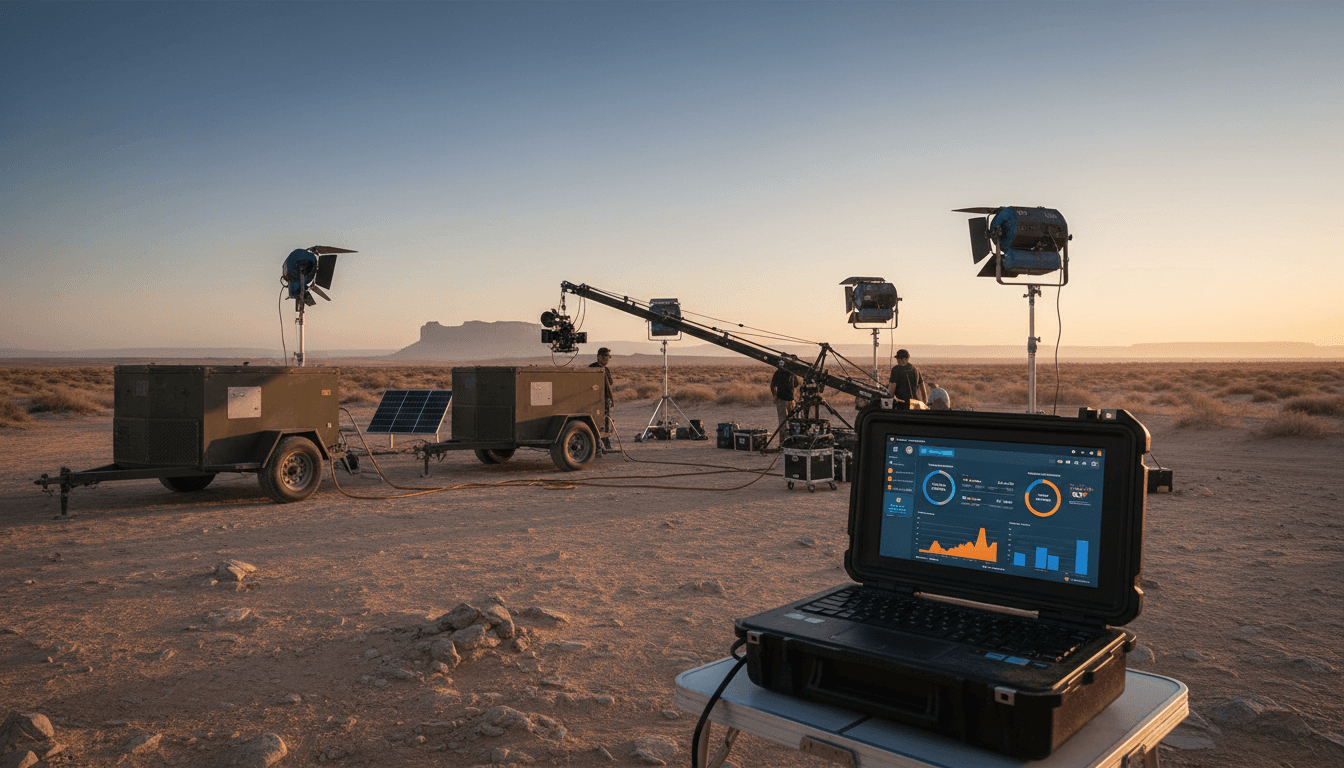
AI-Optimized Clean Mobile Power for Remote Productions
A modern film set can run like a small town that moves every few days — except it often lands where the grid is weak, unavailable, or expensive to access. The default response has been to roll out diesel tow plants, oversize them “just in case,” and accept the noise, fumes, and fuel logistics as the cost of doing business.
That habit is starting to look less like “how production works” and more like a solvable energy planning problem. Clean mobile power (solar trailers, battery energy storage systems, and hydrogen power units) is already working on real productions. The missing ingredient is operational intelligence — the kind utilities and energy providers live and breathe. This is where AI in energy management becomes practical, not theoretical: forecasting spiky loads, scheduling charging, coordinating multiple distributed assets, and keeping uptime in a zero-failure environment.
Film and TV production is a surprisingly useful stress test for decentralized power. If AI-driven load forecasting and dispatch can handle a remote basecamp with HVAC swings, catering peaks, lighting inrush, and EV charging… it can handle a lot of other edge-of-grid problems too.
Film sets are “microgrids with deadlines” (and that’s the point)
A production typically splits energy demand across four zones:
- Set power (lighting, camera gear, sometimes HVAC)
- Basecamp (trailers with HVAC, offices, hair/makeup, wardrobe)
- Transportation (an increasing share as fleets electrify)
- Catering (smaller constant loads plus cooking/HVAC surges)
On-location shoots commonly rely on multiple large diesel generators — often 1,400–1,600 A (210–240 kVA) units — even when the average connected load is far lower. One case study cited in the source material found a production with an average load of just 4% of generator nameplate capacity, and a peak of 16%. That’s not a minor inefficiency. That’s a planning failure that creates fuel waste, maintenance issues (wet stacking), and unnecessary emissions.
This matters for utilities and energy providers because the same anti-pattern shows up anywhere operators fear outages: oversize assets, under-measure loads, and pay the penalty in cost and emissions.
Where AI fits immediately
AI doesn’t replace electricians or operators. It replaces guesswork.
An AI-enabled energy management system (EMS) for mobile power can:
- Forecast load profiles (hourly and sub-hourly) using call sheets, weather, trailer inventory, and historical telemetry.
- Predict peaks and inrush events (HVAC cycling, lighting strikes, catering ramps).
- Recommend rightsized asset mixes (how many kW and how many kWh, and where).
- Optimize charging schedules when grid tie-ins exist (time-of-use arbitrage, demand charge avoidance).
- Coordinate distributed assets (multiple batteries, solar trailers, and a hydrogen unit acting as a long-duration backbone).
In utility terms, productions behave like a portable feeder with high variability and strict reliability requirements — a perfect sandbox for AI-driven demand forecasting and distributed energy resource (DER) orchestration.
Clean mobile power options are real — but orchestration is what makes them scale
Clean mobile power for productions has three practical building blocks today.
Solar trailers: great for daytime baseload, limited in winter peaks
Rooftop solar on modern basecamp trailers is already common in parts of North America. Examples include trailer roofs carrying 2–8 kW of solar with integrated batteries.
But the operational truth is seasonal: a production in New Jersey saw solar+battery runtime 90%–100% in summer, and 50%–70% diesel-free in winter when resistive heating loads rose and solar output fell.
AI opportunity: use weather forecasts, sun-angle models, and heating-degree-day projections to predict when solar will underperform before the crew feels it. Then schedule battery swaps, grid charging, or hydrogen refueling proactively.
Battery energy storage systems (BESS): the “silent workhorse” for variable loads
BESS units are nearly silent, produce no local emissions, and can respond dynamically to changing loads without the efficiency penalties diesel faces at low utilization. In practice, productions are using everything from hand-carried 2–3 kWh packs to towable systems in the 200–300 kWh range (and beyond).
A key reason batteries work so well in production is operational: you can place them closer to loads (less cabling, faster setup), and they don’t threaten sound recording.
AI opportunity: batteries live and die on scheduling — when to charge, at what rate, and how to preserve enough state-of-charge for the next surprise load. AI-based dispatch (especially model predictive control) is the difference between “battery as a rental gadget” and “battery as a dependable prime power asset.”
Hydrogen power units (HPUs): long-duration power when charging is the bottleneck
Hydrogen units are earlier in adoption, but they solve a problem batteries struggle with: long duration without long recharge downtime.
A film-oriented fuel-cell HPU example in the source material delivers 100 kW sustained power and stores just over 1 MWh onboard, with refueling in under 30 minutes. That’s operationally familiar to generator crews.
Hydrogen is not automatically “clean,” though. Emissions depend on how it’s made and delivered, and hydrogen leakage has climate implications.
AI opportunity: treat hydrogen like a constrained fuel inventory problem. AI can optimize refueling routes, boil-off minimization, and “when to run hydrogen vs battery” so the HPU becomes a strategic reserve rather than an expensive always-on asset.
What utilities can learn from Hollywood: load forecasting under chaos
Utilities already use AI for demand forecasting. Film production adds a twist: the load is partly scripted (call sheets) and partly emergent (creative changes, retakes, weather delays).
Here’s a practical mapping from production inputs to AI features:
- Call sheet schedule → time-based load expectations (basecamp ramps, meal breaks, night shoots)
- Trailer roster and HVAC specs → thermal load models and cycling probability
- Lighting plan → peak risk scoring (inrush events, harmonics)
- Location + grid access → charging constraints and backup requirements
- Weather forecast → heating/cooling degree-day adjustment + solar yield prediction
- EV count and route plan → charging energy requirement forecast
The result is a short-term, high-resolution forecast that can drive automated dispatch across a mobile microgrid.
A useful mental model: a production is a temporary virtual power plant in reverse — instead of bidding supply into a market, you’re guaranteeing demand reliability with limited assets.
People also ask: “Why not just use the grid?”
Grid tie-ins are excellent when they exist. The issue is they often don’t:
- Remote locations may have no accessible interconnection
- Urban shoots face permitting delays and site constraints
- Productions move frequently, so grid work may not pencil out
AI can still help when the grid is available by scheduling charging to reduce peak demand charges and by sizing batteries to minimize the tie-in capacity needed.
A practical AI playbook for clean mobile power deployment
If you’re an energy provider, utility innovation team, or DER services company, production power is a blueprint for other temporary and edge-of-grid customers (construction, ports, live events, emergency response).
1) Start with measurement, not assumptions
Most productions oversize because they don’t have trustworthy load data. A lightweight telemetry kit changes everything:
- Circuit-level metering at distribution panels
- State-of-charge and inverter telemetry from BESS
- Fuel and runtime telemetry from diesel/HPU backups
- Weather + location context
With two to four weeks of data across similar shoots, you can train useful forecasting models.
2) Use AI to rightsize and “stack” technologies
The most reliable clean setup is usually a mix:
- Solar trailers for daytime baseload at basecamp
- BESS for fast response, silent operations, and peak shaving
- Grid tie-in when available for cheap charging
- HPU where long duration or extreme temperatures make batteries impractical
AI’s job is to recommend the stack and dispatch it:
- Keep batteries in an efficient operating band
- Reserve headroom for peaks
- Decide when to recharge, swap, or refuel
3) Make reliability measurable (and contractable)
Studios and crews care about one metric: will it fail during a take?
Utilities can bring a familiar discipline here: service-level objectives.
Examples of contractable KPIs:
- Uptime percentage during production hours
- Maximum allowable voltage sag during inrush events
- Reserve margin (kW headroom) maintained at all times
- Time-to-restore under fault conditions
When you can guarantee performance, risk perception drops — and diesel “just in case” becomes optional.
4) Treat charging and refueling as a logistics optimization problem
Batteries require charging time; hydrogen requires fuel logistics and compliance. Both are solvable with optimization:
- Vehicle routing for battery swaps
- Dynamic scheduling around shoot hours
- Depot placement and utilization planning
This is classic AI operations research territory, and it’s directly aligned with how energy-as-a-service models scale.
Why this matters right now (December 2025)
Two forces are squeezing diesel from both sides:
- Regulatory pressure: tighter emissions standards and low-emissions zones raise the cost and hassle of diesel generators in major production hubs.
- Electrification creep: as production fleets add EVs, electricity demand on location increases — and diesel becomes an awkward way to “support electrification.”
Clean mobile power also rides cost curves that diesel doesn’t. The underlying components (solar, inverters, battery cells) keep improving, and the software layer keeps getting smarter.
One detail from the source material is worth sitting with: power and utilities average around 0.8% of a production budget. Even if clean power costs more today, reliability and community impacts can easily dominate that line item through avoided delays, fewer complaints, and faster setups. AI makes those operational benefits predictable and repeatable.
The bigger point for the “AI in Energy & Utilities” series
Most AI in energy conversations orbit big, fixed infrastructure: grid-scale storage, transmission constraints, utility demand response programs. Mobile production power flips the setting, but not the fundamentals.
- Forecast the load.
- Dispatch the assets.
- Prove reliability.
- Minimize cost and emissions.
Film and TV sets are extreme environments for decentralized energy systems. If you can optimize a mobile microgrid that changes location weekly, you can bring the same AI-driven energy management approach to remote communities, critical facilities, construction corridors, and event venues.
The next step for utilities and energy service providers is straightforward: treat clean mobile power as a DER portfolio problem — and use AI to make it boringly reliable.
If you’re building or buying AI for demand forecasting and DER optimization, where else do you have customers that operate like productions — high stakes, time-bound, and increasingly electrified?