Catawba College’s carbon-neutral campus shows how AI, district energy, and high-performance buildings drive measurable savings and lower emissions.
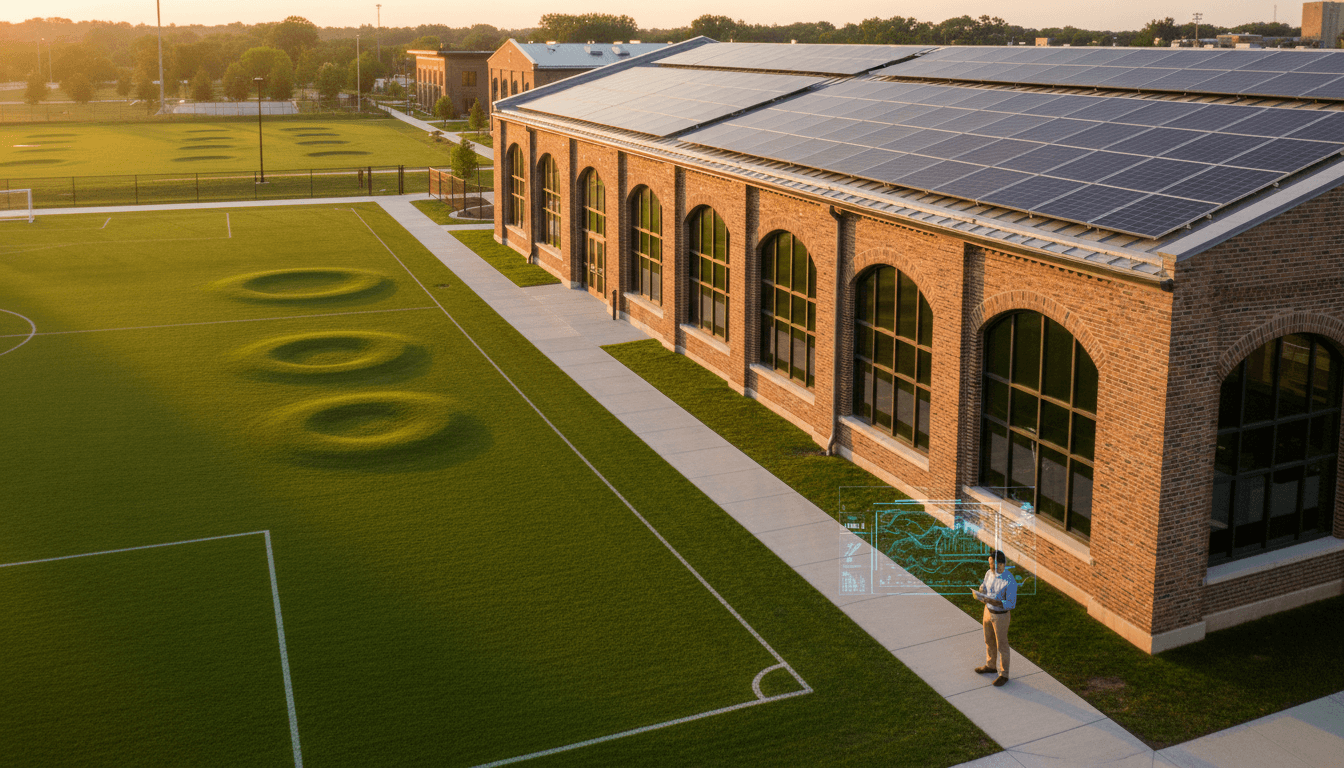
AI-Powered Campus Decarbonization: Lessons from Catawba
Catawba College has about 1,200 students—and it’s already certified carbon neutral, a milestone many larger institutions (and plenty of utilities’ commercial customers) still treat as “someday.” What’s more interesting than the certification itself is how the college is using infrastructure upgrades to get cleaner, more comfortable, and more cost-stable at the same time.
Most organizations approach decarbonization like a shopping list: add solar, swap some equipment, buy offsets, call it progress. Catawba’s approach is closer to how modern utilities think when they’re serious about reliability: treat the campus like a small grid, invest in the thermal network, and modernize buildings so the whole system runs efficiently.
This matters for anyone working in energy and utilities because campuses are a concentrated version of your world: mixed building vintages, aging equipment, tight budgets, real people complaining about comfort, and rising exposure to energy price volatility. Add AI to that mix—and the playbook scales well beyond higher ed.
The real blueprint isn’t “more solar”—it’s systems thinking
The most transferable lesson from Catawba is that decarbonization works when it’s designed as a system, not a set of disconnected projects.
Catawba’s upgrades combine:
- High-performance buildings (new construction and retrofits)
- On-site renewables (solar)
- Geoexchange (ground-source heating and cooling)
- A campus-wide district energy strategy that ties the pieces together
That’s exactly the mindset utilities apply when integrating distributed energy resources (DERs), electrifying load, and meeting emissions targets without sacrificing reliability. A campus just has fewer substations.
Why district energy is the “grid modernization” move for campuses
Catawba’s District Energy and Modernization (DEM) project is built around a closed-loop geoexchange system: in 2024 the college drilled 39 wells, part of a planned four-phase buildout that will eventually provide heating and cooling to 26 campus buildings.
The operational value is straightforward:
- Geoexchange shifts heating/cooling from combustion to efficient heat transfer.
- District energy reduces duplicated equipment and spreads peak loads.
- The system becomes easier to monitor, tune, and optimize over time.
The article cites projected annual reductions of 265 MMBtu of gas and 145,724 kWh of purchased electricity, cutting emissions by 51 metric tons per year once the system components are fully utilized.
That’s not just sustainability. That’s risk management.
Where AI fits: making efficiency measurable, repeatable, and financeable
If you’re in the “AI in Energy & Utilities” world, you already know the promise: better forecasting, fewer outages, lower O&M costs. The campus context gives you a clean way to explain it to stakeholders—because the outcomes are visible.
Here are the highest-ROI places AI supports projects like Catawba’s.
1) Predictive maintenance for aging infrastructure (the unsexy win)
Campuses and utilities share the same problem: deferred maintenance becomes a reliability problem, then a budget crisis.
AI-driven predictive maintenance (combined with good sensors) helps prioritize what to fix first by estimating failure risk and impact. On a campus district energy system, that includes:
- Pump and valve health (vibration, temperature, power draw)
- Heat pump performance drift
- Loop pressure anomalies and leak indicators
- Equipment short-cycling patterns that spike energy use
A simple stance: decarbonization projects fail when O&M is treated as an afterthought. AI is how you keep “high-performance” from turning into “high-maintenance.”
2) Load forecasting for electrification and renewables integration
Catawba has a history of renewable investment: ~837 kW of solar installed in 2015 plus another 55 kW added in 2024, with more planned. The original installation was forecast to save $5 million over 20 years.
The next set of problems isn’t “Can we install solar?” It’s:
- When does the campus peak now that heating electrifies?
- How do we prevent demand charges from eating savings?
- How do we align solar output with heating/cooling loads?
AI-based demand forecasting becomes the connective tissue between building operations and energy procurement. For utilities, this is the same story at larger scale: electrification changes load shapes, and forecasting quality determines whether upgrades are targeted or wasteful.
3) Building optimization that doesn’t annoy occupants
One detail from the source is telling: the Abernethy Physical Education complex (90,000 sq. ft., including a pool) has had comfort issues due to limited air conditioning in key areas, which is no small deal in North Carolina heat and humidity.
Here’s what works in practice: combine envelope improvements with operational intelligence.
“If I address the HVAC but I don’t address the envelope, I’m just heating and cooling the outside.”
AI helps building teams move from static schedules to adaptive control:
- Predict occupancy patterns (class schedules, events, seasonal shifts)
- Detect simultaneous heating/cooling or ventilation inefficiencies
- Optimize setpoints without creating hot/cold complaints
Occupant comfort is not a “nice to have.” It’s how decarbonization avoids becoming politically toxic inside the organization.
Turning a coal plant into a living lab—without making it a museum
Catawba’s Smokestack project is the kind of symbol that gets attention: a former coal-fired power plant (operated from the 1950s to 1990s) being transformed into a 10,000-square-foot student life hub designed for net-zero or better performance.
Symbolism is useful, but the practical lesson is stronger:
Reuse and retrofit can be a decarbonization strategy—if you measure performance like an operator, not a marketer.
This is where AI can turn a “green building” into a continuously improving asset:
- Continuous commissioning (finding control issues after handover)
- Fault detection and diagnostics (FDD) for HVAC and pumps
- Real-time carbon accounting tied to grid emissions factors
For utilities and ESCOs selling energy services, this is the difference between a one-time project and an ongoing performance contract.
Passive House and district energy: why the pairing works
Catawba also broke ground in April 2025 on a three-story, 130-bed residence hall designed to meet Passive House US (Phius) certification and connect to the district energy system.
The stated performance targets versus typical North Carolina construction are substantial:
- 55% lower energy use
- 44% lower heating loads
- 75% lower cooling loads
Here’s the practical stance: deep efficiency makes electrification cheaper.
If you reduce heating and cooling loads through envelope, ventilation, and moisture control, then:
- Heat pumps can be smaller
- The geoexchange field can be sized more efficiently
- Peak demand is lower (which protects the operating budget)
- Backup power requirements drop (better resilience economics)
AI makes this pairing even stronger by validating that the building is actually achieving its modeled targets—then correcting drift over time.
How to copy Catawba’s approach (even if you don’t have donors)
Catawba’s leadership framed the DEM project as bigger than ROI: recruitment, retention, sustainability goals, and deferred maintenance. Still, they ran the numbers. A preliminary analysis cited in the article projects roughly $10 million in savings (NPV) from 2025 to 2054 compared to business-as-usual, considering energy, O&M, and other factors.
If you’re advising a campus, municipality, or a utility customer portfolio, here’s a practical sequence I’ve found works.
Step 1: Treat deferred maintenance as the funding source
Don’t pitch “new tech.” Pitch avoided replacements and avoided failures.
- Inventory end-of-life HVAC, boilers, chillers, controls, and envelopes
- Quantify the cost of keeping them alive for 10–15 years
- Compare that to system-level modernization (district energy + efficiency)
Step 2: Build a measurement plan before you buy equipment
If you can’t measure it, you can’t defend it.
Minimum viable measurement stack:
- Submetering by building or major end-use
- BAS trend data retention (not just live dashboards)
- Weather normalization
- A way to translate energy into operational emissions
AI helps most when the data foundation is real and continuous.
Step 3: Start with “connective tissue” projects
Catawba benefits from older buildings already connected to legacy geoexchange, lowering integration costs. Most sites have an equivalent opportunity: a few assets that are easiest to connect or control centrally.
Pick projects that create momentum:
- A pilot geoexchange loop segment
- Controls upgrades + FDD in 3–5 representative buildings
- Solar + load management to reduce demand peaks
Step 4: Make the plan financeable with performance evidence
Boards, regulators, and finance teams trust measured savings, not renderings.
Within 6–12 months, you want proof points like:
- Reduced peak kW during the hottest weeks
- Fewer comfort complaints (tracked, not anecdotal)
- Maintenance hours per asset trending down
- Verified energy intensity improvement (kBtu/sq. ft.)
That evidence is what turns sustainability from a “nice story” into an investable program.
What utilities and solution providers should take from this
Catawba’s story isn’t just a feel-good campus profile. It’s a compact case study in what many utilities are trying to enable across their territories: electrification plus efficiency plus smarter operations, delivered in a way that customers can afford.
If you sell AI analytics, grid optimization, predictive maintenance, DER orchestration, or building intelligence, campuses are a strong wedge market because they:
- Have complex loads and long asset lifecycles
- Operate like small cities with centralized decision-making
- Care about carbon accounting and public outcomes
- Need resilience as extreme weather and outages become more common
The bigger idea for this “AI in Energy & Utilities” series is simple: AI is most valuable when it’s tied to physical upgrades that change the load shape and failure curve. Catawba is doing the physical part. AI is how others make it scalable.
You don’t need a 1,000-MW grid to benefit from forecasting, optimization, and predictive maintenance. You just need the discipline to treat energy as an operating system—then keep improving it.
If a small college can move from a coal legacy to carbon neutrality while modernizing its infrastructure, what’s the one operational decision your organization could make this quarter that would put you on the same trajectory?