Taiwan’s $11B arms package isn’t just rockets and drones—it’s a networked, AI-ready deterrence stack. See what it signals and how to integrate it.
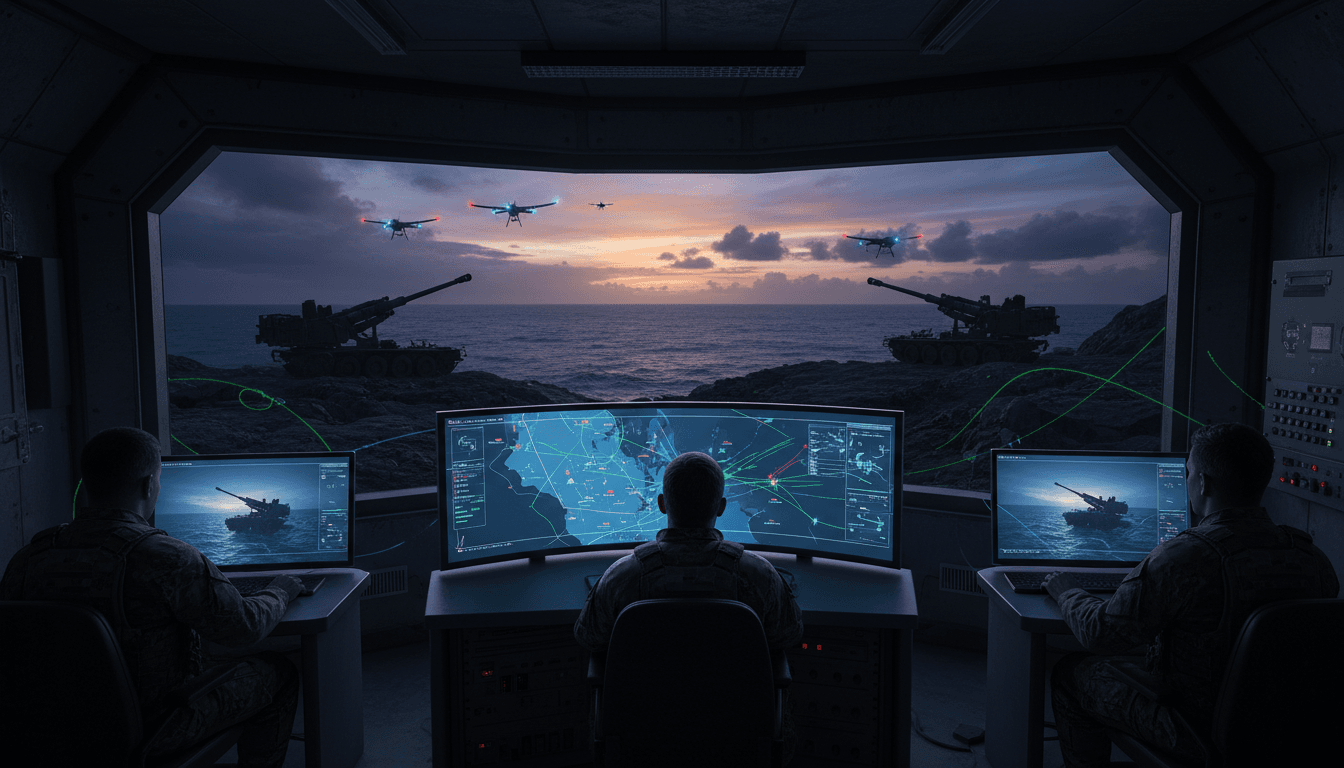
Taiwan’s $11B Arms Package: The AI Deterrence Layer
The number that matters isn’t just $11 billion—it’s the mix of capabilities inside it. The newly approved U.S. Foreign Military Sales package for Taiwan bundles long-range fires, self-propelled artillery, autonomous air vehicles, anti-armor missiles, and (quietly) a billion-dollar class investment in tactical mission network software. Put together, it reads less like a shopping list and more like a blueprint for AI-enabled deterrence.
In the AI in Defense & National Security series, I’ve found the most useful way to interpret big procurement moves is to ask a simple question: What decision advantage is this trying to buy? Taiwan’s answer here is clear—survive first contact, stay connected under attack, and make targeting and resupply faster than an adversary can disrupt them.
What follows is a practical breakdown of what this package signals, where AI is already embedded (even when it’s not labeled “AI”), and how defense and national security leaders should think about integrating autonomy, networks, and cyber resilience into credible regional deterrence.
What the $11B package really buys: time, range, and resilience
This arms package buys Taiwan three things that matter in a high-end contingency: time, range, and resilience. The weapons are important, but the operational effect is the story.
The notified cases include:
- 82 HIMARS and 420 ATACMS plus related strike munitions (up to $4.05B)
- 60 M109A7 self-propelled howitzers (up to $4.03B)
- Altius Autonomous Air Vehicles (up to $1.1B)
- Tactical Mission Network Software (up to $1.01B)
- 1,050 Javelin missiles (up to $375M)
- 1,545 TOW 2B missiles (up to $353M)
- AH-1W helicopter spares and repair parts (up to $96M)
Here’s the stance: the software line item is the center of gravity. Fires and drones are only as effective as the targeting, coordination, and deconfliction behind them. In modern conflict, the side that maintains a working kill chain under jamming and cyber pressure wins opportunities—sometimes in minutes.
Why artillery and rockets still dominate—but look different now
Long-range fires like HIMARS/ATACMS and modern tube artillery like the M109A7 aren’t old-school throwbacks. They’ve become digitally orchestrated assets.
- They depend on rapid sensor-to-shooter workflows.
- They require continuous updates to targeting data.
- They benefit from automated mission planning and route timing.
AI’s role isn’t that a rocket “uses AI” in flight. AI’s role is that target development, prioritization, and battle damage assessment can’t scale without machine assistance when you’re managing hundreds or thousands of possible aimpoints.
The quiet centerpiece: Tactical mission networks as AI infrastructure
A tactical mission network is the plumbing that lets forces share data, maintain situational awareness, and execute fires with speed. It’s also the layer that determines whether AI-enabled decision support is practical or just a demo.
If you want autonomy and AI to matter in real operations, you need:
- Common data standards and message formats (otherwise nothing talks to anything)
- Identity, access, and trust enforcement (because adversaries will try to impersonate, inject, and manipulate)
- Resilient transport across contested links (satcom, line-of-sight, terrestrial backups)
- Edge compute so units can function when cloud reach-back is degraded
AI doesn’t replace command— it compresses the OODA loop
The practical value of military AI in a Taiwan context is time compression:
- Faster correlation of sensor tracks
- Automated alerting for anomalous activity
- Prioritized target queues based on commander intent
- Recommended courses of action with confidence levels
A sentence worth keeping: AI turns overwhelming data volume into manageable decision tempo—if the network survives.
That last clause is why cyber security and digital warfare considerations are inseparable from this package. A mission network under constant attack needs security architecture that assumes compromise, not perfection.
Autonomous air vehicles (Altius) and what “autonomy” really adds
The Altius line item signals an emphasis on distributed, attritable airpower. Autonomous air vehicles are useful because they can be:
- Launched quickly and in volume
- Tasked for reconnaissance, targeting support, and strike (depending on variant and payload)
- Operated in ways that complicate adversary air defenses
Even when a platform is marketed as “autonomous,” autonomy usually breaks down into a few functions:
- Navigation and stabilization in degraded GPS environments
- Onboard perception (basic object recognition, terrain correlation, track maintenance)
- Mission execution logic (route changes, loiter patterns, re-tasking)
- Operator workload reduction (one operator supervising multiple systems)
The real advantage: saturation plus uncertainty
Autonomous systems change deterrence because they create targeting uncertainty for an adversary:
- Is that contact a decoy, a sensor, or a weapon?
- Is it alone, or part of a coordinated swarm?
- If you shoot it, how many more appear?
This is where AI-enabled tactics matter. Autonomy supports distributed operations: many small assets cooperating, reporting, and re-tasking faster than human micromanagement would allow.
But there’s a hard truth: autonomy without secure command-and-control becomes a liability. A jammed or spoofed autonomous fleet can become ineffective—or worse, unsafe.
Deterrence in 2025: the kill chain is the campaign
A lot of commentary treats arms sales as inventory. I don’t. In 2025, deterrence is increasingly about whether your kill chain remains intact under pressure.
Taiwan’s purchase mix maps to a kill chain that’s designed to:
- Sense: distributed drones and sensors
- Decide: networked command with AI-assisted prioritization
- Strike: rockets and artillery with rapid mission processing
- Survive: mobility, redundancy, and cyber resilience
Where AI fits across the operational lifecycle
AI shows up in defense operations long before a shot is fired:
- Surveillance and ISR triage: flagging unusual maritime/air patterns, reducing analyst overload
- Mission planning: automated route generation, threat overlaying, and timing deconfliction
- Logistics forecasting: predicting consumption rates for munitions, spares, fuel; prepositioning intelligently
- Cyber defense: anomaly detection, phishing and lateral-movement identification, and automated containment playbooks
If you’re trying to build a credible defensive posture, logistics and cyber are not supporting acts. They’re the condition for everything else.
The integration challenge most teams underestimate
Most defense organizations get integration wrong by thinking procurement equals capability. It doesn’t.
An $11B package can still underperform if integration is treated as a paperwork step instead of a campaign.
Three integration pitfalls to plan for now
-
Data fragmentation
- Different vendors, different schemas, different classification rules.
- AI models can’t help if they can’t access consistent data at the edge.
-
Model trust and governance
- If operators don’t trust AI recommendations, they’ll ignore them.
- If leaders can’t audit model behavior, they’ll restrict it until it’s useless.
-
Cyber-physical coupling
- A mission network breach isn’t “an IT problem.” It becomes wrong coordinates, delayed fires, friendly-force risk.
What “good” looks like (practical checklist)
If you’re responsible for implementing AI-enabled defense systems—whether in government, primes, or startups—these are the build-first priorities I’d push:
- Resilient communications: multiple paths, rapid failover, graceful degradation
- Edge-first workflows: assume intermittent connectivity and limited bandwidth
- Zero trust enforcement at the tactical layer: identity-bound access, device health, least privilege
- Human-centered interfaces: AI outputs must be actionable (why, confidence, alternatives)
- Red-team the autonomy: spoofing, data poisoning, adversarial examples, and capture scenarios
A line I use internally: If your AI needs perfect networks, it’s not a military AI capability—it’s a lab project.
What this signals for defense tech and national security leaders
This package signals that future posture in the Indo-Pacific will be judged by systems-of-systems performance, not platform specs.
For leaders building or buying capability, the opportunity is also the constraint: you can’t bolt AI onto the end of a procurement. AI has to be treated as:
- a workflow redesign problem,
- a data engineering problem,
- and a trust and assurance problem.
If you’re in defense innovation or acquisition, this is where leads are created: teams want help integrating autonomy, networks, and cyber into operationally credible outcomes.
Deterrence isn’t a single weapon system. It’s the demonstrated ability to coordinate sensors, shooters, and sustainment under attack.
What to do next if you’re modernizing AI-enabled defense capability
The fastest way to make progress is to start with a realistic operational thread (a “day-in-the-life” scenario) and test it end-to-end.
Here are three concrete next steps:
-
Map your kill chain as data flows
- Identify where sensor data originates, how it’s fused, who approves action, and how execution is confirmed.
-
Pick two AI use cases that save minutes, not manpower
- Examples: automated target candidate ranking; cyber anomaly detection with auto-containment.
-
Run an integration exercise under stress
- Deny GPS, jam links, simulate cyber compromise.
- Measure: time-to-target, false alarms, operator workload, and recovery time.
Taiwan’s $11B arms package is a reminder that hardware gets headlines, but AI-enabled networks and cyber resilience decide outcomes. As this series keeps arguing: the future of national security belongs to forces that can think, share, and adapt faster than the disruption aimed at them.
The forward-looking question for 2026 planning cycles is simple: when the network degrades, does your decision advantage stay intact—or vanish?