South Korea’s nuclear latency debate is really a time-and-information problem. Here’s how AI strengthens deterrence—and where it can raise risk.
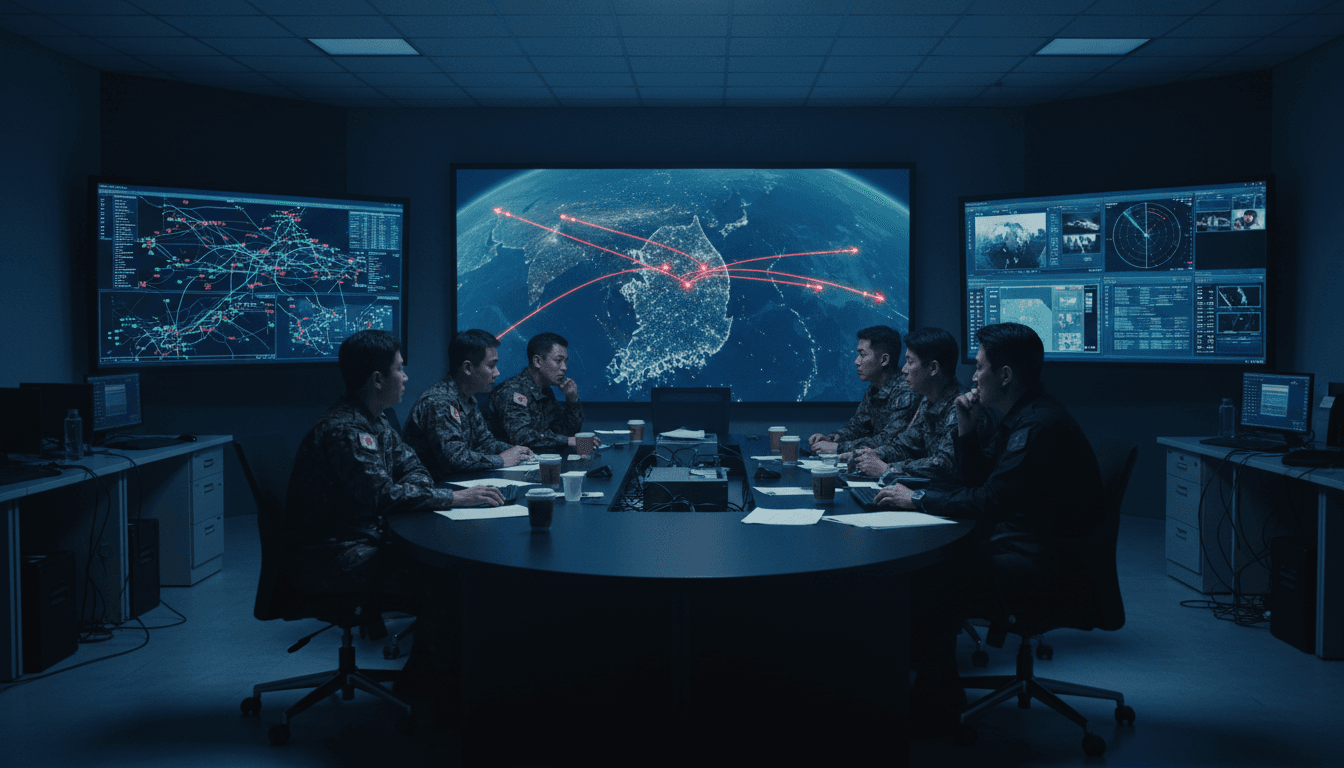
Nuclear Latency in South Korea: Where AI Fits Now
A single phrase can shift an alliance’s center of gravity. When senior U.S. officials describe North Korea as a “nuclear power,” it doesn’t just land as semantics in Seoul—it lands as a planning assumption.
That’s why South Korea’s renewed interest in nuclear latency—the ability to build nuclear weapons on short notice without crossing the line today—deserves more than a policy debate. It’s also a technology debate. Because latency is ultimately about time: time to detect shifts in threat intent, time to reassure a public, time to surge industrial capacity, and time to coordinate with allies without stumbling into escalation.
This post sits inside our AI in Defense & National Security series for a reason: the countries that manage strategic risk well in 2026 won’t be the ones that talk most loudly. They’ll be the ones that build the best decision systems—where AI for intelligence analysis, mission planning, and strategic warning helps leaders see signals earlier, model consequences faster, and avoid “panic procurement” in a crisis.
Nuclear latency is a deterrence posture built on speed
Nuclear latency is less about having a bomb and more about having credible options. The posture signals: “If the world changes, our response timeline is short.” For South Korea, the pressure behind this idea has intensified as two dynamics collide: uncertainty about U.S. political reliability and a North Korea that keeps raising its ceiling.
South Korea’s debate isn’t happening in a vacuum. The past year has added new accelerants:
- Alliance credibility anxiety: Even when extended deterrence is reaffirmed publicly, South Korean planners have to price in U.S. domestic politics and the possibility of a narrower deal that prioritizes protecting the U.S. homeland first.
- North Korea’s evolving threat profile: More testing, more production capacity, more operational confidence, and closer ties that improve access to resources, technology, or diplomatic cover.
Here’s the part many teams miss: latency is not binary. It’s a spectrum of readiness across fuel-cycle expertise, delivery systems, command-and-control planning, industrial surge capacity, and political decision speed.
And the biggest limiter in that spectrum is often the least discussed one: decision speed under uncertainty.
The myth: nuclear latency is “mostly a hardware problem”
Most companies (and plenty of governments) get this wrong. They picture latency as a checklist of facilities and materials. In practice, the hardest part is credible strategic management:
- detecting adversary intent early enough to avoid overreaction n- communicating readiness without cornering the other side
- coordinating with allies so signals aren’t contradictory
- preventing accidents and misinterpretation under pressure
That’s where AI fits—not as a magic oracle, but as a disciplined way to reduce avoidable uncertainty.
Why Seoul’s risk calculus shifted in 2025
South Korea’s nuclear latency conversation heats up when U.S. commitments feel politically fragile. The current environment makes that fragility harder to ignore.
South Korean strategists have long planned around U.S. extended deterrence. But planning isn’t faith; it’s probabilities. When political signals introduce even a modest chance of abandonment or decoupling, a rational defense establishment explores hedges.
Two specific anxieties drive the “hedge logic”:
- A deal that protects the U.S. mainland but leaves South Korea exposed. If Washington pursues a narrower North Korea agreement—whether explicit or implicit—Seoul worries its threat problem becomes “managed,” not solved.
- Normalization of North Korea’s nuclear status. Language that treats Pyongyang as a permanent nuclear-armed state, even informally, changes what “acceptable risk” looks like for South Korea.
This matters because the public dimension is real. Deterrence isn’t only what the adversary believes; it’s what your own population believes about your safety and your government’s competence. When publics lose confidence, leaders take bigger risks.
The practical question decision-makers face
If you’re a national security team in Seoul, the decision isn’t “Do we want nuclear weapons?” The decision is:
How do we create maximum security options while minimizing the chance we trigger the crisis we’re trying to prevent?
AI can’t answer that politically. It can make the trade space clearer.
AI’s real role in strategic deterrence: warning, credibility, and control
AI strengthens deterrence when it improves strategic warning and reduces miscalculation. That’s the cleanest way to connect nuclear latency and emerging technology without drifting into sci-fi.
AI for strategic warning: seeing shifts before they become surprises
Nuclear latency becomes attractive when leaders fear strategic surprise. So the first AI contribution is straightforward: reduce surprise.
High-value applications include:
- Multi-INT fusion (SIGINT, IMINT, OSINT, cyber telemetry) to flag deviations from baseline activity
- Anomaly detection for missile unit movements, test-site logistics, unusual maritime patterns, or procurement signals
- Behavioral trend modeling to track leadership messaging cadence and correlating operational indicators
The goal isn’t perfect prediction. The goal is earlier, defensible alerts that buy policymakers time.
If you buy 72 hours of clearer warning in a rapidly escalating crisis, you change the menu of options from “rash and public” to “measured and coordinated.”
AI for mission planning and readiness: making posture credible without being provocative
Deterrence credibility depends on readiness you can demonstrate selectively. AI-enabled mission planning helps militaries:
- generate contingency plans faster
- test force-employment options across thousands of scenario variations
- optimize logistics and sustainment under disruption
- rehearse escalation pathways and identify “tripwires”
This is where latency connects tightly to modern defense AI: the ability to simulate consequences. When leaders can say, “We’ve modeled these outcomes across multiple adversary responses,” they’re less likely to make symbolic moves that feel strong but create escalation traps.
AI for command-and-control: reducing the chance of catastrophic error
The most dangerous moment in any high-end confrontation is when decision time compresses and information quality degrades.
AI can help by:
- prioritizing alerts so human operators see the most relevant signals first
- automating cross-checks (for example, correlating sensor claims before escalation decisions)
- improving cyber defense around C2 systems through rapid detection of intrusion patterns
One stance I’ll take: If a country is considering nuclear latency, it should invest at least as aggressively in AI-supported control and decision discipline as it does in physical readiness. Hardware without control is how accidents happen.
Where AI makes nuclear latency riskier (and what to do about it)
AI can also amplify instability if it drives overconfidence, faster escalation, or opaque decision-making. If your strategy depends on making calm decisions under pressure, you can’t introduce systems that are brittle, unexplainable, or easy to spoof.
Three failure modes that matter in Northeast Asia
-
False positives from noisy data
- Over-alerting creates “threat inflation,” pushing leaders toward irreversible steps.
-
Model mirages
- Scenario simulators can produce convincing outputs that reflect hidden assumptions more than reality.
-
Adversarial manipulation
- Deception operations can be designed to “feed the model,” not just mislead analysts.
Guardrails that should be non-negotiable
If you’re deploying AI for intelligence analysis or strategic warning in a nuclear-adjacent environment, build these controls in from day one:
- Human-in-command for escalation decisions (not merely human-in-the-loop)
- Red teaming for adversarial ML with documented mitigations
- Provenance tracking for critical inputs (what sensor, what confidence, what chain of custody)
- Model auditing: performance across conditions, drift monitoring, and retraining triggers
- Dual-channel validation: no single AI system should be allowed to “convince” leadership alone
A memorable rule worth keeping: If an AI alert can’t be explained quickly to a national leader, it can’t be allowed to accelerate national decisions.
A practical playbook: using AI to hedge without crossing the line
South Korea doesn’t need to choose between “do nothing” and “build the bomb” to improve deterrence. There’s an actionable middle path where AI strengthens readiness and alliance coordination while keeping political options open.
1) Build an “allied deterrence data layer” before a crisis
Alliances fail under stress when partners don’t share the same picture of reality. Create shared pipelines for:
- baseline pattern libraries (what “normal” looks like)
- jointly agreed alert thresholds
- common confidence scoring
Even modest standardization improves crisis speed. And speed is the currency of latency.
2) Use AI to measure assurance, not just threats
Most deterrence tooling tracks adversaries. Mature strategy also tracks allies.
AI can quantify assurance indicators like:
- deployment patterns and exercise tempos
- logistics prepositioning signals
- diplomatic cadence and messaging alignment
That helps Seoul answer a hard question with data: Is the alliance posture strengthening or softening over time?
3) Invest in “explainable warning” dashboards for senior leaders
Senior decision-makers don’t need raw feeds. They need a concise narrative:
- What changed?
- Why does it matter?
- How confident are we?
- What are the top three alternative explanations?
This is where AI’s value is underrated: not prediction, but compression—turning complex intelligence into usable decision support.
4) Run escalation simulations as a routine, not a ritual
If you only simulate escalation during a crisis, you’re already late.
A quarterly rhythm of AI-supported wargaming—paired with human judgment—can surface:
- inadvertent escalation triggers
- communication failure points
- cyber-physical dependencies in C2
Those insights translate directly into better deterrence posture, whether or not nuclear latency ever becomes policy.
What “People Also Ask” looks like for nuclear latency and AI
Is nuclear latency the same as building nuclear weapons?
No. Nuclear latency is the capability to move quickly if leadership chooses to, without making that choice today. It’s posture, not deployment.
Can AI replace human judgment in deterrence decisions?
No. Deterrence decisions are political and moral choices, not optimization problems. AI can improve warning and planning, but humans must remain accountable.
Does better AI make conflict more or less likely?
Both are possible. Better warning and clearer decision support reduce miscalculation, but poorly governed AI can speed escalation through false confidence or spoofed signals.
Where this goes next for AI in Defense & National Security
South Korea’s flirtation with nuclear latency is a signal that deterrence is becoming more time-sensitive and data-dependent. That’s exactly the environment where AI in defense shows its real value—fast fusion, fast planning, and faster clarity for leaders who don’t get second tries.
If you’re building products or programs in this space, prioritize the unglamorous parts: evaluation, provenance, red teaming, and explainability. Those are the difference between AI that stabilizes deterrence and AI that turns a crisis into a coin flip.
If you want to pressure-test your organization’s readiness—data, models, governance, and operational integration—I can share a practical assessment framework we use for AI-enabled intelligence analysis and mission planning programs in national security contexts.
The forward-looking question isn’t whether AI will shape deterrence. It already is. The question is: Will we build AI systems that slow bad decisions down—or ones that speed them up?