Greece’s expected PULS buy highlights the real shift in long-range fires: AI-enabled targeting, deconfliction, and logistics. See what buyers should plan for.
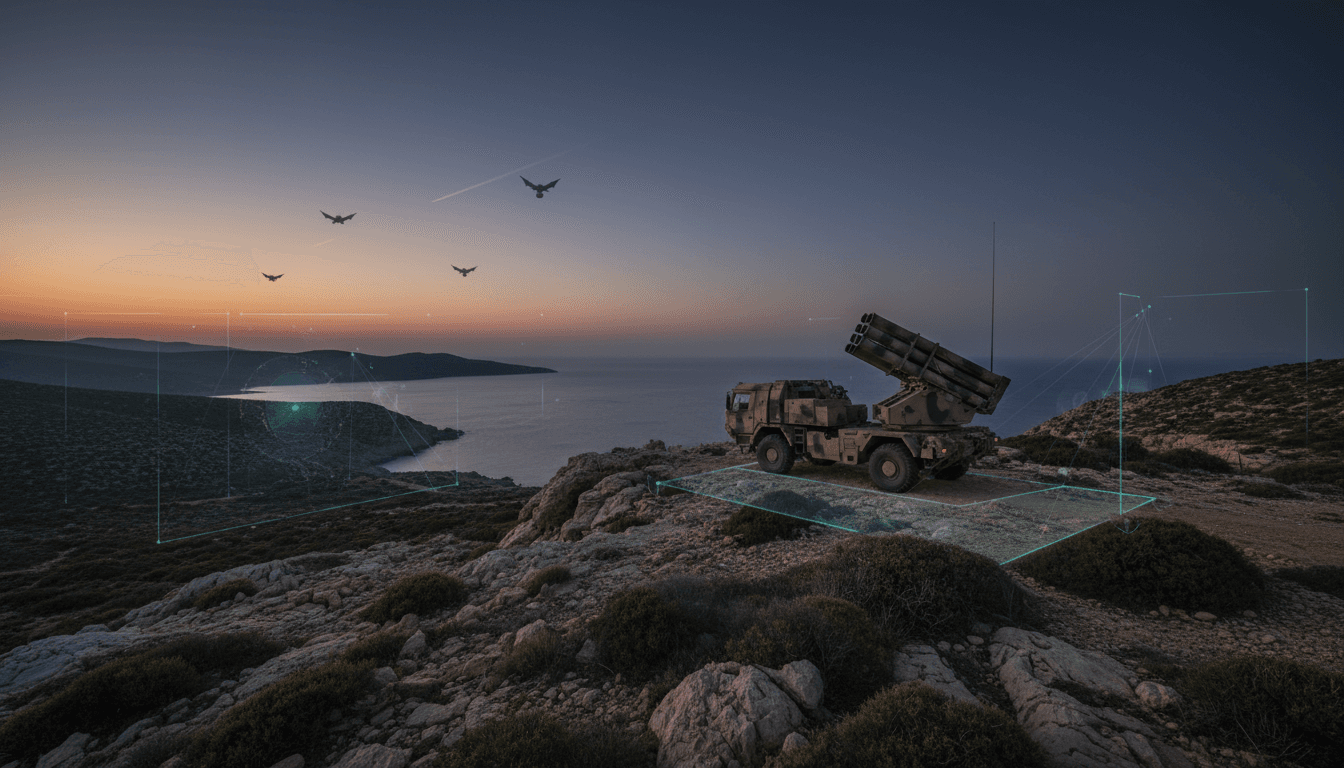
Greece’s PULS Deal: The AI Layer Modern Artillery Needs
Greece is reportedly lining up 36 PULS rocket artillery systems in a deal valued around $757 million, with Elbit Systems saying it expects a contract once commercial negotiations wrap. On paper, that’s a straightforward procurement story: new launchers, new munitions, better range options.
But the part most people miss is where the real modernization happens. The launcher isn’t the hard part anymore. The decision loop is. When a military buys long-range fires in 2025, they’re also buying (or inheriting) the need for faster target validation, tighter deconfliction, cleaner logistics, and stronger cyber controls. That’s where AI in defense stops being a buzzword and becomes the difference between “we own advanced artillery” and “we can use it under pressure.”
This post uses the Greece–PULS storyline to talk about the hidden work behind modern artillery: the AI-enabled targeting stack, the data pipeline that feeds it, and the governance that keeps it safe and politically usable inside an alliance.
Why Greece’s PULS purchase signals a shift in European fires
European long-range fires procurement is moving from “platform-first” to network-first. PULS (and peer systems across NATO) are attractive not only because they can shoot different rocket types and ranges, but because they fit into a reality shaped by Ukraine: counter-battery is fast, targets are fleeting, and ammunition is a strategic resource.
Greece’s broader defense buildup—often discussed alongside the “Achilles’ Shield” air defense concept—points to an integrated approach: air defense, surveillance, and long-range fires as one deterrence package. That package only works if sensors, command systems, and shooters share data at operational tempo.
Here’s the blunt take: long-range artillery without an AI-ready data backbone becomes an expensive way to fire slower. With it, it becomes a credible tool for deterrence and rapid response.
What PULS really offers (beyond the launcher)
Public descriptions of PULS emphasize flexibility—launching unguided rockets, precision-guided munitions, and missiles across ranges, and adapting to wheeled or tracked platforms. That flexibility matters, but it introduces a modern problem:
- Different munition types mean different targeting rules, collateral estimates, and inventory constraints
- Different ranges mean different airspace deconfliction and fires coordination
- Different platform configurations mean different maintenance data and training pipelines
All of that pushes buyers toward software: decision aids, automated checks, predictive maintenance, and resilient communications. AI is the glue that keeps this complexity from slowing operations down.
The AI layer in modern artillery: targeting, deconfliction, and “permission to fire”
AI’s most valuable role in artillery isn’t “autonomous kill chains.” It’s compressing the time between detection and a lawful, confident engagement, while preventing the classic failure modes: misidentification, stale coordinates, friendly-fire risk, and political blowback.
AI-assisted targeting is really three capabilities
1) Target triage and confidence scoring AI models can rank candidate targets based on sensor inputs (ISR feeds, acoustic/radar cueing, EW indicators, pattern-of-life anomalies), then assign confidence scores and explainable features.
This matters because human operators don’t need “more targets.” They need fewer, better targets—ones that are timely, validated, and worth spending scarce precision munitions on.
2) Automated correlation across sensors Modern battlefields produce multiple partial truths: a radar hit, a drone video snippet, a SIGINT cue, an artillery flash report. AI helps fuse these into a single track with uncertainty bounds.
A practical way to think about it:
- Humans are good at judgment
- Machines are good at cross-referencing at scale
When you combine them well, you reduce the number of “false urgency” engagements.
3) Deconfliction and rules-of-engagement checks The final gate is often not technical—it’s procedural. AI can pre-check fires missions against:
- Restricted fire areas
- No-strike lists
- Air corridors and friendly flight schedules
- Planned maneuver routes
- Weapon/munition-specific safety templates
This is where militaries win back minutes without cutting corners. Speed comes from eliminating avoidable rework, not from skipping approvals.
A modern rocket artillery battalion’s best AI feature isn’t auto-fire. It’s auto-prep: fewer manual checks, fewer coordination errors, and fewer “hold” calls at the worst moment.
International defense deals now ship with data problems (and opportunities)
When Israel and Greece deepen defense cooperation—PULS, air defense discussions, training arrangements—there’s an under-discussed deliverable: interoperability under constraint.
You want systems to work together, but you don’t want data to leak, models to be poisoned, or sensitive tactics to become vendor service tickets. Every cross-border defense program now has to answer:
- Where does operational data live?
- Who can access training data, logs, and telemetry?
- How are software updates delivered, validated, and rolled back?
- What happens if communications are degraded or spoofed?
The “AI in defense” procurement trap: buying hardware, inheriting software debt
Most companies get this wrong: they evaluate artillery platforms like durable goods (range, accuracy, mobility) and only later realize they’ve bought a long-term software program.
An AI-capable fires architecture typically needs:
- A common data model for sensor reports and target tracks
- Model governance (testing, drift monitoring, retraining approvals)
- Cyber controls for edge devices and tactical networks
- A simulation environment to test new tactics and software releases
If you don’t budget for those early, you pay later in one of two ways: either the system is underused, or operators create unofficial workarounds.
A practical interoperability stance for Greece (and any buyer)
If you’re integrating systems from multiple countries, insist on three things in the contract language and technical plan:
- Open integration interfaces for C2 and sensor inputs (so you aren’t locked into one ISR pipeline)
- On-prem / sovereign logging options for sensitive mission data (so learning doesn’t require exfiltration)
- Red-team testing of the update chain (because the easiest way to compromise an AI-enabled system is upstream)
These aren’t “nice to have.” They’re how you keep AI-enabled mission planning and fires coordination reliable in real-world coalition conditions.
AI for logistics: the unglamorous piece that decides readiness
Long-range fires are supply-hungry. And in Europe, the 2022–2025 reality has been simple: munition availability and production capacity shape strategy.
AI has a direct, measurable role here: forecasting demand, prioritizing allocations, and reducing downtime.
Where AI delivers the most in artillery readiness
Predictive maintenance for launchers and vehicles PULS is marketed as adaptable to existing wheeled and tracked platforms, which can lower training and maintenance costs. AI improves that promise when you instrument the fleet and predict failures before they become “no-go” events.
Munition inventory optimization Different rockets and missiles have different shelf lives, storage constraints, and resupply timelines. AI planning tools can recommend loadouts per mission set and alert commanders when the “optimal” plan isn’t feasible given inventory.
Route and risk planning for resupply Resupply routes aren’t just distance problems; they’re threat problems. AI can combine:
- Historical threat patterns
- EW and drone risk indicators
- Trafficability and weather inputs
…and propose resupply windows that reduce exposure.
The payoff is clear: you don’t need 20% more launchers if what you really need is 20% fewer deadlined vehicles and fewer wasted rockets.
Cybersecurity and model risk: the Achilles’ heel of AI-enabled fires
If Greece (or any European force) pairs modern rocket artillery with AI-driven surveillance and intelligence components, the cyber attack surface expands fast. Artillery isn’t just steel; it’s:
- Tactical radios and gateways
- Mission planning laptops
- Sensor fusion services
- Update servers and diagnostic tools
- Training simulators and data stores
The four AI-specific risks defense teams should plan for
1) Data poisoning If an adversary can influence the training or fine-tuning data—especially for target recognition or anomaly detection—they can shift model behavior subtly over time.
2) Spoofing and deception AI systems are vulnerable to crafted inputs: decoys, manipulated signatures, and “too perfect” telemetry designed to trigger a false track.
3) Model drift Battlefield conditions change. If models aren’t monitored, performance quietly degrades and operators lose trust.
4) Update-chain compromise Software updates are a strategic vulnerability. If your deployment pipeline isn’t hardened, you’ve built a front door.
A strong approach combines:
- Signed, validated updates and strict rollback procedures
- Continuous evaluation with representative exercises
- “Human-in-the-loop” design that supports fast override without disabling safeguards
What this means for AI in Defense & National Security buyers
Greece’s expected PULS deal fits a larger trend: European militaries are buying long-range fires as part of a connected deterrence system, not as standalone artillery battalions.
If you’re involved in defense acquisition, modernization, or integration, the lesson is actionable:
- Treat rocket artillery as an AI-enabled system-of-systems, not a launcher
- Fund the data pipeline, governance, and cyber controls from day one
- Design for coalition realities: shared operations, constrained data sharing, and contested networks
Here’s what works in practice (and I’ve seen teams succeed with exactly this): run an “operational thread” workshop before final integration—sensor to decision to fires to assessment—then identify where AI can reduce time and error without removing accountability.
The next phase of artillery modernization won’t be won by who buys the most rockets. It’ll be won by who can find, validate, and engage correctly—faster than the adversary can move or deceive.
If you’re building an AI roadmap for mission planning, targeting support, or cyber-resilient integration around long-range fires, what part of the chain is your biggest bottleneck right now: sensor fusion, approvals/deconfliction, or sustainment?